2011 FORD RANGER weight
[x] Cancel search: weightPage 144 of 302

SuperCab 4x4
Powertrain Maximum GCWR -
lb (kg)Maximum trailer
weight - lb (kg)
2–Door without Jump Seat
4.0L w/manual
transmission7000 (3175) 3120 (1415)
4.0L w/automatic
transmission9500 (4309) 5580 (2531)
4–Door without Jump Seat
4.0L w/manual
transmission7000 (3175) 3040 (1379)
4.0L w/automatic
transmission9500 (4309) 5500 (2495)
2–Door with Jump Seat
4.0L w/manual
transmission7000 (3175) 3080 (1397)
4.0L w/automatic
transmission9500 (4309) 5540 (2513)
4–Door with Jump Seat
4.0L w/manual
transmission7000 (3175) 3000 (1361)
4.0L w/automatic
transmission9500 (4309) 5460 (2477)
For high altitude operation, reduce GCW by 2% per 1,000 ft. (300 m)
elevation.
Your vehicle is capable of pulling the maximum trailer weight(s) as
specified above. Certain states require electric trailer brakes for trailers
over a specified weight. This vehicle’s electrical system is not equipped
to accommodate electric trailer brakes.
WARNING:Do not exceed the GVWR or the GAWR specified on
the certification label.
Tires, Wheels and Loading
144
2011 Ranger(ran)
Owners Guide, 1st Printing
USA(fus)
Page 145 of 302
WARNING:Towing trailers beyond the maximum recommended
gross trailer weight exceeds the limit of the vehicle and could
result in engine damage, transmission damage, structural damage, loss
of vehicle control, vehicle rollover and personal injury.
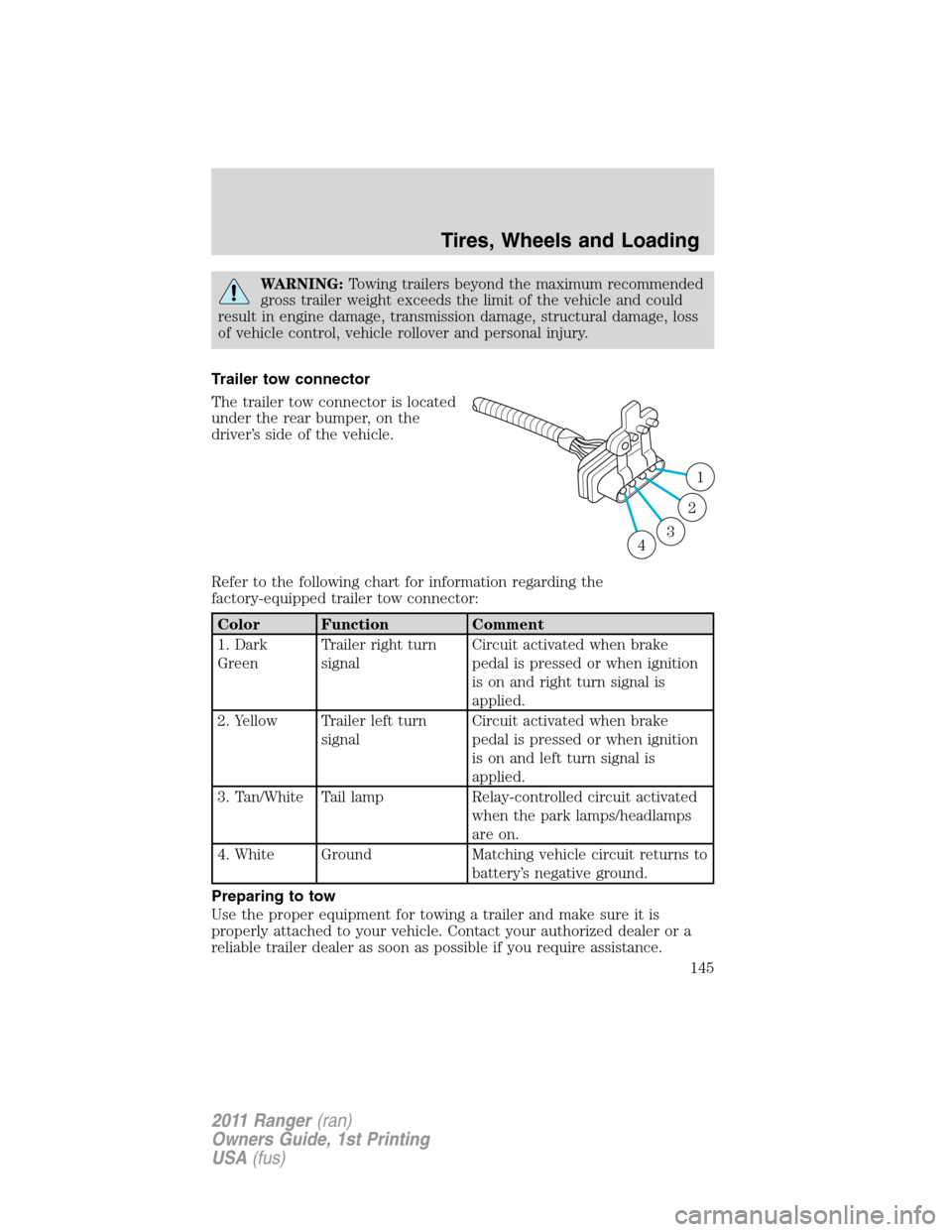
Trailer tow connector
The trailer tow connector is located
under the rear bumper, on the
driver’s side of the vehicle.
Refer to the following chart for information regarding the
factory-equipped trailer tow connector:
Color Function Comment
1. Dark
GreenTrailer right turn
signalCircuit activated when brake
pedal is pressed or when ignition
is on and right turn signal is
applied.
2. Yellow Trailer left turn
signalCircuit activated when brake
pedal is pressed or when ignition
is on and left turn signal is
applied.
3. Tan/White Tail lamp Relay-controlled circuit activated
when the park lamps/headlamps
are on.
4. White Ground Matching vehicle circuit returns to
battery’s negative ground.
Preparing to tow
Use the proper equipment for towing a trailer and make sure it is
properly attached to your vehicle. Contact your authorized dealer or a
reliable trailer dealer as soon as possible if you require assistance.
1
2
34
Tires, Wheels and Loading
145
2011 Ranger(ran)
Owners Guide, 1st Printing
USA(fus)
Page 146 of 302

Hitches
For towing trailers up to 2,000 lb (907 kg), use a weight-carrying hitch
and ball which uniformly distributes the trailer tongue loads through the
underbody structure. For trailers over 2,000 lb (907 kg), use a
frame-mounted weight-distributing hitch. You must distribute the load in
your trailer so that 10–15% of the total weight of the trailer is on the
tongue.
Do not install a single or multi-clamp type bumper hitch, or a hitch
which attaches to the axle. Underbody-mounted hitches are acceptable if
they are installed properly. Follow the towing instructions of a reputable
rental agency.
Whenever a trailer hitch and hardware are removed, make sure all
mounting holes in the underbody are properly sealed to prevent noxious
gases or water from entering.
Using a step bumper (if equipped)
The optional step bumper is equipped with an integral hitch and requires
only a ball with a
34in. (19 mm) shank diameter. The bumper has a
2,000 lb (907 kg) trailer weight and 200 lb (91 kg) tongue weight
capability.
The rated capacities (as shown in this guide) for trailer towing with the
factory bumper are only valid when the trailer hitch ball is installed
directly into the ball hole in the bumper. Addition of bracketry to either
lower the ball hitch position or extend the ball hitch rearward will
significantly increase the loads on the bumper and its attachments. This
can result in the failure of the bumper or the bumper attachments. Use
of any type of hitch extensions should be considered abuse.
Safety chains
Always connect the trailer’s safety chains to the frame or hook retainers
of the vehicle hitch. To connect the trailer’s safety chains, cross the
chains under the trailer tongue and allow slack for turning corners.
If you use a rental trailer, follow the instructions that the rental agency
gives to you.
Do not attach safety chains to the bumper.
Trailer brakes
Electric brakes and manual, automatic or surge-type trailer brakes are
safe if installed properly and adjusted to the manufacturer’s
specifications. The trailer brakes must meet local and Federal
regulations.
Tires, Wheels and Loading
146
2011 Ranger(ran)
Owners Guide, 1st Printing
USA(fus)
Page 246 of 302

Habits
•Smooth, moderate operation can yield up to 10% savings in fuel.
•Steady speeds without stopping will usually give the best fuel
economy.
•Idling for long periods of time (greater than one minute) may waste
fuel.
•Anticipate stopping; slowing down may eliminate the need to stop.
•Sudden or hard accelerations may reduce fuel economy.
•Slow down gradually.
•Driving at reasonable speeds (traveling at 55 mph [88 km/h] uses 15%
less fuel than traveling at 65 mph [105 km/h]).
•Revving the engine before turning it off may reduce fuel economy.
•Using the air conditioner or defroster may reduce fuel economy.
•You may want to turn off the speed control in hilly terrain if
unnecessary shifting between the top gears occurs. Unnecessary
shifting of this type could result in reduced fuel economy.
•Warming up a vehicle on cold mornings is not required and may
reduce fuel economy.
•Resting your foot on the brake pedal while driving may reduce fuel
economy.
•Combine errands and minimize stop-and-go driving.
Maintenance
•Keep tires properly inflated and use only recommended size.
•Operating a vehicle with the wheels out of alignment will reduce fuel
economy.
•Use recommended engine oil. Refer toMaintenance product
specifications and capacitiesin this chapter.
•Perform all regularly scheduled maintenance items. Follow the
recommended maintenance schedule and owner maintenance checks
found inscheduled maintenance information.
Conditions
•Heavily loading a vehicle or towing a trailer may reduce fuel economy
at any speed.
•Carrying unnecessary weight may reduce fuel economy (approximately
1 mpg [0.4 km/L] is lost for every 400 lb [180 kg] of weight carried).
Maintenance and Specifications
246
2011 Ranger(ran)
Owners Guide, 1st Printing
USA(fus)
Page 268 of 302

The Vehicle Identification Number (VIN) contains the following
information:
1. World manufacturer identifier
2. Brake system / Gross Vehicle
Weight Rating (GVWR) / Restraint
Devices and their location
3. Make, vehicle line, series, body
type
4. Engine type
5. Check digit
6. Model year
7. Assembly plant
8. Production sequence number
TRANSMISSION CODE DESIGNATIONS
You can find a transmission code on
the Safety Compliance Certification
Label. The following table tells you
which transmission each code
represents.
Description Code
Five-speed automatic (5R44E/5R55E) D
Five-speed manual (HD) J
Five-speed manual (R1) R
Maintenance and Specifications
268
2011 Ranger(ran)
Owners Guide, 1st Printing
USA(fus)
Page 270 of 302

Peace of mind
•Keyless entry keypad•Seat covers*
•Remote start•Windshield wiper shaker*
•Vehicle security systems•Back up camera*
•Wheel locks•Back up alarm*
•Vehicle tracking and recovery*•Hitch mounted parking sensor*
•Bumper mounted parking sensors*
*Ford Licensed Accessories (FLA) are warranted by the accessory
manufacturer’s warranty. Ford Licensed Accessories are fully designed
and developed by the accessory manufacturer and have not been
designed or tested to Ford Motor Company engineering requirements.
Contact your Ford dealer for details regarding the manufacturer’s limited
warranty and/or a copy of the FLA product limited warranty offered by
the accessory manufacturer.
For maximum vehicle performance, keep the following information in
mind when adding accessories or equipment to your vehicle:
•When adding accessories, equipment, passengers and luggage to your
vehicle, do not exceed the total weight capacity of the vehicle or of
the front or rear axle (GVWR or GAWR as indicated on the Safety
Compliance Certification label). Consult your authorized dealer for
specific weight information.
•The Federal Communications Commission (FCC) and Canadian Radio
Telecommunications Commission (CRTC) regulate the use of mobile
communications systems — such as two-way radios, telephones and
theft alarms - that are equipped with radio transmitters. Any such
equipment installed in your vehicle should comply with FCC or CRTC
regulations and should be installed only by a qualified service
technician.
•Mobile communications systems may harm the operation of your
vehicle, particularly if they are not properly designed for automotive
use.
•To avoid interference with other vehicle functions, such as anti-lock
braking systems, amateur radio users who install radios and antennas
onto their vehicle should not locate the Amateur Radio Antennas in
the area of the driver’s side hood.
•Electrical or electronic accessories or components that are added to
the vehicle by the authorized dealer or the owner may adversely affect
battery performance and durability.
Accessories
270
2011 Ranger(ran)
Owners Guide, 1st Printing
USA(fus)
Page 294 of 302

EXCEPTIONS
In addition, there are several exceptions to the Normal Schedule. They
are listed below:
Normal vehicle axle maintenance
❑Rear axles and power take-off (PTO) units containing synthetic lubricant and light duty trucks equipped with Ford-design
axles are lubricated for life. These lubricants are not to be checked or changed unless a leak is suspected, service is re-
quired or the axle assembly has been submerged in water. The axle and PTO lubricant should be changed anytime the axle
and PTO have been submerged in water. During extended trailer tow operation above 70°F (21°C) ambient and wide open
throttle for extended periods above 45 mph (72 km/h), non-synthetic rear axle lubricants should be replaced every
3,000 miles (4,800 km) or 3 months, whichever occurs first. The 3,000 mile (4,800 km) lubricant change interval may
be waived if the axle was filled with 75W140 synthetic gear lubricant meeting Ford specification WSL-M2C192-A, part
number F1TZ-19580-B or equivalent. Add friction modifier XL-3 (EST-M2C118-A) or equivalent for complete refill of Traction-
Lok rear axles (refer to
Maintenance product and specificationsin theMaintenance and Specificationschapter for details).
The axle lubricant should be changed anytime an axle has been submerged in water.
Police/Taxi/Livery vehicle axle maintenance
❑Replace rear axle lubricant every 100,000 miles (160,000 km). Rear axle lubricant change may be waived if the axle
was filled with 75W140 synthetic gear lubricant meeting Ford specification WSL-M2C192-A, part number FITZ-19580-B or
equivalent. Add four ounces (118 mL) of additive friction modifier XL-3 (EST-M2C118-A) or equivalent for complete refill of
Traction-Lok rear axles. The axle lubricant should be changed anytime the axle has been submerged in water.
E–450 and F–450/550 axle maintenance
❑Replace rear axle lubricant every 100,000 miles (160,000 km) under normal driving conditions on all E–450 and
F–450/550 applications. For E–450 and F–450/550 vehicles operated at or near maximum Gross Vehicle Weights, the
rear axle lubricant should be replaced every 50,000 miles (80,000 km). In addition, this 50,000 mile (80,000 km)
schedule should be observed when the vehicles are operated under the Special Operating Conditions.
California fuel filter replacement
❑If vehicle is registered in California, the California Air Resources Board has determined that the failure to perform this main-
tenance item will not nullify the emission warranty or limit recall liability prior to the completion of the vehicle’s useful life.
Ford Motor Company, however, urges you to have all recommended maintenance services performed at the specified inter-
vals and to record all vehicle service.
Class A Motorhome
❑Every two years - Change brake fluid
Scheduled Maintenance Guide
294
2011 Ranger(ran)
Owners Guide, 1st Printing
USA(fus)