2011 FORD RANGER brake
[x] Cancel search: brakePage 145 of 302
WARNING:Towing trailers beyond the maximum recommended
gross trailer weight exceeds the limit of the vehicle and could
result in engine damage, transmission damage, structural damage, loss
of vehicle control, vehicle rollover and personal injury.
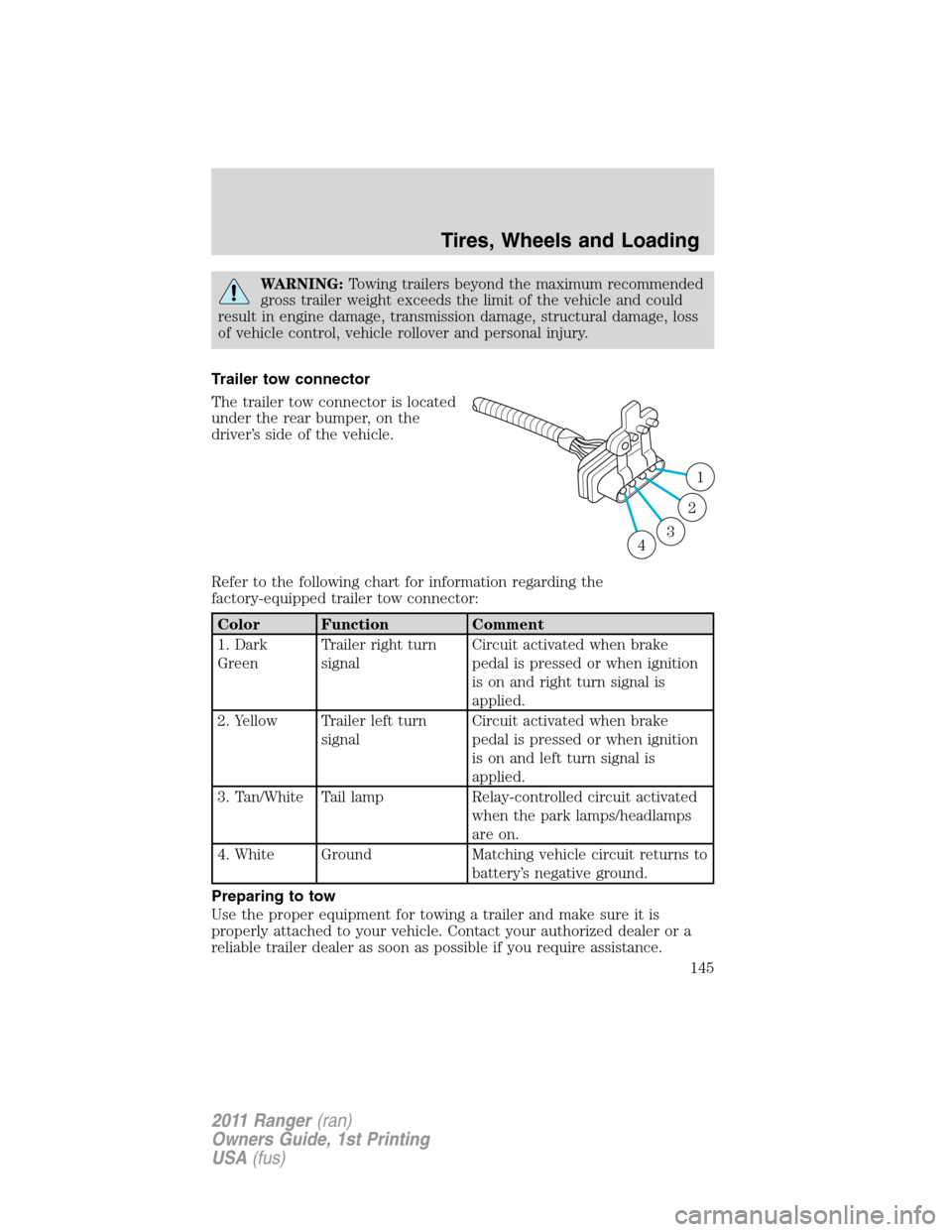
Trailer tow connector
The trailer tow connector is located
under the rear bumper, on the
driver’s side of the vehicle.
Refer to the following chart for information regarding the
factory-equipped trailer tow connector:
Color Function Comment
1. Dark
GreenTrailer right turn
signalCircuit activated when brake
pedal is pressed or when ignition
is on and right turn signal is
applied.
2. Yellow Trailer left turn
signalCircuit activated when brake
pedal is pressed or when ignition
is on and left turn signal is
applied.
3. Tan/White Tail lamp Relay-controlled circuit activated
when the park lamps/headlamps
are on.
4. White Ground Matching vehicle circuit returns to
battery’s negative ground.
Preparing to tow
Use the proper equipment for towing a trailer and make sure it is
properly attached to your vehicle. Contact your authorized dealer or a
reliable trailer dealer as soon as possible if you require assistance.
1
2
34
Tires, Wheels and Loading
145
2011 Ranger(ran)
Owners Guide, 1st Printing
USA(fus)
Page 146 of 302

Hitches
For towing trailers up to 2,000 lb (907 kg), use a weight-carrying hitch
and ball which uniformly distributes the trailer tongue loads through the
underbody structure. For trailers over 2,000 lb (907 kg), use a
frame-mounted weight-distributing hitch. You must distribute the load in
your trailer so that 10–15% of the total weight of the trailer is on the
tongue.
Do not install a single or multi-clamp type bumper hitch, or a hitch
which attaches to the axle. Underbody-mounted hitches are acceptable if
they are installed properly. Follow the towing instructions of a reputable
rental agency.
Whenever a trailer hitch and hardware are removed, make sure all
mounting holes in the underbody are properly sealed to prevent noxious
gases or water from entering.
Using a step bumper (if equipped)
The optional step bumper is equipped with an integral hitch and requires
only a ball with a
34in. (19 mm) shank diameter. The bumper has a
2,000 lb (907 kg) trailer weight and 200 lb (91 kg) tongue weight
capability.
The rated capacities (as shown in this guide) for trailer towing with the
factory bumper are only valid when the trailer hitch ball is installed
directly into the ball hole in the bumper. Addition of bracketry to either
lower the ball hitch position or extend the ball hitch rearward will
significantly increase the loads on the bumper and its attachments. This
can result in the failure of the bumper or the bumper attachments. Use
of any type of hitch extensions should be considered abuse.
Safety chains
Always connect the trailer’s safety chains to the frame or hook retainers
of the vehicle hitch. To connect the trailer’s safety chains, cross the
chains under the trailer tongue and allow slack for turning corners.
If you use a rental trailer, follow the instructions that the rental agency
gives to you.
Do not attach safety chains to the bumper.
Trailer brakes
Electric brakes and manual, automatic or surge-type trailer brakes are
safe if installed properly and adjusted to the manufacturer’s
specifications. The trailer brakes must meet local and Federal
regulations.
Tires, Wheels and Loading
146
2011 Ranger(ran)
Owners Guide, 1st Printing
USA(fus)
Page 147 of 302

WARNING:Do not connect a trailer’s hydraulic brake system
directly to your vehicle’s brake system. Your vehicle may not
have enough braking power and your chances of having a collision
greatly increase.
The braking system of the tow vehicle is rated for operation at the
GVWR not GCWR.
Trailer lamps
Trailer lamps are required on most towed vehicles. Make sure all running
lights, brake lights, turn signals and hazard lights are working. Contact
your authorized dealer or trailer rental agency for proper instructions
and equipment for hooking-up trailer lamps.
Driving while you tow
When towing a trailer:
•Do not drive faster than 70 mph (113 km/h) during the first 500 miles
(800 km) of trailer towing and don’t make full-throttle starts.
•Turn off the speed control. The speed control may shut off
automatically when you are towing on long, steep grades.
•Use a lower gear to eliminate excessive automatic transmission
shifting and assist in transmission cooling. For additional information,
refer toAutomatic transmission operationin theDrivingchapter.
•Under extreme conditions with large frontal trailers, high outside
temperatures and highway speeds, the coolant gauge may indicate
higher than normal coolant temperatures. If this occurs, reduce speed
until the coolant temperature returns to the normal range. Refer to
Gaugesin theInstrument Clusterchapter.
•Allow more distance for stopping with a trailer attached; anticipate
stops and brake gradually.
Servicing after towing
If you tow a trailer for long distances, your vehicle will require more
frequent service intervals. Refer toSpecial operating conditionsin the
Scheduled Maintenance Guidechapter for more information.
Trailer towing tips
•Practice turning, stopping and backing-up before starting on a trip to
get the feel of the vehicle-trailer combination. When turning, make
wider turns so the trailer wheels will clear curbs and other obstacles.
Tires, Wheels and Loading
147
2011 Ranger(ran)
Owners Guide, 1st Printing
USA(fus)
Page 149 of 302

Vehicles equipped with a manual transmission:
Before you tow your vehicle:
•Release the parking brake.
•Move the gearshift to the neutral position.
•Turn the key in the ignition to the off/unlocked position.
•The maximum towing speed is 55 mph (88 km/h).
•The maximum recommended distance is unlimited.
•Put 4WD switch in 2WD mode (4WD only)
•The vehicle must be towed in the forward direction to ensure no
damage is done to the internal transmission components.
In addition, it is recommended that you follow the instructions provided
by the aftermarket manufacturer of the towing equipment, if provided.
In case of a roadside emergency with a disabled vehicle, seeWrecker
towingin theRoadside Emergencieschapter.
2WD vehicles equipped with an automatic transmissions:Do not
tow your vehicle with any wheels on the ground, as vehicle or
transmission damage may occur. It is recommended to tow your vehicle
with all four (4) wheels off the ground such as when using a car-hauling
trailer. Otherwise, no recreational towing is permitted.
4WD vehicles equipped with an automatic transmission and
electronic shift transfer case (Neutral tow kit accessory):
On vehicles equipped with 4WD, an accessory is available that allows you
to tow your vehicle, behind another vehicle, with all the wheels on the
ground. Contact your authorized dealer for more details. Do not tow your
vehicle with all wheels on the ground unless you install the neutral tow
kit as vehicle damage may occur.
In case of a roadside emergency with a disabled vehicle, seeWrecker
towingin theRoadside Emergencieschapter.
CAMPER BODIES
Your vehicle is not recommended for slide-in camper bodies.
Tires, Wheels and Loading
149
2011 Ranger(ran)
Owners Guide, 1st Printing
USA(fus)
Page 151 of 302
WARNING:Do not start your vehicle in a closed garage or in
other enclosed areas. Exhaust fumes can be toxic. Always open
the garage door before you start the engine. SeeGuarding against
exhaust fumesin this chapter for more instructions.
WARNING:If you smell exhaust fumes inside your vehicle, have
your dealer inspect your vehicle immediately. Do not drive if you
smell exhaust fumes.
Important safety precautions
When the engine starts, the idle RPM runs faster to warm the engine. If
the engine idle speed does not slow down automatically, have the vehicle
checked.
Before starting the vehicle:
1. Make sure all occupants buckle their safety belts. For more
information on safety belts and their proper usage, refer to theSeating
and Safety Restraintschapter.
2. Make sure the headlamps and electrical accessories are off.
If starting a vehicle with an automatic transmission:
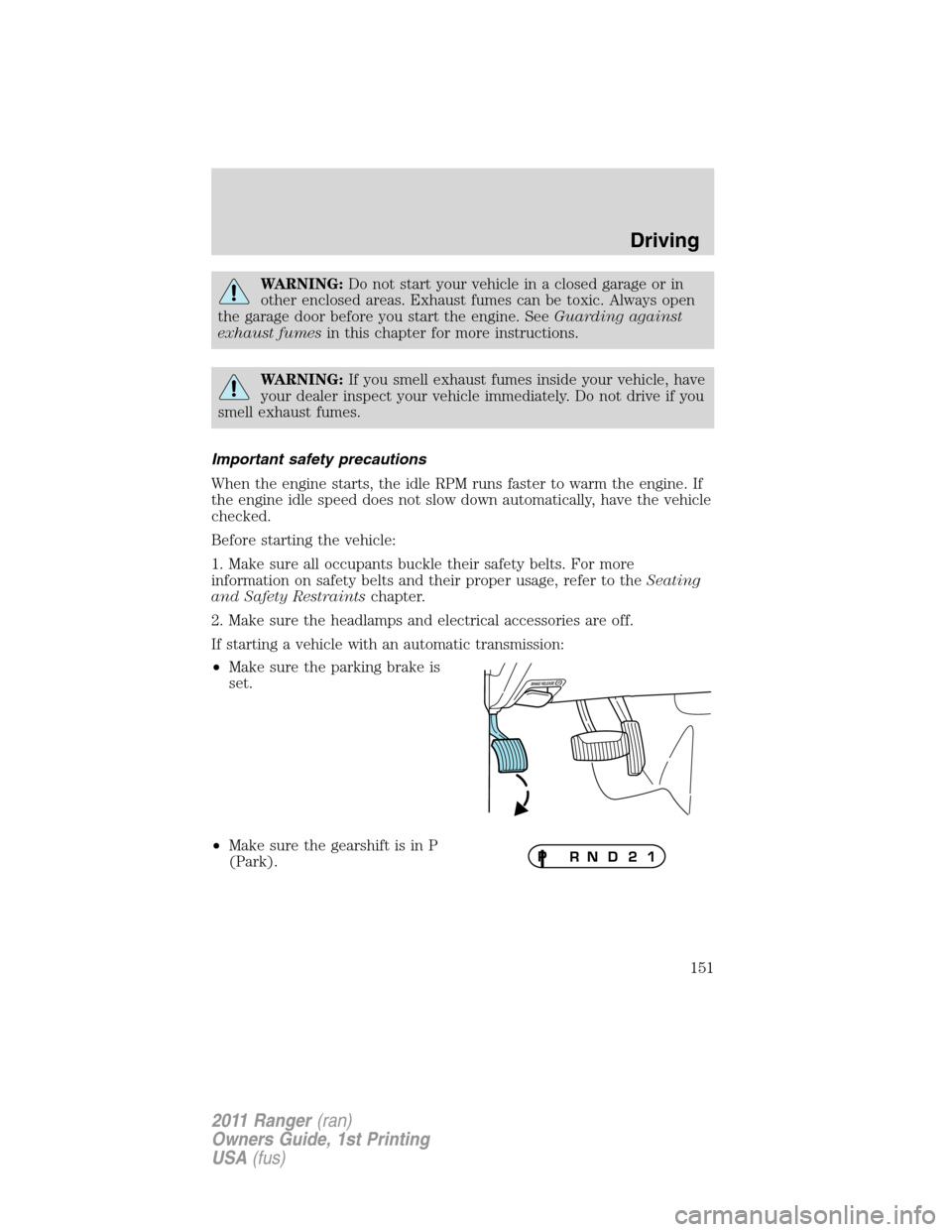
•Make sure the parking brake is
set.
•Make sure the gearshift is in P
(Park).
Driving
151
2011 Ranger(ran)
Owners Guide, 1st Printing
USA(fus)
Page 152 of 302

If starting a vehicle with a manual
transmission:
•Make sure the parking brake is
set.
•Press and hold the clutch pedal
to the floor, then put the
gearshift lever in the N (Neutral)
position.
3. Turn the key to 4 (on) without
turning the key to 5 (start).
If there is difficulty in turning the key, firmly rotate the steering wheel
left and right until the key turns freely. This condition may occur when:
•the front wheels are turned,
•the front wheel is against the curb, or
•the steering wheel is turned when getting in or out of the vehicle.
Some warning lights will briefly illuminate. SeeWarning lights and
chimesin theInstrument Clusterchapter for more information
regarding the warning lights.
Starting the engine
Note:Whenever you start your vehicle, release the key as soon as the
engine starts. Excessive cranking could damage the starter.
1
2
34
5
Driving
152
2011 Ranger(ran)
Owners Guide, 1st Printing
USA(fus)
Page 155 of 302

•Finally, have the engine block heater system checked during your fall
tune-up to be sure it’s in good working order.
How to use the engine block heater
Ensure the receptacle terminals are clean and dry prior to use. To clean
them, use a dry cloth.
Depending on the type of factory installed equipment, your engine block
heater will use .4 to 1.0 kilowatt-hours of energy per hour of use. Your
factory installed block heater system does not have a thermostat;
however, maximum temperature is attained after approximately three
hours of operation. Block heater operation longer than three hours will
not improve system performance and will unnecessarily use additional
electricity.
Make sure system is unplugged and properly stowed before driving the
vehicle. While not in use, make sure the protective cover seals the
prongs of the engine block heater cord plug.
BRAKES
Occasional brake noise is normal. If a metal-to-metal, continuous grinding
or continuous squeal sound is present, the brake linings may be worn-out
and should be inspected by an authorized dealer. If the vehicle has
continuous vibration or shudder in the steering wheel while braking, the
vehicle should be inspected by an authorized dealer.
Refer toWarning lights and
chimesin theInstrument Cluster
chapter for information on the brake
system warning light.
Four-wheel anti-lock brake system (ABS)
This vehicle is equipped with an anti-lock braking system (ABS). A noise
from the hydraulic pump motor and pulsation in the pedal may be
observed during ABS braking events and the brake pedal may suddenly
travel a little farther as soon as ABS braking is done and normal brake
operation resumes. Pedal pulsation coupled with noise while braking
under panic conditions or on loose gravel, bumps, wet or snowy roads is
normal and indicates proper functioning of the vehicle’s anti-lock brake
system.
Note:The ABS performs a self-check after you start the engine and
begin to drive away.
A brief mechanical noise may be heard during this test. This is normal. If
a malfunction is found, the ABS warning light will come on. If the vehicle
P!
BRAKE
Driving
155
2011 Ranger(ran)
Owners Guide, 1st Printing
USA(fus)
Page 156 of 302

has continuous vibration or shudder in the steering wheel while braking,
the vehicle should be inspected by an authorized dealer.
The ABS operates by detecting the
onset of wheel lockup during brake
applications and compensates for
this tendency. The wheels are
prevented from locking even when
the brakes are firmly applied. The
accompanying illustration depicts
the advantage of an ABS equipped
vehicle (on bottom) to a non-ABS
equipped vehicle (on top) during hard braking with loss of front braking
traction.
WARNING:The anti-lock system does not decrease the time
necessary to apply the brakes or always reduce stopping
distance. Always leave enough room between your vehicle and the
vehicle in front of you to stop.
Using ABS
When hard braking is required, apply continuous force on the brake
pedal. Do not pump the brake pedal since this will reduce the
effectiveness of the ABS and will increase your vehicle’s stopping
distance. The ABS will be activated immediately, allowing you to retain
steering control during hard braking and on slippery surfaces. However,
the ABS does not decrease stopping distance.
ABS warning lamp
The ABS lamp in the instrument
cluster momentarily illuminates
when the ignition is turned on. If
the light does not illuminate during
start up, remains on or flashes, the
ABS may be disabled and may need to be serviced.
Even when the ABS is disabled,
normal braking is still effective. If
your BRAKE warning lamp
illuminates with the parking brake
released, have your brake system
serviced immediately by an authorized dealer.
ABS
P!
BRAKE
Driving
156
2011 Ranger(ran)
Owners Guide, 1st Printing
USA(fus)