2011 FORD MUSTANG fuel
[x] Cancel search: fuelPage 219 of 348
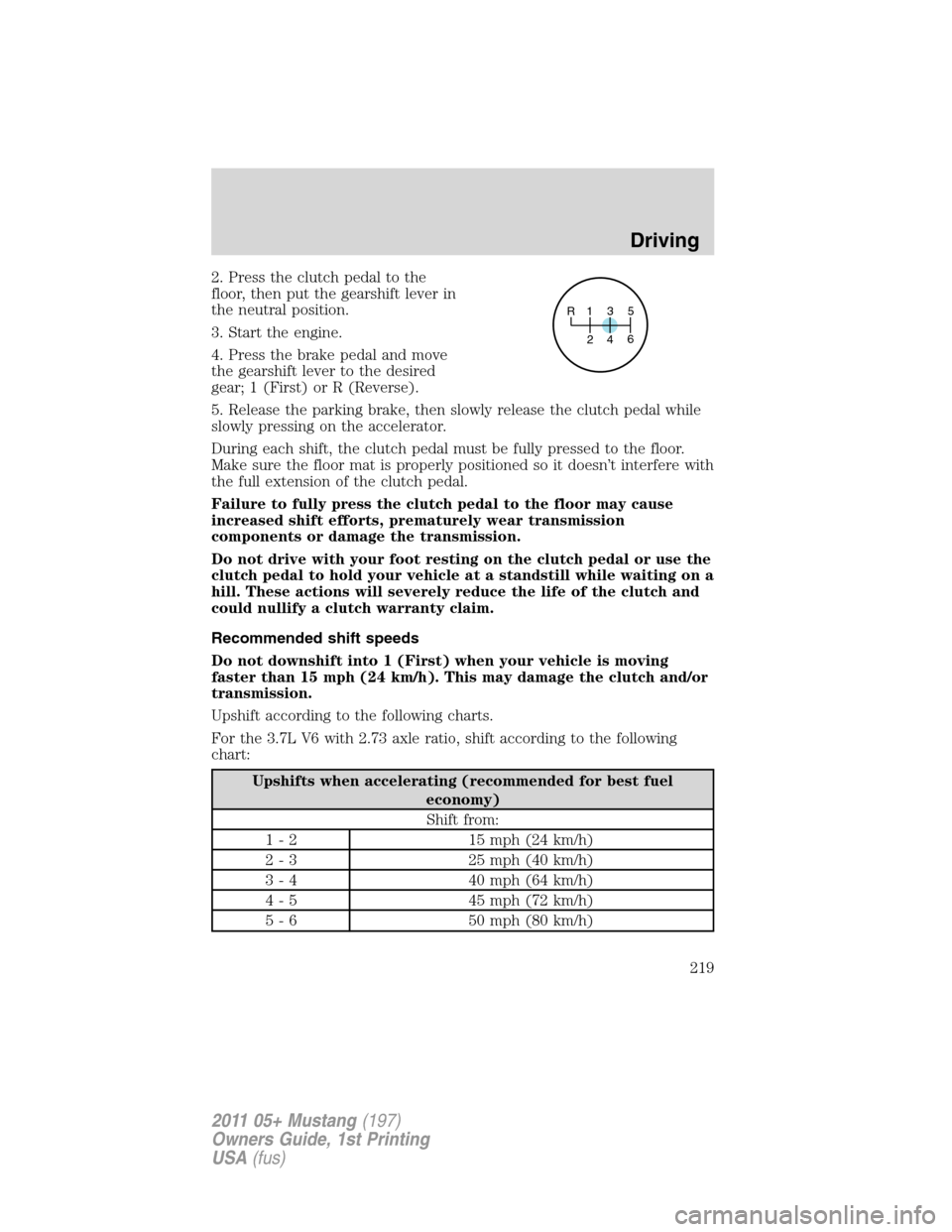
2. Press the clutch pedal to the
floor, then put the gearshift lever in
the neutral position.
3. Start the engine.
4. Press the brake pedal and move
the gearshift lever to the desired
gear; 1 (First) or R (Reverse).
5. Release the parking brake, then slowly release the clutch pedal while
slowly pressing on the accelerator.
During each shift, the clutch pedal must be fully pressed to the floor.
Make sure the floor mat is properly positioned so it doesn’t interfere with
the full extension of the clutch pedal.
Failure to fully press the clutch pedal to the floor may cause
increased shift efforts, prematurely wear transmission
components or damage the transmission.
Do not drive with your foot resting on the clutch pedal or use the
clutch pedal to hold your vehicle at a standstill while waiting on a
hill. These actions will severely reduce the life of the clutch and
could nullify a clutch warranty claim.
Recommended shift speeds
Do not downshift into 1 (First) when your vehicle is moving
faster than 15 mph (24 km/h). This may damage the clutch and/or
transmission.
Upshift according to the following charts.
For the 3.7L V6 with 2.73 axle ratio, shift according to the following
chart:
Upshifts when accelerating (recommended for best fuel
economy)
Shift from:
1 - 2 15 mph (24 km/h)
2 - 3 25 mph (40 km/h)
3 - 4 40 mph (64 km/h)
4 - 5 45 mph (72 km/h)
5 - 6 50 mph (80 km/h)
135
24R
6
Driving
219
2011 05+ Mustang(197)
Owners Guide, 1st Printing
USA(fus)
Page 220 of 348

For the 3.7L V6 with 3.31 axle ratio, shift according to the following
chart:
Upshifts when accelerating (recommended for best fuel
economy)
Shift from:
1 - 2 13 mph (21 km/h)
2 - 3 26 mph (42 km/h)
3 - 4 37 mph (59 km/h)
4 - 5 43 mph (69 km/h)
5 - 6 59 mph (95 km/h)
For the 5.0L V8, shift according to the following chart:
Upshifts when accelerating (recommended for best fuel
economy)
Shift from (When not in skip shift mode):
1 - 2 17 mph (27 km/h)
2 - 3 25 mph (40 km/h)
3 - 4 40 mph (64 km/h)
4 - 5 45 mph (72 km/h)
5 - 6 50 mph (80 km/h)
Shift from (When skip shift mode active):
1-4 17 mph (27 km/h)
4-5 25 mph (40 km/h)
5-6 40 mph (64 km/h)
Skip Shift (if equipped) (V8 engines only)
This feature locks out 2 (Second) and 3 (Third) gears for improved fuel
economy. If the message center displays 1–> 4 SHIFT, shift the
transmission directly from 1 (First) to 4 (Fourth), otherwise you can
shift normally. Refer toMessage centerin theInstrument Cluster
chapter.
Reverse
1. Make sure that your vehicle is at a complete stop before you shift into
R (Reverse). Failure to do so may damage the transmission.
2. Press the clutch pedal to the floor to disengage clutch.
3. Move the gearshift lever into the neutral position and wait at least
three seconds before shifting into R (Reverse).
Driving
220
2011 05+ Mustang(197)
Owners Guide, 1st Printing
USA(fus)
Page 226 of 348

ROADSIDE ASSISTANCE
Getting roadside assistance
To fully assist you should you have a vehicle concern, Ford Motor
Company offers a complimentary roadside assistance program. This
program is separate from the New Vehicle Limited Warranty. The service
is available:
•24-hours, seven days a week
•for the coverage period listed on the Roadside Assistance Card
included in your Owner Guide portfolio.
Roadside assistance will cover:
•a flat tire change with a good spare (except vehicles that have been
supplied with a tire inflation kit)
•battery jump start
•lock-out assistance (key replacement cost is the customer’s
responsibility)
•fuel delivery – Independent Service Contractors, if not prohibited by
state, local or municipal law shall deliver up to 2.0 gallons (7.5L) of
gasoline or 5.0 gallons (18.9L) of diesel fuel to a disabled vehicle. Fuel
delivery service is limited to two no-charge occurrences within a
12-month period.
•winch out – available within 100 feet (30.5 meters) of a paved or
county maintained road, no recoveries.
•towing – Ford/Mercury/Lincoln eligible vehicle towed to an authorized
dealer within 35 miles (56 km) of the disablement location or to the
nearest authorized dealer. If a member requests to be towed to an
authorized dealer more than 35 miles (56 km) from the disablement
location, the member shall be responsible for any mileage costs in
excess of 35 miles (56 km).
Trailers shall be covered up to $200 if the disabled eligible vehicle
requires service at the nearest authorized dealer. If the trailer is disabled,
but the towing vehicle is operational, the trailer does not qualify for any
roadside services.
Canadian customers refer to your Warranty Guide or visit our
website at www.ford.ca for information on:
Using roadside assistance
Complete the roadside assistance identification card and place it in your
wallet for quick reference. In the United States, this card is found in the
Roadside Emergencies
226
2011 05+ Mustang(197)
Owners Guide, 1st Printing
USA(fus)
Page 227 of 348

Owner Guide portfolio in the glove compartment. In Canada, the card is
found in theWarranty Guidein the glove compartment.
U.S. Ford, Mercury and Lincoln vehicle customers who require Roadside
Assistance, call 1-800-241-3673.
Canadian customers who require roadside assistance, call
1-800-665-2006.
If you need to arrange roadside assistance for yourself, Ford Motor
Company will reimburse a reasonable amount for towing to the nearest
dealership within 35 miles (56 km). To obtain reimbursement
information, U.S. Ford, Mercury and Lincoln vehicle customers call
1-800-241-3673. Customers will be asked to submit their original
receipts.
Canadian customers who need to obtain reimbursement information, call
1-800-665-2006 or visit our website at www.ford.ca.
HAZARD FLASHER CONTROL
The hazard flasher control is located
on the center console next to the
gearshift lever. The hazard flashers
will operate when the ignition is in
any position or if the key is not in
the ignition.
Press in the flasher control and all front and rear direction signals will
flash. Press the flasher control again to turn them off. Use it when your
vehicle is disabled and is creating a safety hazard for other motorists.
Note:With extended use, the flasher may run down your battery.
FUEL PUMP SHUT-OFF
In the event of a moderate to severe collision, this vehicle is equipped
with a fuel pump shut-off feature that stops the flow of fuel to the
engine. Not every impact will cause a shut-off.
Should your vehicle shut off after a collision due to this feature, you may
restart your vehicle by doing the following:
1. Turn the ignition switch to the off position.
2. Turn the ignition switch to the on position.
In some instances the vehicle may not restart the first time you try to
restart and may take one additional attempt.
Roadside Emergencies
227
2011 05+ Mustang(197)
Owners Guide, 1st Printing
USA(fus)
Page 228 of 348
WARNING:Failure to inspect and if necessary repair fuel leaks
after a collision may increase the risk of fire and serious injury.
Ford Motor Company recommends that the fuel system be inspected
by an authorized dealer after any collision.
FUSES AND RELAYS
Fuses
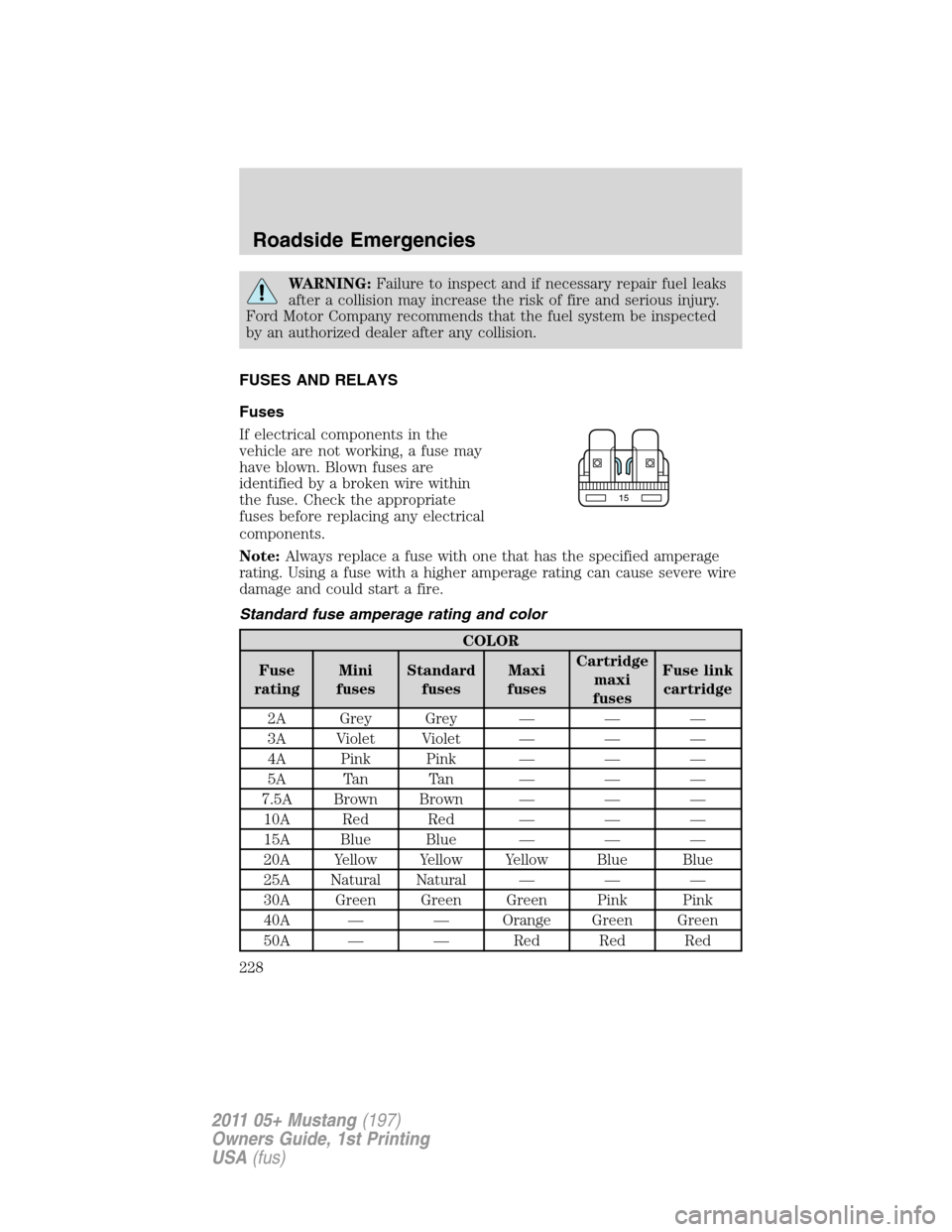
If electrical components in the
vehicle are not working, a fuse may
have blown. Blown fuses are
identified by a broken wire within
the fuse. Check the appropriate
fuses before replacing any electrical
components.
Note:Always replace a fuse with one that has the specified amperage
rating. Using a fuse with a higher amperage rating can cause severe wire
damage and could start a fire.
Standard fuse amperage rating and color
COLOR
Fuse
ratingMini
fusesStandard
fusesMaxi
fusesCartridge
maxi
fusesFuse link
cartridge
2A Grey Grey — — —
3A Violet Violet — — —
4A Pink Pink — — —
5A Tan Tan — — —
7.5A Brown Brown — — —
10A Red Red — — —
15A Blue Blue — — —
20A Yellow Yellow Yellow Blue Blue
25A Natural Natural — — —
30A Green Green Green Pink Pink
40A — — Orange Green Green
50A — — Red Red Red
15
Roadside Emergencies
228
2011 05+ Mustang(197)
Owners Guide, 1st Printing
USA(fus)
Page 233 of 348

Fuse/Relay
LocationFuse Amp
RatingProtected Circuits
1 80A* Passenger compartment fuse
panel
2 — Not used
3 — Not used
4 30A* Blower motor relay
5 20A* Powerpoint (body)
6 40A* Rear defroster
7 40A* Cooling fan relay
8 40A* Anti-lock brake system (ABS)
pump
9 30A* Wipers
10 30A* ABS valve
11 — Not used
12 — Not used
13 15A** Fuel pump relay (non-Shelby)
25A** Fuel pump relay (Shelby only)
14 — Not used
15 10A** Intercooler pump relay (Shelby
only)
16 20A** Heated seats
17 10A** Alternator sense
18 20A* Auxiliary body module (ABM)
19 30A* Starter relay
20 30A* Rear amplifier (Shaker 1000
radio)
21 30A* Powertrain relay
22 20A* Powerpoint (instrument panel)
23 10A** Powertrain control module (PCM)
keep-alive power
24 10A** Brake on/off (BOO) power
25 10A** A/C compressor relay
Roadside Emergencies
233
2011 05+ Mustang(197)
Owners Guide, 1st Printing
USA(fus)
Page 234 of 348
Fuse/Relay
LocationFuse Amp
RatingProtected Circuits
26 20A** Left high intensity discharge
headlamp relay
27 20A** Right high intensity discharge
headlamp relay
28 — Not used
29 30A* Passenger front window
30 — Not used
31 30A* Passenger power seat
32 30A* Driver power seat
33 30A* Front amplifier (Shaker 500
radio)
34 30A* Driver front window motor
35 40A* Convertible top motor
36 Diode Fuel diode
37 — Not used
38 15A** Fuel injectors (Shelby only)
39 5A** Rear defroster coil (run/start)
40 15A** PCM vehicle power4–ignition
coil
41 G8VA relay Fuel pump relay
42 G8VA relay Intercooler pump relay (Shelby
only)
43 G8VA relay A/C compressor relay
44 — Not used (spare)
45 5A** PCM run/start
46 5A** PCM vehicle power 3 – general
powertrain components
47 15A** PCM vehicle power 1
48 15A** Mass air flow sensor
49 15A** PCM vehicle power 2 – emissions
related powertrain components
50 Full ISO relay Cooling fan relay (high)
Roadside Emergencies
234
2011 05+ Mustang(197)
Owners Guide, 1st Printing
USA(fus)
Page 235 of 348

Fuse/Relay
LocationFuse Amp
RatingProtected Circuits
51 Full ISO relay Blower motor relay
52 Full ISO relay Starter relay
53 Full ISO relay Rear defroster relay
54 Full ISO relay Front wiper relay
55 Full ISO relay Cooling fan relay (low)
56 High current
relayFuel pump sensor (Shelby only)
57 Full ISO relay PCM relay
58 High current
relayNot used (Spare)
* Cartridge Fuses ** Mini Fuses
Auxiliary relay with heated seats (if equipped)
On heated seat equipped vehicles, there is a relay box located under the
driver seat containing two relays for the driver and passenger heated
seats.
CHANGING THE TIRES
If you get a flat tire while driving, do not apply the brake heavily.
Instead, gradually decrease your speed. Hold the steering wheel firmly
and slowly move to a safe place on the side of the road.
Note:The tire pressure monitoring system (TPMS) indicator light will
illuminate when the spare tire is in use. To restore the full functionality
of the monitoring system, all road wheels equipped with tire pressure
monitoring sensors must be mounted on the vehicle.
Have a flat serviced by an authorized dealer in order to prevent damage
to the TPMS sensors, refer toTire pressure monitoring system
(TPMS)in theTires, Wheels and Loadingchapter. Replace the spare
tire with a road tire as soon as possible. During repairing or replacing of
the flat tire, have the authorized dealer inspect the TPMS sensor for
damage.
WARNING:The use of tire sealants may damage your tire
pressure monitoring system (TPMS) and should not be used.
However, if you must use a sealant, the TPMS sensor and valve stem
on the wheel must be replaced by an authorized Ford dealer.
Roadside Emergencies
235
2011 05+ Mustang(197)
Owners Guide, 1st Printing
USA(fus)