Page 223 of 348

WARNING:Objects that are close to either corner of the
bumper or under the bumper, might not be seen on the screen
due to the limited coverage of the camera system.
WARNING:Backup as slow as possible since higher speeds
might limit your reaction time to stop the vehicle.
WARNING:Do not use the camera system with the trunk open.
If the back end of the vehicle is hit or damaged, then check with your
authorized dealer to have your rear video system checked for proper
coverage and operation.
Night time and dark area use
At night time or in dark areas, the camera system relies on the reverse
lamp lighting to produce an image. Therefore it is necessary that both
reverse lamps are operating in order to get a clear image in the dark. If
either of the lamps are not operating, stop using the camera system, at
least in the dark, until the lamp(s) are replaced and functioning.
Servicing
•If the image comes on while the vehicle is not in R (Reverse), have
the system inspected by your authorized dealer.
•If the image is not clear, then check if there is anything covering the
lens such as dirt, mud, ice, snow, etc. If the image is still not clear
after cleaning, have your system inspected by your authorized dealer.
BLIND SPOT MIRRORS
Blind spot mirrors have a convex spotter mirror built into the upper
outboard corner of the outside mirrors. They are designed to assist the
driver by increasing visibility along the side of the vehicle.
Driving
223
2011 05+ Mustang(197)
Owners Guide, 1st Printing
USA(fus)
Page 224 of 348
Driving with blind spot mirrors
Before a lane change, check the
main mirror first, then check the
blind spot mirror. If no vehicles are
present in the blind spot mirror and
the traffic in the adjacent lane is at
a safe distance, signal that you are
going to change lanes. Glance over
your shoulder to verify traffic is
clear, and carefully change lanes.
When the approaching vehicle is at
a distance, its image is small and
near the inboard edge of the main
mirror. As the vehicle approaches,
the image becomes larger and
begins to move outboard across the
main mirror (1). As the vehicle
approaches its image will transition
from the main mirror and begin to
appear in the blind spot mirror (2).
As the vehicle leaves the blind spot
mirror it will transition to the driver’s peripheral field of view (3).
WARNING:Objects in the blind spot mirror are closer than they
appear.
3
2
1
Driving
224
2011 05+ Mustang(197)
Owners Guide, 1st Printing
USA(fus)
Page 228 of 348
WARNING:Failure to inspect and if necessary repair fuel leaks
after a collision may increase the risk of fire and serious injury.
Ford Motor Company recommends that the fuel system be inspected
by an authorized dealer after any collision.
FUSES AND RELAYS
Fuses
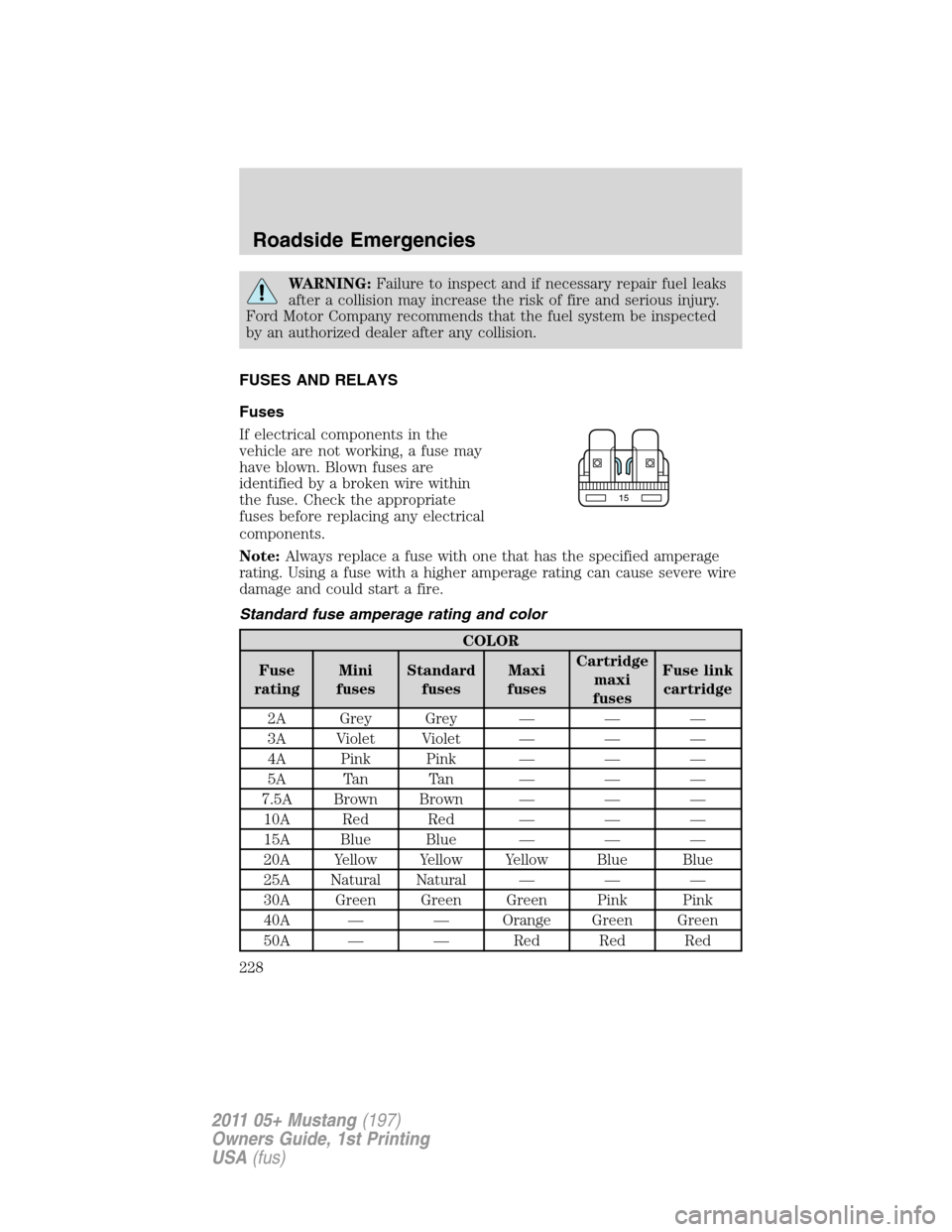
If electrical components in the
vehicle are not working, a fuse may
have blown. Blown fuses are
identified by a broken wire within
the fuse. Check the appropriate
fuses before replacing any electrical
components.
Note:Always replace a fuse with one that has the specified amperage
rating. Using a fuse with a higher amperage rating can cause severe wire
damage and could start a fire.
Standard fuse amperage rating and color
COLOR
Fuse
ratingMini
fusesStandard
fusesMaxi
fusesCartridge
maxi
fusesFuse link
cartridge
2A Grey Grey — — —
3A Violet Violet — — —
4A Pink Pink — — —
5A Tan Tan — — —
7.5A Brown Brown — — —
10A Red Red — — —
15A Blue Blue — — —
20A Yellow Yellow Yellow Blue Blue
25A Natural Natural — — —
30A Green Green Green Pink Pink
40A — — Orange Green Green
50A — — Red Red Red
15
Roadside Emergencies
228
2011 05+ Mustang(197)
Owners Guide, 1st Printing
USA(fus)
Page 232 of 348
Power distribution box
The power distribution box is located in the engine compartment. The
power distribution box contains high-current fuses that protect your
vehicle’s main electrical systems from overloads.
Do not probe the contacts for the fuses and relays in the power
distribution box as damage will occur, causing improper, or loss
of, electrical functionality.
WARNING:Always disconnect the battery before servicing high
current fuses.
WARNING:To reduce risk of electrical shock, always replace
the cover to the Power Distribution Box before reconnecting the
battery or refilling fluid reservoirs.
If the battery has been disconnected and reconnected, refer to the
Batterysection of theMaintenance and Specificationschapter.
The high-current fuses are coded as follows.
Roadside Emergencies
232
2011 05+ Mustang(197)
Owners Guide, 1st Printing
USA(fus)
Page 235 of 348

Fuse/Relay
LocationFuse Amp
RatingProtected Circuits
51 Full ISO relay Blower motor relay
52 Full ISO relay Starter relay
53 Full ISO relay Rear defroster relay
54 Full ISO relay Front wiper relay
55 Full ISO relay Cooling fan relay (low)
56 High current
relayFuel pump sensor (Shelby only)
57 Full ISO relay PCM relay
58 High current
relayNot used (Spare)
* Cartridge Fuses ** Mini Fuses
Auxiliary relay with heated seats (if equipped)
On heated seat equipped vehicles, there is a relay box located under the
driver seat containing two relays for the driver and passenger heated
seats.
CHANGING THE TIRES
If you get a flat tire while driving, do not apply the brake heavily.
Instead, gradually decrease your speed. Hold the steering wheel firmly
and slowly move to a safe place on the side of the road.
Note:The tire pressure monitoring system (TPMS) indicator light will
illuminate when the spare tire is in use. To restore the full functionality
of the monitoring system, all road wheels equipped with tire pressure
monitoring sensors must be mounted on the vehicle.
Have a flat serviced by an authorized dealer in order to prevent damage
to the TPMS sensors, refer toTire pressure monitoring system
(TPMS)in theTires, Wheels and Loadingchapter. Replace the spare
tire with a road tire as soon as possible. During repairing or replacing of
the flat tire, have the authorized dealer inspect the TPMS sensor for
damage.
WARNING:The use of tire sealants may damage your tire
pressure monitoring system (TPMS) and should not be used.
However, if you must use a sealant, the TPMS sensor and valve stem
on the wheel must be replaced by an authorized Ford dealer.
Roadside Emergencies
235
2011 05+ Mustang(197)
Owners Guide, 1st Printing
USA(fus)
Page 236 of 348
WARNING:Refer toTire pressure monitoring system (TPMS)
in theTires, Wheels and Loadingchapter for important
information. If the tire pressure monitor sensor becomes damaged, it
will no longer function.
Dissimilar spare tire/wheel information
WARNING:Failure to follow these guidelines could result in an
increased risk of loss of vehicle control, injury or death.
If you have a dissimilar spare tire/wheel, then it is intended for
temporary use only. This means that if you need to use it, you should
replace it as soon as possible with a road tire/wheel that is the same size
and type as the road tires and wheels that were originally provided by
Ford. If the dissimilar spare tire or wheel is damaged, it should be
replaced rather than repaired.
Roadside Emergencies
236
2011 05+ Mustang(197)
Owners Guide, 1st Printing
USA(fus)
Page 238 of 348

The usage of a full-size dissimilar spare tire/wheel can lead to
impairment of the following:
•Handling, stability and braking performance
•Comfort and noise
•Ground clearance and parking at curbs
•Winter weather driving capability
•Wet weather driving capability
•All-Wheel driving capability (if applicable)
•Load leveling adjustment (if applicable)
When driving with the full-size dissimilar spare tire/wheel additional
caution should be given to:
•Towing a trailer
•Driving vehicles equipped with a camper body
•Driving vehicles with a load on the cargo rack
Drive cautiously when using a full-size dissimilar spare tire/wheel and
seek service as soon as possible.
Stopping and securing the vehicle
1. Park on a level surface, set the
parking brake and activate the
hazard flashers.
2. Place the gearshift lever in P
(Park) (automatic transmission) or
R (Reverse) (manual transmission)
and turn the engine off.
Tire change procedure
WARNING:When one of the front wheels is off the ground, the
transmission alone will not prevent the vehicle from moving or
slipping off the jack, even if the vehicle is in P (Park) (automatic
transmission) or R (Reverse) (manual transmission).
WARNING:To help prevent the vehicle from moving when you
change a tire, be sure the parking brake is set, then block (in
both directions) the wheel that is diagonally opposite (other side and
end of the vehicle) to the tire being changed.
Roadside Emergencies
238
2011 05+ Mustang(197)
Owners Guide, 1st Printing
USA(fus)
Page 239 of 348
WARNING:If the vehicle slips off the jack, you or someone else
could be seriously injured.
WARNING:Do not attempt to change a tire on the side of the
vehicle close to moving traffic. Pull far enough off the road to
avoid the danger of being hit when operating the jack or changing the
wheel.
Note:Passengers should not remain in the vehicle when the vehicle is
being jacked.
1. Block both the front and rear of
the wheel diagonally opposite the
flat tire. For example, if the left
front tire is flat, block the right rear
wheel.
2. Remove the lug wrench, spare
tire and jack.
Roadside Emergencies
239
2011 05+ Mustang(197)
Owners Guide, 1st Printing
USA(fus)


