Page 247 of 357
Upshift according to the following chart:
Recommended upshifts (for best fuel economy) when
accelerating
5-speed manual transmission
Shift from:
1 - 2 14 mph (23 km/h)
2 - 3 24 mph (39 km/h)
3 - 4 32 mph (51 km/h)
4 - 5 44 mph (71 km/h)
Reverse
Make sure that your vehicle is at a complete stop before you shift
into R (Reverse). Failure to do so may damage the transmission.
Hold the clutch pedal down and move the gearshift lever into the neutral
position. Wait at least three seconds before shifting into R (Reverse).
Note:The gearshift lever can only be moved into R (Reverse) by moving
it from left of 3 (Third) and 4 (Fourth) before shifting into R (Reverse).
This is a lockout feature that protects the transmission from accidentally
being shifted into R (Reverse) from 5 (Fifth).
If R (Reverse) is not fully engaged, press the clutch pedal down and
return the gearshift to the neutral position. Release the clutch pedal for
a moment, then press it down and shift to R (Reverse) again.
Parking your vehicle
1. Apply the brake and shift into the neutral position.
2. Fully apply the parking brake, hold the clutch pedal down, then shift
into 1 (First).
3. Turn the ignition off.
WARNING:Do not park your vehicle in Neutral, it may move
unexpectedly and injure someone. Use 1 (First) gear and set the
parking brake fully.
Driving
247
2011 Fiesta(fie)
Owners Guide, 1st Printing
USA(fus)
Page 250 of 357
ROADSIDE ASSISTANCE
Getting roadside assistance
To fully assist you should you have a vehicle concern, Ford Motor
Company offers a complimentary roadside assistance program. This
program is separate from the New Vehicle Limited Warranty. The service
is available:
•24-hours, seven days a week
•for the coverage period listed on the Roadside Assistance Card
included in your Owner Guide portfolio.
Roadside assistance will cover:
•a flat tire change with a good spare (except vehicles that have been
supplied with a tire inflation kit)
•battery jump start
•lock-out assistance (key replacement cost is the customer’s
responsibility)
•fuel delivery – Independent Service Contractors, if not prohibited by
state, local or municipal law shall deliver up to 2.0 gallons (7.5L) of
gasoline or 5.0 gallons (18.9L) of diesel fuel to a disabled vehicle. Fuel
delivery service is limited to two no-charge occurrences within a
12-month period.
•winch out – available within 100 feet (30.5 meters) of a paved or
county maintained road, no recoveries.
•towing – Ford/Mercury/Lincoln eligible vehicle towed to an authorized
dealer within 35 miles (56 km) of the disablement location or to the
nearest authorized dealer. If a member requests to be towed to an
authorized dealer more than 35 miles (56 km) from the disablement
location, the member shall be responsible for any mileage costs in
excess of 35 miles (56 km).
Trailers shall be covered up to $200 if the disabled eligible vehicle
requires service at the nearest authorized dealer. If the trailer is disabled,
but the towing vehicle is operational, the trailer does not qualify for any
roadside services.
Roadside Emergencies
250
2011 Fiesta(fie)
Owners Guide, 1st Printing
USA(fus)
Page 255 of 357
Fuse/Relay
LocationFuse Amp
RatingProtected circuits
F21 10A BCM, Climate control, Passive
anti-theft system transceiver,
Electronic power steering module,
Instrument cluster, Engine
compartment fuse panel
F22 7.5A Accelerator pedal position sensor,
Powertrain control module
(PCM), Gear shifter, Anti-lock
brake system (ABS) ignition feed
F23 10A Transmission control unit ignition
feed, TPMS ignition feed
F24 7.5A Front dome lamp, Moon roof
switch
F25 7.5A Exterior mirrors
F26 7.5A TPMS
F27 — Not used
F28 — Not used
F29 — Not used
F30 — Not used
F31 30A Driver and rear power window
switches
F32 20A Passenger compartment fuse
panel battery saver relay
F33 20A Power points
F34 30A Driver and passenger power
window switches
F35 20A Moon roof
F36 — Not used
R1 — Ignition relay
R2 — Left rear stop/turn lamp relay
R3 — Right rear stop/turn lamp relay
R4 — Driver heated seat relay
Roadside Emergencies
255
2011 Fiesta(fie)
Owners Guide, 1st Printing
USA(fus)
Page 257 of 357
To remove a fuse, use the fuse puller tool provided on the inside of the
passenger compartment fuse panel cover.
The high-current fuses are coded as follows:
Fuse/Relay
LocationFuse Amp
RatingProtected circuits
F1 40A* Anti-lock brake system (ABS)
pump
F2 50A* Transmission control module
(TCM)
F3 40A* Engine cooling fan relay
F4 40A* Heater blower relay, Climate
controls
F5 60A* Passenger compartment fuse
panel
F6 30A* Body control module (BCM) –
door locks
F22
F6 F1
F2
F3
F4
F5
F7
F8
F9
F10
F11
F12
F13
F14
F15
F16
F17
F18
F19
F20
F21F23F24
F25
F26
F27
F28
F29
F30
F31
F32
F33
F34
F35
F36
F37
F38 F39 F40
R7
R1
R2
R3R8
R9
R10
R11
R6 R5 R4
R12
R13
Roadside Emergencies
257
2011 Fiesta(fie)
Owners Guide, 1st Printing
USA(fus)
Page 263 of 357
Tire change procedure
WARNING:When one of the front wheels is off the ground, the
transmission alone will not prevent the vehicle from moving or
slipping off the jack, even if the vehicle is in P (Park) (automatic
transmission) or R (Reverse) (manual transmission).
WARNING:To help prevent the vehicle from moving when you
change a tire, be sure the parking brake is set, then block (in
both directions) the wheel that is diagonally opposite (other side and
end of the vehicle) to the tire being changed.
WARNING:If the vehicle slips off the jack, you or someone else
could be seriously injured.
WARNING:Do not attempt to change a tire on the side of the
vehicle close to moving traffic. Pull far enough off the road to
avoid the danger of being hit when operating the jack or changing the
wheel.
Note:Passengers should not remain in the vehicle when the vehicle is
being jacked.
1. Remove the spare tire and jack by
turning their tie-down bolts
counterclockwise. The lug wrench is
located in a bag next to, or on top
of, the spare tire.
2. Block the diagonally opposite
wheel.
Roadside Emergencies
263
2011 Fiesta(fie)
Owners Guide, 1st Printing
USA(fus)
Page 264 of 357
3. Loosen each wheel lug nut
one-half turn counterclockwise but
do not remove them until the wheel
is raised off the ground.
4. The vehicle jacking points are
located inward of the wheels.
WARNING:To lessen the risk of personal injury, do not put any
part of your body under the vehicle while changing a tire. Do not
start the engine when your vehicle is on the jack. The jack is only
meant for changing the tire.
5. Position the jack in the indentions
on the sill next to the tire you are
changing. Turn the jack handle
clockwise until the tire is off the
ground.
6. Remove the lug nuts with the lug wrench.
7. Replace the flat tire with the spare tire, making sure the valve stem is
facing outward. Reinstall the lug nuts until the wheel is snug against the
hub. Do not fully tighten the lug nuts until the wheel has been lowered.
8. Lower the wheel by turning the jack handle counterclockwise.
Roadside Emergencies
264
2011 Fiesta(fie)
Owners Guide, 1st Printing
USA(fus)
Page 265 of 357
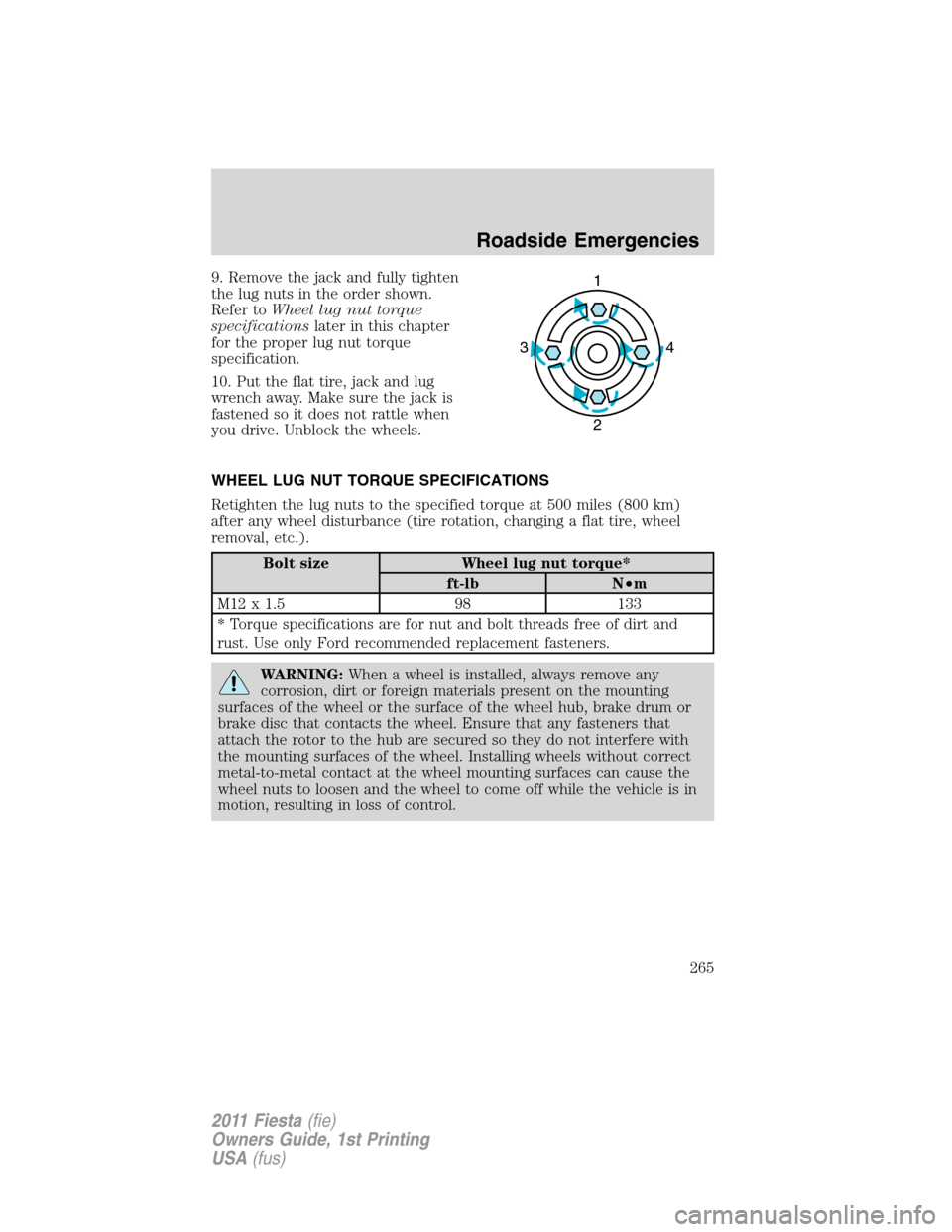
9. Remove the jack and fully tighten
the lug nuts in the order shown.
Refer toWheel lug nut torque
specificationslater in this chapter
for the proper lug nut torque
specification.
10. Put the flat tire, jack and lug
wrench away. Make sure the jack is
fastened so it does not rattle when
you drive. Unblock the wheels.
WHEEL LUG NUT TORQUE SPECIFICATIONS
Retighten the lug nuts to the specified torque at 500 miles (800 km)
after any wheel disturbance (tire rotation, changing a flat tire, wheel
removal, etc.).
Bolt size Wheel lug nut torque*
ft-lb N•m
M12 x 1.5 98 133
* Torque specifications are for nut and bolt threads free of dirt and
rust. Use only Ford recommended replacement fasteners.
WARNING:When a wheel is installed, always remove any
corrosion, dirt or foreign materials present on the mounting
surfaces of the wheel or the surface of the wheel hub, brake drum or
brake disc that contacts the wheel. Ensure that any fasteners that
attach the rotor to the hub are secured so they do not interfere with
the mounting surfaces of the wheel. Installing wheels without correct
metal-to-metal contact at the wheel mounting surfaces can cause the
wheel nuts to loosen and the wheel to come off while the vehicle is in
motion, resulting in loss of control.
1
4 3
2
Roadside Emergencies
265
2011 Fiesta(fie)
Owners Guide, 1st Printing
USA(fus)
Page 271 of 357
Emergency towing
In case of a roadside emergency with a disabled vehicle (without access
to wheel dollies, car hauling trailer, or flatbed transport vehicle) your
vehicle (regardless of transmission powertrain configuration) can be flat
towed (all wheels on the ground) under the following conditions:
•Vehicle is facing forward so that it is being towed in a forward
direction.
•Place the transmission in N (Neutral). Refer toBrake-shift interlock
in theDrivingchapter for specific instructions if you cannot move the
gear shift lever into N (Neutral).
•Maximum speed is not to exceed 35 mph (56 km/h).
•Maximum distance is 50 miles (80 km).
Roadside Emergencies
271
2011 Fiesta(fie)
Owners Guide, 1st Printing
USA(fus)