Page 153 of 290

GETTING ROADSIDE ASSISTANCE
To fully assist you should you have a vehicle concern, Ford offers a
complimentary roadside assistance program. This program is separate
from the New Vehicle Limited Warranty and is not applicable to vehicles
sold in Canada. The service is available:
•24–hours, seven days a week
•for the New Vehicle Limited Warranty period (U.S.) of two years
(unlimited miles)
Roadside assistance will cover:
•battery jump start.
•lock out assistance (key replacement is customer responsibility).
•towing – Ford/Mercury/Lincoln eligible vehicle towed to the nearest
authorized dealer within 35 miles (56.3 km) of the disablement
location or to the nearest authorized dealer. If a member requests to
be towed to the nearest authorized dealer more than 35 miles
(56.3 km) from the disablement location, the member shall be
responsible for any mileage costs in excess of 35 miles (56.3 km).
Trailers shall be covered up to $100 if the disabled Eligible Vehicles
requires service at the nearest authorized dealer. If the trailer is disabled,
but the towing vehicle is operational, the trailer does not qualify for any
Roadside services.
Using roadside assistance
Complete the roadside assistance identification card and place it in your
wallet for quick reference. This card is found in the Owner Guide
portfolio in the glove compartment.
To receive roadside assistance in the United States, call 1-800-241-3673.
If you need to arrange roadside assistance for yourself, Ford will
reimburse a reasonable amount. To obtain information about
reimbursement, call 1-800-241-3673.
Roadside Emergencies
153
2011 F-650/750(f67)
Supplement, 2nd Printing
USA(fus)
Page 158 of 290
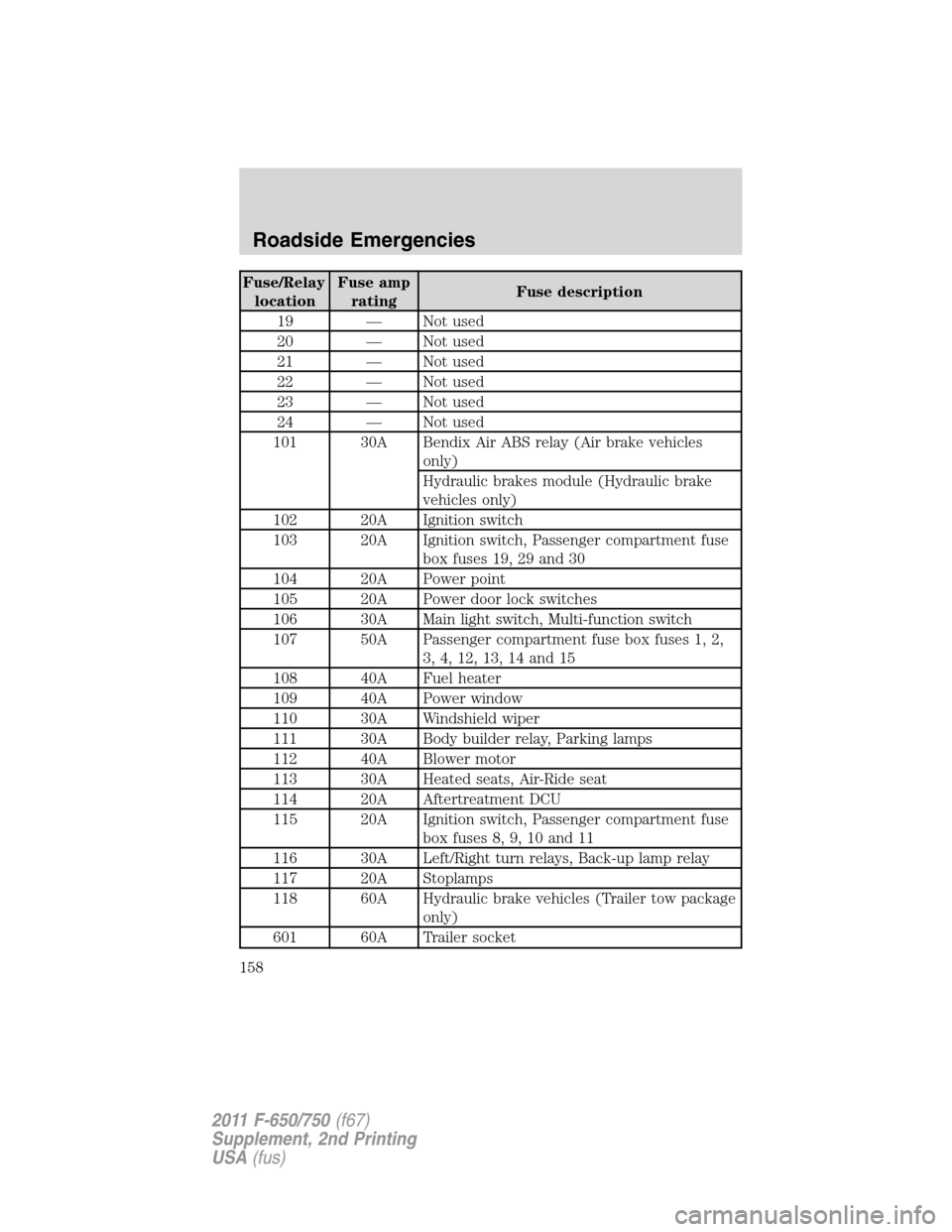
Fuse/Relay
locationFuse amp
ratingFuse description
19 — Not used
20 — Not used
21 — Not used
22 — Not used
23 — Not used
24 — Not used
101 30A Bendix Air ABS relay (Air brake vehicles
only)
Hydraulic brakes module (Hydraulic brake
vehicles only)
102 20A Ignition switch
103 20A Ignition switch, Passenger compartment fuse
box fuses 19, 29 and 30
104 20A Power point
105 20A Power door lock switches
106 30A Main light switch, Multi-function switch
107 50A Passenger compartment fuse box fuses 1, 2,
3, 4, 12, 13, 14 and 15
108 40A Fuel heater
109 40A Power window
110 30A Windshield wiper
111 30A Body builder relay, Parking lamps
112 40A Blower motor
113 30A Heated seats, Air-Ride seat
114 20A Aftertreatment DCU
115 20A Ignition switch, Passenger compartment fuse
box fuses 8, 9, 10 and 11
116 30A Left/Right turn relays, Back-up lamp relay
117 20A Stoplamps
118 60A Hydraulic brake vehicles (Trailer tow package
only)
601 60A Trailer socket
Roadside Emergencies
158
2011 F-650/750(f67)
Supplement, 2nd Printing
USA(fus)
Page 159 of 290
Fuse/Relay
locationFuse amp
ratingFuse description
602 60A Air brake trailer tow fuse block
30A Hydraulic brakes pump motor 2
201 — Windshield washer relay
202 — Wiper high/low relay
203 — Wiper run/park relay
204 — Windshield wiper relay
205 — Body builder relay, right turn
206 — Body builder relay, left turn
207 — ABS event relay (Hydraulic brake vehicles
only)
208 — Body builder relay, back-up lamps relay
209 — Auxiliary stoplamp relay
301 — Fuel heater/Fuel transfer pump relay
302 — Body builder relay, parking lamps relay
303 — Blower motor relay
304 — DEF (Urea) line heaters relay
Individual maxi-fuse holder in engine compartment
Fuse
locationFuse amp
ratingFuse description
9925 30A Hydraulic brakes pump motor 1
Roadside Emergencies
159
2011 F-650/750(f67)
Supplement, 2nd Printing
USA(fus)
Page 161 of 290
Relay
locationRelay description
R21 Run
R22 Door unlock
R23 ABS warning indicator
R24 DRL #2
R25 Park lights
R26 Spare
Trailer tow relays (if equipped)
Fuse/Relay
LocationFuse Amp
RatingDescription
1 30A* Trailer tow ABS feed (non electric trailer
brake vehicles only)
2 30A* Trailer tow park/marker lamps
3 30A* Trailer tow stop lamps
4 30A* Trailer tow turn/stop lamps (combined)
Trailer tow turn lamps (separate)
5 — Not used
R1 — Trailer tow ABS relay (non electric trailer
brake vehicles only)
Roadside Emergencies
161
2011 F-650/750(f67)
Supplement, 2nd Printing
USA(fus)
Page 162 of 290

Fuse/Relay
LocationFuse Amp
RatingDescription
R2 — Trailer tow marker lamp relay
R3 — Trailer tow stop lamp relay
R4 — Trailer tow tail lamp relay
R5 — Not used
R6 — Not used
R7 — Trailer tow left turn lamp relay
R8 — Trailer tow right turn lamp relay
*Maxi fuse
Inline fuses
Your vehicle may have several inline fuses located in/on the battery
cables located in the battery box depending on application.
•All Allison transmission equipped vehicles have a 10 Amp fuse located
in the clean power cables located in the battery box.
•All vehicles have a 30 Amp fused located in the clean power cables
located in the battery box.
•All vehicles equipped with an Eaton transmission have a 30 Amp fuse
located in the clean power cables located in the battery box.
•All Hydraulic brake equipped vehicles have a 40 Amp fuse located in
the clean power cables located in the battery box and in addition
another 30 Amp fuse located in a fuse holder just above the power
distribution center located in the vehicles engine compartment.
JUMP STARTING
WARNING:The gases around the battery can explode if
exposed to flames, sparks, or lit cigarettes. An explosion could
result in injury or vehicle damage.
WARNING:Batteries contain sulfuric acid which can burn skin,
eyes and clothing, if contacted.
Do not attempt to push-start your automatic transmission
vehicle. Automatic transmissions do not have push-start
capability. Attempting to push-start a vehicle with an automatic
transmission may cause transmission damage.
Roadside Emergencies
162
2011 F-650/750(f67)
Supplement, 2nd Printing
USA(fus)
Page 166 of 290

3. Remove the jumper cable from the positive (+) terminal of the booster
vehicle’s battery.
4. Remove the jumper cable from the positive (+) terminal of the
disabled vehicle’s battery.
After the disabled vehicle has been started and the jumper cables
removed, allow it to idle for several minutes so the engine computer can
relearnits idle conditions.
WRECKER TOWING INSTRUCTIONS
Before moving the disabled vehicle, check for adequate road clearance of
vehicle components. It is recommended the disabled vehicle be unloaded
prior to being towed to reduce any abnormal load to the vehicle
components resulting from the towing procedures. Before towing, be
sure to fully release the parking brake. The spring-actuated type parking
brake can be reset by recharging the air system with at least 64 psi
(441 kPa) of air. If the brake system will not retain air pressure, then the
spring brakes must be released manually. Refer toParking brakein the
Drivingchapter.
Note:For towing, make sure the vehicle is securely connected to the
tow vehicle and the tow vehicle’s parking brakes are applied before
releasing the disabled vehicle’s spring brakes.
+–+–
+–+–
Roadside Emergencies
166
2011 F-650/750(f67)
Supplement, 2nd Printing
USA(fus)
Page 167 of 290

WARNING:To reduce the risk of personal injury or property
damage when manually releasing the spring brakes, be sure to
block the wheels so the vehicle cannot move once the brakes are
released.
Towing the vehicle with the front wheels suspended
When it is necessary to tow a vehicle with the front wheels suspended,
extra precautions must be taken to avoid transmission or differential
damage. Proceed as follows:
•Remove the axle shafts from the axle assembly to prevent the wheels
from driving the differential and the transmission.
•The wheel hub ends must be covered to prevent loss of axle lubricant
and entrance of other contaminants. If the axle shafts are not
removed, removal of the driveshaft is required.
Note:To avoid transmission damage, vehicles should not be towed even
a short distance without suspending rear wheels or removing the axle
shafts or driveshaft.
Note:In the event the chassis is equipped with a tandem axle and the
vehicle is to be towed from the front, the forward rear axle may be
raised to clear the road surface and secured to the frame by chains or
U-bolts, allowing only the rear rear axle to contact the road surface. Axle
shafts must be removed from the rear rear axle assembly. The wheel hub
ends must be covered to prevent loss of axle lubricant and entrance of
contaminants. Use extreme care in securing the chains or U-bolts to
avoid possible damage to the brake lines, hoses or other components.
Towing vehicles equipped with a driver-controlled differential lock
Note:If the vehicle must be towed to a service facility with the drive
axle wheels on the ground, it is necessary to remove the axle shafts
before the vehicle is towed.
Roadside Emergencies
167
2011 F-650/750(f67)
Supplement, 2nd Printing
USA(fus)
Page 168 of 290

1. Shift collar in the locked position
2. Actuator assembly and shift fork
3. Axle shaft
4. Interference between the shift
collar and housing
5. Shift collar in the unlocked
position
6. Outer splines - axle shaft to collar
7. Shift collar and differential case
splines
8. Inner splines - axle shaft to side
gear
9. Side gear
10. Differential (plain) case half
Removing axle shafts before towing
1. Shift the main differential to the unlocked (disengaged) position. The
differential lock light will turn off.
2. Remove the capscrews and washers or stud nuts and washers from
flanges of both axle shafts.
3. Loosen the tapered dowels in the flanges of both axle shafts by
holding a 1
12inch diameter brass drift or hammer against the axle shaft
center and hitting it with a five or six pound hammer.Note:Do not use
a chisel or wedge to loosen the axle shafts and dowels. Use of a chisel or
wedge can damage the hub, axle shafts and oil seals.
4. Remove the tapered dowels and both axle shafts from the axle
assembly.
5. Assemble a cover over openings of both wheels ends to prevent loss of
lubricant and keep dirt away from the wheel bearing cavities.
Note:One of the axle shafts has two sets of splines. One set to engage
with the differential side gear and one set to engage with the shift collar
for the differential lock. It may be necessary to rotate the shaft slightly
to align the gear spline teeth with the shift collar teeth in order to
remove the axle shaft.
Roadside Emergencies
168
2011 F-650/750(f67)
Supplement, 2nd Printing
USA(fus)

