2011 FORD ESCAPE HYBRID maintenance schedule
[x] Cancel search: maintenance schedulePage 3 of 363

Maintenance and Specifications 291
Engine compartment 294
Engine oil 297
Battery 300
Engine Coolant and Motor/Electronics Coolant 302
Fuel information 308
Air filter(s) 320
Part numbers 324
Maintenance product specifications and capacities 325
Engine data 328
Accessories 331
Ford Extended Service Plan 334
Scheduled Maintenance Guide 338
Normal scheduled maintenance and log 344
Index 357
All rights reserved. Reproduction by any means, electronic or mechanical
including photocopying, recording or by any information storage and retrieval
system or translation in whole or part is not permitted without written
authorization from Ford Motor Company. Ford may change the contents without
notice and without incurring obligation.
Copyright © 2010 Ford Motor Company
Table of Contents
3
2011 Escape Hybrid(ehv)
Owners Guide, 2nd Printing
USA(fus)
Page 9 of 363
achieved with mild to moderate acceleration and deceleration. Moderate
braking is particularly important since it allows you to maximize the
energy captured by the regenerative braking system.
NOTE:Having your engine running is not always an indication of
inefficiency – in some cases it is actually more efficient than driving in
electric mode.
Additional Tips:
•Do not carry extra loads
•Be mindful of adding external accessories that may increase
aerodynamic drag
•Observe posted speed limits
•Perform all scheduled maintenance
•There is no need to wait for your engine to “warm up”. The vehicle is
ready to drive immediately after starting
Refer toEssentials of good fuel economyin theMaintenance and
Specificationschapter for more fuel saving tips.
Frequently asked questions
Question Answer
What are the series of
clicks from the cargo area
when I first turn the key in
the ignition?The high voltage battery is electrically
isolated from the rest of the vehicle when
the key is off. When the key is turned to
on, high voltage contactors inside the
battery are closed to make the electricity
available to the motor/generator and
enable the vehicle to drive. The clicks are
the sound of these contactors as they
close and open during start up and shut
down.
Why does the engine
sometimes start at key-on?The vehicle’s computer will determine if
an engine start is necessary for cabin
heating or windshield defrost. The engine
will also be started when ambient
temperatures are low.
Introduction
9
2011 Escape Hybrid(ehv)
Owners Guide, 2nd Printing
USA(fus)
Page 11 of 363
Question Answer
What is the fan noise I hear
from the rear of my hybrid?The fan noise comes from two fans
located inside the high voltage battery.
These fans turn on when the battery
requires cooling air. The fan speed, and
associated noise level, will change
according to both the amount of cooling
required and the speed of the vehicle to
maintain good performance.
How far can I go in Electric
Drive if I run out of gas?Running out of gas is not recommended.
However, you may be able to go about
one mile, driving at 30 mph (48 km/h), if
the battery has a normal state of charge.
What is the engine oil
change service interval?The engine oil should be changed every
10,000 miles (16,000 km) under normal
operating conditions. See theScheduled
Maintenance Guidechapter.
Can I put E10 or E85 in my
vehicle, and how will it
affect my fuel economy?Your hybrid vehicle can use E10 (10%
ethanol, 90% gasoline) fuel, but you may
notice slightly reduced fuel economy
because ethanol contains less energy per
gallon than gasoline. Your hybrid vehicle
is not designed to use E85 (85% ethanol).
How long will my high
voltage battery last? Does it
need maintenance?The high voltage battery system is
designed to last the life of the vehicle and
requires no maintenance.
Can you charge the battery
with a plug into an A/C
outlet?There are no provisions for charging the
high voltage battery from a power supply
external to the vehicle.
Can I tow the hybrid
behind my motor home
with all four wheels down?Yes. Your hybrid vehicle can be
“flat-towed” without modification. See the
Recreational towingsection in theTires,
Wheels and Loadingchapter for more
information.
Introduction
11
2011 Escape Hybrid(ehv)
Owners Guide, 2nd Printing
USA(fus)
Page 27 of 363

System check and vehicle feature customization
Press the SETUP button repeatedly
to cycle the message center through
the following features:
PRESS RESET FOR ENGLISH
When entering the setup menu and a non-English language has been
selected, this message will be displayed to change back to English.
Press the RESET button to change back to English.
RESET FOR SYSTEM CHECK
When this message appears, press the RESET button and the message
center will begin to cycle through the following systems and provide a
status of the item if needed.
1. OIL LIFE
2. ELEC DRIVE
3. BRAKE SYSTEM
4. LIFTGATE AND GLASS
5. DTE/FUEL LEVEL
6. MYKEY DISTANCE (if a MyKey™ is programmed)
7. MYKEY(S) PROGRAMMED
8. ADMIN KEYS PROGRAMMED
9. PARK AID (if equipped)
Note:Some systems show a message only if a condition is present.
OIL LIFE
This displays the remaining oil life.
An oil change is required whenever indicated by the message center and
according to the recommended maintenance schedule. USE ONLY
RECOMMENDED ENGINE OILS.
To reset the oil monitoring system to 100% after each oil change,
perform the following:
1. Press and release the SETUP button to display “OIL LIFE XXX%
HOLD RESET = NEW”.
2. Press and hold the RESET button for two seconds and release to reset
the oil life to 100%.
Instrument Cluster
27
2011 Escape Hybrid(ehv)
Owners Guide, 2nd Printing
USA(fus)
Page 186 of 363
Tire and wheel alignment
A bad jolt from hitting a curb or pothole can cause the front end of your
vehicle to become misaligned or cause damage to your tires. If your
vehicle seems to pull to one side when you’re driving, the wheels may be
out of alignment. Have an authorized dealer check the wheel alignment
periodically.
Wheel misalignment in the front or the rear can cause uneven and rapid
treadwear of your tires and should be corrected by an authorized dealer.
Front-wheel drive (FWD) vehicles and those with an independent rear
suspension (if equipped) may require alignment of all four wheels.
The tires should also be balanced periodically. An unbalanced tire and
wheel assembly may result in irregular tire wear.
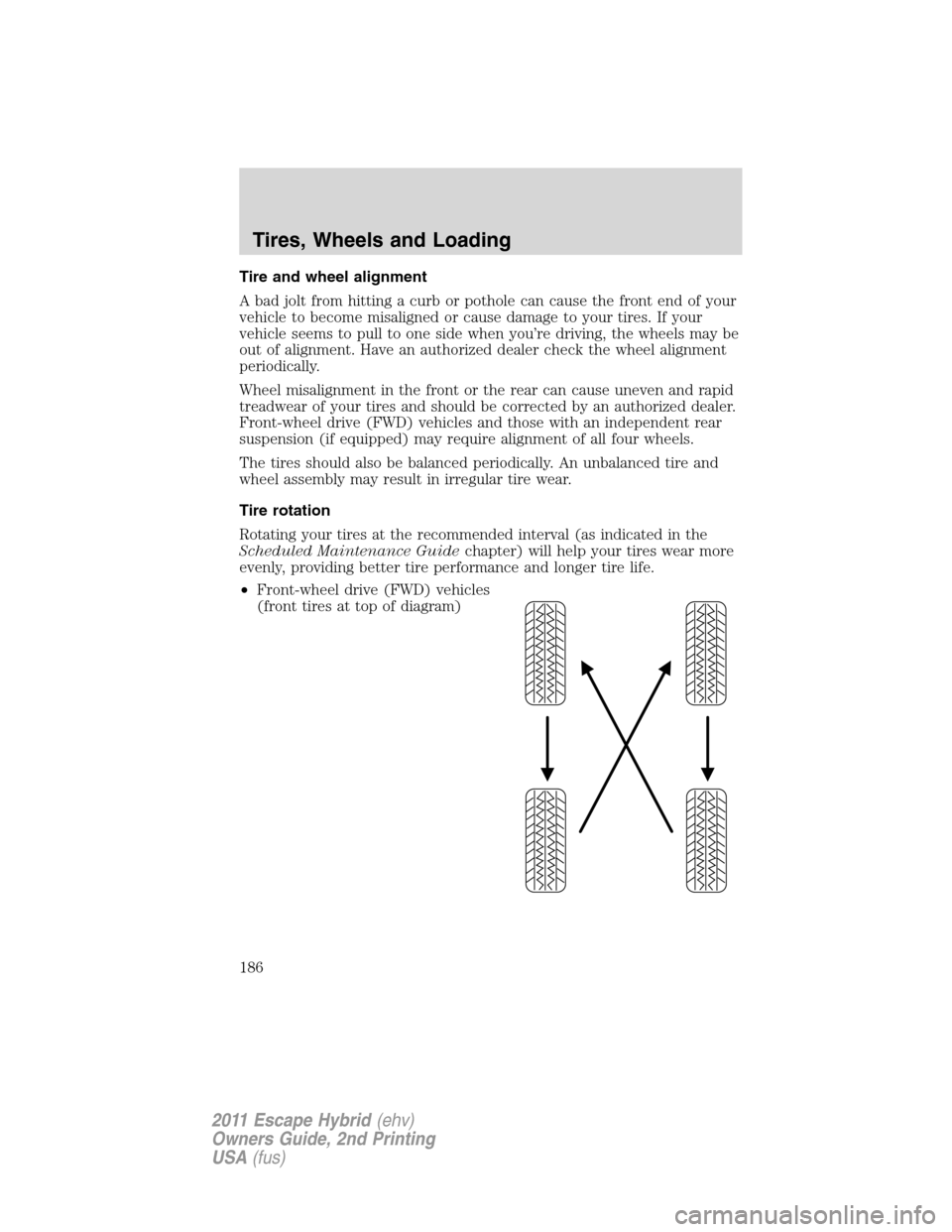
Tire rotation
Rotating your tires at the recommended interval (as indicated in the
Scheduled Maintenance Guidechapter) will help your tires wear more
evenly, providing better tire performance and longer tire life.
•Front-wheel drive (FWD) vehicles
(front tires at top of diagram)
Tires, Wheels and Loading
186
2011 Escape Hybrid(ehv)
Owners Guide, 2nd Printing
USA(fus)
Page 206 of 363
Follow these guidelines to ensure safe towing:
•Do not tow a trailer until your vehicle has been driven at least
1,000 miles (1,600 km).
•Consult your local motor vehicle laws for towing a trailer.
•Refer to the instructions included with towing accessories for the
proper installation and adjustment specifications.
•Thoroughly prepare your vehicle for towing. Refer toPreparing to
towin this chapter.
•Stay within your vehicle’s load limits.
•Use extra caution when driving while trailer towing. Refer toDriving
while you towin this chapter.
•Service your vehicle more frequently if you tow a trailer. Refer to
Special operating conditionsin theScheduled Maintenance Guide
chapter.
For load specification terms found on the label and instructions on
calculating your vehicle’s load, refer toVehicle loading - with and
without a trailerin this chapter. Remember to figure in the tongue load
of your loaded trailer when figuring the total weight.
Powertrain Maximum GCWR -
lb (kg)Maximum Trailer
Weight - lb (kg)
2WD 2.5L 4880 (2214) 1000 (454)
4WD 2.5L 5040 (2286) 1000 (454)
Notes:
– For high altitude operation, reduce GCW by 2% per 1000 ft (300 m)
elevation.
– Your vehicle is capable of pulling the maximum trailer weight(s) as
specified above; the combined weight of the completed towing vehicle
and the loaded trailer must not exceed the GCWR.
– Maximum trailer frontal area should not exceed 24 ft
2(2.2 m2).
– Certain states require electric trailer brakes for trailers over a
specified weight. Be sure to check state regulations for this specified
weight. The maximum trailer weights listed above may be limited to
this specified weight, as the vehicle’s electrical system does not include
the wiring connector needed to activate electric trailer brakes.
WARNING:Do not exceed the GVWR or the GAWR specified on
the certification label.
Tires, Wheels and Loading
206
2011 Escape Hybrid(ehv)
Owners Guide, 2nd Printing
USA(fus)
Page 208 of 363
Trailer lamps
Trailer lamps are required on most towed vehicles. Make sure all running
lights, brake lights, turn signals and hazard lights are working. Do not
connect trailer lamps directly to your vehicle’s tail lamps. This can cause
damage to your vehicle’s electrical system. Contact your authorized
dealer or trailer rental agency for proper instructions and equipment for
hooking-up trailer lamps.
WARNING:Never connect any trailer lighting to the vehicle’s
tail lamp circuits, because it may damage the electrical system
resulting in fire. Contact your authorized dealer as soon as possible for
assistance in proper trailer tow wiring installation. Additional electrical
equipment may be required.
Driving while you tow
When towing a trailer:
•Do not drive faster than 70 mph (113 km/h) during the first 500 miles
(800 km) of trailer towing and don’t make full-throttle starts.
•Turn off the speed control. The speed control may shut off
automatically when you are towing on long, steep grades.
•Allow more distance for stopping with a trailer attached; anticipate
stops and brake gradually.
Servicing after towing
If you tow a trailer for long distances, your vehicle will require more
frequent service intervals. Refer toSpecial operating conditionsin the
Scheduled Maintenance Guidechapter.
Tires, Wheels and Loading
208
2011 Escape Hybrid(ehv)
Owners Guide, 2nd Printing
USA(fus)
Page 268 of 363
4. Slide the wheel partially under the vehicle and install the retainer
through the center of the wheel.
5. Turn the jack handle clockwise until the tire is raised to its original
position underneath the vehicle. The effort to turn the jack handle
increases significantly as the tire contacts the frame. The spare tire
carrier will ratchet when the tire is in the fully stowed position. The
spare tire carrier has a built-in ratchet feature that will not allow you to
overtighten. If the spare tire carrier ratchets with very little effort, take
the vehicle to your authorized dealer for assistance at your earliest
convenience.If your vehicle is equipped with a trailer hitch, guide
the tire with one hand; keep the rear of the tire tilted down until
the tire clears the bumper.
6. Check that the tire lies flat against the frame assembly. Push against
the tire to make sure it is tightly seated under the vehicle. Loosen and
retighten, if necessary. Failure to properly stow the spare tire may result
in failure of the winch cable and loss of the spare tire.(Make sure that
the tire does not contact the bumper.)
7. Repeat this tightness check procedure (every six months, per
scheduled maintenance information),when servicing the spare tire
pressure or at any time that the spare tire is disturbed through service of
other components.
WHEEL LUG NUT TORQUE SPECIFICATIONS
Retighten the lug nuts to the specified torque at 500 miles (800 km)
after any wheel disturbance (tire rotation, changing a flat tire, wheel
removal, etc.).
Bolt size Wheel lug nut torque*
ft-lb N•m
M12 x 1.5 100 135
* Torque specifications are for nut and bolt threads free of dirt and
rust. Use only Ford recommended replacement fasteners.
WARNING:When a wheel is installed, always remove any
corrosion, dirt or foreign materials present on the mounting
surfaces of the wheel or the surface of the wheel hub, brake drum or
brake disc that contacts the wheel. Ensure that any fasteners that
attach the rotor to the hub are secured so they do not interfere with
the mounting surfaces of the wheel. Installing wheels without correct
metal-to-metal contact at the wheel mounting surfaces can cause the
wheel nuts to loosen and the wheel to come off while the vehicle is in
motion, resulting in loss of control.
Roadside Emergencies
268
2011 Escape Hybrid(ehv)
Owners Guide, 2nd Printing
USA(fus)