Page 40 of 497
For vehicles equipped with the EVIC, the power window
switches will remain active for up to 10 minutes after the
ignition switch is turned to the LOCK position. Opening
either front door will cancel this feature. The time is
programmable. Refer to “Electronic Vehicle Information
Center (EVIC)/Personal Settings (Customer-
Programmable Features)” in “Understanding Your In-
strument Panel” for further information.
NOTE:
•If the window runs into any obstacle during auto-
closure, it will reverse direction and then go back
down. Remove the obstacle and use the window
switch again to close the window.
•Any impact due to rough road conditions may trigger
the auto-reverse function unexpectedly during auto-
closure. If this happens, pull the switch lightly to the
first detent and hold to close window manually.
WARNING!
There is no anti-pinch protection when the window
is almost closed. Be sure to clear all objects from the
window before closing.
Reset
At some point in time, it may be necessary to reactivate
the auto-up feature. To do so, perform the following
procedure:
1. Pull the window switch up to close the window
completely and continue to hold the switch up for an
additional two seconds after the window is closed.
2. Push the window switch down firmly to the second
detent to open the window completely and continue to
hold the switch down for an additional two seconds after
the window is fully open.
2
THINGS TO KNOW BEFORE STARTING YOUR VEHICLE 37
Page 41 of 497

Window Lockout Button
The window lockout button on the driver’s door (below
the power window switches) allows you to disable the
window control on the other doors. To disable the
window controls on the other doors, press the window
LOCKOUT button. To enable the window controls, press
the window LOCKOUT button a second time.
Wind Buffeting
Wind buffeting can be described as the perception of
pressure on the ears or a helicopter-type sound in the
ears. Your vehicle may exhibit wind buffeting with the
windows down, or the sunroof (if equipped) in certain
open or partially open positions. This is a normal occur-
rence and can be minimized. If the buffeting occurs with
the sunroof open, adjust the sunroof opening to minimize
the buffeting.
LIFTGATE
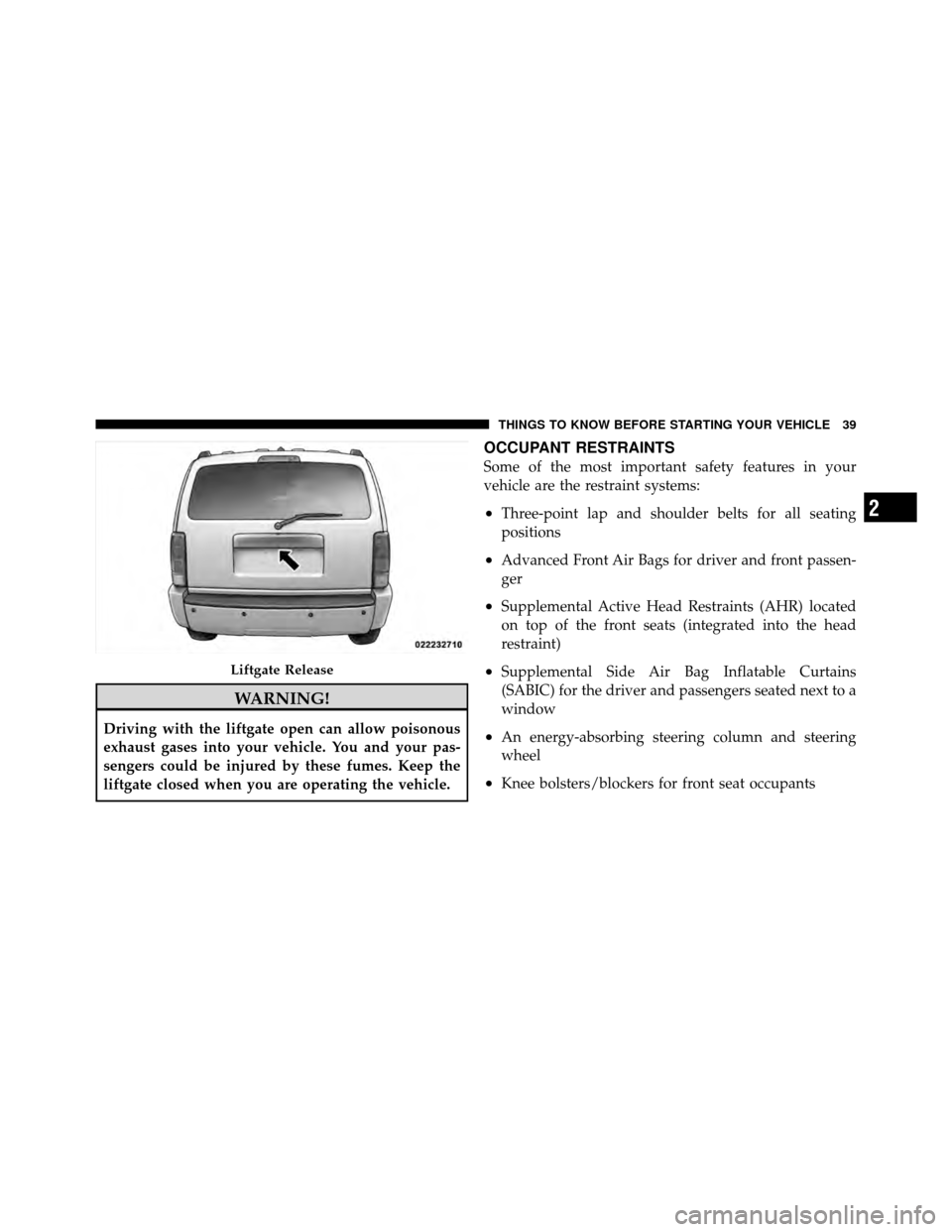
To open the liftgate, pull up (squeeze) on the handle and
lift. Manually unlocking the vehicle doors with the
plunger or a key in the lock cylinder will not unlock the
liftgate.
Window Lockout Button
38 THINGS TO KNOW BEFORE STARTING YOUR VEHICLE
Page 42 of 497
WARNING!
Driving with the liftgate open can allow poisonous
exhaust gases into your vehicle. You and your pas-
sengers could be injured by these fumes. Keep the
liftgate closed when you are operating the vehicle.
OCCUPANT RESTRAINTS
Some of the most important safety features in your
vehicle are the restraint systems:
•Three-point lap and shoulder belts for all seating
positions
•Advanced Front Air Bags for driver and front passen-
ger
•Supplemental Active Head Restraints (AHR) located
on top of the front seats (integrated into the head
restraint)
•Supplemental Side Air Bag Inflatable Curtains
(SABIC) for the driver and passengers seated next to a
window
•An energy-absorbing steering column and steering
wheel
•Knee bolsters/blockers for front seat occupants
Liftgate Release
2
THINGS TO KNOW BEFORE STARTING YOUR VEHICLE 39
Page 44 of 497
secured in the rear seat in child restraints or belt-
positioning booster seats. Older children who do not use
child restraints or belt-positioning booster seats should
ride properly buckled up in the rear seat. Never allow
children to slide the shoulder belt behind them or under
their arm.
If a child from 1 to 12 years old (not in a rear facing child
seat) must ride in the front passenger seat, move the seat
as far back as possible and use the proper child restraint.
(Refer to “Child Restraints”)
You should read the instructions provided with your
child restraint to make sure that you are using it properly.
2.All occupants should always wear their lap and
shoulder belts properly.
3. The driver and front passenger seats should be
moved back as far as practical to allow the Advanced
Front Air Bags room to inflate. 4.
Do not lean against the door or window. If your
vehicle has side air bags, and deployment occurs, the
side air bags will inflate forcefully into the space
between you and the door.
5. If the air bag system in this vehicle needs to be
modified to accommodate a disabled person, contact
the Customer Center. Phone numbers are provided
under �If You Need Assistance�.
WARNING!
•Relying on the air bags alone could lead to more
severe injuries in a collision. The air bags work
with your seat belt to restrain you properly. In
some collisions, the air bags won’t deploy at all.
Always wear your seat belts even though you have
air bags.
(Continued)
2
THINGS TO KNOW BEFORE STARTING YOUR VEHICLE 41
Page 45 of 497
WARNING! (Continued)
•Being too close to the steering wheel or instrument
panel during Advanced Front Air Bag deployment
could cause serious injury, including death. Air
Bags need room to inflate. Sit back, comfortably
extending your arms to reach the steering wheel or
instrument panel.
•Supplemental Side Air Bag Inflatable Curtain
(SABIC) also need room to inflate. Do not lean
against the door or window. Sit upright in the
center of the seat.
•In an accident, you and your passengers can suffer
much greater injuries if you are not properly
buckled up. You can strike the interior of your
vehicle or other passengers, or you can be thrown
out of the vehicle. Always be sure you and others
in your vehicle are buckled up properly.Buckle up even though you are an excellent driver, even
on short trips. Someone on the road may be a poor driver
and cause an accident that includes you. This can happen
far away from home or on your own street.
Research has shown that seat belts save lives, and they
can reduce the seriousness of injuries in an accident.
Some of the worst injuries happen when people are
thrown from the vehicle. Seat belts reduce the possibility
of ejection and the risk of injury caused by striking the
inside of the vehicle. Everyone in a motor vehicle should
be belted at all times.
42 THINGS TO KNOW BEFORE STARTING YOUR VEHICLE
Page 62 of 497
This vehicle may be equipped with driver and/or front
passenger seat track position sensors that may adjust the
inflation rate of the Advanced Front Air Bags based upon
seat position.
This vehicle may be equipped with a driver and/or front
passenger seat belt buckle switch that detects whether
the driver or front passenger seat belt is fastened. The
seat belt buckle switch may adjust the inflation rate of the
Advanced Front Air Bags.
This vehicle is equipped with Supplemental Side Air Bag
Inflatable Curtains (SABIC) that run the entire length of
the headliner to protect the driver, front, and rear pas-
sengers sitting next to a window.NOTE:
•Air Bag covers may not be obvious in the interior trim,
but they will open during air bag deployment.
•After any accident, the vehicle should be taken to an
authorized dealer immediately.
Supplemental Side Air Bag Inflatable
Curtains (SABIC) Label Location
2
THINGS TO KNOW BEFORE STARTING YOUR VEHICLE 59
Page 65 of 497

WARNING! (Continued)
•Do not have any accessory items installed which
will alter the roof, including adding a sunroof to
your vehicle. Do not add roof racks that require
permanent attachments (bolts or screws) for instal-
lation on the vehicle roof. Do not drill into the roof
of the vehicle for any reason.
Supplemental Side Air Bag Inflatable Curtain
(SABIC)
SABIC air bags may offer side-impact and vehicle roll-
over protection to front and rear seat outboard occupants
in addition to that provided by the body structure. Each
air bag features inflated chambers placed adjacent to the
head of each outboard occupant that reduce the potential
for side-impact head injuries. The SABIC air bags deploy
downward, covering both windows on the impact side.NOTE:
•Should a vehicle rollover occur, the pretensioners
and/or SABIC air bags on both sides of the vehicle
may deploy.
•Air Bag covers may not be obvious in the interior trim,
but they will open during air bag deployment.
•Being too close to the side air bags during deployment
could cause you to be severely injured or killed.
The system includes side impact sensors that are cali-
brated to deploy the side air bags during impacts that
require side air bag occupant protection.
62 THINGS TO KNOW BEFORE STARTING YOUR VEHICLE
Page 73 of 497
The Advanced Front Air Bag gas is vented through the
vent holes in the sides of the air bag. In this way, the air
bags do not interfere with your control of the vehicle.
Along with seat belts and pretensioners, Advanced Front
Air Bags work with the knee bolsters to provide im-
proved protection for the driver and front passenger. Side
air bags also work with seat belts to improve occupant
protection.
Supplemental Side Air Bag Inflatable Curtains
(SABIC)
TheSupplemental Side Air Bag Inflatable Curtains
(SABIC) may deploy during rollovers and collisions
where the impact is confined to a particular area of the
side of the vehicle, depending on the severity and type of
collision. In these events, the ORC will deploy the SABIC
only on the impact side of the vehicle. Because air bag
sensors estimate deceleration over time, vehicle speed and damage by themselves are not good indicators of
whether or not an air bag should have deployed.
A quantity of non-toxic gas is generated to inflate the side
curtain air bag. The inflating side curtain air bag pushes
the outside edge of the headliner out of the way and
covers the window. The air bag inflates in about 30
milliseconds (about one quarter of the time it takes to
blink your eyes) with enough force to injure you if you
are not belted and seated properly, or if items are
positioned in the area where the side curtain air bag
inflates. This especially applies to children. The side
curtain air bag is only about 312inches (9 cm) thick when
it is inflated.
The system includes side impact sensors that are cali-
brated to deploy the side air bags during impacts that
require air bag occupant protection.
70 THINGS TO KNOW BEFORE STARTING YOUR VEHICLE