Page 392 of 497
WARNING!
•Take care to avoid the radiator cooling fan when-
ever the hood is raised. It can start anytime the
ignition switch is on. You can be injured by
moving fan blades.
•Remove any metal jewelry such as watch bands or
bracelets that might make an inadvertent electrical
contact. You could be seriously injured.
•Batteries contain sulfuric acid that can burn your
skin or eyes and generate hydrogen gas which is
flammable and explosive. Keep open flames or
sparks away from the battery.
1. Set the parking brake, shift the automatic transmission
into PARK and turn the ignition to LOCK.
2. Turn off the heater, radio, and all unnecessary electri-
cal accessories.
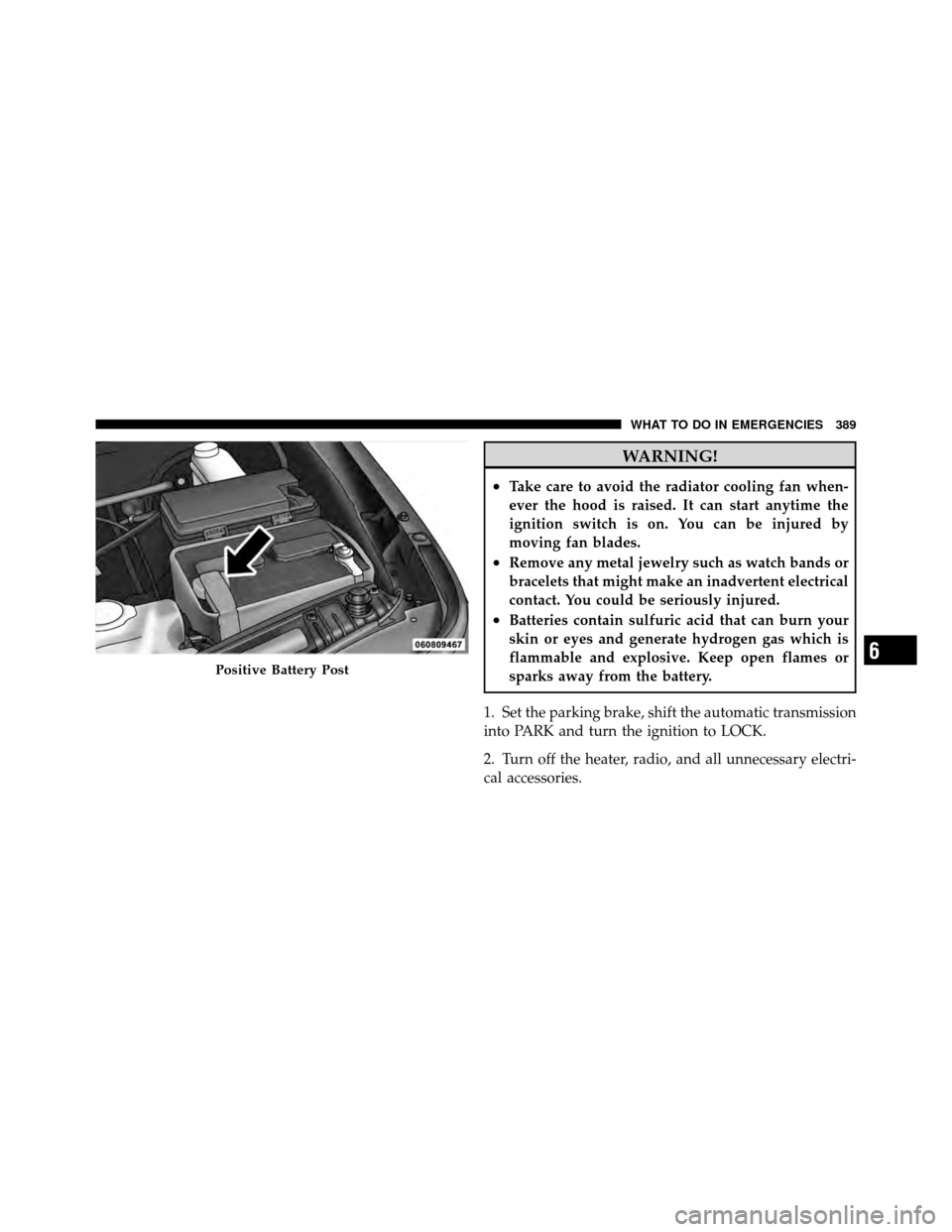
Positive Battery Post6
WHAT TO DO IN EMERGENCIES 389
Page 403 of 497

▫Exhaust System ..................... 415
▫ Cooling System ..................... 417
▫ Brake System ....................... 422
▫ Automatic Transmission ............... 424
▫ Transfer Case ....................... 426
▫ Front/Rear Axle Fluid ................. 427
▫ Appearance Care And Protection From
Corrosion .......................... 427
� Fuses .............................. 432
▫ Totally Integrated Power Module ......... 432
� Replacement Bulbs .................... 438
� Bulb Replacement ..................... 438
▫ Headlamp ......................... 438 ▫
Left Front Turn Signal ................. 439
▫ Right Front Turn Signal ................ 440
▫ Front Side Marker .................... 440
▫ Front Fog Lamp (Front Fascia Mounted) .... 440
▫ Rear Tail, Stop, Turn Signal, And Backup
Lamp ............................. 441
▫ Center High Mounted Stop Lamp
(CHMSL) .......................... 442
� Fluid Capacities ...................... 443
� Fluids, Lubricants And Genuine Parts ....... 444
▫ Engine ............................ 444
▫ Chassis ........................... 445
400 MAINTAINING YOUR VEHICLE
Page 420 of 497

•Do not try to start the engine by pushing or towing the
vehicle.
•Do not idle the engine with any spark plug wires
disconnected or removed, such as when diagnostic
testing, or for prolonged periods during very rough
idle or malfunctioning operating conditions.
Cooling System
WARNING!
You or others can be badly burned by hot engine
coolant (antifreeze) or steam from your radiator. If
you see or hear steam coming from under the hood,
do not open the hood until the radiator has had time
to cool. Never try to open a cooling system pressure
cap when the radiator or coolant bottle is hot.
Engine Coolant Checks
Check engine coolant (antifreeze) protection every
12 months (before the onset of freezing weather, where
applicable). If the engine coolant (antifreeze) is dirty or
rusty in appearance, the system should be drained,
flushed and refilled with fresh engine coolant (anti-
freeze). Check the front of the A/C condenser (if
equipped) or radiator for any accumulation of bugs,
leaves, etc. If dirty, clean by gently spraying water from a
garden hose vertically down the face of the A/C con-
denser (if equipped) or the back of the radiator core.
Check the engine cooling system hoses for brittle rubber,
cracking, tears, cuts, and tightness of the connection at
the coolant recovery bottle and radiator. Inspect the
entire system for leaks.
With the engine at normal operating temperature (but
not running), check the cooling system pressure cap for
proper vacuum sealing by draining a small amount of
7
MAINTAINING YOUR VEHICLE 417
Page 421 of 497

engine coolant (antifreeze) from the radiator drain cock.
If the cap is sealing properly, the engine coolant (anti-
freeze) will begin to drain from the coolant recovery
bottle. DO NOT REMOVE THE COOLANT PRESSURE
CAP WHEN THE COOLING SYSTEM IS HOT.
Cooling System – Drain, Flush, And Refill
If the engine coolant (antifreeze) is dirty and contains a
considerable amount of sediment, clean and flush with
reliable cooling system cleaner. Follow with a thorough
rinsing to remove all deposits and chemicals. Properly
dispose of the old engine coolant (antifreeze).
Refer to the “Maintenance Schedule” for the proper
maintenance intervals.
Selection Of Engine Coolant
Use only the manufacturer’s recommended engine cool-
ant (antifreeze). Refer to “Fluids, Lubricants, and Genu-
ine Parts” in “Maintaining Your Vehicle” for further
information.
CAUTION!
•Mixing of engine coolant (antifreeze) other than
the specified HOAT engine coolant (antifreeze)
may result in decreased corrosion protection and
engine damage. If a non-HOAT engine coolant
(antifreeze) is introduced into the cooling system
in an emergency, it should be replaced with the
specified engine coolant (antifreeze) as soon as
possible.
•Do not use water alone or alcohol based engine
coolant (antifreeze) products. Do not use addi-
tional rust inhibitors or antirust products, as they
may not be compatible with the engine coolant
(antifreeze) and may plug the radiator.
•This vehicle has not been designed for use with
propylene glycol based engine coolant (anti-
freeze). Use of propylene glycol based engine
coolant (antifreeze) is not recommended.
418 MAINTAINING YOUR VEHICLE
Page 422 of 497

Adding Coolant
Your vehicle has been built with an improved engine
coolant (antifreeze) that allows extended maintenance
intervals. This engine coolant (antifreeze) can be used up
to five years or 104,000 miles (169 000 km) before
replacement. To prevent reducing this extended mainte-
nance period, it is important that you use the same
engine coolant (antifreeze) throughout the life of your
vehicle.
Please review these recommendations for using Hybrid
Organic Additive Technology (HOAT) engine coolant
(antifreeze). When adding engine coolant (antifreeze):
•The manufacturer recommends using MOPAR�
Antifreeze/Coolant 5 Year/100,000 Mile Formula
HOAT (Hybrid Organic Additive Technology) or
equivalent.
•Mix a minimum solution of 50% HOAT engine coolant
and distilled water. Use higher concentrations (not to
exceed 70%) if temperatures below�34°F (�37°C) are
anticipated.
•Use only high purity water such as distilled or deion-
ized water when mixing the water/engine coolant
(antifreeze) solution. The use of lower quality water
will reduce the amount of corrosion protection in the
engine cooling system.
Please note that it is the owner’s responsibility to main-
tain the proper level of protection against freezing ac-
cording to the temperatures occurring in the area where
the vehicle is operated.
NOTE: Mixing engine coolant (antifreeze) types will
decrease the life of the engine coolant (antifreeze) and
will require more frequent coolant changes.
7
MAINTAINING YOUR VEHICLE 419
Page 423 of 497

Cooling System Pressure Cap
The cap must be fully tightened to prevent the loss of
engine coolant (antifreeze) and to ensure that the engine
coolant (antifreeze) will return to the radiator from the
coolant reserve tank.
The cap should be inspected and cleaned if there is any
accumulation of foreign material on the sealing surfaces.
WARNING!
•The warning words “DO NOT OPEN HOT” on the
cooling system pressure cap are a safety precaution.
Never add engine coolant (antifreeze) when the
engine is overheated. Do not loosen or remove the
cap to cool an overheated engine. Heat causes
pressure to build up in the cooling system. To
prevent scalding or injury, do not remove the pres-
sure cap while the system is hot or under pressure.
(Continued)
WARNING! (Continued)
•Do not use a pressure cap other than the one
specified for your vehicle. Personal injury or en-
gine damage may result.
Disposal Of Used Engine Coolant
Used ethylene glycol based engine coolant (antifreeze) is
a regulated substance requiring proper disposal. Check
with your local authorities to determine the disposal
rules for your community. To prevent ingestion by ani-
mals or children, do not store ethylene glycol based
engine coolant (antifreeze) in open containers or allow it
to remain in puddles on the ground. If ingested by a child
or pet, seek emergency assistance immediately. Clean up
any ground spills immediately.
420 MAINTAINING YOUR VEHICLE
Page 425 of 497

•If frequent engine coolant (antifreeze) additions are
required, or if the level in the recovery bottle does not
drop when the engine cools, the cooling system should
be pressure tested for leaks.
•Maintain engine coolant (antifreeze) concentration at
50% HOAT engine coolant (antifreeze) (minimum)
and distilled water for proper corrosion protection of
your engine which contains aluminum components.
•Make sure that the radiator and coolant recovery
bottle hoses are not kinked or obstructed.
•Keep the front of the radiator clean. If your vehicle is
equipped with air conditioning, keep the front of the
condenser clean, also.
•Do not change the thermostat for Summer or Winter
operation. If replacement is ever necessary, install onlythe correct type thermostat. Other designs may result
in unsatisfactory cooling performance, poor gas mile-
age, and increased emissions.
Brake System
In order to assure brake system performance, all brake
system components should be inspected periodically.
Refer to the “Maintenance Schedule” for the proper
maintenance intervals.
WARNING!
Riding the brakes can lead to brake failure and
possibly a collision. Driving with your foot resting or
riding on the brake pedal can result in abnormally
high brake temperatures, excessive lining wear, and
possible brake damage. You would not have your full
braking capacity in an emergency.
422 MAINTAINING YOUR VEHICLE
Page 446 of 497
FLUID CAPACITIES
U.S.Metric
Fuel (Approximate) 19.5 Gallons73.8 Liters
Engine Oil with Filter
3.7 Liter Engine (SAE 5W-20, API Certified) 5 Quarts4.7 Liters
4.0 Liter Engine (SAE 10W-30, API Certified) 5.5 Quarts5.2 Liters
Cooling System *
3.7 Liter Engine (MOPAR� Antifreeze/Engine Coolant 5
Year/100,000 Mile Formula or equivalent) 14 Quarts
13.3 Liters
4.0 Liter Engine (MOPAR� Antifreeze/Engine Coolant 5
Year/100,000 Mile Formula or equivalent) 14 Quarts
13.3 Liters
* Includes heater and coolant recovery bottle filled to MAX level.
7
MAINTAINING YOUR VEHICLE 443