Page 213 of 497

ODOMETER button on the instrument cluster. To reset
the oil change indicator system (after performing the
scheduled maintenance), refer to the following proce-
dure:1. Turn the ignition switch to the ON/RUN position.
Do not start the engine.
2. Fully depress the accelerator pedal slowly three
times within 10 seconds.
3. Turn the ignition switch to the OFF/LOCK position.
NOTE: If the indicator message illuminates when you
start the vehicle, the oil change indicator system did not
reset. If necessary, repeat this procedure.
27. Malfunction Indicator Light (MIL) The Malfunction Indicator Light (MIL) is part of
an onboard diagnostic system, called OBD, that
monitors engine and automatic transmission con-
trol systems. The light will illuminate when the key is in the ON/RUN position, before engine start. If the bulb
does not come on when turning the key from OFF to
ON/RUN, have the condition checked promptly.
Certain conditions, such as a loose or missing gas cap,
poor fuel quality, etc., may illuminate the MIL after
engine start. The vehicle should be serviced if the light
stays on through several of your typical driving cycles. In
most situations, the vehicle will drive normally and will
not require towing.
CAUTION!
Prolonged driving with the MIL on could cause
damage to the engine control system. It also could
affect fuel economy and drivability. If the MIL is
flashing, severe catalytic converter damage and
power loss will soon occur. Immediate service is
required.
210 UNDERSTANDING YOUR INSTRUMENT PANEL
Page 403 of 497

▫Exhaust System ..................... 415
▫ Cooling System ..................... 417
▫ Brake System ....................... 422
▫ Automatic Transmission ............... 424
▫ Transfer Case ....................... 426
▫ Front/Rear Axle Fluid ................. 427
▫ Appearance Care And Protection From
Corrosion .......................... 427
� Fuses .............................. 432
▫ Totally Integrated Power Module ......... 432
� Replacement Bulbs .................... 438
� Bulb Replacement ..................... 438
▫ Headlamp ......................... 438 ▫
Left Front Turn Signal ................. 439
▫ Right Front Turn Signal ................ 440
▫ Front Side Marker .................... 440
▫ Front Fog Lamp (Front Fascia Mounted) .... 440
▫ Rear Tail, Stop, Turn Signal, And Backup
Lamp ............................. 441
▫ Center High Mounted Stop Lamp
(CHMSL) .......................... 442
� Fluid Capacities ...................... 443
� Fluids, Lubricants And Genuine Parts ....... 444
▫ Engine ............................ 444
▫ Chassis ........................... 445
400 MAINTAINING YOUR VEHICLE
Page 407 of 497

Tighten the gas cap until a�clicking�sound is heard. This
is an indication that the gas cap is properly tightened.
Press the odometer reset button to turn the message off.
If the problem persists, the message will appear the next
time the vehicle is started. This might indicate a damaged
cap. If the problem is detected twice in a row, the system
will turn on the MIL. Resolving the problem will turn the
MIL light off.
EMISSIONS INSPECTION AND MAINTENANCE
PROGRAMS
In some localities, it may be a legal requirement to pass
an inspection of your vehicle’s emissions control system.
Failure to pass could prevent vehicle registration.
For states that require an Inspection and Mainte-
nance (I/M), this check verifies the “Malfunction
Indicator Light (MIL)” is functioning and is not
on when the engine is running, and that the OBD II
system is ready for testing. Normally, the OBD II system will be ready. The OBD II
system may
notbe ready if your vehicle was recently
serviced, recently had a dead battery or a battery replace-
ment. If the OBD II system should be determined not
ready for the I/M test, your vehicle may fail the test.
Your vehicle has a simple ignition key-actuated test,
which you can use prior to going to the test station. To
check if your vehicle’s OBD II system is ready, you must
do the following:
1. Turn the ignition switch to the ON position, but do not
crank or start the engine.
2. If you crank or start the engine, you will have to start
this test over.
3. As soon as you turn the ignition switch to the ON
position, you will see the MIL symbol come on as part of
a normal bulb check.
404 MAINTAINING YOUR VEHICLE
Page 441 of 497

CAUTION! (Continued)
•When replacing a blown fuse, it is important to
use only a fuse having the correct amperage rating.
The use of a fuse with a rating other than indicated
may result in a dangerous electrical system over-
load. If a properly rated fuse continues to blow, it
indicates a problem in the circuit that must be
corrected.
REPLACEMENT BULBS
LIGHT BULBS – InteriorBulb No.
Dome Lamp ......................... TL212–2
Liftgate Lamp ........................... 567
Overhead Console Lamps ............. PLW214–2A
Reading Lamp ...................... WL212–2LIGHT BULBS – Exterior
Bulb No.
Headlamp ......................... 9008 H13
Front Park/Turn ...................... 3157AK
Front Sidemarker ......................... 168
Back-Up ............................. 3057K
Center High Mounted Stoplamp ............. LED
(serviced at an authorized dealer)
Fog Lamp .......................... H10 9145
License Plate Lamp ....................... 168
Rear Tail, Stop, Turn Signal ................3057K
BULB REPLACEMENT
Headlamp
1. Open the hood.
2. Reach behind the headlamp unit in the engine com-
partment to access the headlamp bulb lock ring.
3. Firmly grasp the lock ring on the back of the headlamp
unit housing.
438 MAINTAINING YOUR VEHICLE
Page 442 of 497
4. Rotate the lock ring on the back of the headlamp
housing counterclockwise to unlock it.
CAUTION!
Do not touch the new bulb with your fingers. Oil
contamination will severely shorten bulb life. If the
bulb comes in contact with any oily surface, clean the
bulb with rubbing alcohol.
5. Disconnect the electrical connector and replace the
bulb.
Left Front Turn Signal
1. Turn the steering wheel all the way to the right (full
right lock).
2. Remove the door in the left wheel liner by twisting
counter clockwise. Access to the bulb can be gained
through the wheel liner hole. 3. Disconnect the electrical connector.
4. Twist the bulb counter clockwise to remove.
Access Door
7
MAINTAINING YOUR VEHICLE 439
Page 443 of 497
Right Front Turn Signal
1. Open the hood.
2. Reach behind the headlight unit in the engine com-
partment to access the turn signal bulb.
3. Twist the bulb counterclockwise to remove.
4. Disconnect the electrical connector and replace the
bulb.
Front Side Marker
1. Open the hood.
2. Remove the grille assembly as follows:a. Remove eight fasteners.
b. Remove two screws from each headlamp. c. Remove two rivets from the center of the grille.
d. Remove one push pin from the top of each fender.
e. Pull the grille assembly toward you to disconnect
the grille clips to the fender and the headlamp ball-
studs to the front end module.
3. Disconnect electrical connector.
4. Turn the bulb counterclockwise to remove.
Front Fog Lamp (Front Fascia Mounted)
1. Reach under the vehicle to access the back of the front
fog lamp.
2. Disconnect the electrical connector from the front fog
lamp housing.
440 MAINTAINING YOUR VEHICLE
Page 444 of 497
3. Firmly grasp the bulb by the two latches and squeeze
them together to unlock the bulb from the front fog lamp
housing.
4. Pull the bulb straight out from the keyed opening in
the housing.
CAUTION!
Do not touch the new bulb with your fingers. Oil
contamination will severely shorten bulb life. If the
bulb comes in contact with any oily surface, clean the
bulb with rubbing alcohol.
Rear Tail, Stop, Turn Signal, and Backup Lamp
1. Open the lift gate.
2. Remove the two push pins.
Push Pins
7
MAINTAINING YOUR VEHICLE 441
Page 445 of 497
3. Pull lamp straight back and disconnect electrical con-
nection.
4. Remove the two screws attaching the backplate to the
lamp assembly.
5. Pull the backplate straight back from the lamp hous-
ing.
6. Disconnect the electrical connector.
7. Remove the bulb from the backplate.Center High Mounted Stop Lamp (CHMSL)
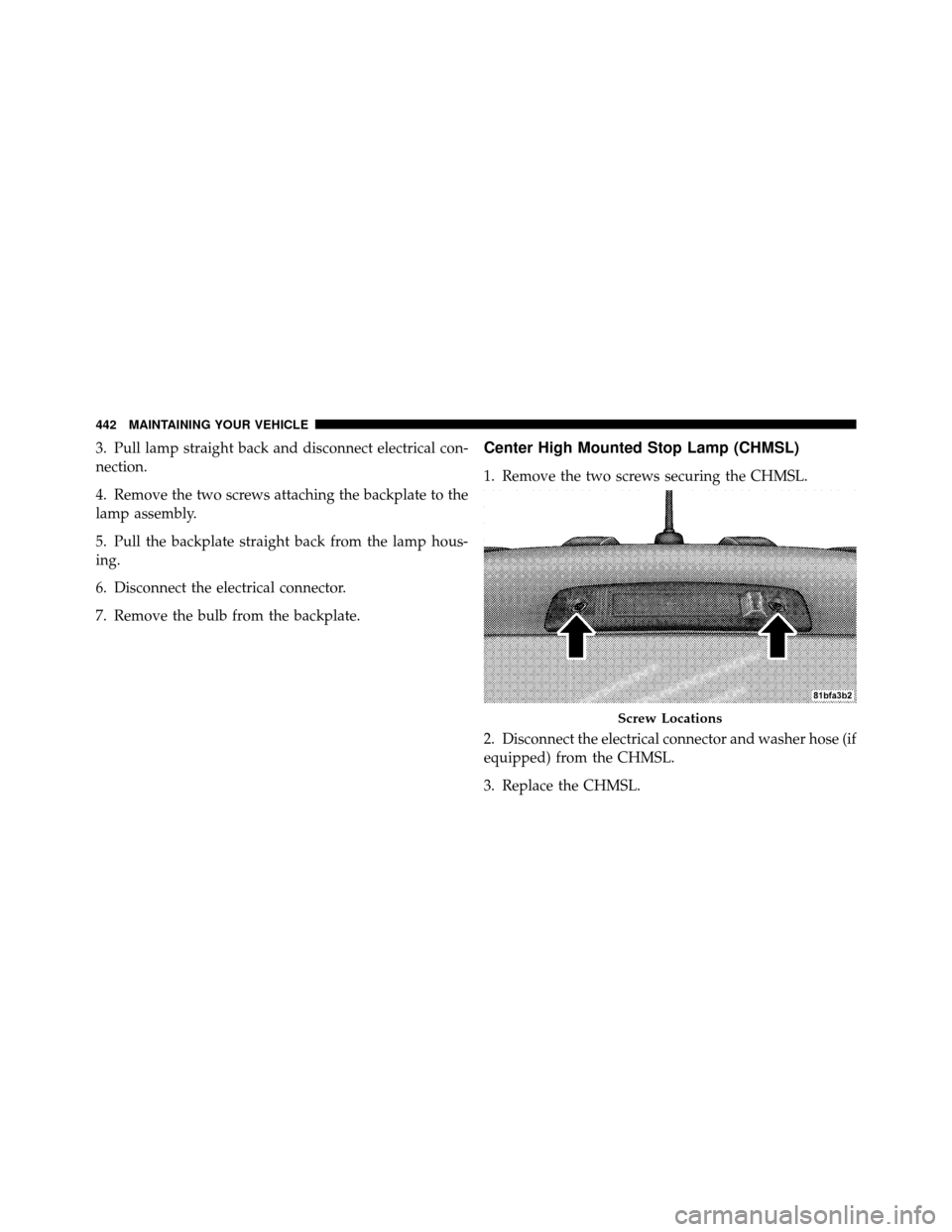
1. Remove the two screws securing the CHMSL.
2. Disconnect the electrical connector and washer hose (if
equipped) from the CHMSL.
3. Replace the CHMSL.
Screw Locations
442 MAINTAINING YOUR VEHICLE