Page 312 of 497
If necessary, add fluid to restore to the proper indicated
level. With a clean cloth, wipe any spilled fluid from all
surfaces. Refer to “Fluids, Lubricants, and Genuine
Parts” in “Maintaining Your Vehicle” for further
information.
PARKING BRAKE
Before leaving the vehicle, make sure that the parking
brake is fully applied. Also, be certain to leave the
transmission in PARK.
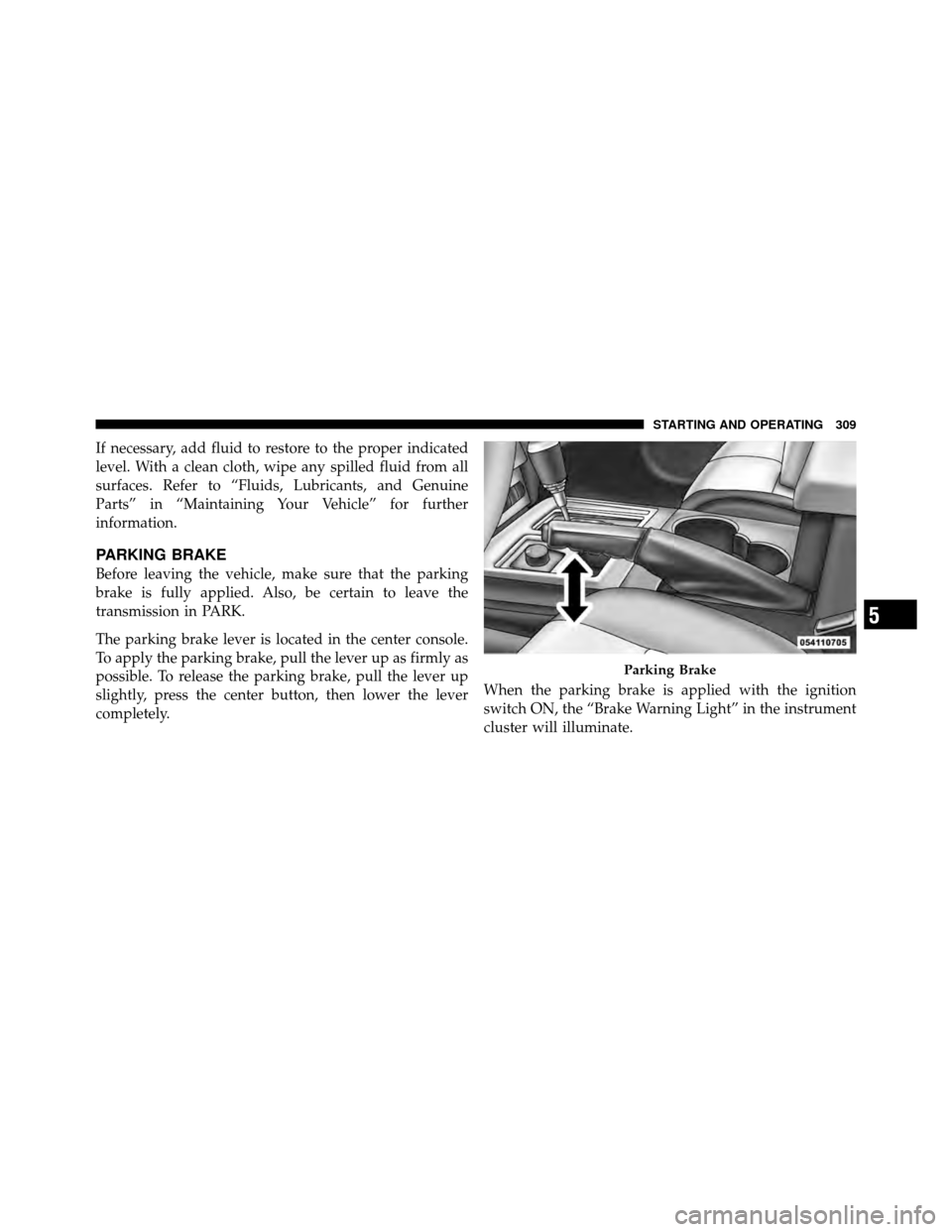
The parking brake lever is located in the center console.
To apply the parking brake, pull the lever up as firmly as
possible. To release the parking brake, pull the lever up
slightly, press the center button, then lower the lever
completely.When the parking brake is applied with the ignition
switch ON, the “Brake Warning Light” in the instrument
cluster will illuminate.
Parking Brake
5
STARTING AND OPERATING 309
Page 314 of 497
WARNING! (Continued)
•Always fully apply the parking brake when leav-
ing your vehicle or it may roll and cause damage or
injury. Also, be certain to leave the transmission in
PARK. Failure to do so may cause the vehicle to
roll and cause damage or injury.
CAUTION!
If the “Brake Warning Light” remains on with the
parking brake released, a brake system malfunction
is indicated. Have the brake system serviced by an
authorized dealer immediately.
ANTI-LOCK BRAKE SYSTEM
The Anti-Lock Brake System (ABS) is designed to aid the
driver in maintaining vehicle control under adverse
braking conditions. The system operates with a separatecomputer to modulate hydraulic pressure, to prevent
wheel lock-up and help avoid skidding on slippery
surfaces.
All vehicle wheels and tires must be the same size and
type, and tires must be properly inflated, to produce
accurate signals for the computer.
WARNING!
Significant over or under-inflation of tires or mixing
sizes of tires or wheels on the vehicle can lead to loss
of braking effectiveness.
The ABS conducts a low-speed self-test at about 12 mph
(20 km/h). If you have your foot lightly on the brake
while this test is occurring, you may feel slight pedal
movement. The movement can be more apparent on ice
and snow. This is normal.5
STARTING AND OPERATING 311
Page 335 of 497
Tire Pressures For High Speed Operation
The manufacturer advocates driving at safe speeds
within posted speed limits. Where speed limits or condi-
tions are such that the vehicle can be driven at high
speeds, maintaining correct tire inflation pressure is very
important. Increased tire pressure and reduced vehicle
loading may be required for high-speed vehicle opera-
tion. Refer to original equipment or an authorized tire
dealer for recommended safe operating speeds, loading
and cold tire inflation pressures.
WARNING!
High speed driving with your vehicle under maxi-
mum load is dangerous. The added strain on your
tires could cause them to fail. You could have a
serious collision. Do not drive a vehicle loaded to the
maximum capacity at continuous speeds above
75 mph (120 km/h).
Radial Ply Tires
WARNING!
Combining radial ply tires with other types of tires
on your vehicle will cause your vehicle to handle
poorly. The instability could cause a collision. Al-
ways use radial ply tires in sets of four. Never
combine them with other types of tires.
Cuts and punctures in radial tires are repairable only in
the tread area because of sidewall flexing. Consult your
authorized tire dealer for radial tire repairs.
Spare Tire Matching Original Equipped Tire and
Wheel – If Equipped
Your vehicle may be equivalent with a spare tire and
wheel in look and function as the original equipment tire
and wheel found on the front or rear axle of your vehicle.
This spare tire may be used in the tire rotation for your
332 STARTING AND OPERATING
Page 361 of 497

•If the gas cap is not tightened properly, the MIL will
come on. Be sure the gas cap is tightened every time
the vehicle is refueled.
Loose Fuel Filler Cap Message
If the vehicle diagnostic system determines that the fuel
filler cap is loose, improperly installed, or damaged, a
gASCAP” message will display in the odometer or a
“CHECK GASCAP” message will be displayed in the
Electronic Vehicle Information Center (EVIC). Refer to
“Electronic Vehicle Information Center” in “Understand-
ing Your Instrument Panel” for further information.
Tighten the fuel filler cap until a “clicking” sound is
heard. This is an indication that the fuel filler cap is
properly tightened. Refer to “Onboard Diagnostic Sys-
tem” in “Maintaining Your Vehicle” for further
information.
VEHICLE LOADING
Certification Label
As required by National Highway Traffic Safety Admin-
istration regulations, your vehicle has a certification label
affixed to the driver’s side door or B-Pillar.
This label contains the month and year of manufacture,
Gross Vehicle Weight Rating (GVWR), Gross Axle Weight
Rating (GAWR) front and rear, and Vehicle Identification
Number (VIN). A Month-Day-Hour (MDH) number is
included on this label and indicates the month, day, and
hour of manufacture. The bar code that appears on the
bottom of the label is your VIN.
358 STARTING AND OPERATING
Page 402 of 497
MAINTAINING YOUR VEHICLE
CONTENTS
�Engine Compartment — 3.7L ............. 401
� Engine Compartment — 4.0L ............. 402
� Onboard Diagnostic System — OBD II ...... 403
▫ Loose Fuel Filler Cap Message ........... 403
� Emissions Inspection And Maintenance
Programs ............................ 404
� Replacement Parts ..................... 405
� Dealer Service ........................ 405 �
Maintenance Procedures ................. 406
▫ Engine Oil ......................... 407
▫ Engine Oil Filter ..................... 410
▫ Engine Air Cleaner Filter ............... 410
▫ Maintenance-Free Battery .............. 411
▫ Air Conditioner Maintenance ............ 412
▫ Body Lubrication .................... 413
▫ Windshield Wiper Blades ............... 414
▫ Adding Washer Fluid ................. 414
7
Page 403 of 497

▫Exhaust System ..................... 415
▫ Cooling System ..................... 417
▫ Brake System ....................... 422
▫ Automatic Transmission ............... 424
▫ Transfer Case ....................... 426
▫ Front/Rear Axle Fluid ................. 427
▫ Appearance Care And Protection From
Corrosion .......................... 427
� Fuses .............................. 432
▫ Totally Integrated Power Module ......... 432
� Replacement Bulbs .................... 438
� Bulb Replacement ..................... 438
▫ Headlamp ......................... 438 ▫
Left Front Turn Signal ................. 439
▫ Right Front Turn Signal ................ 440
▫ Front Side Marker .................... 440
▫ Front Fog Lamp (Front Fascia Mounted) .... 440
▫ Rear Tail, Stop, Turn Signal, And Backup
Lamp ............................. 441
▫ Center High Mounted Stop Lamp
(CHMSL) .......................... 442
� Fluid Capacities ...................... 443
� Fluids, Lubricants And Genuine Parts ....... 444
▫ Engine ............................ 444
▫ Chassis ........................... 445
400 MAINTAINING YOUR VEHICLE
Page 404 of 497
ENGINE COMPARTMENT — 3.7L
1 — Air Cleaner Filter6 — Washer Fluid Reservoir
2 — Engine Oil Dipstick 7 — Engine Coolant Reservoir
3 — Brake Fluid Reservoir 8 — Engine Oil Fill
4 — Integrated Power Module (Fuses) 9 — Coolant Pressure Cap
5 — Battery
7
MAINTAINING YOUR VEHICLE 401
Page 405 of 497
ENGINE COMPARTMENT — 4.0L
1 — Air Cleaner Filter6 — Engine Oil Fill
2 — Engine Oil Dipstick 7 — Washer Fluid Reservoir
3 — Brake Fluid Reservoir 8 — Engine Coolant Reservoir
4 — Integrated Power Module (Fuses) 9 — Coolant Pressure Cap
5 — Battery
402 MAINTAINING YOUR VEHICLE