Page 402 of 557

•Some additives used in regular gasoline are not fully
compatible with E-85 and may form deposits in your
engine. To eliminate driveability issues that may be
caused by these deposits, a supplemental gasoline
additive, such as MOPAR�Injector Cleanup or
Techron may be used.
Selection Of Engine Oil For Flexible Fuel Vehicles
(E-85) And Gasoline Vehicles
FFV vehicles operated on E-85 require specially formu-
lated engine oils. These special requirements are included
in MOPAR� engine oils, and in equivalent oils meeting
Chrysler Specification MS-6395. The manufacturer re-
quires engine oils that are API Certified and meet the
requirements of Material Standard MS-6395. MS-6395
contains additional requirements, developed during ex-
tensive fleet testing, to provide additional protection to
Chrysler Group LLC engines. Use MOPAR �or an
equivalent oil meeting the specification MS-6395.
Starting
The characteristics of E-85 fuel make it unsuitable for use
when ambient temperatures fall below 0°F (-18°C). In the
range of 0°F (-18°C) to 32°F (0°C), you may experience an
increase in the time it takes for your engine to start, and
a deterioration in driveability (sags and/or hesitations)
until the engine is fully warmed up.
NOTE: Use of the engine block heater (if equipped) is
beneficial for E-85 startability when the ambient tempera-
ture is less than 32°F (0°C).
Cruising Range
Because E-85 fuel contains less energy per gallon/liter
than gasoline, you will experience an increase in fuel
consumption. You can expect your miles per gallon
(mpg)/miles per liter and your driving range to decrease
by about 30%, compared to gasoline operation.
400 STARTING AND OPERATING
Page 425 of 557

HAZARD WARNING FLASHERS
The Hazard Warning flasher switch is located in the
instrument panel switch bank, above the climate controls.Press the switch to turn on the Hazard Warning
flasher. When the switch is activated, all directional
turn signals will flash on and off to warn oncoming
traffic of an emergency. Press the switch a second time to
turn off the Hazard Warning flashers.
This is an emergency warning system and it should not
be used when the vehicle is in motion. Use it when your
vehicle is disabled and it is creating a safety hazard for
other motorists.
When you must leave the vehicle to seek assistance, the
Hazard Warning flashers will continue to operate even
though the ignition is placed in the OFF position.
NOTE: With extended use the Hazard Warning flashers
may wear down your battery.
IF YOUR ENGINE OVERHEATS
In any of the following situations, you can reduce the
potential for overheating by taking the appropriate ac-
tion.
•On the highways — slow down.
•In city traffic — while stopped, place the transmission
in NEUTRAL, but do not increase engine idle speed.
NOTE: There are steps that you can take to slow down
an impending overheat condition:
•If your air conditioner (A/C) is on, turn it off. The A/C
system adds heat to the engine cooling system and
turning the A/C off can help remove this heat.
•You can also turn the temperature control to maximum
heat, the mode control to floor and the blower control
to High. This allows the heater core to act as a
supplement to the radiator and aids in removing heat
from the engine cooling system.
6
WHAT TO DO IN EMERGENCIES 423
Page 441 of 557

WARNING!
•Take care to avoid the radiator cooling fan when-
ever the hood is raised. It can start anytime the
ignition switch is ON. You can be injured by
moving fan blades.
•Remove any metal jewelry such as watch bands or
bracelets that might make an inadvertent electrical
contact. You could be seriously injured.
•Batteries contain sulfuric acid that can burn your
skin or eyes and generate hydrogen gas which is
flammable and explosive. Keep open flames or
sparks away from the battery.
1. Set the parking brake, shift the automatic transmission
into PARK and turn the ignition to LOCK.
2. Turn off the heater, radio, and all unnecessary electri-
cal accessories. 3. Remove the protective cover over the remote positive
(+)
battery post. To remove the cover, press the locking
tab and pull upward on the cover.
4. If using another vehicle to jump-start the battery, park
the vehicle within the jumper cables reach, set the
parking brake and make sure the ignition is OFF.
WARNING!
Do not allow vehicles to touch each other as this
could establish a ground connection and personal
injury could result.
6
WHAT TO DO IN EMERGENCIES 439
Page 495 of 557
CavityCartridge
Fuse Mini-
Fuse Description
F141 40 Amp
Green Anti-Lock Brake Sys-
tem
F142 40 Amp
Green Glow Plugs – If
Equipped
F143 40 Amp
Green Exterior Lights 1
F144 40 Amp
Green Exterior Lights 2
F145 30 Amp
Pink To Body Computer –
Lamp
F146 30 Amp
Pink Spare
F147 30 Amp
Pink Spare
F148 40 Amp
Green Radiator Fan MotorCavity
Cartridge
Fuse Mini-
Fuse Description
F149 30 Amp
Pink Starter Solenoid
F150 25 Amp
Natural Powertrain Control
Modules
F151 30 Amp
Pink Headlamp Washer
Motor – If Equipped
F152 25 Amp
Natural Diesel Fuel Heater – If
Equipped
F153 20 Amp
Yellow Fuel Pump
F156 10 Amp
Red Brake/Electronic Sta-
bility Control Module
F157 10 Amp
Red Transfer Case Module
– If Equipped
F158 10 Amp
Red Active Hood Module
– If Equipped
7
MAINTAINING YOUR VEHICLE 493
Page 496 of 557
CavityCartridge
Fuse Mini-
Fuse Description
F159 10 Amp
Red Spare
F160 20 Amp
Yellow Interior Lights
F161 20 Amp
Yellow Horn
F162 50 Amp
Red Cabin Heater #1/
Vacuum Pump – If
Equipped
F163 50 Amp
Red Cabin Heater #2 – If
Equipped
F164 25 Amp
Natural Powertrain Auto Shut-
down
F165 20 Amp
Yellow Powertrain Shutdown
F166 20 Amp
Yellow SpareCavity
Cartridge
Fuse Mini-
Fuse Description
F167 30 Amp
Green Powertrain Shutdown
F168 10 Amp
Red Air Conditioner
Clutch
F169 40 Amp
Green Emissions – Partial
Zero Emissions Ve-
hicle Motor
F170 15 Amp
Blue Emissions – Partial
Zero Emissions Ve-
hicle Actuators
F172 20 Amp
Yellow Spare
F173 25 Amp
Natural Anti Lock Brake
Valves
F174 20 Amp
Yellow Siren – If Equipped
494 MAINTAINING YOUR VEHICLE
Page 497 of 557
CavityCartridge
Fuse Mini-
Fuse Description
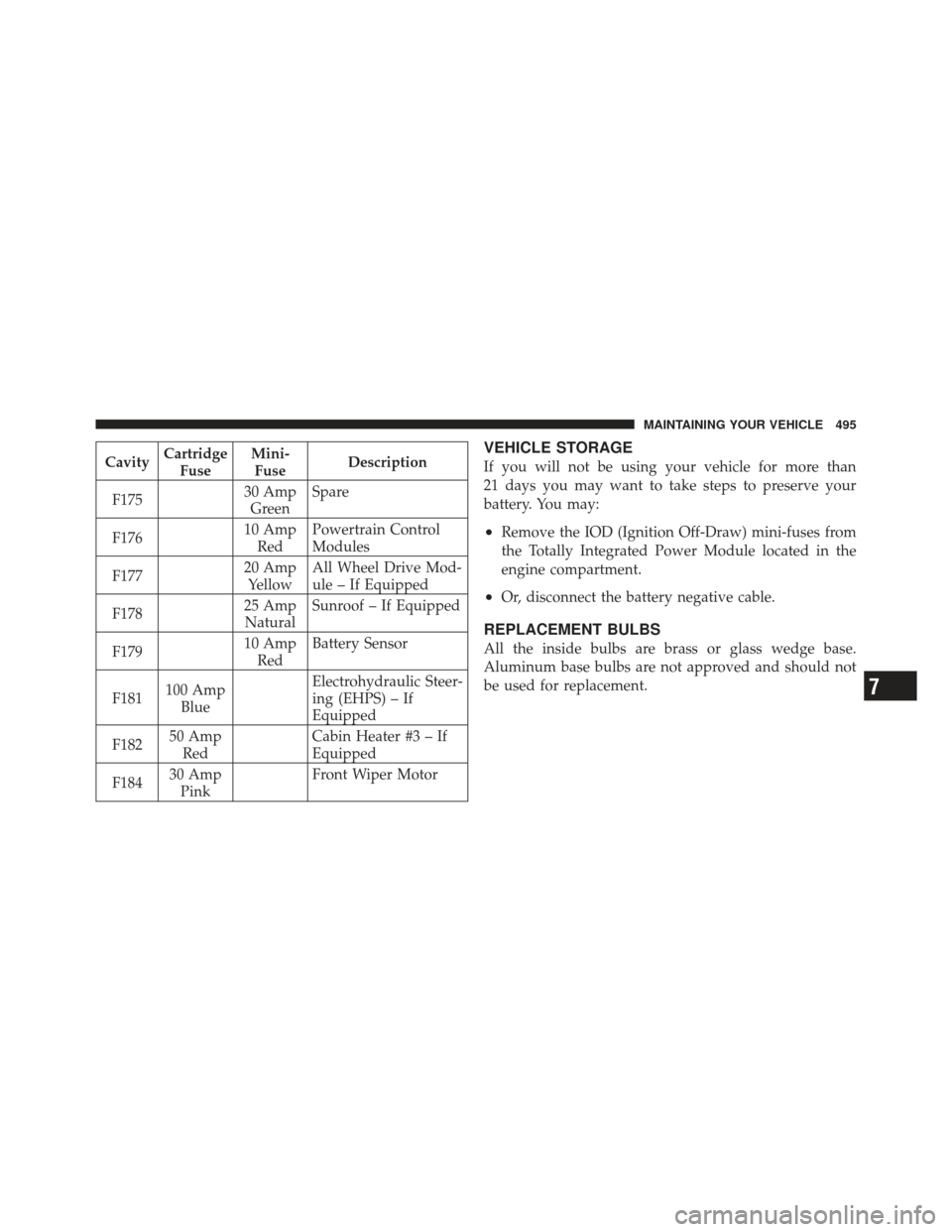
F175 30 Amp
Green Spare
F176 10 Amp
Red Powertrain Control
Modules
F177 20 Amp
Yellow All Wheel Drive Mod-
ule – If Equipped
F178 25 Amp
Natural Sunroof – If Equipped
F179 10 Amp
Red Battery Sensor
F181 100 Amp
Blue Electrohydraulic Steer-
ing (EHPS) – If
Equipped
F182 50 Amp
Red Cabin Heater #3 – If
Equipped
F184 30 Amp
Pink Front Wiper MotorVEHICLE STORAGE
If you will not be using your vehicle for more than
21 days you may want to take steps to preserve your
battery. You may:
•Remove the IOD (Ignition Off-Draw) mini-fuses from
the Totally Integrated Power Module located in the
engine compartment.
•Or, disconnect the battery negative cable.
REPLACEMENT BULBS
All the inside bulbs are brass or glass wedge base.
Aluminum base bulbs are not approved and should not
be used for replacement.
7
MAINTAINING YOUR VEHICLE 495
Page 505 of 557
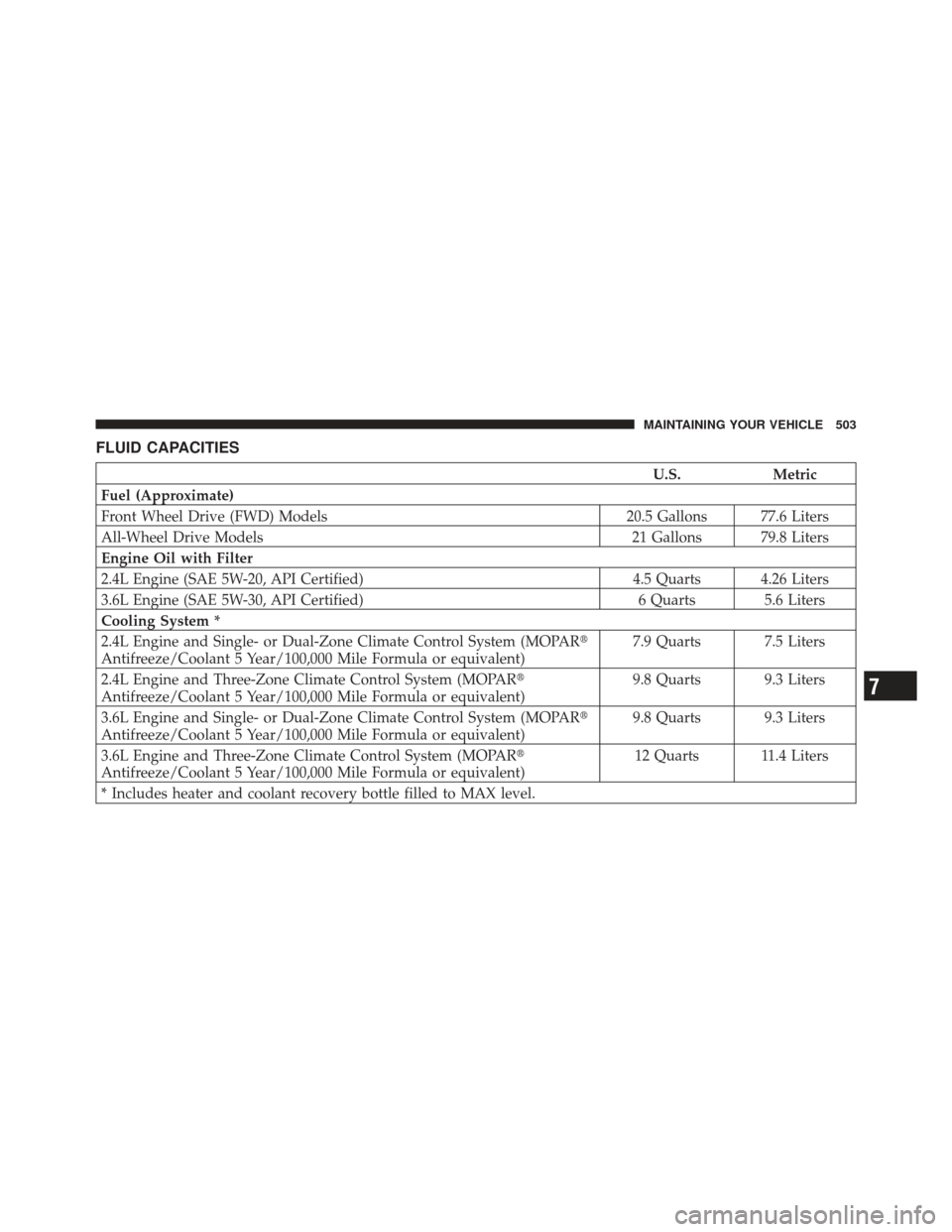
FLUID CAPACITIES
U.S.Metric
Fuel (Approximate)
Front Wheel Drive (FWD) Models 20.5 Gallons 77.6 Liters
All-Wheel Drive Models 21 Gallons 79.8 Liters
Engine Oil with Filter
2.4L Engine (SAE 5W-20, API Certified) 4.5 Quarts 4.26 Liters
3.6L Engine (SAE 5W-30, API Certified) 6 Quarts 5.6 Liters
Cooling System *
2.4L Engine and Single- or Dual-Zone Climate Control System (MOPAR�
Antifreeze/Coolant 5 Year/100,000 Mile Formula or equivalent) 7.9 Quarts 7.5 Liters
2.4L Engine and Three-Zone Climate Control System (MOPAR�
Antifreeze/Coolant 5 Year/100,000 Mile Formula or equivalent) 9.8 Quarts 9.3 Liters
3.6L Engine and Single- or Dual-Zone Climate Control System (MOPAR�
Antifreeze/Coolant 5 Year/100,000 Mile Formula or equivalent) 9.8 Quarts 9.3 Liters
3.6L Engine and Three-Zone Climate Control System (MOPAR�
Antifreeze/Coolant 5 Year/100,000 Mile Formula or equivalent) 12 Quarts 11.4 Liters
* Includes heater and coolant recovery bottle filled to MAX level.
7
MAINTAINING YOUR VEHICLE 503
Page 539 of 557

Emergency, In Case ofFreeing Vehicle When Stuck ............. 441
Hazard Warning Flasher ............... 423
Jacking ............................ 425
Jump Starting ....................... 437
Overheating ........................ 423
Towing ............................ 444
Emission Control System Maintenance ......... 454
Engine ............................. 88,451
Air Cleaner ......................... 460
Block Heater ........................ 338
Break-In Recommendations .............. 88
Checking Oil Level ................... 457
Compartment .................... 451,452
Compartment Identification ............. 452
Coolant (Antifreeze) ................ 472,504
Cooling ........................... 472
Exhaust Gas Caution ..............42,90,397
Fails to Start ........................ 337 Flooded, Starting
..................... 337
Fuel Requirements .................... 393
Jump Starting ....................... 437
Oil ......................... 457,503,504
Oil Change Interval ................ 275,458
Oil Filler Cap .................... 451,459
Oil Filter ........................... 460
Oil Filter Disposal .................... 460
Oil Selection ..................... 458,503
Oil Synthetic ........................ 459
Operation ........................... 88
Overheating ........................ 423
Starting ........................... 334
Temperature Gauge ................... 266
Engine Oil Viscosity ...................... 459
Engine Oil Viscosity Chart ................. 459
Enhanced Accident Response Feature .......... 71
Entry System, Illuminated .................. 20
Ethanol ............................... 394
10
INDEX 537