Page 8 of 452
WARNINGS AND CAUTIONS
This Owner’s Manual containsWARNINGSagainst op-
erating procedures that could result in a collision or
bodily injury. It also contains CAUTIONSagainst proce-
dures that could result in damage to your vehicle. If you
do not read this entire manual, you may miss important
information. Observe all Warnings and Cautions.
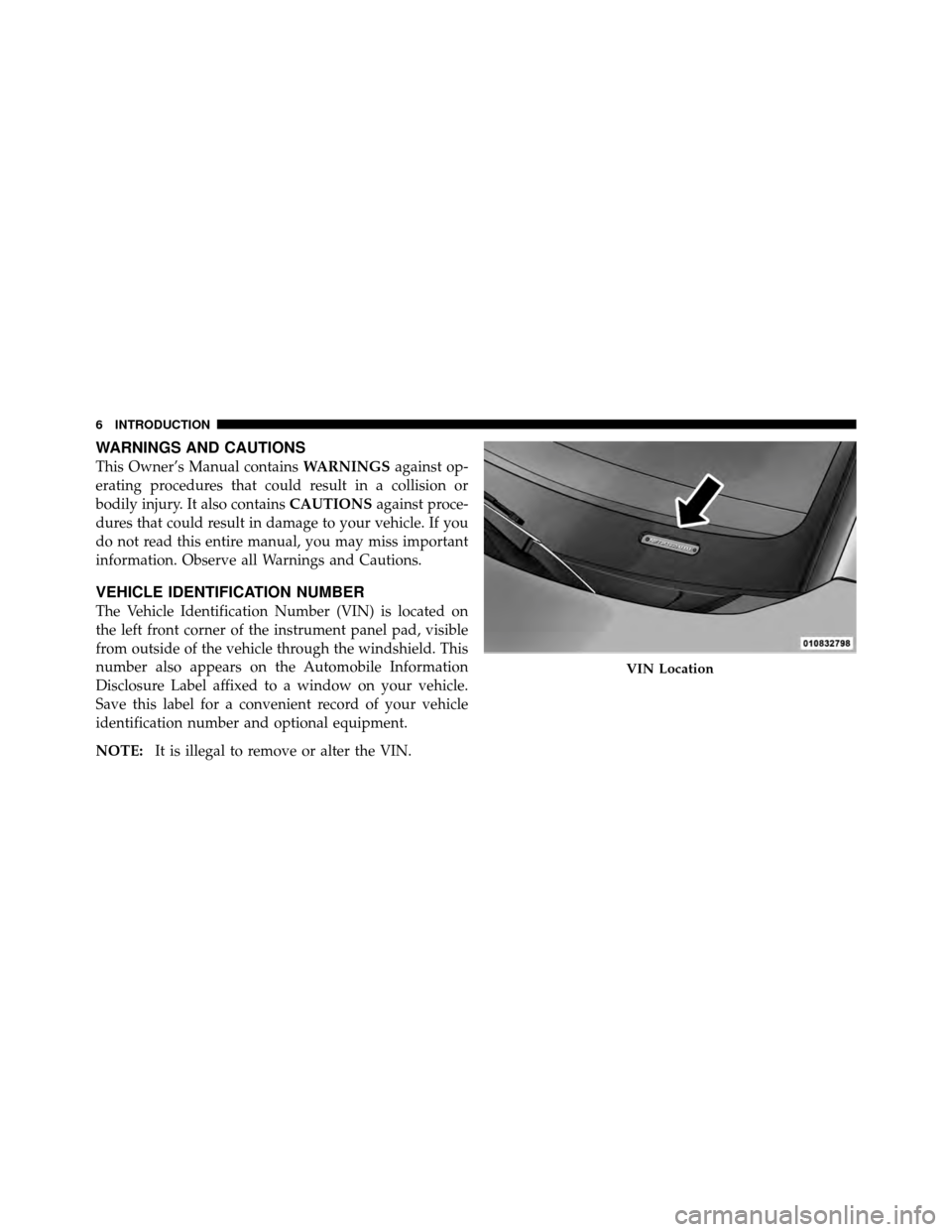
VEHICLE IDENTIFICATION NUMBER
The Vehicle Identification Number (VIN) is located on
the left front corner of the instrument panel pad, visible
from outside of the vehicle through the windshield. This
number also appears on the Automobile Information
Disclosure Label affixed to a window on your vehicle.
Save this label for a convenient record of your vehicle
identification number and optional equipment.
NOTE: It is illegal to remove or alter the VIN.
VIN Location
6 INTRODUCTION
Page 12 of 452
�Remote Keyless Entry (RKE) .............. 20
▫ To Unlock The Doors .................. 21
▫ To Lock The Doors .................... 21
▫ Using The Panic Alarm ................. 23
▫ General Information ................... 23
▫ Programming Additional Transmitters ...... 24
▫ Battery Replacement ................... 24
� Remote Starting System — If Equipped ....... 25
▫ How To Use Remote Start ............... 25
� Door Locks ........................... 28
▫ Manual Door Locks ................... 28
▫ Power Door Locks .................... 28
▫ Child-Protection Door Lock .............. 32�
Windows ............................ 33
▫ Power Windows ...................... 33
▫ Auto-Down — Driver’s Side Only ......... 34
▫ Window Lockout Switch ................ 34
▫ Wind Buffeting ....................... 35
� Occupant Restraints ..................... 35
▫ Lap/Shoulder Belts .................... 39
▫ Adjustable Upper Shoulder Belt Anchorage . . . 44
▫ Center Lap Belts ...................... 45
▫ Lap/Shoulder Belt Untwisting Procedure .... 46
▫ Seat Belts In Passenger Seating Positions ..... 46
▫ Automatic Locking Retractor Mode (ALR) —
If Equipped ......................... 47
10 THINGS TO KNOW BEFORE STARTING YOUR VEHICLE
Page 28 of 452
WARNING!
•Do not start or run an engine in a closed garage or
confined area. Exhaust gas contains Carbon Mon-
oxide (CO) which is odorless and colorless. Car-
bon Monoxide is poisonous and can cause serious
injury or death when inhaled.
•Keep Remote Keyless Entry (RKE) transmitters
away from children. Operation of the Remote Start
System, windows, door locks or other controls
could cause serious injury or death.
To Enter Remote Start
Press and release the REMOTE START button
on the RKE transmitter twice within five sec-
onds. The parking lights will flash and the horn
will chirp twice (if programmed). Then, the
engine will start and the vehicle will remain in the
Remote Start mode for a 15-minute cycle. NOTE:
•The park lamps will turn on and remain on during
Remote Start mode.
•For security, power window and power sunroof op-
eration (if equipped) are disabled when the vehicle is
in the Remote Start mode.
•The engine can be started two consecutive times (two
15-minute cycles) with the RKE transmitter. However,
the ignition switch must be cycled to the ON/RUN
position before you can repeat the start sequence for a
third cycle.
Remote start will also cancel if any of the following occur:
•The engine stalls or RPM exceeds 2500
•Any engine warning lamps come on
•The hood is opened
•The hazard switch is pressed
26 THINGS TO KNOW BEFORE STARTING YOUR VEHICLE
Page 35 of 452
WARNING!
Avoid trapping anyone in a vehicle in a collision.
Remember that the rear doors can only be opened
from the outside when the Child-Protection locks are
engaged.
NOTE:
•After setting the Child-Protection Door Lock system,
always test the door from the inside to make certain it
is in the desired position.
•For emergency exit with the system engaged, move
the door lock switch to the UNLOCK position, roll
down the window and open the door with the outside
door handle.
WINDOWS
Power Windows
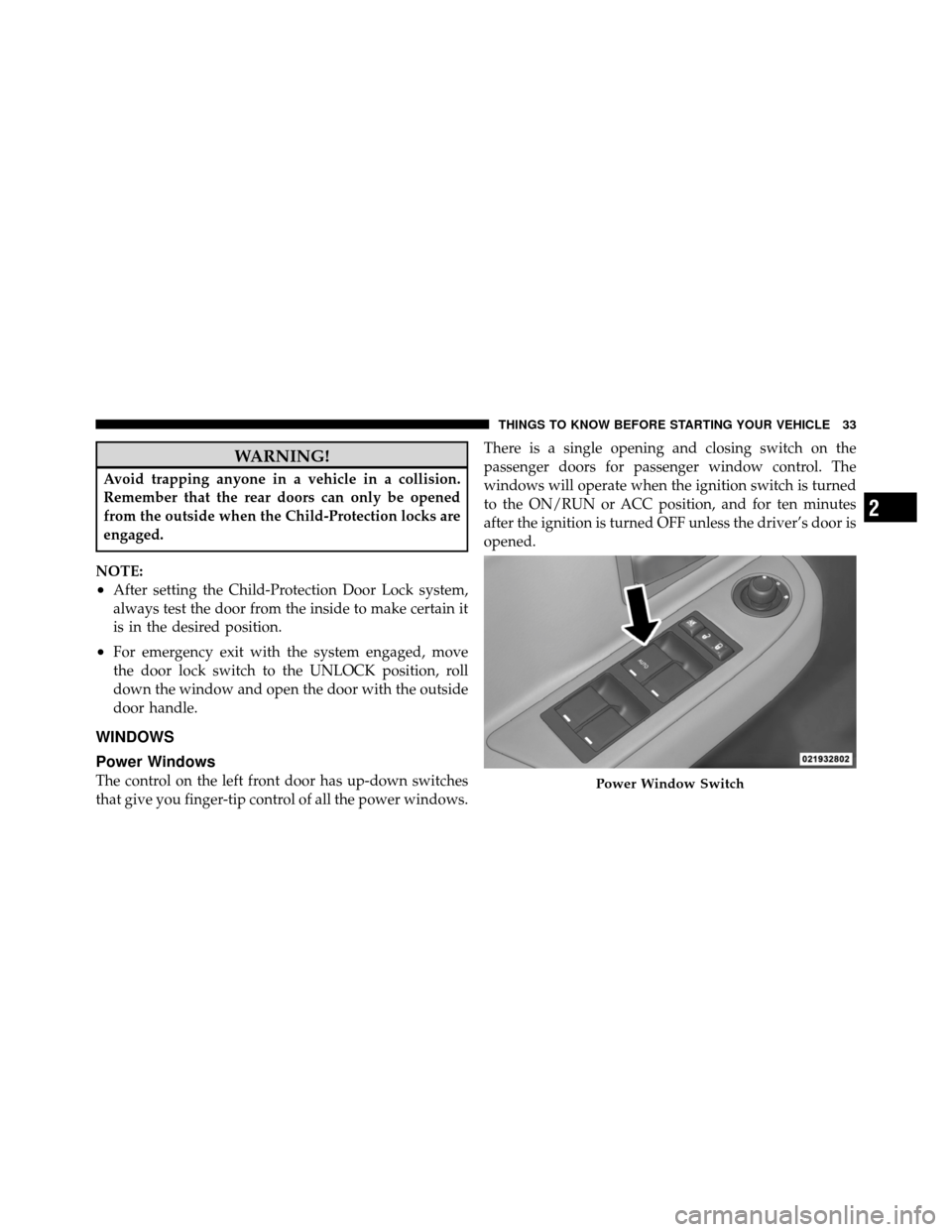
The control on the left front door has up-down switches
that give you finger-tip control of all the power windows. There is a single opening and closing switch on the
passenger doors for passenger window control. The
windows will operate when the ignition switch is turned
to the ON/RUN or ACC position, and for ten minutes
after the ignition is turned OFF unless the driver’s door is
opened.Power Window Switch
2
THINGS TO KNOW BEFORE STARTING YOUR VEHICLE 33
Page 36 of 452
WARNING!
Never leave children alone in a vehicle. Leaving
unattended children in a vehicle is dangerous for a
number of reasons. A child or others could be seri-
ously or fatally injured. Don’t leave the key in the
ignition. A child could operate power windows,
other controls, or move the vehicle.
Auto-Down — Driver’s Side Only
The driver’s window switch has an Auto-Down feature.
Push the window switch past the first detent, release, and
the window will go down automatically. To cancel the
Auto-Down movement, operate the switch in either the
up or down direction and release the switch.
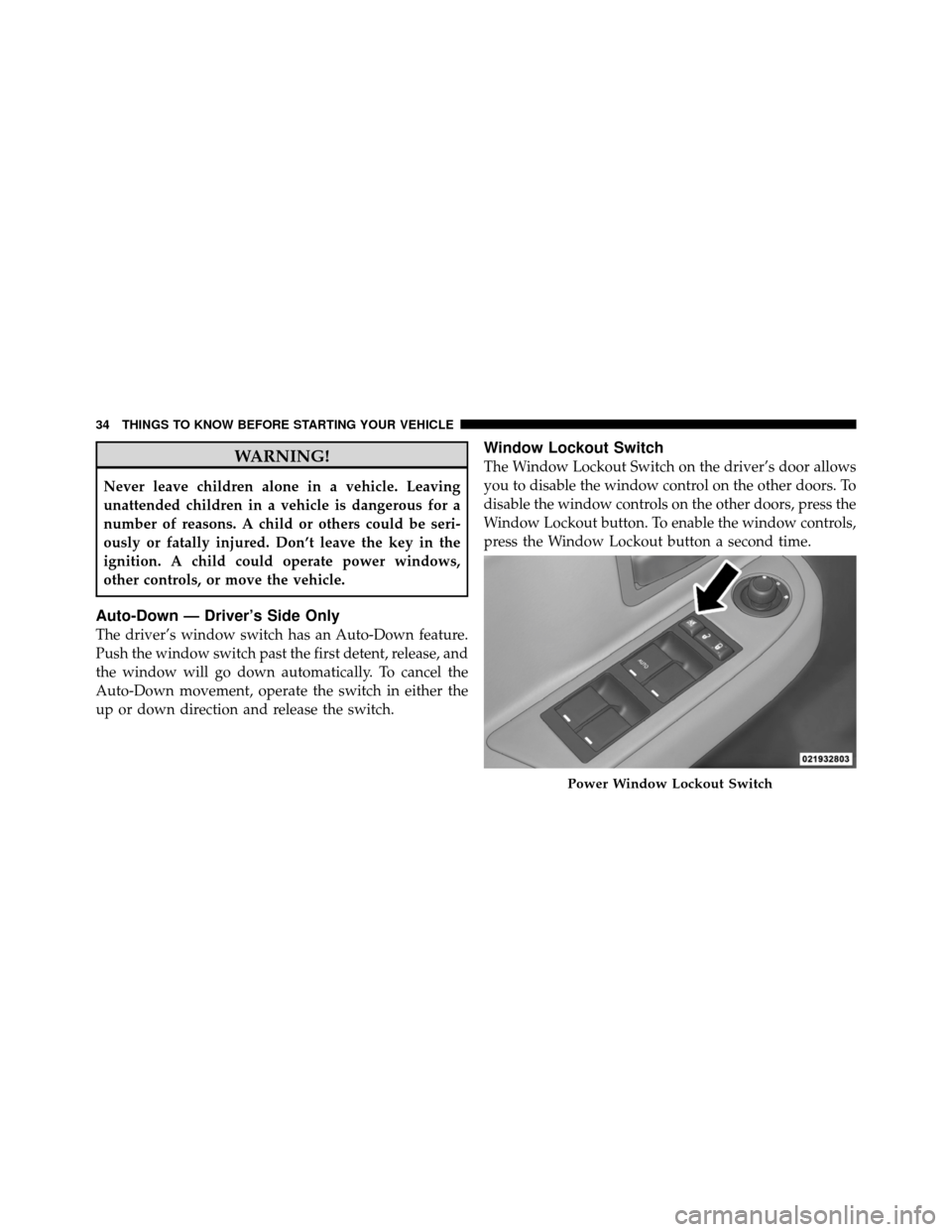
Window Lockout Switch
The Window Lockout Switch on the driver’s door allows
you to disable the window control on the other doors. To
disable the window controls on the other doors, press the
Window Lockout button. To enable the window controls,
press the Window Lockout button a second time.
Power Window Lockout Switch
34 THINGS TO KNOW BEFORE STARTING YOUR VEHICLE
Page 37 of 452
Wind Buffeting
Wind buffeting can be described as the perception of
pressure on the ears or a helicopter-type sound in the
ears. Your vehicle may exhibit wind buffeting with the
windows down or partially open. This is a normal
occurrence and can be minimized. If the rear windows
are open and buffeting occurs, open the front and rear
windows together to minimize the buffeting.
OCCUPANT RESTRAINTS
Some of the most important safety features in your
vehicle are the restraint systems:
•Three-point lap and shoulder belts for all seating
positions
•Advanced Front Air Bags for driver and front passen-
ger
•Supplemental Side Air Bag Inflatable Curtains
(SABIC) for the driver and passengers seated next to a
window — if equipped
•An energy-absorbing steering column and steering
wheel
•Knee bolsters for front seat occupants
•Front seat belts incorporate pretensioners that may
enhance occupant protection by managing occupant
energy during an impact event
Please pay close attention to the information in this
section. It tells you how to use your restraint system
properly, to keep you and your passengers as safe as
possible.
2
THINGS TO KNOW BEFORE STARTING YOUR VEHICLE 35
Page 39 of 452
If a child from 1 to 12 years old (not in a rear facing child
seat) must ride in the front passenger seat, move the seat
as far back as possible and use the proper child restraint.
(Refer to “Child Restraints”)
You should read the instructions provided with your
child restraint to make sure that you are using it properly.
2.All occupants should always wear their lap and
shoulder belts properly.
3. The driver and front passenger seats should be
moved back as far as practical to allow the Advanced
Front Air Bags room to inflate.
4. Do not lean against the door or window. If your
vehicle has side air bags, and deployment occurs, the
side air bags will inflate forcefully into the space
between you and the door. 5.
If the air bag system in this vehicle needs to be
modified to accommodate a disabled person, contact
the Customer Center. Phone numbers are provided
under �If You Need Assistance�.
WARNING!
•Relying on the air bags alone could lead to more
severe injuries in a collision. The air bags work
with your seat belt to restrain you properly. In
some collisions, the air bags won’t deploy at all.
Always wear your seat belts even though you have
air bags.
(Continued)
2
THINGS TO KNOW BEFORE STARTING YOUR VEHICLE 37
Page 40 of 452
WARNING! (Continued)
•Being too close to the steering wheel or instrument
panel during Advanced Front Air Bag deployment
could cause serious injury, including death. Air
Bags need room to inflate. Sit back, comfortably
extending your arms to reach the steering wheel or
instrument panel.
•Supplemental Side Air Bag Inflatable Curtain
(SABIC) also need room to inflate. Do not lean
against the door or window. Sit upright in the
center of the seat.
•In an accident, you and your passengers can suffer
much greater injuries if you are not properly
buckled up. You can strike the interior of your
vehicle or other passengers, or you can be thrown
out of the vehicle. Always be sure you and others
in your vehicle are buckled up properly.Buckle up even though you are an excellent driver, even
on short trips. Someone on the road may be a poor driver
and cause an accident that includes you. This can happen
far away from home or on your own street.
Research has shown that seat belts save lives, and they
can reduce the seriousness of injuries in an accident.
Some of the worst injuries happen when people are
thrown from the vehicle. Seat belts reduce the possibility
of ejection and the risk of injury caused by striking the
inside of the vehicle. Everyone in a motor vehicle should
be belted at all times.
38 THINGS TO KNOW BEFORE STARTING YOUR VEHICLE