Page 329 of 452

NOTE:Check the automatic transmission fluid level
before towing.
Tow/Haul – If Equipped
To reduce potential for automatic transmission overheat-
ing, turn the TOW/HAUL feature ON when driving in
hilly areas or shift the transmission to Drive position 2 on
more severe grades.
Electronic Speed Control – If Equipped
Do not use in hilly terrain or with heavy loads.
When using the speed control, if you experience speed
drops greater than 10 mph (16 km/h), disengage until
you can resume cruising speed.
Use speed control in flat terrain and with light loads to
maximize fuel efficiency.
Cooling System
To reduce potential for engine and transmission over-
heating, take the following actions:
City Driving
When stopped for short periods of time, shift the trans-
mission into NEUTRAL and increase engine idle speed.
Highway Driving
Reduce speed.
Air Conditioning
Turn off temporarily.
SNOWPLOW
Snow plows, winches, and other aftermarket equipment
should notbe added to the front end of your vehicle. The
airbag crash sensors may be affected by the change in the
front end structure. The airbags could deploy unexpect-
edly or could fail to deploy during a collision.
5
STARTING AND OPERATING 327
Page 350 of 452
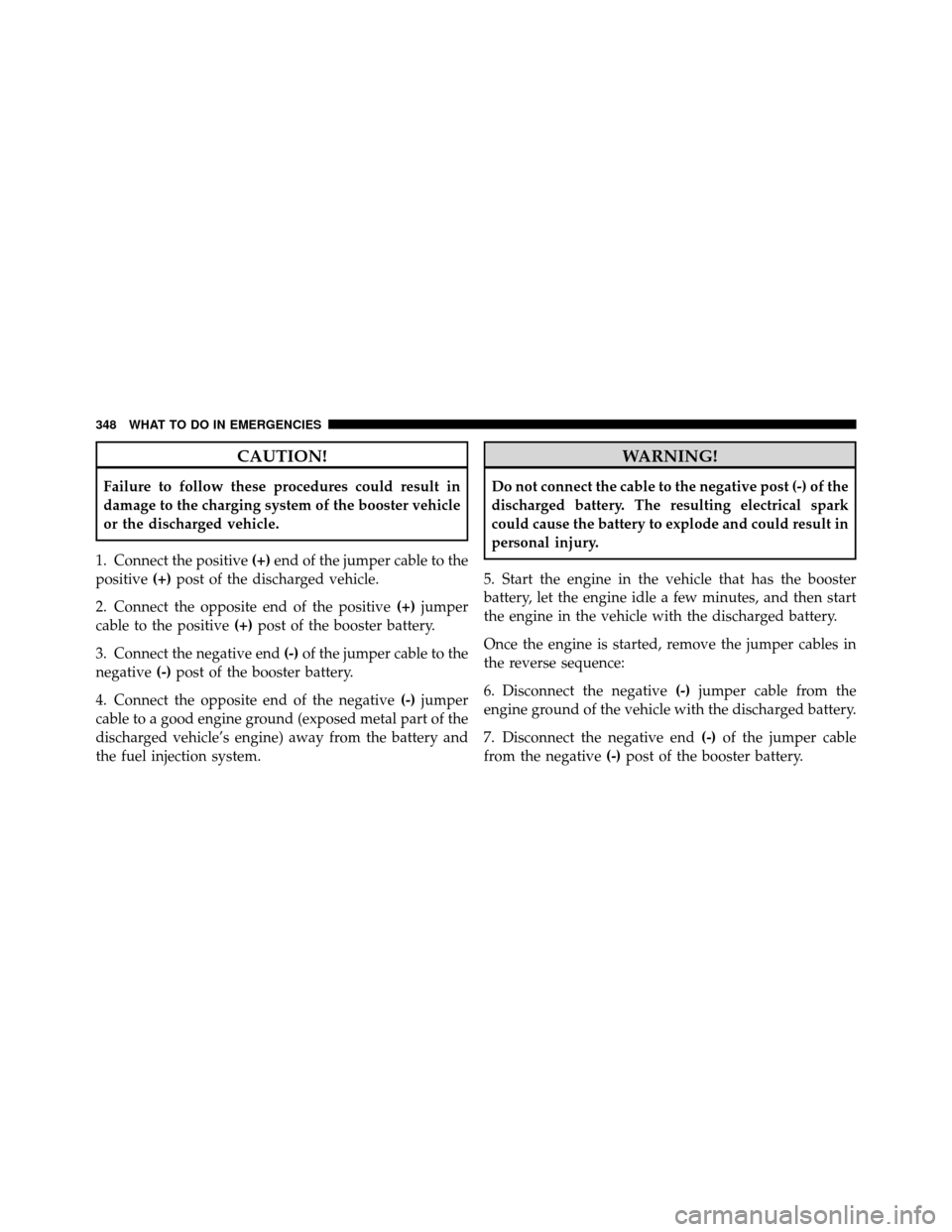
CAUTION!
Failure to follow these procedures could result in
damage to the charging system of the booster vehicle
or the discharged vehicle.
1. Connect the positive (+)end of the jumper cable to the
positive (+)post of the discharged vehicle.
2. Connect the opposite end of the positive (+)jumper
cable to the positive (+)post of the booster battery.
3. Connect the negative end (-)of the jumper cable to the
negative (-)post of the booster battery.
4. Connect the opposite end of the negative (-)jumper
cable to a good engine ground (exposed metal part of the
discharged vehicle’s engine) away from the battery and
the fuel injection system.
WARNING!
Do not connect the cable to the negative post (-) of the
discharged battery. The resulting electrical spark
could cause the battery to explode and could result in
personal injury.
5. Start the engine in the vehicle that has the booster
battery, let the engine idle a few minutes, and then start
the engine in the vehicle with the discharged battery.
Once the engine is started, remove the jumper cables in
the reverse sequence:
6. Disconnect the negative (-)jumper cable from the
engine ground of the vehicle with the discharged battery.
7. Disconnect the negative end (-)of the jumper cable
from the negative (-)post of the booster battery.
348 WHAT TO DO IN EMERGENCIES
Page 355 of 452
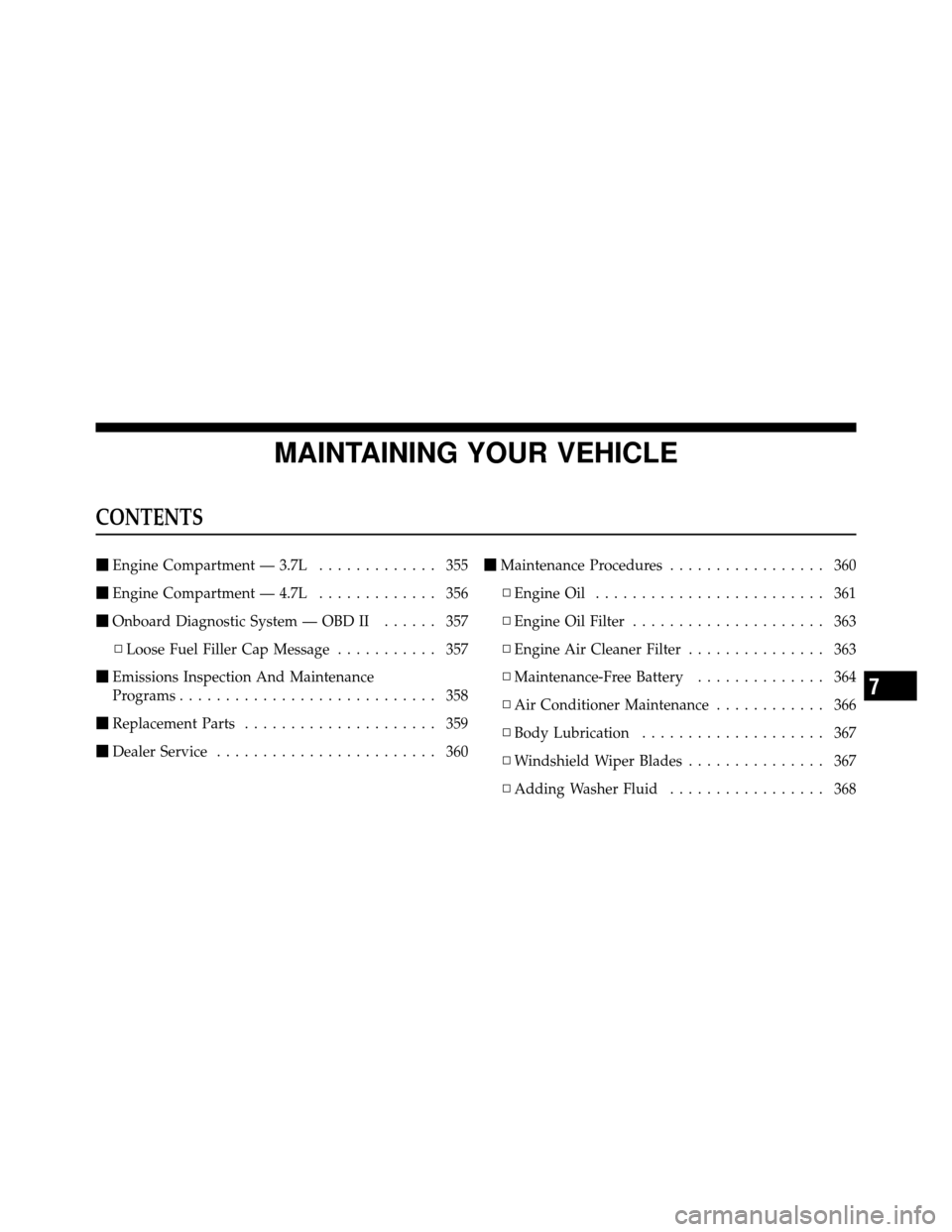
MAINTAINING YOUR VEHICLE
CONTENTS
�Engine Compartment — 3.7L ............. 355
� Engine Compartment — 4.7L ............. 356
� Onboard Diagnostic System — OBD II ...... 357
▫ Loose Fuel Filler Cap Message ........... 357
� Emissions Inspection And Maintenance
Programs ............................ 358
� Replacement Parts ..................... 359
� Dealer Service ........................ 360 �
Maintenance Procedures ................. 360
▫ Engine Oil ......................... 361
▫ Engine Oil Filter ..................... 363
▫ Engine Air Cleaner Filter ............... 363
▫ Maintenance-Free Battery .............. 364
▫ Air Conditioner Maintenance ............ 366
▫ Body Lubrication .................... 367
▫ Windshield Wiper Blades ............... 367
▫ Adding Washer Fluid ................. 368
7
Page 359 of 452
ONBOARD DIAGNOSTIC SYSTEM — OBD II
Your vehicle is equipped with a sophisticated onboard
diagnostic system called OBD II. This system monitors
the performance of the emissions, engine, and automatic
transmission control systems. When these systems are
operating properly, your vehicle will provide excellent
performance and fuel economy, as well as engine emis-
sions well within current government regulations.
If any of these systems require service, the OBD II system
will turn on the “Malfunction Indicator Light” (MIL). It
will also store diagnostic codes and other information to
assist your service technician in making repairs. Al-
though your vehicle will usually be drivable and not
need towing, see your authorized dealer for service as
soon as possible.CAUTION!
•Prolonged driving with the MIL on could cause
further damage to the emission control system. It
could also affect fuel economy and drivability. The
vehicle must be serviced before any emissions
tests can be performed.
•If the MIL is flashing while the engine is running,
severe catalytic converter damage and power loss
will soon occur. Immediate service is required.
Loose Fuel Filler Cap Message
After fuel is added, the vehicle diagnostic system can
determine if the fuel filler cap is possibly loose, improp-
erly installed, or damaged. A “gASCAP” message will be
displayed in the odometer. Tighten the gas cap until a
�clicking�sound is heard. This is an indication that the
gas cap is properly tightened. Press the odometer reset
button to turn the message off. If the problem persists,
7
MAINTAINING YOUR VEHICLE 357
Page 364 of 452
NOTE: Under no circumstances should oil change
intervals exceed 8,000 miles (13 000 km) or six months,
whichever occurs first.
Engine Oil Selection
For best performance and maximum protection under all
types of operating conditions, the manufacturer only
recommends engine oils that are API certified and meet
the requirements of Chrysler Material Standard MS-6395.
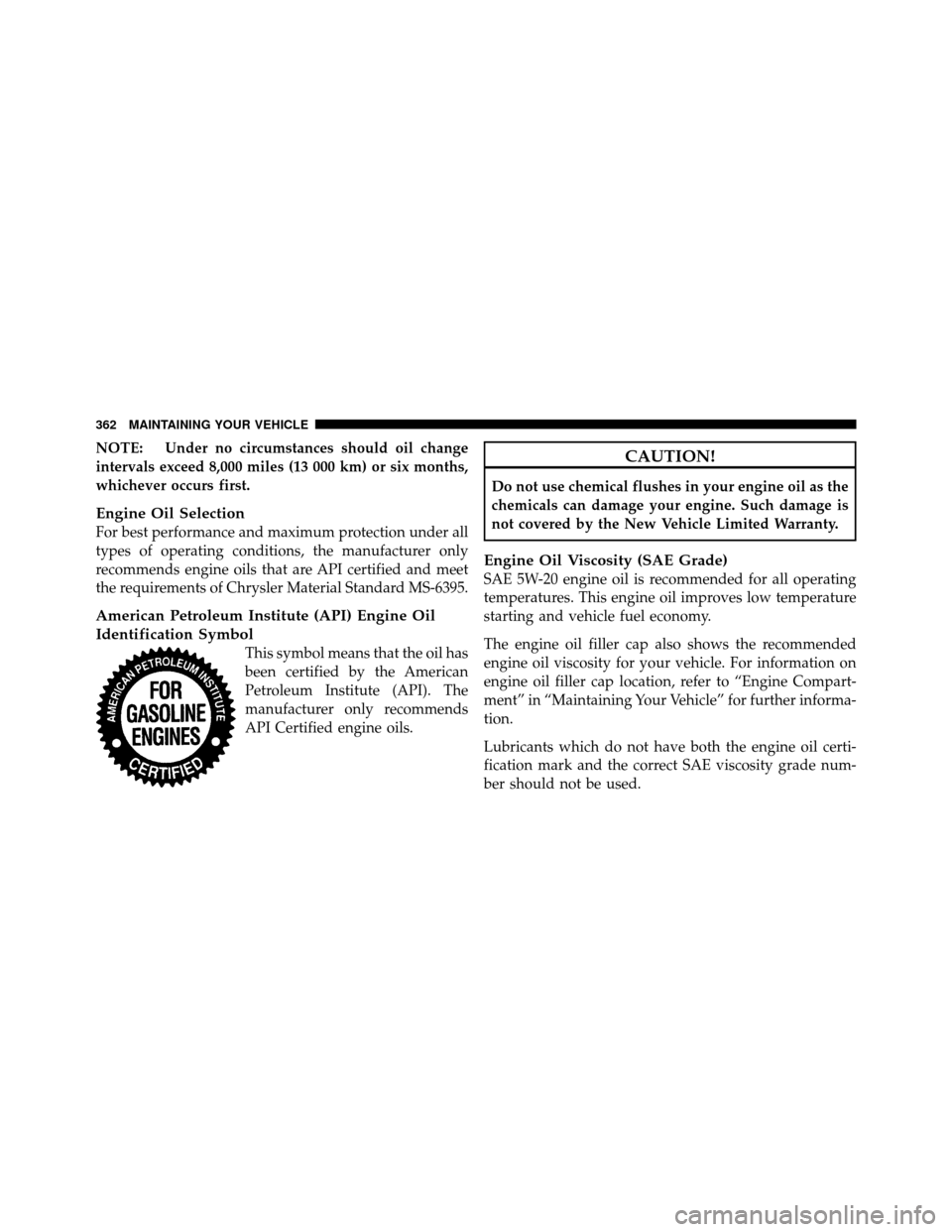
American Petroleum Institute (API) Engine Oil
Identification Symbol
This symbol means that the oil has
been certified by the American
Petroleum Institute (API). The
manufacturer only recommends
API Certified engine oils.
CAUTION!
Do not use chemical flushes in your engine oil as the
chemicals can damage your engine. Such damage is
not covered by the New Vehicle Limited Warranty.
Engine Oil Viscosity (SAE Grade)
SAE 5W-20 engine oil is recommended for all operating
temperatures. This engine oil improves low temperature
starting and vehicle fuel economy.
The engine oil filler cap also shows the recommended
engine oil viscosity for your vehicle. For information on
engine oil filler cap location, refer to “Engine Compart-
ment” in “Maintaining Your Vehicle” for further informa-
tion.
Lubricants which do not have both the engine oil certi-
fication mark and the correct SAE viscosity grade num-
ber should not be used.
362 MAINTAINING YOUR VEHICLE
Page 371 of 452
have an authorized technician inspect the complete ex-
haust system and adjacent body areas for broken, dam-
aged, deteriorated, or mispositioned parts. Open seams
or loose connections could permit exhaust fumes to seep
into the passenger compartment. In addition, inspect the
exhaust system each time the vehicle is raised for lubri-
cation or oil change. Replace as required.
WARNING!
•Exhaust gases can injure or kill. They contain
carbon monoxide (CO), which is colorless and
odorless. Breathing it can make you unconscious
and can eventually poison you. To avoid breathing
CO, refer to “Safety Tips/Exhaust Gas” in “Things
To Know Before Starting Your Vehicle” for further
information.(Continued)
WARNING! (Continued)
•A hot exhaust system can start a fire if you park
over materials that can burn. Such materials might
be grass or leaves coming into contact with your
exhaust system. Do not park or operate your ve-
hicle in areas where your exhaust system can
contact anything that can burn.
CAUTION!
•The catalytic converter requires the use of un-
leaded fuel only. Leaded gasoline will destroy the
effectiveness of the catalyst as an emissions con-
trol device and may seriously reduce engine per-
formance and cause serious damage to the engine.(Continued)
7
MAINTAINING YOUR VEHICLE 369
Page 390 of 452
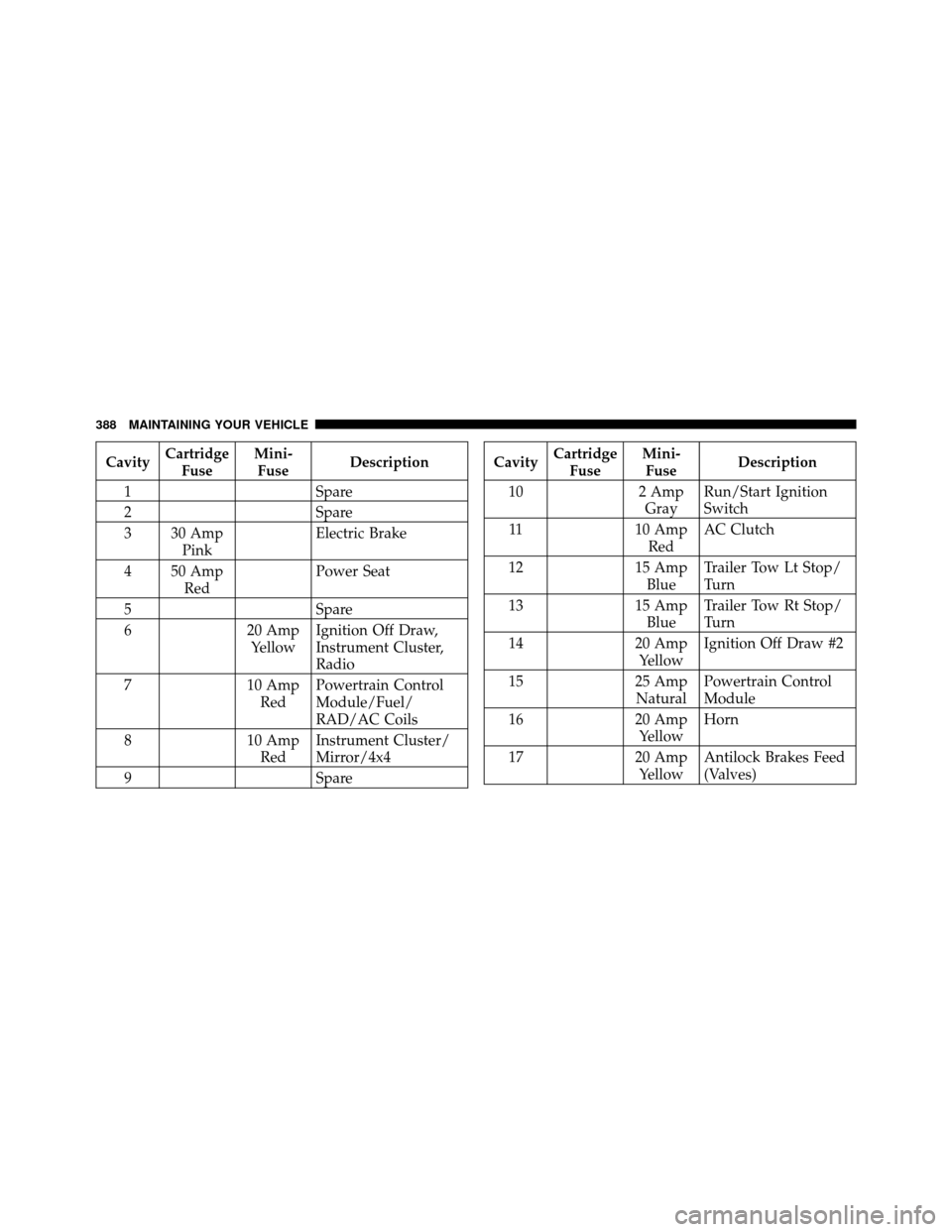
CavityCartridge
Fuse Mini-
Fuse Description
1 Spare
2 Spare
3 30 Amp Pink Electric Brake
4 50 Amp Red Power Seat
5 Spare
6 20 Amp
Yellow Ignition Off Draw,
Instrument Cluster,
Radio
7 10 Amp
Red Powertrain Control
Module/Fuel/
RAD/AC Coils
8 10 Amp
Red Instrument Cluster/
Mirror/4x4
9 SpareCavityCartridge
Fuse Mini-
Fuse Description
10 2 Amp
Gray Run/Start Ignition
Switch
11 10 Amp
Red AC Clutch
12 15 Amp
Blue Trailer Tow Lt Stop/
Turn
13 15 Amp
Blue Trailer Tow Rt Stop/
Turn
14 20 Amp
Yellow Ignition Off Draw #2
15 25 Amp
Natural Powertrain Control
Module
16 20 Amp
Yellow Horn
17 20 Amp
Yellow Antilock Brakes Feed
(Valves)
388 MAINTAINING YOUR VEHICLE
Page 391 of 452
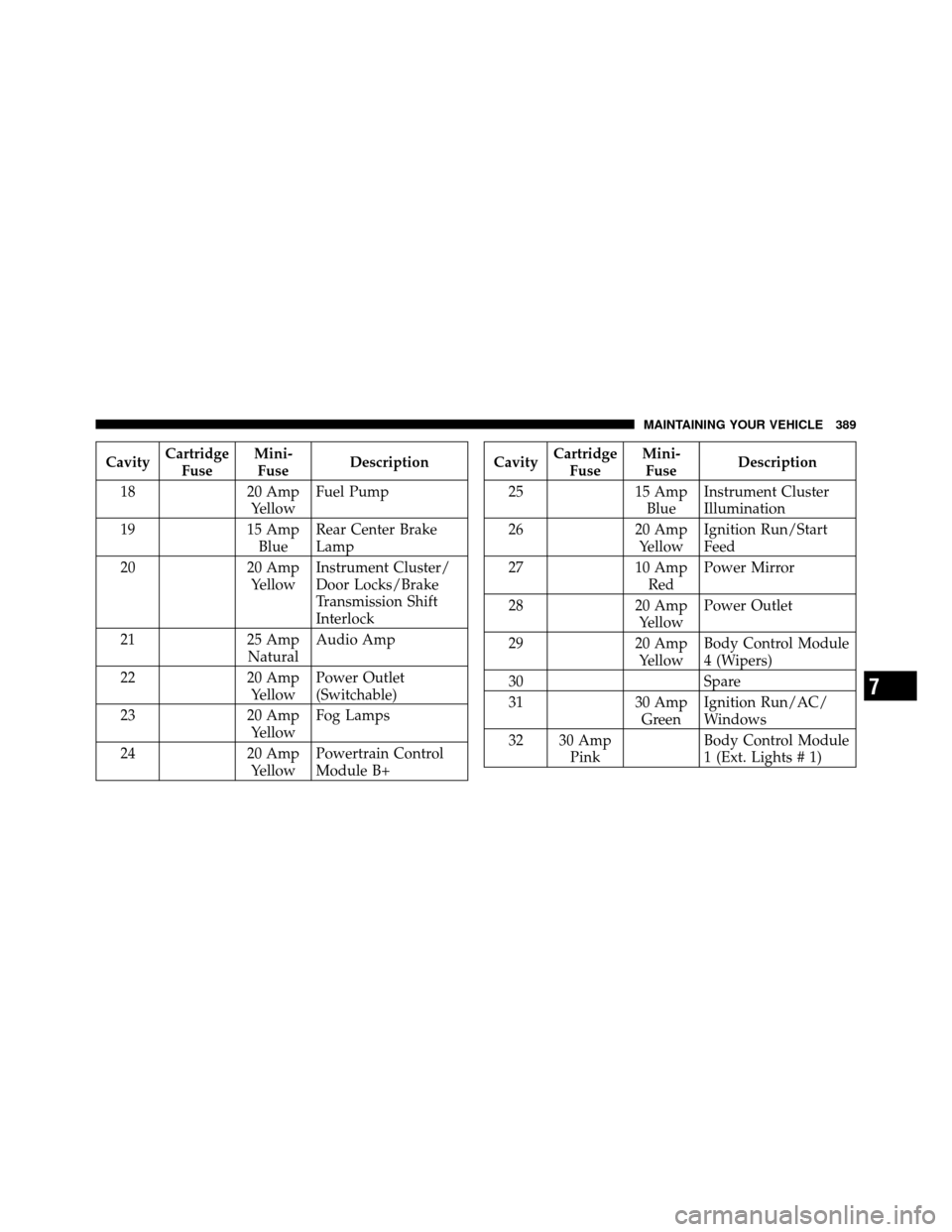
CavityCartridge
Fuse Mini-
Fuse Description
18 20 Amp
Yellow Fuel Pump
19 15 Amp
Blue Rear Center Brake
Lamp
20 20 Amp
Yellow Instrument Cluster/
Door Locks/Brake
Transmission Shift
Interlock
21 25 Amp
Natural Audio Amp
22 20 Amp
Yellow Power Outlet
(Switchable)
23 20 Amp
Yellow Fog Lamps
24 20 Amp
Yellow Powertrain Control
Module B+Cavity
Cartridge
Fuse Mini-
Fuse Description
25 15 Amp
Blue Instrument Cluster
Illumination
26 20 Amp
Yellow Ignition Run/Start
Feed
27 10 Amp
Red Power Mirror
28 20 Amp
Yellow Power Outlet
29 20 Amp
Yellow Body Control Module
4 (Wipers)
30 Spare
31 30 Amp
Green Ignition Run/AC/
Windows
32 30 Amp Pink Body Control Module
1 (Ext. Lights # 1)
7
MAINTAINING YOUR VEHICLE 389