Page 80 of 452
Safety Checks You Should Make Inside The
Vehicle
Seat Belts
Inspect the belt system periodically, checking for cuts,
frays, and loose parts. Damaged parts must be replaced
immediately. Do not disassemble or modify the system.
Front seat belt assemblies must be replaced after a
collision. Rear seat belt assemblies must be replaced after
a collision if they have been damaged (i.e., bent retractor,
torn webbing, etc.). If there is any question regarding belt
or retractor condition, replace the belt.
Airbag Warning Light
The light should come on and remain on for four to eight
seconds as a bulb check when the ignition switch is first
turned ON. If the light is not lit during starting, see your
authorized dealer. If the light stays on, flickers, or comes
on while driving, have the system checked by an autho-
rized dealer.
Defroster
Check operation by selecting the defrost mode and place
the blower control on high speed. You should be able to
feel the air directed against the windshield. See your
authorized dealer for service if your defroster is
inoperable.
Floor Mat Safety Information
Always use floor mats designed to fit the footwell of your
vehicle. Use only floor mats that leave the pedal area
unobstructed and that are firmly secured so that they
cannot slip out of position and interfere with the pedals
or impair safe operation of your vehicle in other ways.
WARNING!
Pedals that cannot move freely can cause loss of
vehicle control and increase the risk of serious per-
sonal injury.(Continued)
78 THINGS TO KNOW BEFORE STARTING YOUR VEHICLE
Page 82 of 452
Periodic Safety Checks You Should Make Outside
The Vehicle
Tires
Examine tires for excessive tread wear and uneven wear
patterns. Check for stones, nails, glass, or other objects
lodged in the tread or sidewall. Inspect the tread for cuts
and cracks. Inspect sidewalls for cuts, cracks and bulges.
Check the wheel nuts for tightness. Check the tires
(including spare) for proper cold inflation pressure.
Lights
Have someone observe the operation of exterior lights
while you work the controls. Check turn signal and high
beam indicator lights on the instrument panel.
Door Latches
Check for positive closing, latching, and locking.
Fluid Leaks
Check area under vehicle after overnight parking for fuel,
engine coolant, oil, or other fluid leaks. Also, if gasoline
fumes are detected or if fuel, power steering fluid, or
brake fluid leaks are suspected, the cause should be
located and corrected immediately.
80 THINGS TO KNOW BEFORE STARTING YOUR VEHICLE
Page 84 of 452
�Seats .............................. 123
▫ Power Driver Seat .................... 124
▫ Manual Seat Adjustment ............... 126
▫ Front Seat — Manual Recliner ........... 128
▫ Manual Lumbar — If Equipped .......... 128
▫ Heated Seats — If Equipped ............ 129
▫ Head Restraints ..................... 130
▫ Extended Cab/Crew Cab Rear Seat ....... 132
� To Open And Close The Hood ............ 132
� Lights ............................. 134
▫ Headlights, Parking Lights And
Panel Lights ........................ 134
▫ Headlight Delay ..................... 135 ▫
Lights-On Reminder .................. 135
▫ Daytime Running Lights — If Equipped .... 135
▫ Fog Lights — If Equipped .............. 135
▫ Interior Lights ...................... 135
▫ Multifunction Lever .................. 136
▫ Battery Saver ....................... 138
▫ Cargo Light — If Equipped ............. 139
� Windshield Wipers And Washers .......... 139
▫ Windshield Wipers ................... 140
▫ Windshield Washers .................. 141
� Tilt Steering Column ................... 142
� Electronic Speed Control — If Equipped ..... 143
▫ To Activate ......................... 144
82 UNDERSTANDING THE FEATURES OF YOUR VEHICLE
Page 85 of 452
▫To Set A Desired Speed ................ 144
▫ To Deactivate ....................... 144
▫ To Resume Speed .................... 144
▫ To Vary The Speed Setting .............. 145
▫ To Accelerate For Passing .............. 145
� Overhead Console ..................... 146
▫ Courtesy/Reading Lights .............. 147
� Compass/Temperature Mini-Trip Computer . . . 147
▫ US/M Button ....................... 148
▫ Reset Button ........................ 148
▫ Step Button ........................ 149
▫ Average Fuel Economy (AVG ECO) ....... 149
▫ Distance To Empty (DTE) .............. 149 ▫
Trip Odometer (ODO) ................. 150
▫ Elapsed Time (ET) ................... 150
▫ C/T Button ........................ 150
▫ Global Reset ........................ 151
▫ Compass/Temperature Display .......... 151
▫ Automatic Compass Calibration .......... 152
▫ Manual Compass Calibration ............ 152
▫ To Put Into A Calibration Mode .......... 152
▫ Outside Temperature .................. 153
� Garage Door Opener — If Equipped ........ 153
▫ Programming HomeLink� .............. 155
▫ Gate Operator/Canadian Programming .... 157
▫ Using HomeLink� ................... 158
3
UNDERSTANDING THE FEATURES OF YOUR VEHICLE 83
Page 87 of 452
MIRRORS
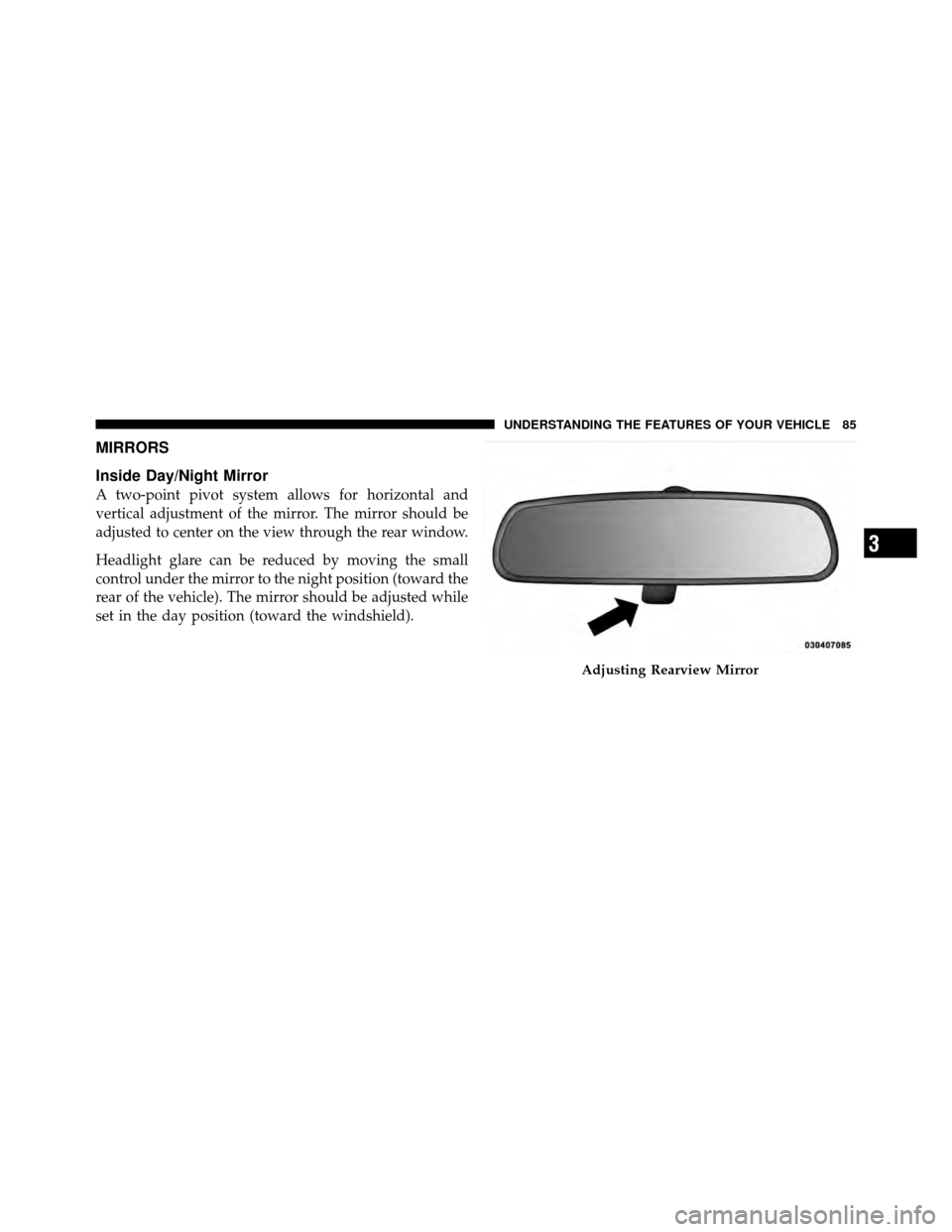
Inside Day/Night Mirror
A two-point pivot system allows for horizontal and
vertical adjustment of the mirror. The mirror should be
adjusted to center on the view through the rear window.
Headlight glare can be reduced by moving the small
control under the mirror to the night position (toward the
rear of the vehicle). The mirror should be adjusted while
set in the day position (toward the windshield).
Adjusting Rearview Mirror
3
UNDERSTANDING THE FEATURES OF YOUR VEHICLE 85
Page 88 of 452
Automatic Dimming Mirror — If Equipped
This mirror automatically adjusts for headlight glare
from vehicles behind you. You can turn the feature on or
off by pressing the button at the base of the mirror. A light
to the left of the button will illuminate to indicate when
the dimming feature is activated. The sensor to the right
of the button does not illuminate.
CAUTION!
To avoid damage to the mirror during cleaning, never
spray any cleaning solution directly onto the mirror.
Apply the solution onto a clean cloth and wipe the
mirror clean.
Automatic Dimming Mirror
86 UNDERSTANDING THE FEATURES OF YOUR VEHICLE
Page 89 of 452
Outside Mirrors
To receive maximum benefit, adjust the outside mirror(s)
to center on the adjacent lane of traffic with a slight
overlap of the view obtained on the inside mirror.
WARNING!
Vehicles and other objects seen in the passenger side
convex mirror will look smaller and farther away
than they really are. Relying too much on your
passenger side mirror could cause you to collide with
another vehicle or other object. Use your inside
mirror when judging the size or distance of a vehicle
seen in the passenger side mirror.
Outside Mirrors Folding Feature — If Equipped
Folding outside mirrors are hinged, and may be moved
either forward or rearward, to resist damage.
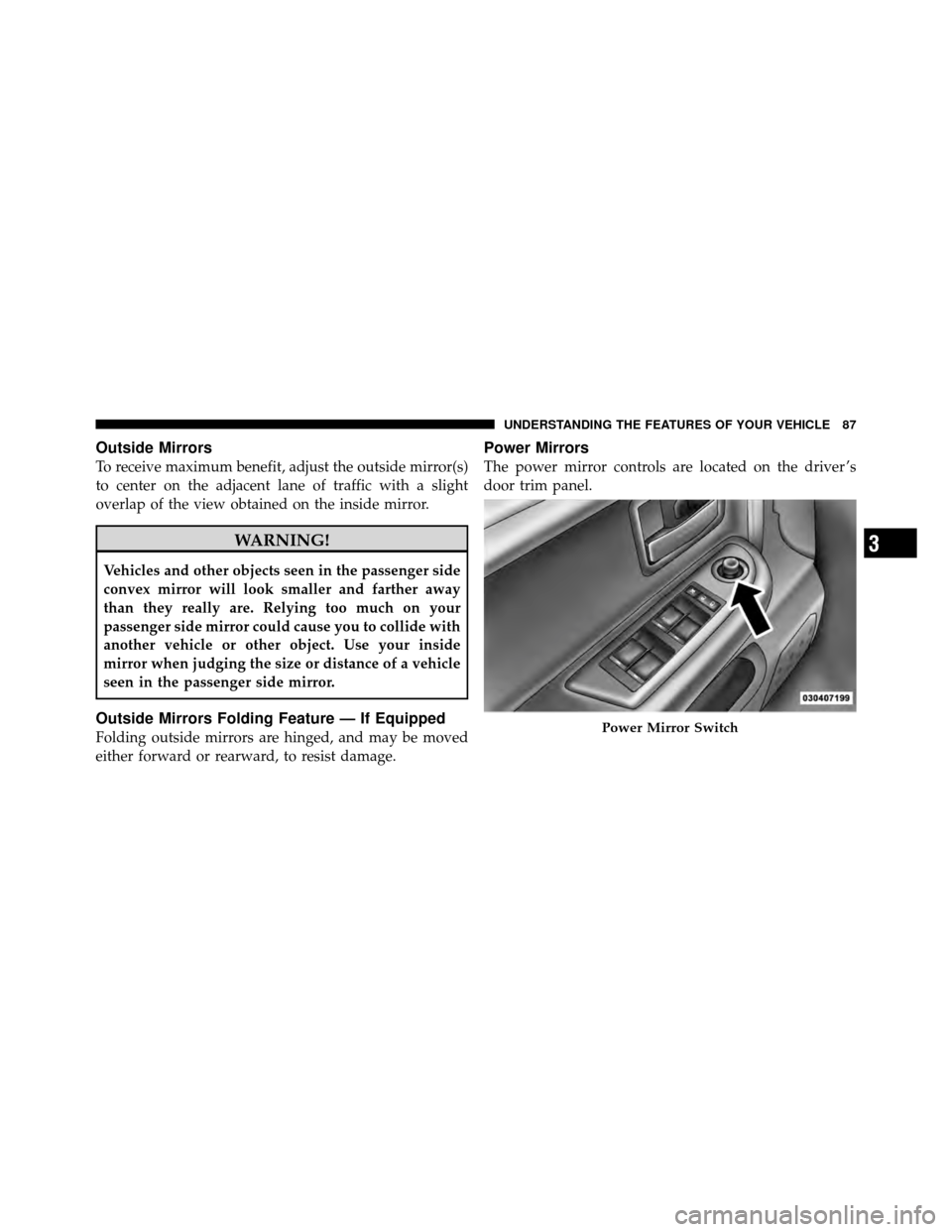
Power Mirrors
The power mirror controls are located on the driver ’s
door trim panel.
Power Mirror Switch
3
UNDERSTANDING THE FEATURES OF YOUR VEHICLE 87
Page 104 of 452
Canada and 060 for Mexico). The number dialed may
not be applicable with the available mobile service and
area.
•If supported, this number may be programmable on
some systems. To do this, press the
button and
say “Setup”, followed by “Emergency”.
•The Uconnect™ Phone does slightly lower your
chances of successfully making a phone call as to that
for the mobile phone directly.
WARNING!
To use your Uconnect™ Phone System in an emer-
gency, your mobile phone must be:
•turned on,
•paired to the Uconnect™ System,
•and have network coverage.
Towing Assistance
If you need towing assistance:
•Press thebutton to begin.
•After the “Ready” prompt and the following beep, say
“Towing Assistance”.
NOTE:
•The towing assistance number dialed is based on the
country where the vehicle is purchased (1-800-528-
2069 for the U.S., 1-877-213-4525 for Canada, 55-14-
3454 for Mexico City and 1-800-712-3040 for outside
Mexico City in Mexico). Please refer to the 24-Hour
“Towing Assistance” coverage details on the DVD in
the Warranty Information Booklet and the 24-Hour
Towing Assistance references.
•If supported, this number may be programmable on
some systems. To do this, press the
button and
say “Setup”, followed by “Towing Assistance”.
102 UNDERSTANDING THE FEATURES OF YOUR VEHICLE