Page 297 of 452
CAUTION!
•Do not use tire chains on vehicles equipped with
tires other than P245/70R16. There may not be
adequate clearance for the chains and you are
risking structural or body damage to your vehicle.
•Do not use tire chains on the front wheels of your
vehicle. There may not be adequate clearance for
the chains and you are risking structural or body
damage to your vehicle.
SNOW TIRES
Some areas of the country require the use of snow tires
during the winter. All season tires can be identified by the
M+S designation on the tire sidewall.
If you need snow tires, select tires equivalent in size and
type to the original equipment tires. Use snow tires only
in sets of four; failure to do so may adversely affect the
safety and handling of your vehicle.Snow tires generally have lower speed ratings than what
was originally equipped with your vehicle and should
not be operated at sustained speeds over 75 mph
(120 km/h). For speeds above 75 mph (120 km/h) refer to
original equipment or an authorized tire dealer for
recommended safe operating speeds, loading and cold
tire inflation pressures.
While studded tires improve performance on ice, skid
and traction capability on wet or dry surfaces may be
poorer than that of non-studded tires. Some states pro-
hibit studded tires; therefore, local laws should be
checked before using these tire types.
TIRE ROTATION RECOMMENDATIONS
The tires on the front and rear of your vehicle operate at
different loads and perform different steering, driving,
and braking functions. For these reasons, they wear at
unequal rates and tend to develop irregular wear pat-
terns.
5
STARTING AND OPERATING 295
Page 298 of 452
These effects can be reduced by timely rotation of tires.
The benefits of rotation are especially worthwhile with
aggressive tread designs such as those on all season type
tires. Rotation will increase tread life, help to maintain
mud, snow and wet traction levels, and contribute to a
smooth, quiet ride.
Refer to the “Maintenance Schedule” for the proper
maintenance intervals. More frequent rotation is permis-
sible if desired. The reasons for any rapid or unusual
wear should be corrected prior to rotation being per-
formed.
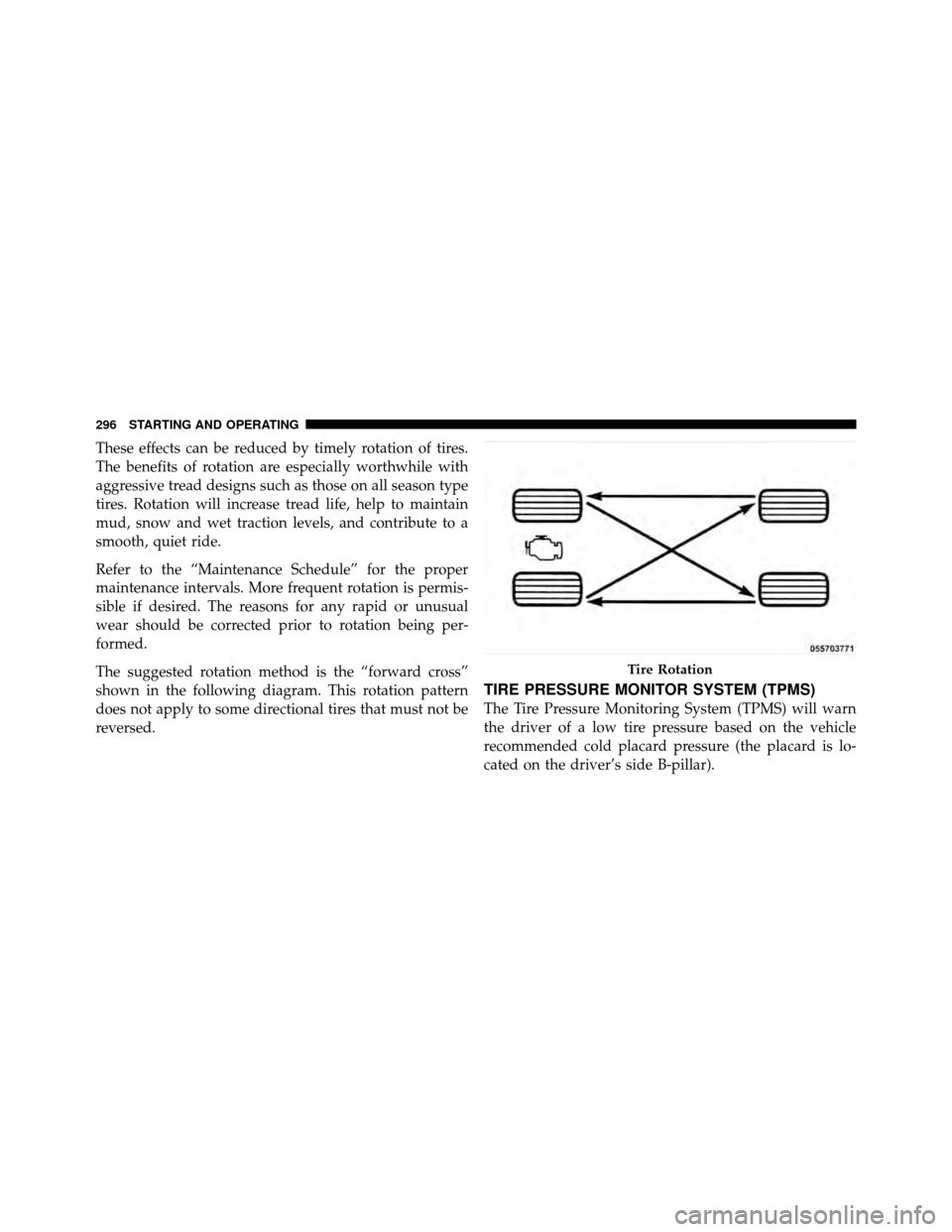
The suggested rotation method is the “forward cross”
shown in the following diagram. This rotation pattern
does not apply to some directional tires that must not be
reversed.
TIRE PRESSURE MONITOR SYSTEM (TPMS)
The Tire Pressure Monitoring System (TPMS) will warn
the driver of a low tire pressure based on the vehicle
recommended cold placard pressure (the placard is lo-
cated on the driver’s side B-pillar).
Tire Rotation
296 STARTING AND OPERATING
Page 300 of 452

Lamp” will still be ON. In this situation, the “TPMS
Lamp” will turn off only after the tires have been inflated
to the vehicle’s recommended cold placard pressure
value.
CAUTION!
•The TPMS has been optimized for the original
equipment tires and wheels. TPMS pressures have
been established for the tire size equipped on your
vehicle. Undesirable system operation or sensor
damage may result when using replacement
equipment that is not of the same size, type, and/or
style. Aftermarket wheels can cause sensor dam-
age. Do not use aftermarket tire sealants or balance
beads if your vehicle is equipped with a TPMS, as
damage to the sensors may result.(Continued)
CAUTION! (Continued)
•After inspecting or adjusting the tire pressure
always reinstall the valve stem cap. This will
prevent moisture and dirt from entering the valve
stem, which could damage the tire pressure moni-
toring sensor.
NOTE:
•The TPMS is not intended to replace normal tire care
and maintenance, or to provide warning of a tire
failure or condition.
•The TPMS should not be used as a tire pressure gauge
while adjusting your tire pressure.
•Driving on a significantly under-inflated tire causes
the tire to overheat and can lead to tire failure.
Under-inflation also reduces fuel efficiency and tire
tread life, and may affect the vehicle’s handling and
stopping ability.
298 STARTING AND OPERATING
Page 316 of 452
The entire vehicle should first be weighed on a commer-
cial scale to ensure that the GVWR has not been ex-
ceeded. The weight on the front and rear of the vehicle
should then be determined separately to be sure that the
load is properly distributed over front and rear axle.
Weighing the vehicle may show that the GAWR of either
the front or rear axles has been exceeded but the total
load is within the specified GVWR. If so, weight must be
shifted from front to rear or rear to front as appropriate
until the specified weight limitations are met.
Store heavier items down low and be sure that the weight
is distributed equally. Stow all loose items securely before
driving.
Improper weight distribution can have an adverse effect
on the way your vehicle steers and handles and the way
the brakes operate.WARNING!
Do not load your vehicle any heavier than the GVWR
or the maximum front and rear GAWR. If you do,
parts on your vehicle can break, or it can change the
way your vehicle handles. This could cause you to
lose control and result in a collision. Also, overload-
ing can shorten the life of your vehicle.
TRAILER TOWING
In this section you will find safety tips and information
on limits to the type of towing you can reasonably do
with your vehicle. Before towing a trailer carefully re-
view this information to tow your load as efficiently and
safely as possible.
To maintain warranty coverage, follow the requirements
and recommendations in this manual concerning ve-
hicles used for trailer towing.
314 STARTING AND OPERATING
Page 434 of 452

Adding Engine Coolant (Antifreeze).......... 373
Adding Fuel ........................... 310
Air Cleaner, Engine (Engine Air Cleaner Filter) . . . 363
Air Conditioner Maintenance ............... 366
Air Conditioning ........................ 238
Air Conditioning Refrigerant .............366,367
Air Conditioning System ................238,366
Air Conditioning, Operating Tips ..........238,241
Air Filter .............................. 363
Air Pressure, Tires ....................... 285
Airbag ........................... 51,58,190
Airbag Deployment ....................... 59
Airbag Light ........................ 57,61,78
Airbag Maintenance ....................... 60
Airbag, Side .......................... 55,58
Airbag, Window (Side Curtain) ...........54,55,58
Alarm (Security Alarm) .................18,181
Alarm System (Security Alarm) ............... 18
Alarm, Panic ............................ 23 Alterations/Modifications, Vehicle
............. 7
Antenna, Satellite Radio ................208,232
Anti-Lock Brake System (ABS) .............. 273
Anti-Lock Warning Light .................. 181
Anti-Theft Security Alarm (Theft Alarm) ........ 18
Anti-Theft System ..................... 18,181
Antifreeze (Engine Coolant) ..............372,401
Disposal ........................... 374
Appearance Care ........................ 382
Assistance Towing ....................... 102
Auto Unlock, Doors ....................... 31
Automatic Dimming Mirror ................. 86
Automatic Door Locks ..................... 29
Automatic Transaxle .................... 12,252
Interlock System ...................... 15
Automatic Transmission .............249,253,378
Adding Fluid ....................... 379
Fluid Level Check .................... 379
Fluid Type ......................... 403
432 INDEX