Page 70 of 452
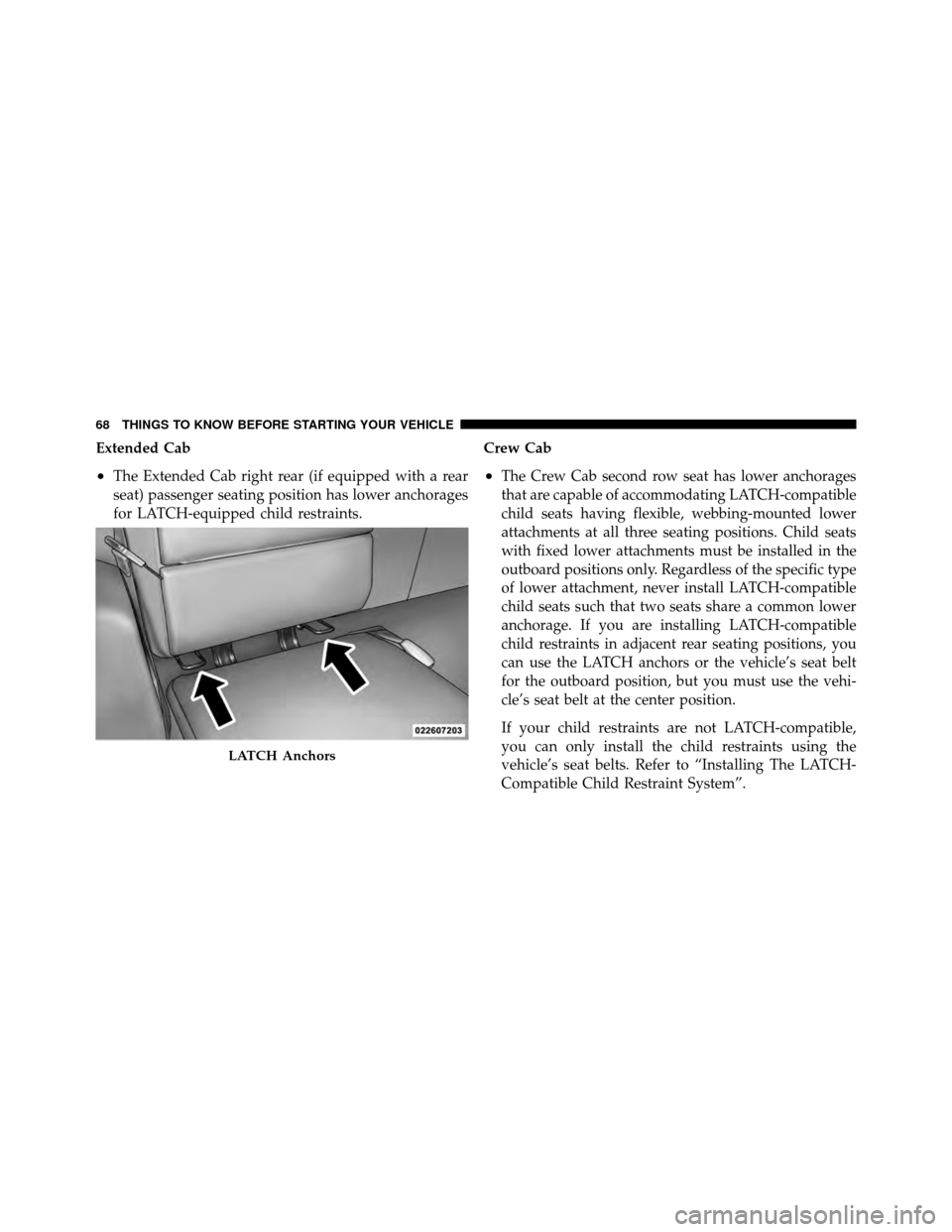
Extended Cab
•The Extended Cab right rear (if equipped with a rear
seat) passenger seating position has lower anchorages
for LATCH-equipped child restraints.Crew Cab•The Crew Cab second row seat has lower anchorages
that are capable of accommodating LATCH-compatible
child seats having flexible, webbing-mounted lower
attachments at all three seating positions. Child seats
with fixed lower attachments must be installed in the
outboard positions only. Regardless of the specific type
of lower attachment, never install LATCH-compatible
child seats such that two seats share a common lower
anchorage. If you are installing LATCH-compatible
child restraints in adjacent rear seating positions, you
can use the LATCH anchors or the vehicle’s seat belt
for the outboard position, but you must use the vehi-
cle’s seat belt at the center position.
If your child restraints are not LATCH-compatible,
you can only install the child restraints using the
vehicle’s seat belts. Refer to “Installing The LATCH-
Compatible Child Restraint System”.
LATCH Anchors
68 THINGS TO KNOW BEFORE STARTING YOUR VEHICLE
Page 78 of 452
A new engine may consume some oil during its first few
thousand miles (kilometers) of operation. This should be
considered a normal part of the break-in and not inter-
preted as an indication of difficulty.
SAFETY TIPS
Transporting Passengers
NEVER TRANSPORT PASSENGERS IN THE CARGO
AREA.
WARNING!
•Do not leave children or animals inside parked
vehicles in hot weather. Interior heat build-up may
cause serious injury or death.(Continued)
WARNING! (Continued)
•It is extremely dangerous to ride in a cargo area,
inside or outside of a vehicle. In a collision, people
riding in these areas are more likely to be seri-
ously injured or killed.
•Do not allow people to ride in any area of your
vehicle that is not equipped with seats and seat
belts.
•Be sure everyone in your vehicle is in a seat and
using a seat belt properly.
76 THINGS TO KNOW BEFORE STARTING YOUR VEHICLE
Page 84 of 452
�Seats .............................. 123
▫ Power Driver Seat .................... 124
▫ Manual Seat Adjustment ............... 126
▫ Front Seat — Manual Recliner ........... 128
▫ Manual Lumbar — If Equipped .......... 128
▫ Heated Seats — If Equipped ............ 129
▫ Head Restraints ..................... 130
▫ Extended Cab/Crew Cab Rear Seat ....... 132
� To Open And Close The Hood ............ 132
� Lights ............................. 134
▫ Headlights, Parking Lights And
Panel Lights ........................ 134
▫ Headlight Delay ..................... 135 ▫
Lights-On Reminder .................. 135
▫ Daytime Running Lights — If Equipped .... 135
▫ Fog Lights — If Equipped .............. 135
▫ Interior Lights ...................... 135
▫ Multifunction Lever .................. 136
▫ Battery Saver ....................... 138
▫ Cargo Light — If Equipped ............. 139
� Windshield Wipers And Washers .......... 139
▫ Windshield Wipers ................... 140
▫ Windshield Washers .................. 141
� Tilt Steering Column ................... 142
� Electronic Speed Control — If Equipped ..... 143
▫ To Activate ......................... 144
82 UNDERSTANDING THE FEATURES OF YOUR VEHICLE
Page 125 of 452
Voice Training
For users experiencing difficulty with the system recog-
nizing their voice commands or numbers the Uconnect™
Voice “Voice Training” feature may be used.
1. Press the Voice Command
button, say “System
Setup” and once you are in that menu then say “Voice
Training.” This will train your own voice to the system
and will improve recognition.
2. Repeat the words and phrases when prompted by
Uconnect™ Voice. For best results, the “Voice Training”
session should be completed when the vehicle is parked,
engine running, all windows closed, and the blower fan
switched off. This procedure may be repeated with a new
user. The system will adapt to the last trained voice only.
SEATS
Seats are a part of the Occupant Restraint System of the
vehicle.
WARNING!
•It is dangerous to ride in a cargo area, inside or
outside of a vehicle. In a collision, people riding in
these areas are more likely to be seriously injured
or killed.
•Do not allow people to ride in any area of your
vehicle that is not equipped with seats and seat
belts.
•Be sure everyone in your vehicle is in a seat and
using a seat belt properly.
3
UNDERSTANDING THE FEATURES OF YOUR VEHICLE 123
Page 127 of 452
Adjusting The Seat Up Or Down
The height of the seats can be adjusted up or down. Pull
upward or push downward on the four-way seat switch,
the seat will move in the direction of the switch. Release
the switch when you have reached the desired position.
Tilting The Seat Up Or Down
The angle of the seat cushion can be adjusted in four
directions. Pull upward or push downward on the front
or rear seat switches (located on either side of the
four-way switch), the front or rear of the seat cushion will
move in the direction of the switch. Release the switch
when you have reached the desired position.
Tilt Adjustment
3
UNDERSTANDING THE FEATURES OF YOUR VEHICLE 125
Page 128 of 452
WARNING!
•Adjusting a seat while driving may be dangerous.
Moving a seat while driving could result in loss of
control which could cause a collision and serious
injury or death.
•Seats should be adjusted before fastening the seat
belts and while the vehicle is parked. Serious
injury or death could result from a poorly adjusted
seat belt.
•Do not ride with the seatback reclined so that the
shoulder belt is no longer resting against your
chest. In a collision you could slide under the seat
belt, which could result in serious injury or death.
CAUTION!
Do not place any article under a power seat or
impede its ability to move as it may cause damage to
the seat controls. Seat travel may become limited if
movement is stopped by an obstruction in the seat’s
path.
Manual Seat Adjustment
For models equipped with manual seats, the driver and
passenger seats can be adjusted forward or rearward by
using a bar located by the front of the seat cushion, near
the floor.
126 UNDERSTANDING THE FEATURES OF YOUR VEHICLE
Page 129 of 452
While sitting in the seat, lift up on the bar and move the
seat forward or rearward. Release the bar once you have
reached the desired position. Then, using body pressure,
move forward and rearward on the seat to be sure that
the seat adjusters have latched.
WARNING!
•Adjusting a seat while driving may be dangerous.
Moving a seat while driving could result in loss of
control which could cause a collision and serious
injury or death.
•Seats should be adjusted before fastening the seat
belts and while the vehicle is parked. Serious
injury or death could result from a poorly adjusted
seat belt.Adjusting Bar
3
UNDERSTANDING THE FEATURES OF YOUR VEHICLE 127
Page 131 of 452
Heated Seats — If Equipped
On some models, the front driver and passenger seats
may be equipped with heaters in both the seat cushions
and seatbacks.
There are two heated seat switches that allow the driver
and passenger to operate the seats independently. Thecontrols for each seat are located on a switch bank near
the bottom center of the instrument panel.
You can choose from HIGH, LOW or OFF heat settings.
Amber indicator lights in each switch indicate the level of
heat in use. Two indicator lights will illuminate for
HIGH, one for LOW and none for OFF.
Press the switch once to select HIGH-level
heating. Press the switch a second time to select
LOW-level heating. Press the switch a third
time to shut the heating elements OFF.
When the HIGH-level setting is selected, the heater will
provide a boosted heat level during the first four minutes
of operation. Then, the heat output will drop to the
normal HIGH-level. If the HIGH-level setting is selected,
the system will automatically switch to LOW-level after
approximately 30 minutes of continuous operation. At
that time, the number of illuminated LEDs changes from
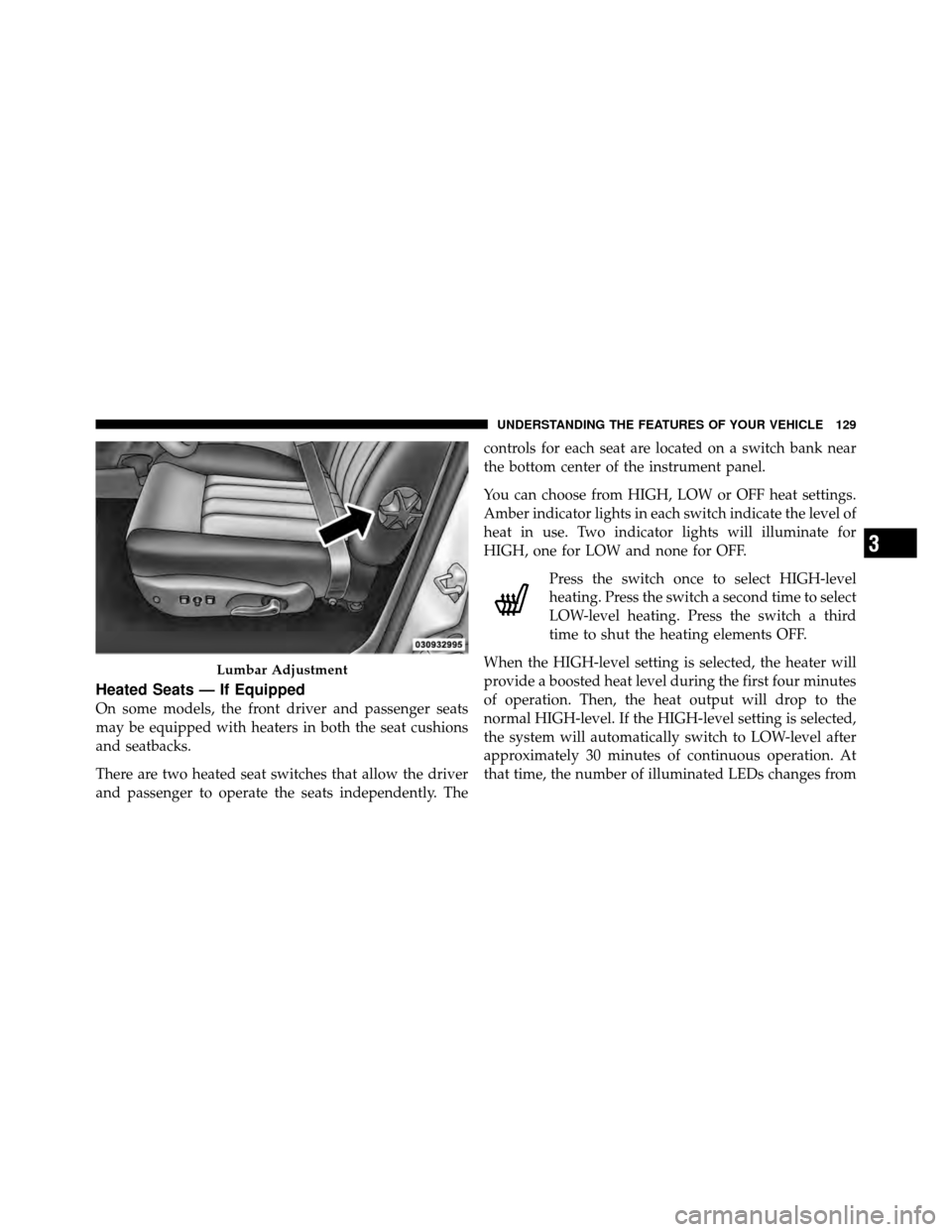
Lumbar Adjustment
3
UNDERSTANDING THE FEATURES OF YOUR VEHICLE 129