Page 334 of 452
8. After the NEUTRAL indicator light turns off, release
the NEUTRAL button.
9. After the NEUTRAL button has been released, the
transfer case will shift into the position identified by the
transfer case switch.
10. Start the engine. Shift the transmission into DRIVE to
verify that the transfer case has engaged.
11. Set the parking brake. Shift the transmission into
PARK.
NOTE:
•Steps 1 through 5 are requirements that must be met
prior to pressing the NEUTRAL button, and must
continue to be met until one second elapses and the
shift has been completed. If any of these requirements
(with the exception of 3 - key ON) are not met prior to
pressing the NEUTRAL button or are no longer met
during the one second time, then all of the modeposition indicator lights will flash continuously until
all requirements are met or until the NEUTRAL button
is released.
•The ignition key must be ON for a shift to take place
and for the position indicator lights to be operable. If
the key is not ON, the shift will not take place and no
position indicator lights will be on or flashing.
•A flashing NEUTRAL position indicator light indicates
that shift requirements have not been met.
CAUTION!
•Do not use a bumper mounted clamp-on tow bar
on your vehicle. The bumper face bar will be
damaged.
•Do not disconnect the rear driveshaft because
fluid will leak from the transfer case and damage
internal parts.
332 STARTING AND OPERATING
Page 356 of 452
▫Exhaust System ..................... 368
▫ Cooling System ..................... 371
▫ Brake System ....................... 376
▫ Automatic Transmission ............... 378
▫ Transfer Case ....................... 381
▫ Front/Rear Axle Fluid ................. 381
▫ Appearance Care And Protection From
Corrosion .......................... 382
� Fuses .............................. 387
▫ Underhood Fuses (Power Distribution
Center) ........................... 387
� Vehicle Storage ....................... 391
� Replacement Bulbs .................... 392 �
Bulb Replacement ..................... 392
▫ Headlamp (Halogen)/Front Park And Turn
Signal Lamps ....................... 392
▫ Rear Side Marker, Taillamps/Stop Lamps,
And Turn Signal Bulbs ................ 394
▫ Center High-Mounted Stop Lamp And Cargo
Lamp ............................. 397
▫ License Lamps ...................... 399
▫ Fog Lamps ......................... 401
� Fluid Capacities ...................... 401
� Fluids, Lubricants And Genuine Parts ....... 402
▫ Engine ............................ 402
▫ Chassis ........................... 403
354 MAINTAINING YOUR VEHICLE
Page 357 of 452
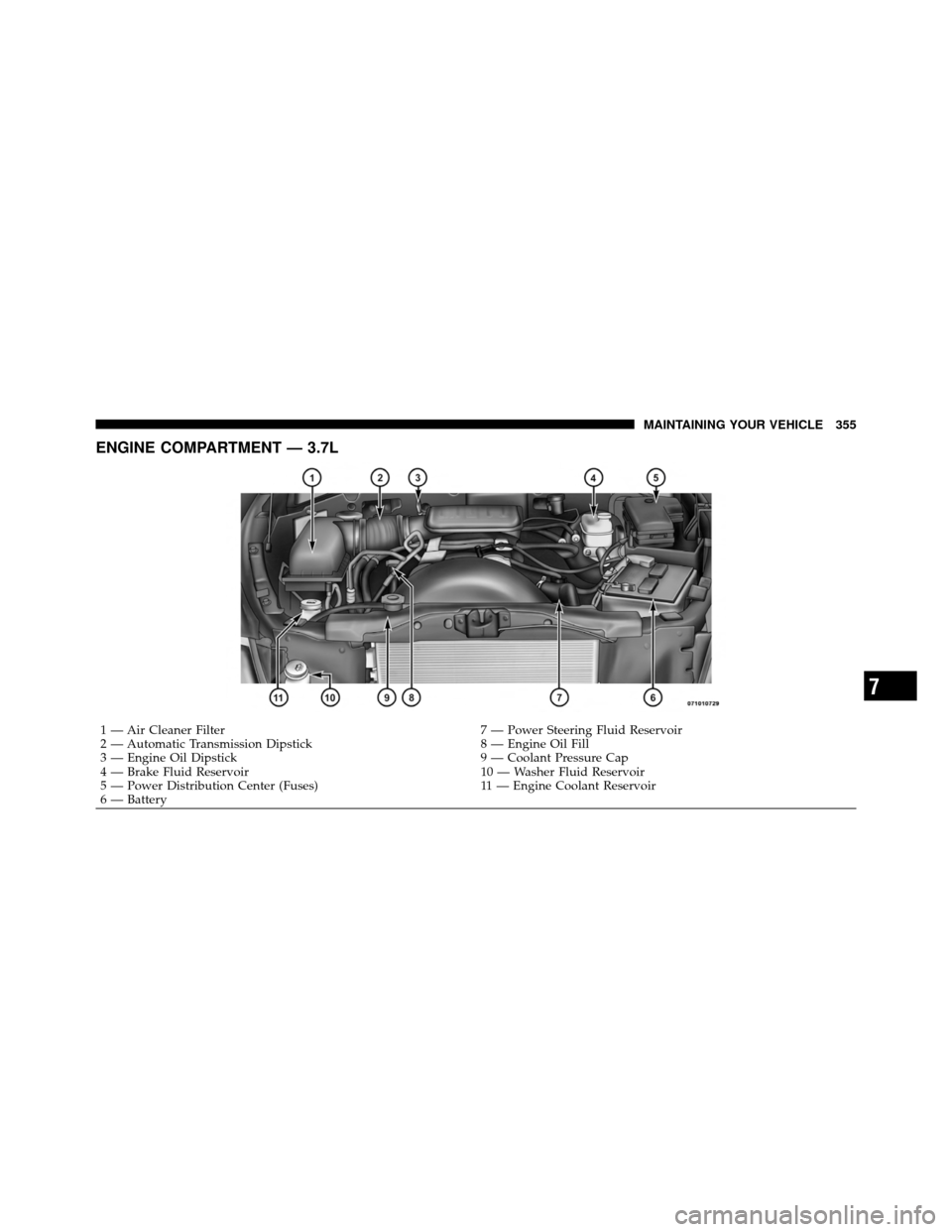
ENGINE COMPARTMENT — 3.7L
1 — Air Cleaner Filter7 — Power Steering Fluid Reservoir
2 — Automatic Transmission Dipstick 8 — Engine Oil Fill
3 — Engine Oil Dipstick 9 — Coolant Pressure Cap
4 — Brake Fluid Reservoir 10 — Washer Fluid Reservoir
5 — Power Distribution Center (Fuses) 11 — Engine Coolant Reservoir
6 — Battery
7
MAINTAINING YOUR VEHICLE 355
Page 358 of 452
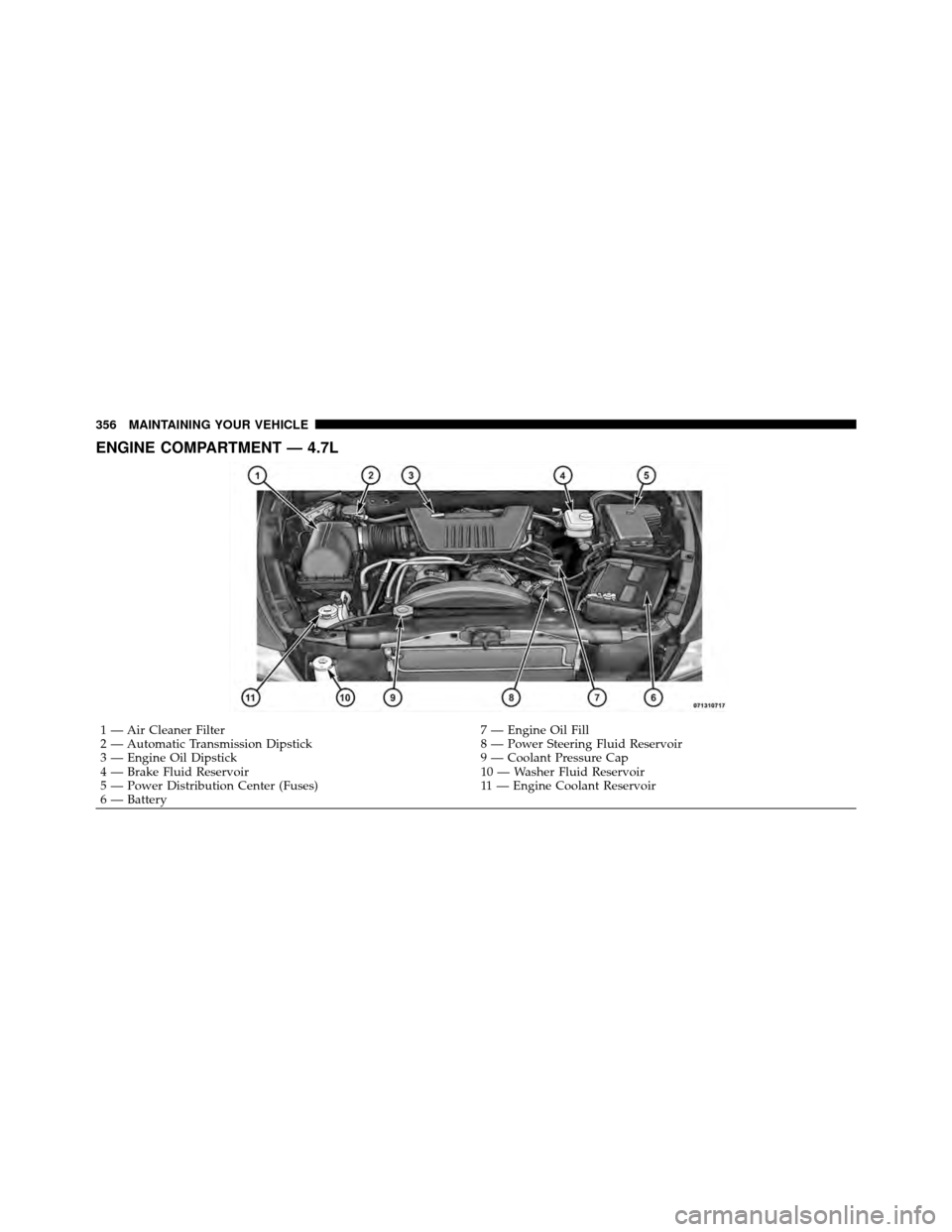
ENGINE COMPARTMENT — 4.7L
1 — Air Cleaner Filter7 — Engine Oil Fill
2 — Automatic Transmission Dipstick 8 — Power Steering Fluid Reservoir
3 — Engine Oil Dipstick 9 — Coolant Pressure Cap
4 — Brake Fluid Reservoir 10 — Washer Fluid Reservoir
5 — Power Distribution Center (Fuses) 11 — Engine Coolant Reservoir
6 — Battery
356 MAINTAINING YOUR VEHICLE
Page 378 of 452

•If frequent engine coolant (antifreeze) additions are
required, or if the level in the coolant recovery bottle
does not drop when the engine cools, the cooling
system should be pressure tested for leaks.
•Maintain engine coolant (antifreeze) concentration at
50% HOAT engine coolant (antifreeze) (minimum)
and distilled/deionized water for proper corrosion
protection of your engine, which contains aluminum
components.
•Make sure that the radiator and coolant recovery
bottle overflow hoses are not kinked or obstructed.
•Keep the front of the radiator clean. If your vehicle is
equipped with air conditioning, also keep the front of
the condenser clean.
•Do not change the thermostat for Summer or Winter
operation. If replacement is ever necessary, install
ONLY the correct type thermostat. Other designs mayresult in unsatisfactory engine coolant (antifreeze)
performance, poor gas mileage, and increased
emissions.
Brake System
Fluid Level Check – Brake Master Cylinder
The fluid level in the master cylinder should be checked
whenever the vehicle is serviced, or immediately if the
“Brake Warning Light” is on. If necessary, add fluid to
bring level to the full mark on the side of the reservoir of
the brake master cylinder. Be sure to clean the top of the
master cylinder area before removing the cap. With disc
brakes, the fluid level can be expected to fall as the brake
pads wear. Brake fluid level should be checked when
pads are replaced. If the brake fluid level is abnormally
low, check the system for leaks.
Refer to “Fluids, Lubricants, and Genuine Parts” in
“Maintaining Your Vehicle” for further information.
376 MAINTAINING YOUR VEHICLE
Page 379 of 452
WARNING!
•Use only manufacturer’s recommended brake
fluid. Refer to “Fluids, Lubricants, and Genuine
Parts” in “Maintaining Your Vehicle” for further
information. Using the wrong type of brake fluid
can severely damage your brake system and/or
impair its performance. The proper type of brake
fluid for your vehicle is also identified on the
original factory installed hydraulic master cylin-
der reservoir.(Continued)
WARNING! (Continued)
•To avoid contamination from foreign matter or
moisture, use only new brake fluid or fluid that
has been in a tightly closed container. Keep the
master cylinder reservoir cap secured at all times.
Brake fluid in a open container absorbs moisture
from the air resulting in a lower boiling point.
This may cause it to boil unexpectedly during hard
or prolonged braking, resulting in sudden brake
failure. This could result in a collision.
•Overfilling the brake fluid reservoir can result in
spilling brake fluid on hot engine parts, causing
the brake fluid to catch fire. Brake fluid can also
damage painted and vinyl surfaces, care should be
taken to avoid its contact with these surfaces.(Continued)
7
MAINTAINING YOUR VEHICLE 377
Page 380 of 452
WARNING! (Continued)
•Do not allow petroleum based fluid to contami-
nate the brake fluid. Brake seal components could
be damaged, causing partial or complete brake
failure. This could result in a collision.
Automatic Transmission
Selection Of Lubricant
It is important that the proper lubricant is used in the
transmission to assure optimum transmission perfor-
mance. Use only the manufacturer ’s recommended trans-
mission fluid. Refer to “Fluids, Lubricants, and Genuine
Parts” in “Maintaining Your Vehicle” for further informa-
tion. It is important that the transmission fluid be main-
tained at the prescribed level using the recommended
fluid. No chemical flushes should be used in any trans-
mission; only the approved lubricant may be used.
Special Additives
Automatic Transmission Fluid (ATF) is an engineered
product and its performance may be impaired by supple-
mental additives. Therefore, do not add any fluid addi-
tives to the transmission. The only exception to this
policy is the use of special dyes to aid in detecting fluid
leaks. In addition, avoid using transmission sealers as
they may adversely affect seals.
NOTE:If your vehicle is equipped with a dipstick, use
the following procedure. If your vehicle has a capped
dipstick, it is sealed and should not be tampered with.
Your authorized dealer has the proper tools to ensure that
the fluid level is set properly.
378 MAINTAINING YOUR VEHICLE
Page 381 of 452
Fluid Level Check
Check the fluid level while the transmission is at normal
operating temperature 180° F (82° C). This occurs after at
least 15 miles (24 km) of driving. At normal operating
temperature the fluid cannot be held comfortably be-
tween the fingertips.
To check the automatic transmission fluid level properly,
the following procedure must be used:
1. Operate the engine at idle speed and normal operating
temperature.
2. The vehicle must be on level ground.
3. Fully apply the parking brake and press the brake
pedal.
4. Place the shift lever momentarily into each gear posi-
tion, ending with the shift lever in PARK.5. Remove the dipstick, wipe it clean and reinsert it until
seated.
6. Remove the dipstick again and note the fluid level on
both sides. The fluid level should be between the “HOT”
(upper) reference holes on the dipstick at normal operat-
ing temperature. Verify that solid coating of oil is seen on
both sides of the dipstick. If the fluid is low, add as
required into the dipstick tube.
Do not overfill.After
adding any quantity of oil through the oil fill tube, wait
a minimum of two minutes for the oil to fully drain into
the transmission before rechecking the fluid level.
NOTE: If it is necessary to check the transmission below
the operating temperature, the fluid level should be
between the two “COLD” (lower) holes on the dipstick
with the fluid at approximately 70° F (21° C) (room
temperature). If the fluid level is correctly established at
room temperature, it should be between the “HOT”
7
MAINTAINING YOUR VEHICLE 379