Page 404 of 566

CAUTION!
•The TPMS has been optimized for the original
equipment tires and wheels. TPMS pressures and
warning have been established for the tire size
equipped on your vehicle. Undesirable system
operation or sensor damage may result when us-
ing replacement equipment that is not of the same
size, type, and/or style. Aftermarket wheels can
cause sensor damage. Do not use aftermarket tire
sealants or balance beads if your vehicle is
equipped with a TPMS, as damage to the sensors
may result.
•After inspecting or adjusting the tire pressure,
always reinstall the valve stem cap. This will
prevent moisture and dirt from entering the valve
stem, which could damage the TPM sensor.NOTE:
•The TPMS is not intended to replace normal tire care
and maintenance or to provide warning of a tire failure
or condition.
•The TPMS should not be used as a tire pressure gauge
while adjusting your tire pressure.
•Driving on a significantly under-inflated tire causes
the tire to overheat and can lead to tire failure.
Under-inflation also reduces fuel efficiency and tire
tread life, and may affect the vehicle’s handling and
stopping ability.
•The TPMS is not a substitute for proper tire mainte-
nance, and it is the driver ’s responsibility to maintain
correct tire pressure using an accurate tire pressure
gauge, even if under-inflation has not reached the
level to trigger illumination of the TPM Telltale Light.
402 STARTING AND OPERATING
Page 405 of 566

•Seasonal temperature changes will affect tire pressure,
and the TPMS will monitor the actual tire pressure in
the tire.
Base System
The Tire Pressure Monitor System (TPMS) uses wireless
technology with wheel rim mounted electronic sensors to
monitor tire pressure levels. Sensors mounted to each
wheel as part of the valve stem transmit tire pressure
readings to the receiver module.
NOTE:It is particularly important for you to check the
tire pressure in all of the tires on your vehicle monthly
and to maintain the proper pressure.
The TPMS consists of the following components:
•Receiver module,
•Four TPM sensors, and
•TPM Telltale Light The matching full size spare wheel and tire assembly (if
equipped) has a TPM sensor. The matching full size spare
can be used in place of any of the four road tires. The
TPMS will only monitor the pressure in the full size spare
when it is used in place of a road tire. Otherwise, a spare
with a pressure below the low-pressure limit will not
cause the TPM Telltale Light to illuminate or the chime to
sound.
Tire Pressure Monitoring Low Pressure Warnings
The TPM Telltale Light will illuminate in the
instrument cluster, a
�LOW TIRE�message will be
displayed and a chime will sound when tire pres-
sure is low in one or more of the four active road tires.
Should this occur, you should stop as soon as possible,
check the inflation pressure of each tire on your vehicle,
and inflate each tire to the vehicle’s recommended cold
placard pressure value. Once the system receives the
updated tire pressures, the system will automatically
update and the TPM Telltale Light and �LOW TIRE�5
STARTING AND OPERATING 403
Page 406 of 566

message will turn off. The vehicle may need to be driven
for up to 20 minutes above 15 mph (24 km/h) in order for
the TPMS to receive this information.
Service TPMS Warning
If a system fault is detected, the TPM Telltale Light will
flash on and off for 75 seconds and then remain on solid.
The system fault will also sound a chime. If the ignition
switch is cycled, this sequence will repeat, providing the
system fault still exists. The TPM Telltale Light will turn
off when the fault condition no longer exists. A system
fault can occur due to any of the following:
1. Signal interference due to electronic devices or driving
next to facilities emitting the same radio frequencies as
the TPM sensors.
2. Installing aftermarket window tinting that contains
materials that may block radio wave signals.
3. Accumulation of snow or ice around the wheels or
wheel housings.4. Using tire chains on the vehicle.
5. Using wheels/tires not equipped with TPM sensors.
Vehicles with Full Size Spare
1. The matching full size spare wheel and tire assembly
has a TPM sensor that can be monitored by the TPMS.
2. If you install the full size spare in place of a road tire
that has a pressure below the low-pressure warning limit,
upon the next ignition switch cycle, a chime will sound
and the TPM Telltale Light and
�LOW TIRE�message will
turn ON.
3. Driving the vehicle for up to 20 minutes above 15 mph
(24 km/h) will turn off the TPM Telltale Light and �LOW
TIRE� message as long as no tire pressure is below the
low-pressure warning limit in any of the four active road
tires.
404 STARTING AND OPERATING
Page 408 of 566
The TPMS consists of the following components:
•Receiver module,
•Four TPM sensors,
•Various TPMS messages, which display in the Elec-
tronic Vehicle Information Center (EVIC), and
•TPM Telltale Light
The matching full size spare wheel and tire assembly (if
equipped) has a TPM sensor. The full size spare can be
used in place of any of the four road tires. A spare with a
pressure below the low-pressure limit will not cause the
TPM Telltale Light to illuminate or the chime to sound.
Tire Pressure Monitoring Low Pressure Warnings
The TPM Telltale Light will illuminate in the
instrument cluster and a chime will sound when tire pressure is low in one or more of the four active road
tires. In addition, the EVIC will display a
�LOW TIRE�
message and a graphic showing the pressure values of
each tire with the low tire pressure values flashing.
406 STARTING AND OPERATING
Page 410 of 566

If the ignition switch is cycled, this sequence will repeat,
providing the system fault still exists. If the system fault
no longer exists, the TPM Telltale Light will no longer
flash, and the�SERVICE TPM SYSTEM� message will no
longer display, and a pressure value will display in place
of the dashes. A system fault can occur due to any of the
following:
1. Signal interference due to electronic devices or driving
next to facilities emitting the same radio frequencies as
the TPM sensors.
2. Installing aftermarket window tinting that contains
materials that may block radio wave signals.
3. Accumulation of snow or ice around the wheels or
wheel housings.
4. Using tire chains on the vehicle.
5. Using wheels/tires not equipped with TPM sensors. The EVIC will also display a
�SERVICE TPM SYSTEM�
message for a minimum of five seconds when a system
fault related to an incorrect sensor location fault is
detected. In this case, the �SERVICE TPM SYSTEM�
message is then followed with a graphic display with
pressure values still shown. This indicates that the pres-
sure values are still being received from the TPM sensors
but they may not be located in the correct vehicle
position. The system still needs to be serviced as long as
the �SERVICE TPM SYSTEM� message is displayed.
Vehicles with Full Size Spare
1. The matching full size spare wheel and tire assembly
has a TPM sensor that can be monitored by the TPMS.
2. If you install the full size spare in place of a road tire
that has a pressure below the low-pressure warning limit,
upon the next ignition switch cycle, a chime will sound
and the TPM Telltale Light will turn ON. In addition, the
408 STARTING AND OPERATING
Page 562 of 566
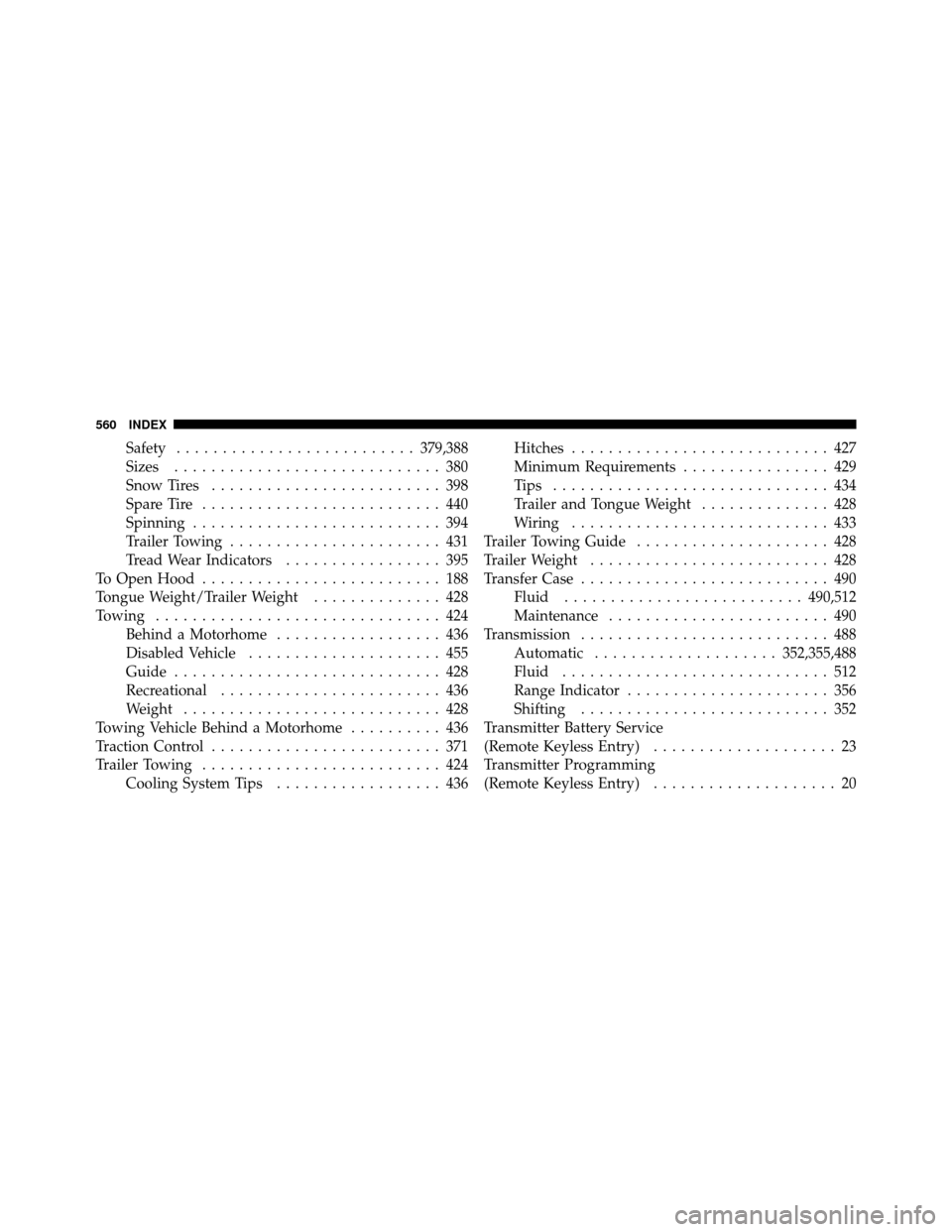
Safety.......................... 379,388
Sizes ............................. 380
Snow Tires ......................... 398
Spare Tire .......................... 440
Spinning ........................... 394
Trailer Towing ....................... 431
Tread Wear Indicators ................. 395
To Open Hood .......................... 188
Tongue Weight/Trailer Weight .............. 428
Towing ............................... 424
Behind a Motorhome .................. 436
Disabled Vehicle ..................... 455
Guide ............................. 428
Recreational ........................ 436
Weight ............................ 428
Towing Vehicle Behind a Motorhome .......... 436
Traction Control ......................... 371
Trailer Towing .......................... 424
Cooling System Tips .................. 436 Hitches
............................ 427
Minimum Requirements ................ 429
Tips .............................. 434
Trailer and Tongue Weight .............. 428
Wiring ............................ 433
Trailer Towing Guide ..................... 428
Trailer Weight .......................... 428
Transfer Case ........................... 490
Fluid .......................... 490,512
Maintenance ........................ 490
Transmission ........................... 488
Automatic .................... 352,355,488
Fluid ............................. 512
Range Indicator ...................... 356
Shifting ........................... 352
Transmitter Battery Service
(Remote Keyless Entry) .................... 23
Transmitter Programming
(Remote Keyless Entry) .................... 20
560 INDEX
Page:
< prev 1-8 9-16 17-24
