2011 DODGE CHALLENGER brake light
[x] Cancel search: brake lightPage 285 of 490
WARNING! (Continued)
•The Anti-Lock Brake System (ABS) cannot prevent
the natural laws of physics from acting on the
vehicle, nor can it increase braking or steering
efficiency beyond that afforded by the condition
of the vehicle brakes and tires or the traction
afforded.
•The Anti-Lock Brake System (ABS) cannot prevent
collisions, including those resulting from exces-
sive speed in turns, following another vehicle too
closely, or hydroplaning.
•The capabilities of an Anti-Lock Brake System
(ABS) equipped vehicle must never be exploited
in a reckless or dangerous manner, that could
jeopardize the user’s safety or the safety of others.
All vehicle wheels and tires must be the same size and
type and tires must be properly inflated to produce
accurate signals for the computer.
Anti-Lock Brake Warning Light
The “Anti-Lock Brake System (ABS) Warning
Light” monitors the Anti-Lock Brake System. The
light will come on when the ignition switch is turned to
the ON position and may stay on for as long as four
seconds.
If the “ABS Warning Light” remains on or comes on
while driving, it indicates that the anti-lock portion of the
brake system is not functioning and that service is
required. However, the conventional brake system will
continue to operate normally if the “Brake Warning
Light” is not on.
If the “ABS Warning Light” is on, the brake system
should be serviced as soon as possible to restore the
benefits of anti-lock brakes. If the “ABS Warning Light”
does not come on when the ignition switch is turned to
the ON position, have the bulb repaired as soon as
possible.
5
STARTING AND OPERATING 283
Page 286 of 490
If both the “Brake Warning Light” and the “ABS Warning
Light” remain on, the ABS and EBD systems are not
functioning. Immediate repair to the ABS system is
required.
ELECTRONIC BRAKE CONTROL SYSTEM
Your vehicle is equipped with an advanced electronic
brake control system commonly referred to as ESP. This
system includes the Anti-Lock Brake System (ABS), the
Traction Control System (TCS), the Brake Assist System
(BAS), and the Electronic Stability Program (ESP). These
systems work together to enhance both vehicle stability
and control in various driving conditions.
An additional electronic brake control feature called Hill
Start Assist (HSA) is standard on manual transmission
models.
Anti-Lock Brake System (ABS)
This system aids the driver in maintaining vehicle control
under adverse braking conditions by controlling hydrau-
lic brake pressure. This prevents wheel lock-up to help
avoid skidding on slippery surfaces during braking.
Refer to “Anti-Lock Brake System” in “Starting and
Operating” for further information.
WARNING!
The ABS cannot prevent the natural laws of physics
from acting on the vehicle, nor can it increase the
traction afforded by prevailing road conditions. The
ABS cannot prevent accidents, including those result-
ing from excessive speed in turns, driving on very
slippery surfaces, or hydroplaning. The capabilities
of an ABS-equipped vehicle must never be exploited
in a reckless or dangerous manner that could jeopar-
dize the user’s safety or the safety of others.
284 STARTING AND OPERATING
Page 289 of 490

WARNING!
There may be situations on minor hills (i.e., less than
8%), with a loaded vehicle, or while pulling a trailer,
when the system will not activate and slight rolling
may occur. This could cause a collision with another
vehicle or object. Always remember the driver is
responsible for braking the vehicle.
Disabling/Enabling HSA
If you wish to turn on or off the HSA system, it can be
done using the Customer Programmable Features in the
Electronic Vehicle Information Center (EVIC). Refer to
“Electronic Vehicle Information Center (EVIC)” in “Un-
derstanding Your Instrument Panel” for further
information.
Electronic Stability Program (ESP)
This system enhances directional control and stability of
the vehicle under various driving conditions. The ESP
corrects for oversteering and understeering the vehicle
by applying the brake of the appropriate wheel. Engine
power may also be reduced to assist in counteracting the
condition of oversteer or understeer and help the vehicle
maintain the desired path.
The ESP uses sensors in the vehicle to determine the path
that the driver intends to steer the vehicle and compares
it to the actual path of the vehicle. When the actual path
does not match the intended path, the ESP applies the
brake of the appropriate wheel to assist in counteracting
the condition of oversteer or understeer.
•Oversteer - when the vehicle is turning more than
appropriate for the steering wheel position.
•Understeer - when the vehicle is turning less than
appropriate for the steering wheel position.
5
STARTING AND OPERATING 287
Page 339 of 490
WARNING!
•An improperly adjusted weight distributing hitch
system may reduce handling, stability, braking
performance, and could result in a collision.
•Weight distributing systems may not be compat-
ible with surge brake couplers. Consult with your
hitch and trailer manufacturer or a reputable rec-
reational vehicle dealer for additional
information.
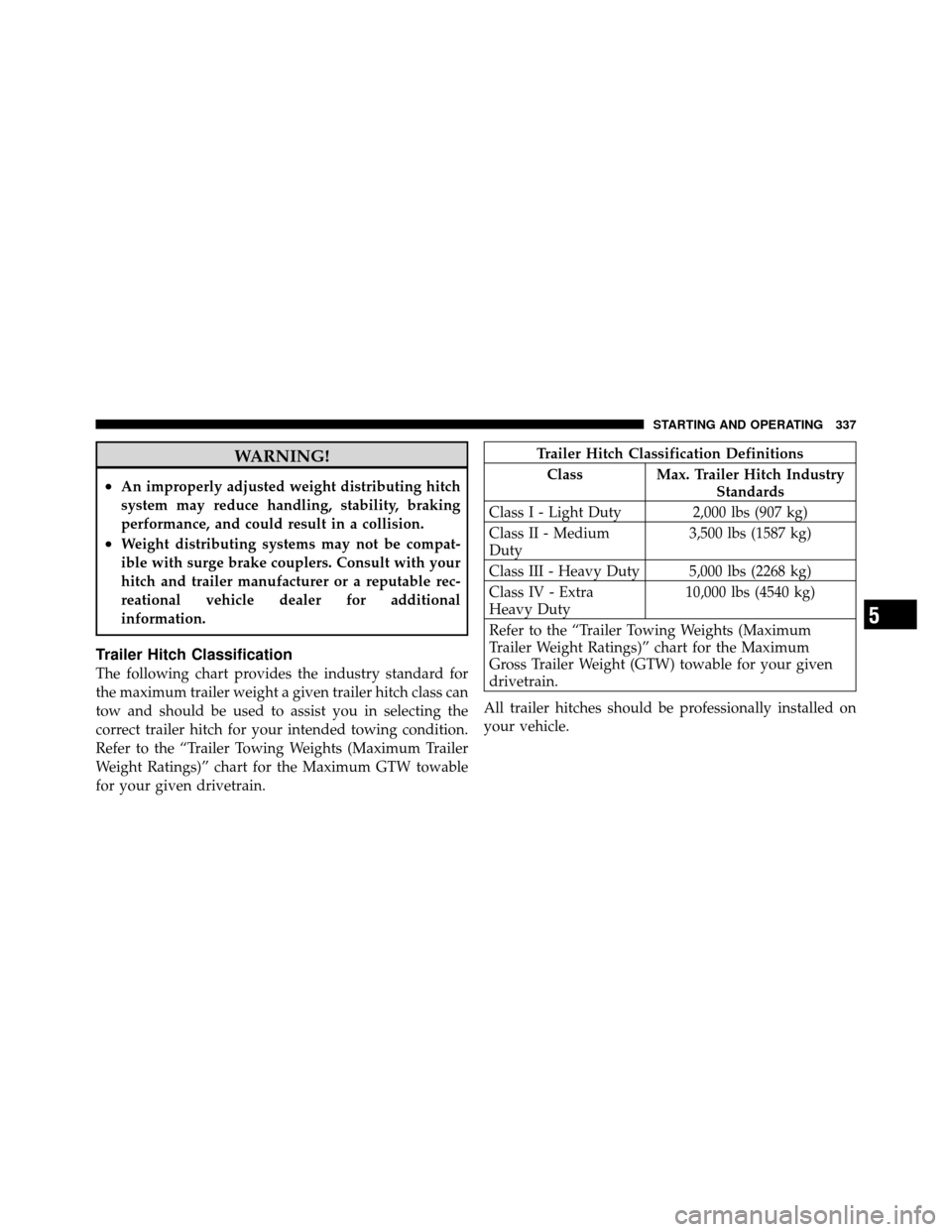
Trailer Hitch Classification
The following chart provides the industry standard for
the maximum trailer weight a given trailer hitch class can
tow and should be used to assist you in selecting the
correct trailer hitch for your intended towing condition.
Refer to the “Trailer Towing Weights (Maximum Trailer
Weight Ratings)” chart for the Maximum GTW towable
for your given drivetrain.
Trailer Hitch Classification DefinitionsClass Max. Trailer Hitch Industry Standards
Class I - Light Duty 2,000 lbs (907 kg)
Class II - Medium
Duty 3,500 lbs (1587 kg)
Class III - Heavy Duty 5,000 lbs (2268 kg)
Class IV - Extra
Heavy Duty 10,000 lbs (4540 kg)
Refer to the “Trailer Towing Weights (Maximum
Trailer Weight Ratings)” chart for the Maximum
Gross Trailer Weight (GTW) towable for your given
drivetrain.
All trailer hitches should be professionally installed on
your vehicle.
5
STARTING AND OPERATING 337
Page 410 of 490
Master Cylinder – Brake Fluid Level Check
Check the fluid level in the master cylinder immediately
if the brake system warning light indicates system fail-
ure.
Check the fluid level in the master cylinder when per-
forming underhood services.
Clean the top of the master cylinder area before removing
the cap. Add fluid to bring the level up to the “MAX”
mark on the side of the master cylinder reservoir.
Overfilling of fluid is not recommended because it may
cause leaking in the system.
Add enough fluid to bring the level up to the require-
ments described on the brake fluid reservoir. With disc
brakes, fluid level can be expected to fall as the brake
pads wear. However, low fluid level may be caused by a
leak and a checkup may be needed.Use only manufacturer’s recommended brake fluid. Re-
fer to “Fluids, Lubricants, and Genuine Parts” in “Main-
taining Your Vehicle” for further information.
WARNING!
•Use only manufacturer’s recommended brake
fluid. Refer to “Fluids, Lubricants, and Genuine
Parts” in “Maintaining Your Vehicle” for further
information. Using the wrong type of brake fluid
can severely damage your brake system and/or
impair its performance. The proper type of brake
fluid for your vehicle is also identified on the
original factory installed hydraulic master cylin-
der reservoir.
(Continued)
408 MAINTAINING YOUR VEHICLE
Page 442 of 490

Once A Month
•Check tire pressure and look for unusual wear or
damage.
•Inspect the battery, and clean and tighten the terminals
as required.
•Check the fluid levels of the coolant reservoir, brake
master cylinder, and power steering, and add as
needed.
•Check all lights and other electrical items for correct
operation.At Each Oil Change
•Change the engine oil filter.
•Inspect the brake hoses and lines.
CAUTION!
Failure to perform the required maintenance items
may result in damage to the vehicle.
Required Maintenance Intervals
Refer to the Maintenance Schedules on the following
pages for the required maintenance intervals.
8
M
A I
N T
E
N A
N CE
S
C
H E
D
U L
E
S440 MAINTENANCE SCHEDULES
Page 468 of 490
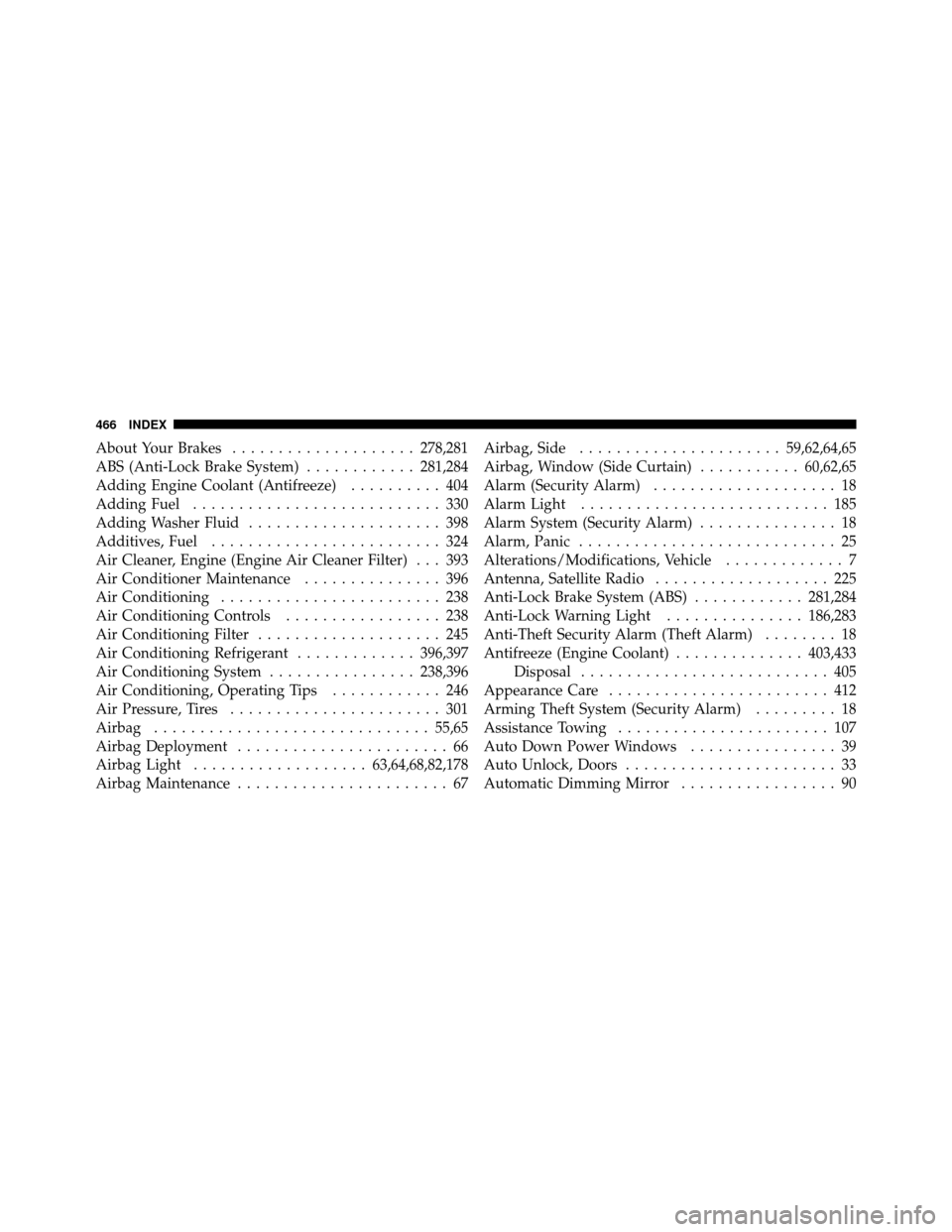
About Your Brakes.................... 278,281
ABS (Anti-Lock Brake System) ............281,284
Adding Engine Coolant (Antifreeze) .......... 404
Adding Fuel ........................... 330
Adding Washer Fluid ..................... 398
Additives, Fuel ......................... 324
Air Cleaner, Engine (Engine Air Cleaner Filter) . . . 393
Air Conditioner Maintenance ............... 396
Air Conditioning ........................ 238
Air Conditioning Controls ................. 238
Air Conditioning Filter .................... 245
Air Conditioning Refrigerant .............396,397
Air Conditioning System ................238,396
Air Conditioning, Operating Tips ............ 246
Air Pressure, Tires ....................... 301
Airbag .............................. 55,65
Airbag Deployment ....................... 66
Airbag Light ................... 63,64,68,82,178
Airbag Maintenance ....................... 67 Airbag, Side
...................... 59,62,64,65
Airbag, Window (Side Curtain) ...........60,62,65
Alarm (Security Alarm) .................... 18
Alarm Light ........................... 185
Alarm System (Security Alarm) ............... 18
Alarm, Panic ............................ 25
Alterations/Modifications, Vehicle ............. 7
Antenna, Satellite Radio ................... 225
Anti-Lock Brake System (ABS) ............281,284
Anti-Lock Warning Light ...............186,283
Anti-Theft Security Alarm (Theft Alarm) ........ 18
Antifreeze (Engine Coolant) ..............403,433
Disposal ........................... 405
Appearance Care ........................ 412
Arming Theft System (Security Alarm) ......... 18
Assistance Towing ....................... 107
Auto Down Power Windows ................ 39
Auto Unlock, Doors ....................... 33
Automatic Dimming Mirror ................. 90
466 INDEX
Page 469 of 490
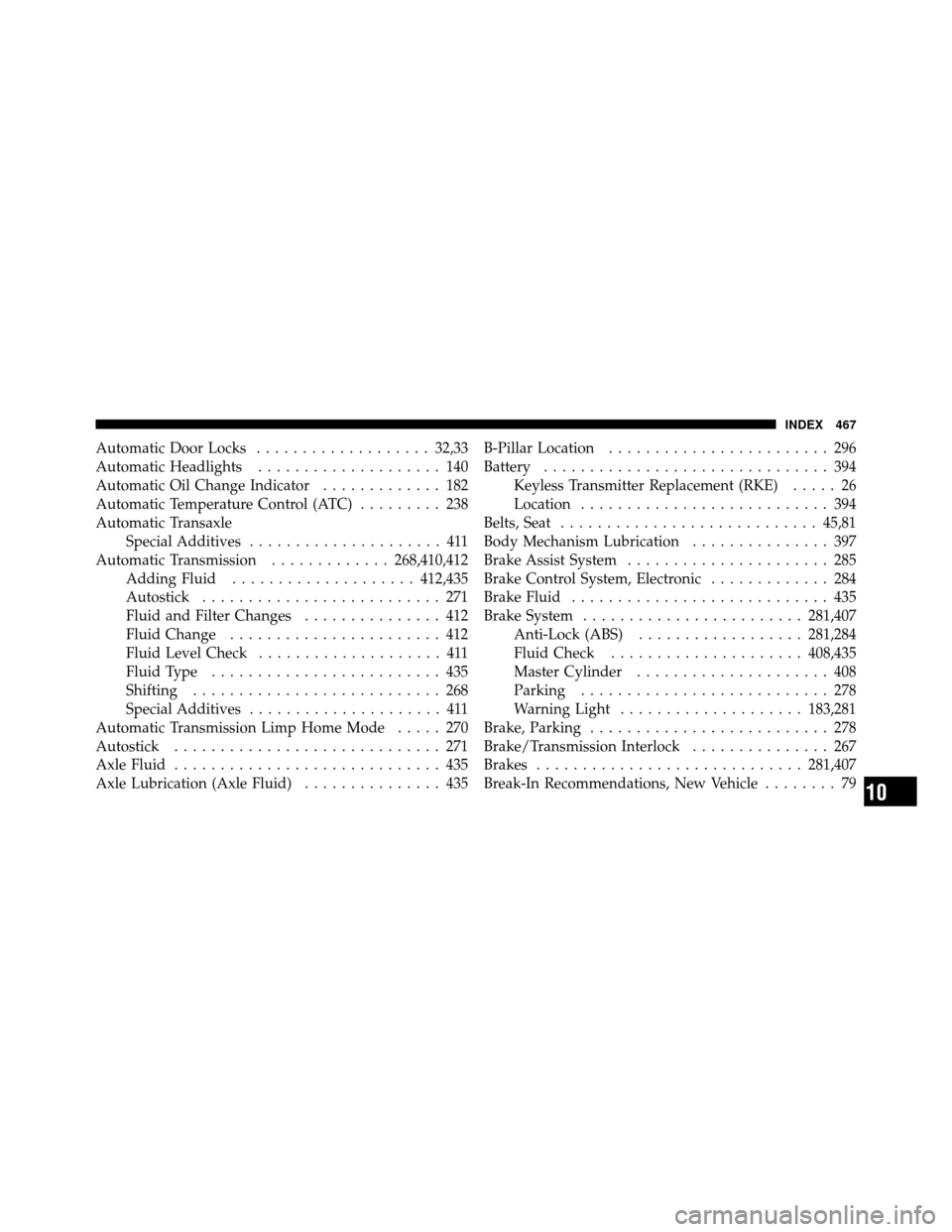
Automatic Door Locks................... 32,33
Automatic Headlights .................... 140
Automatic Oil Change Indicator ............. 182
Automatic Temperature Control (ATC) ......... 238
Automatic Transaxle Special Additives ..................... 411
Automatic Transmission .............268,410,412
Adding Fluid .................... 412,435
Autostick .......................... 271
Fluid and Filter Changes ............... 412
Fluid Change ....................... 412
Fluid Level Check .................... 411
Fluid Type ......................... 435
Shifting ........................... 268
Special Additives ..................... 411
Automatic Transmission Limp Home Mode ..... 270
Autostick ............................. 271
Axle Fluid ............................. 435
Axle Lubrication (Axle Fluid) ............... 435B-Pillar Location
........................ 296
Battery ............................... 394
Keyless Transmitter Replacement (RKE) ..... 26
Location ........................... 394
Belts, Seat ............................ 45,81
Body Mechanism Lubrication ............... 397
Brake Assist System ...................... 285
Brake Control System, Electronic ............. 284
Brake Fluid ............................ 435
Brake System ........................ 281,407
Anti-Lock (ABS) .................. 281,284
Fluid Check ..................... 408,435
Master Cylinder ..................... 408
Parking ........................... 278
Warning Light .................... 183,281
Brake, Parking .......................... 278
Brake/Transmission Interlock ............... 267
Brakes ............................. 281,407
Break-In Recommendations, New Vehicle ........ 79
10
INDEX 467