2011 DODGE CARAVAN tire pressure
[x] Cancel search: tire pressurePage 433 of 562
WARNING! (Continued)
3. GAWR
4. Trailer tongue weight rating for that trailer hitch.
(This requirement may limit the ability to always
achieve the 10% to 15% range of trailer tongue weight
as a percentage of total trailer weight.)
Towing Requirements – Tires
•
Do not attempt to tow a trailer while using a compact
spare tire.
•Proper tire inflation pressures are essential to the safe
and satisfactory operation of your vehicle. Refer to
“Tires – General Information” in “Starting and Oper-
ating” for proper tire inflation procedures.
•Check the trailer tires for proper tire inflation pres-
sures before trailer usage.
•Check for signs of tire wear or visible tire damage
before towing a trailer. Refer to “Tires – General
Information” in “Starting and Operating” for the
proper inspection procedure.
•When replacing tires, refer to “Tires – General Infor-
mation” in “Starting and Operating” for proper tire
replacement procedures. Replacing tires with a higher
load carrying capacity will not increase the vehicle’s
GVWR and GAWR limits.
Towing Requirements – Trailer Brakes
•
Donot interconnect the hydraulic brake system or
vacuum system of your vehicle with that of the trailer.
This could cause inadequate braking and possible
personal injury.
5
STARTING AND OPERATING 431
ProCarManuals.com
Page 441 of 562

CAUTION!
Driving with a hot cooling system could damage
your vehicle. If temperature gauge reads “H”, pull
over and stop the vehicle. Idle the vehicle with the air
conditioner turned off until the pointer drops back
into the normal range. If the pointer remains on the
“H”, turn the engine off immediately, and call for
service.
WARNING!
You or others can be badly burned by hot engine
coolant (antifreeze) or steam from your radiator. If
you see or hear steam coming from under the hood,
do not open the hood until the radiator has had time
to cool. Never try to open a cooling system pressure
cap when the radiator or coolant bottle is hot.
JACKING AND TIRE CHANGING
WARNING!
•Do not attempt to change a tire on the side of the
vehicle close to moving traffic. Pull far enough off
the road to avoid the danger of being hit when
operating the jack or changing the wheel.
•Being under a jacked-up vehicle is dangerous. The
vehicle could slip off the jack and fall on you. You
could be crushed. Never put any part of your body
under a vehicle that is on a jack.
•Never start or run the engine while the vehicle is
on a jack. If you need to get under a raised vehicle,
take it to a service center where it can be raised on
a lift.(Continued)6
WHAT TO DO IN EMERGENCIES 439
ProCarManuals.com
Page 455 of 562
WARNING!
A loose tire or jack thrown forward in a collision or
hard stop could endanger the occupants of the ve-
hicle. Always stow the jack parts and the spare tire in
the places provided. Have the deflated (flat) tire
repaired or replaced immediately.
10. Place the deflated (flat) tire and compact spare tire
cover assembly. in the rear cargo area. Do not stow the
deflated tire in the spare tire location. Have the full-
sized tire repaired or replaced, as soon as possible.
11. Stow the cable and wheel spacer before driving the
vehicle. Reassemble the winch handle extensions to form
a “T” and fit the winch “T” handle over the drive nut.
Rotate the nut to the right until the winch mechanism
clicks at least three times. 12. Stow the jack, jack handle and winch handle tools
back in the stowage compartment.
13. Check the compact spare tire pressure as soon as
possible. Correct the tire pressure, as required.
Wheel Nuts
All wheel nuts should be tightened occasionally, to
eliminate the possibility of wheel studs being sheared or
the bolt holes in the wheels becoming elongated. This is
especially important during the first few hundred miles
of operation, and after each time a tire is changed, to
allow the wheel nuts to become properly set. All nuts
should first be firmly seated against the wheel. The nuts
should then be tightened to recommended torque.
Tighten the nuts to final torque in increments. Progress
around the bolt circle, tightening the nut opposite to the
nut just previously tightened until final torque is
achieved. Recommended torque is 102 ft lbs (138 N·m).
6
WHAT TO DO IN EMERGENCIES 453
ProCarManuals.com
Page 462 of 562
FREEING A STUCK VEHICLE
If your vehicle becomes stuck in mud, sand or snow, it
can often be moved by a rocking motion. Turn your
steering wheel right and left to clear the area around the
front wheels. Then move the shift lever back and forth
between DRIVE and REVERSE. Using minimal accelera-
tor pedal pressure to maintain the rocking motion, with-
out spinning the wheels, is most effective.
CAUTION!
Racing the engine or spinning the wheels may lead to
transmission overheating and failure. Allow the en-
gine to idle with the shift lever in NEUTRAL for at
least one minute after every five rocking-motion
cycles. This will minimize overheating and reduce
the risk of transmission failure during prolonged
efforts to free a stuck vehicle.NOTE:
To improve the vehicle’s traction when starting
off in deep snow, sand or gravel, it may be desirable to
switch the Electronic Stability Program (ESP) to “Partial
Off” mode. Refer to “Electronic Brake Control System” in
“Starting and Operating” for further information.
CAUTION!
•When “rocking” a stuck vehicle by moving be-
tween DRIVE and REVERSE, do not spin the
wheels faster than 15 mph (24 km/h), or drivetrain
damage may result.
•Revving the engine or spinning the wheels too fast
may lead to transmission overheating and failure.
It can also damage the tires. Do not spin the
wheels above 30 mph (48 km/h) while in gear (no
transmission shifting occurring).
460 WHAT TO DO IN EMERGENCIES
ProCarManuals.com
Page 486 of 562

Cooling System
WARNING!
•When working near the radiator cooling fan, dis-
connect the fan motor lead or turn the ignition
switch to the OFF position. The fan is temperature
controlled and can start at anytime the ignition
switch is in the ON position.
•You or others can be badly burned by hot engine
coolant (antifreeze) or steam from your radiator. If
you see or hear steam coming from under the
hood, do not open the hood until the radiator has
had time to cool. Never try to open a cooling
system pressure cap when the radiator is hot.
Coolant Checks
Check the engine coolant (antifreeze) protection every
12 months (before the onset of freezing weather, where
applicable). If the engine coolant (antifreeze) is dirty orrusty in appearance, the system should be drained,
flushed and refilled with fresh coolant. Check the front of
the A/C condenser for any accumulation of bugs, leaves,
etc. If dirty, clean by gently spraying water from a garden
hose vertically down the face of the condenser.
Check the coolant recovery bottle tubing for brittle rub-
ber, cracking, tears, cuts and tightness of the connection
at the bottle and radiator. Inspect the entire system for
leaks.
With the engine at normal operating temperature (but
not running), check the cooling system pressure cap for
proper vacuum sealing by draining a small amount of
engine coolant (antifreeze) from the radiator drain cock.
If the cap is sealing properly, the engine coolant (anti-
freeze) will begin to drain from the coolant recovery
bottle. DO NOT REMOVE THE COOLANT PRESSURE
CAP WHEN THE COOLING SYSTEM IS HOT.
484 MAINTAINING YOUR VEHICLE
ProCarManuals.com
Page 505 of 562
CavityCartridge
Fuse Mini-Fuse Description
M9 — 20 Amp YellowRear Heated Seat –
If Equipped
M10 — 15 Amp BlueIgnition Off Draw —
Video System, Satel-
lite Radio, DVD,
Hands-Free Module,
Universal Garage
Door Opener, Vanity
Lamp, Streaming
Video Module
M11 — 10 Amp RedIgnition Off Draw –
Climate Control Sys-
tem
M12 — 30 Amp GreenAmplifier (AMP)/
RadioCavity
Cartridge
Fuse Mini-Fuse Description
M13 — 20 Amp YellowIgnition Off Draw—
Instrument Cluster,
SIREN, Clock Mod-
ule, Multi-Function
Control Switch/ITM
M14 — 20 Amp YellowSpare Fuse
M15 — 20 Amp YellowRear View Mirror,
Instrument Cluster,
Multi-Function Con-
trol Switch, Tire
Pressure Monitor,
Glow Plug Module –
Export Diesel Only,
Assy-Shifter (Hall
Effect), Acoustic
Noise Cancellation
7
MAINTAINING YOUR VEHICLE 503
ProCarManuals.com
Page 519 of 562

•Under no circumstances should oil change intervals
exceed 8,000 miles (13 000 km) or six months, which-
ever comes first.
Your authorized dealer will reset the oil change indicator
message after completing the scheduled oil change. If a
scheduled oil change is performed by someone other
than your authorized dealer, the message can be reset by
referring to the steps described under “Electronic Vehicle
Information Center (EVIC)/Oil Change Required” in
“Understanding Your Instrument Panel” or under “In-
strument Cluster Description/Odometer/Trip Odom-
eter” in “Understanding Your Instrument Panel” for
further information.
At Each Stop For Fuel
•Check the engine oil level about five minutes after a
fully warmed engine is shut OFF. Checking the oil
level while the vehicle is on level ground will improve the accuracy of the oil level reading. Add oil only
when the level is at or below the ADD, SAFE or MIN
mark.
•Check the windshield washer solvent and add if
required.
Once A Month
•Check tire pressure and look for unusual wear or
damage.
•Inspect the battery and clean and tighten the terminals
as required.
•Check the fluid levels of the coolant reservoir, the
brake master cylinder, the power steering and the
transmission and add as needed.
•Check all lights and other electrical items for correct
operation.
8
M A I
N T
E
N A
N CE
S
C
H E
D
U L
E
SMAINTENANCE SCHEDULES 517
ProCarManuals.com
Page 542 of 562
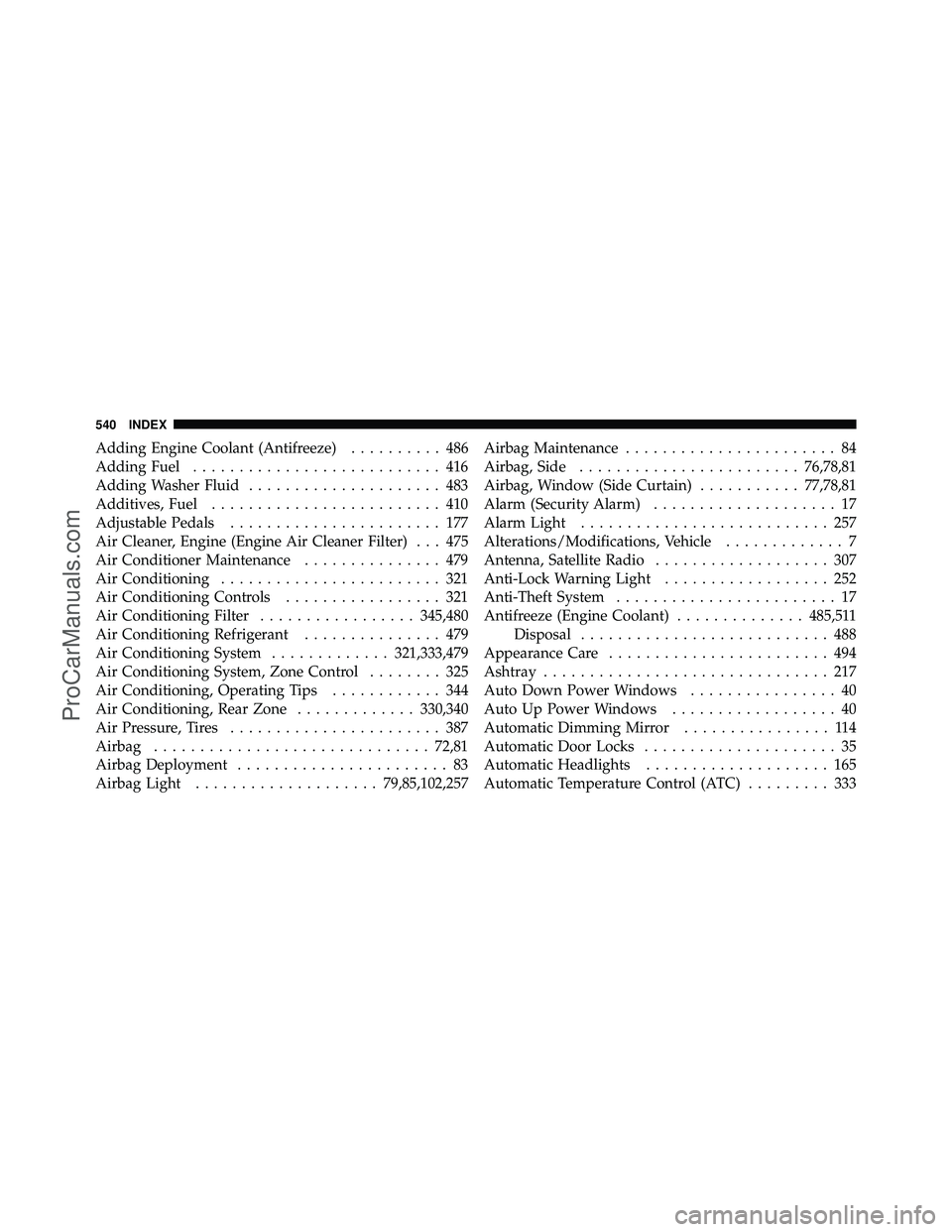
Adding Engine Coolant (Antifreeze).......... 486
Adding Fuel ........................... 416
Adding Washer Fluid ..................... 483
Additives, Fuel ......................... 410
Adjustable Pedals ....................... 177
Air Cleaner, Engine (Engine Air Cleaner Filter) . . . 475
Air Conditioner Maintenance ............... 479
Air Conditioning ........................ 321
Air Conditioning Controls ................. 321
Air Conditioning Filter .................345,480
Air Conditioning Refrigerant ............... 479
Air Conditioning System .............321,333,479
Air Conditioning System, Zone Control ........ 325
Air Conditioning, Operating Tips ............ 344
Air Conditioning, Rear Zone .............330,340
Air Pressure, Tires ....................... 387
Airbag .............................. 72,81
Airbag Deployment ....................... 83
Airbag Light .................... 79,85,102,257Airbag Maintenance
....................... 84
Airbag, Side ........................ 76,78,81
Airbag, Window (Side Curtain) ...........77,78,81
Alarm (Security Alarm) .................... 17
Alarm Light ........................... 257
Alterations/Modifications, Vehicle ............. 7
Antenna, Satellite Radio ................... 307
Anti-Lock Warning Light .................. 252
Anti-Theft System ........................ 17
Antifreeze (Engine Coolant) ..............485,511
Disposal ........................... 488
Appearance Care ........................ 494
Ashtray ............................... 217
Auto Down Power Windows ................ 40
Auto Up Power Windows .................. 40
Automatic Dimming Mirror ................ 114
Automatic Door Locks ..................... 35
Automatic Headlights .................... 165
Automatic Temperature Control (ATC) ......... 333
540 INDEX
ProCarManuals.com