2011 DODGE CARAVAN seats
[x] Cancel search: seatsPage 64 of 562
6. To release the belt, push the red button on the buckle.
The belt will automatically retract to its stowed position.
If necessary, slide the latch plate down the webbing to
allow the belt to retract fully.
WARNING!
A frayed or torn belt could rip apart in an accident
and leave you with no protection. Inspect the belt
system periodically, checking for cuts, frays, or loose
parts. Damaged parts must be replaced immediately.
Do not disassemble or modify the system. Seat belt
assemblies must be replaced after an accident if they
have been damaged (bent retractor, torn webbing,
etc.).
Third Row Center Shoulder Belt Instructions
The shoulder belt for the third row center seat is located
in the headliner slightly behind the third row seat.Pull the strap down and secure the small latch plate of
the lap belt into the small buckle until you hear a “click”.
Position the shoulder belt on your chest so that it is
comfortable and not resting on your neck. When the belt
is long enough to fit, insert the large latch plate into the
buckle until you hear a “click.” The retractor should
withdraw any slack in the belt.
To release the small latch plate, position the end of the
large latch plate against the red button on the small latch
plate and push upward. Reinstall the latch plates into the
headliner.
Adjustable Upper Shoulder Belt Anchorage
In the front seats and the second row outboard seats, the
shoulder belt anchorage can be adjusted upward or
downward to help position the belt away from your
neck. The upper anchorage can be adjusted upward by
62 THINGS TO KNOW BEFORE STARTING YOUR VEHICLE
ProCarManuals.com
Page 76 of 562

This vehicle is equipped with Supplemental Seat-
Mounted Side Air Bags (SAB) to provide enhanced
protection for an occupant during a side impact. The
SABs are located in the outboard side of the front seats.
NOTE:
•Air Bag covers may not be obvious in the interior trim,
but they will open during air bag deployment.
•After any accident, the vehicle should be taken to an
authorized dealer immediately.
Air Bag System Components
Your vehicle may be equipped with the following air bag
system components:
•Occupant Restraint Controller (ORC)
•Air Bag Warning Light
•Steering Wheel and Column
•Instrument Panel
•Supplemental Driver Side Knee Air Bag
•Knee Impact Bolster
•Driver Advanced Front Air Bag
•Passenger Advanced Front Air Bag
•Supplemental Seat-Mounted Side Air Bags (SAB)
•Supplemental Side Air Bag Inflatable Curtains
(SABIC)
•Front and Side Impact Sensors
•Front Seat Belt Pretensioners, Seat Belt Buckle Switch,
and Seat Track Position Sensors
•Supplemental Active Head Restraint for Driver and
Front Passenger
74 THINGS TO KNOW BEFORE STARTING YOUR VEHICLE
ProCarManuals.com
Page 78 of 562
WARNING! (Continued)
•Do not mount any accessories to the knee bolster
such as alarm lights, stereos, citizen band radios,
etc.
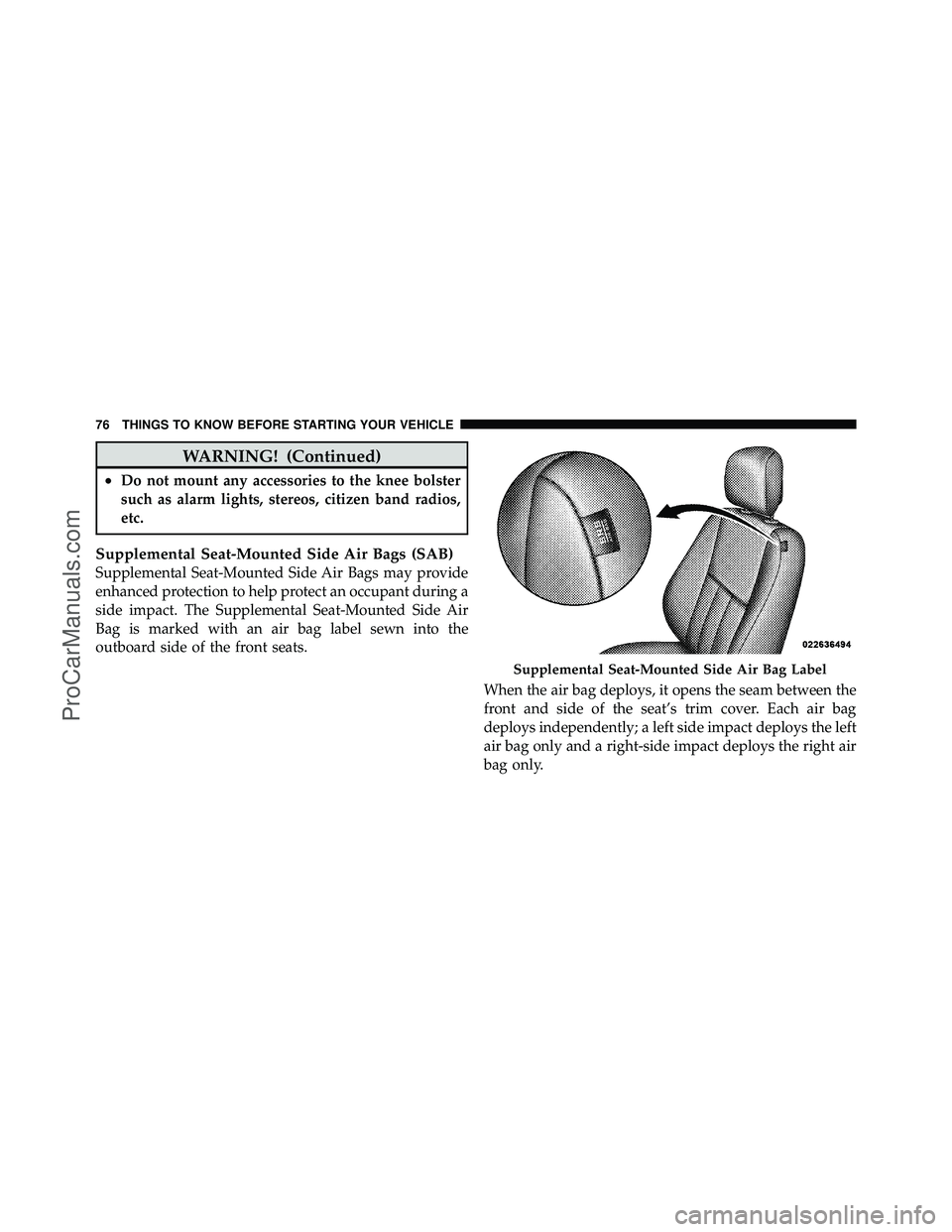
Supplemental Seat-Mounted Side Air Bags (SAB)
Supplemental Seat-Mounted Side Air Bags may provide
enhanced protection to help protect an occupant during a
side impact. The Supplemental Seat-Mounted Side Air
Bag is marked with an air bag label sewn into the
outboard side of the front seats.When the air bag deploys, it opens the seam between the
front and side of the seat’s trim cover. Each air bag
deploys independently; a left side impact deploys the left
air bag only and a right-side impact deploys the right air
bag only.
Supplemental Seat-Mounted Side Air Bag Label
76 THINGS TO KNOW BEFORE STARTING YOUR VEHICLE
ProCarManuals.com
Page 89 of 562
To read data recorded by an EDR, special equipment is
required, and access to the vehicle or the EDR is needed.
In addition to the vehicle manufacturer, other parties,
such as law enforcement, that have the special equip-
ment, can read the information if they have access to the
vehicle or the EDR.
Child Restraints
Everyone in your vehicle needs to be buckled up all the
time, including babies and children. Every state in the
United States and all Canadian provinces require that
small children ride in proper restraint systems. This is the
law, and you can be prosecuted for ignoring it.
Children 12 years or younger should ride properly
buckled up in a rear seat. According to crash statistics,
children are safer when properly restrained in the rear
seats rather than in the front.
WARNING!
In a collision, an unrestrained child, even a tiny baby,
can become a projectile inside the vehicle. The force
required to hold even an infant on your lap could
become so great that you could not hold the child, no
matter how strong you are. The child and others
could be badly injured. Any child riding in your
vehicle should be in a proper restraint for the child’s
size.
Infants And Small Children
There are different sizes and types of restraints for
children from newborn size to the child almost large
enough for an adult safety belt. Always check the child
seat Owner’s Manual to ensure you have the right seat
for your child. Use the restraint that is correct for your
child.
2
THINGS TO KNOW BEFORE STARTING YOUR VEHICLE 87
ProCarManuals.com
Page 90 of 562
•Safety experts recommend that children ride
rearward-facing in the vehicle until they are at least
one year old and weigh at least 20 lbs (9 kg). Two types
of child restraints can be used rearward-facing: infant
carriers and convertible child seats. Both types of child
restraints are held in the vehicle by the lap/shoulder
belt or the LATCH child restraint anchorage system.
Refer to “Lower Anchors and Tether for CHildren
(LATCH)”.
•The infant carrier is only used rearward-facing in the
vehicle. It is recommended for children who weigh up
to about 20 lbs (9 kg). Convertible child seats can be
used either rearward-facing or forward-facing in the
vehicle. Convertible child seats often have a higher
weight limit in the rearward-facing direction than
infant carriers do, so they can be used rearward-facing
by children who weigh more than 20 lbs (9 kg) but are
less than one year old.
WARNING!
Rearward-facing child seats must never be used in
the front seat of a vehicle with a front passenger air
bag. An air bag deployment could cause severe
injury or death to infants in this position.
Older Children And Child Restraints
Children who weigh more than 20 lbs (9 kg) and who are
older than one year can ride forward-facing in the
vehicle. Forward-facing child seats and convertible child
seats used in the forward-facing direction are for children
who weigh 20 to 40 lbs (9 to 18 kg) and who are older
than one year. These child seats are also held in the
vehicle by the lap/shoulder belt or the LATCH child
restraint anchorage system. Refer to “Lower Anchors and
Tether for CHildren (LATCH)”.
88 THINGS TO KNOW BEFORE STARTING YOUR VEHICLE
ProCarManuals.com
Page 91 of 562
An aftermarket belt-positioning booster seat is for chil-
dren weighing more than 40 lbs (18 kg), but who are still
too small to properly fit the vehicle’s seat belts. If the
child can not sit with knees bent over the vehicles seat
cushion while the child’s back is against the seatback,
they should use a belt-positioning booster seat. The child
and booster seat are held in the vehicle by the lap/
shoulder belt.
Children Too Large For Booster Seats
Children who are large enough to wear the shoulder belt
comfortably, and whose legs are long enough to bend
over the front of the seat when their back is against the
seatback, should use the lap/shoulder belt in a rear seat.
•Make sure that the child is upright in the seat.
•The lap portion should be low on the hips and as snug
as possible.
•Check belt fit periodically. A child’s squirming or
slouching can move the belt out of position.
•If the shoulder belt contacts the face or neck, move the
child closer to the center of the vehicle. If this doesn’t
help, move the child to the center rear seating position
and use both the lap and shoulder belt. Never allow a
child to put the shoulder belt under an arm or behind
their back.
NOTE: For additional information, refer to
www.seatcheck.org or call 1–866–SEATCHECK. Cana-
dian residents should refer to Transport Canada’s web-
site for additional information: http://www.tc.gc.ca/
roadsafety/safedrivers/childsafety/index.htm
2
THINGS TO KNOW BEFORE STARTING YOUR VEHICLE 89
ProCarManuals.com
Page 93 of 562

Installing The Child Restraint System
We urge you to carefully follow the directions of the
manufacturer when installing your child restraint. Many,
but not all, restraint systems will be equipped with
separate straps on each side, with each having a hook or
connector, and a means for adjusting the tension in the
strap. Forward-facing toddler restraints and some
rearward-facing infant restraints will also be equipped
with a tether strap, a hook and means for adjusting the
tension in the strap. Not all child restraint systems will be
installed as described here. Again, carefully follow the
installation instructions that are provided with the child
restraint system.
In general, you will first loosen the child seat adjusters on
the lower straps and tether straps so that you can more
easily attach the hook or connector to the lower anchor-
ages and tether anchorages. Then tighten all three straps
as you push the child restraint rearward and downward
into the seat.Not all child restraint systems will be installed as we
have described here. Again, carefully follow the instruc-
tions that come with the child restraint system.
WARNING!
Improper installation of a child restraint to the
LATCH anchorages can lead to failure of an infant or
child restraint. The child could be badly injured or
killed. Follow the manufacturer’s directions exactly
when installing an infant or child restraint.
Installing The LATCH-Compatible Child Restraint
System
Each vehicle, except commercial cargo vehicles, is
equipped with the child restraint anchorage sys-
tem called LATCH, which stands for Lower An-
chors and Tether for CHildren. Two LATCH child
restraint anchorage systems are installed on all second-row
seats and in the center position on all third row fold-in-floor
2
THINGS TO KNOW BEFORE STARTING YOUR VEHICLE 91
ProCarManuals.com
Page 94 of 562
seats. Second-row seats also feature tether strap anchorages,
located in the rear surface of the seatback. In addition, all
third row fold-in-floor seats are equipped with a child
restraint tether anchor at the center seating position.
NOTE:
•When using the LATCH attaching system to install a
child restraint, please ensure that all seat belts not being
used for occupant restraints are stowed and out of reach
of children. It is recommended that before installing the
child restraint, buckle the seat belt so the seat belt is
tucked behind the child restraint and out of reach. If the
buckled seat belt interferes with the child restraint instal-
lation, instead of tucking the seat belt behind the child
restraint, route the seat belt through the child restraint
belt path and then buckle it. This should stow the seat
belt out of the reach of an inquisitive child. Remind all
children in the vehicle that the seat belts are not toys and
should not be played with, and never leave your child
unattended in the vehicle.
•If your child restraint seat is not LATCH-compatible,
install the restraint using the vehicle seat belts.
Installing the Lower Attachments:
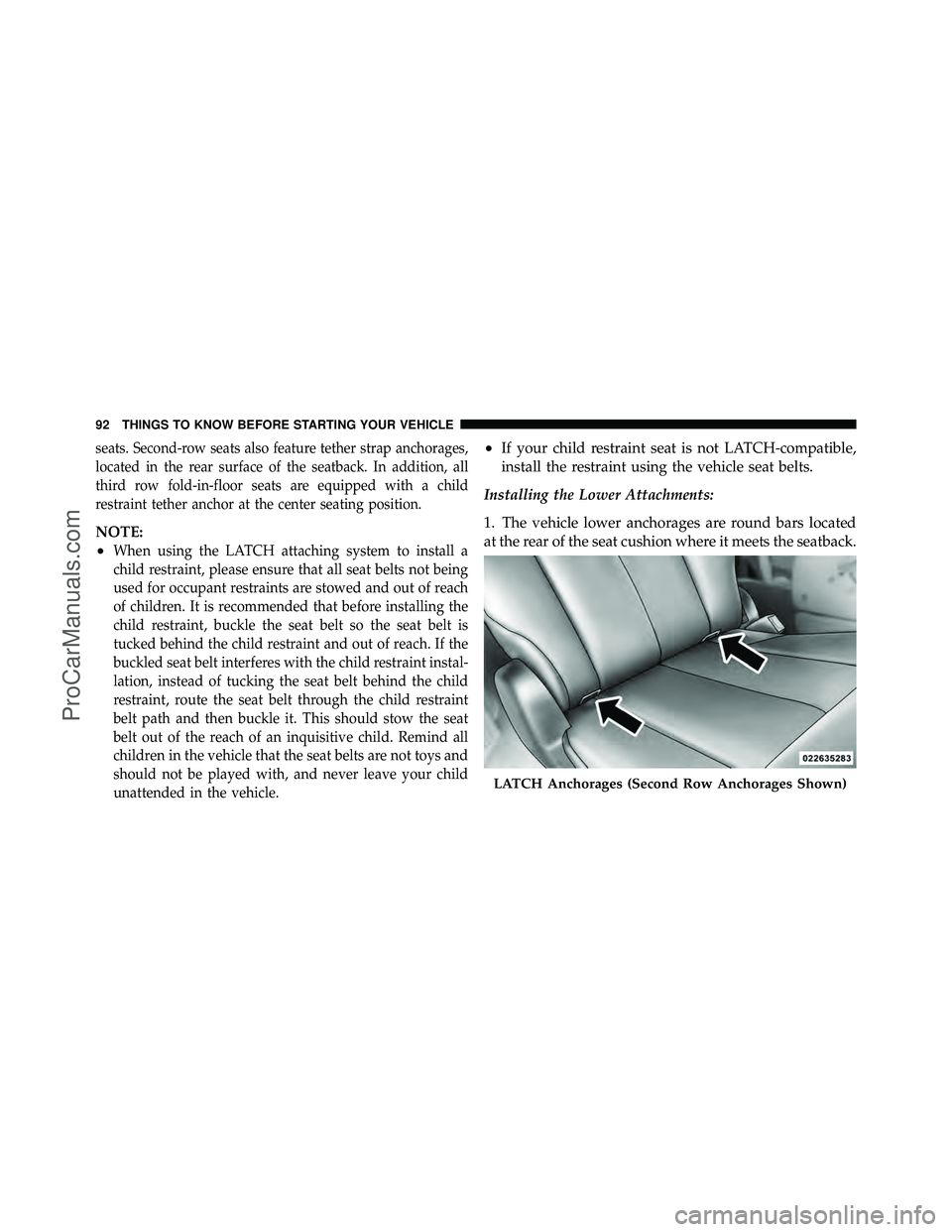
1. The vehicle lower anchorages are round bars located
at the rear of the seat cushion where it meets the seatback.
LATCH Anchorages (Second Row Anchorages Shown)
92 THINGS TO KNOW BEFORE STARTING YOUR VEHICLE
ProCarManuals.com