Page 390 of 486
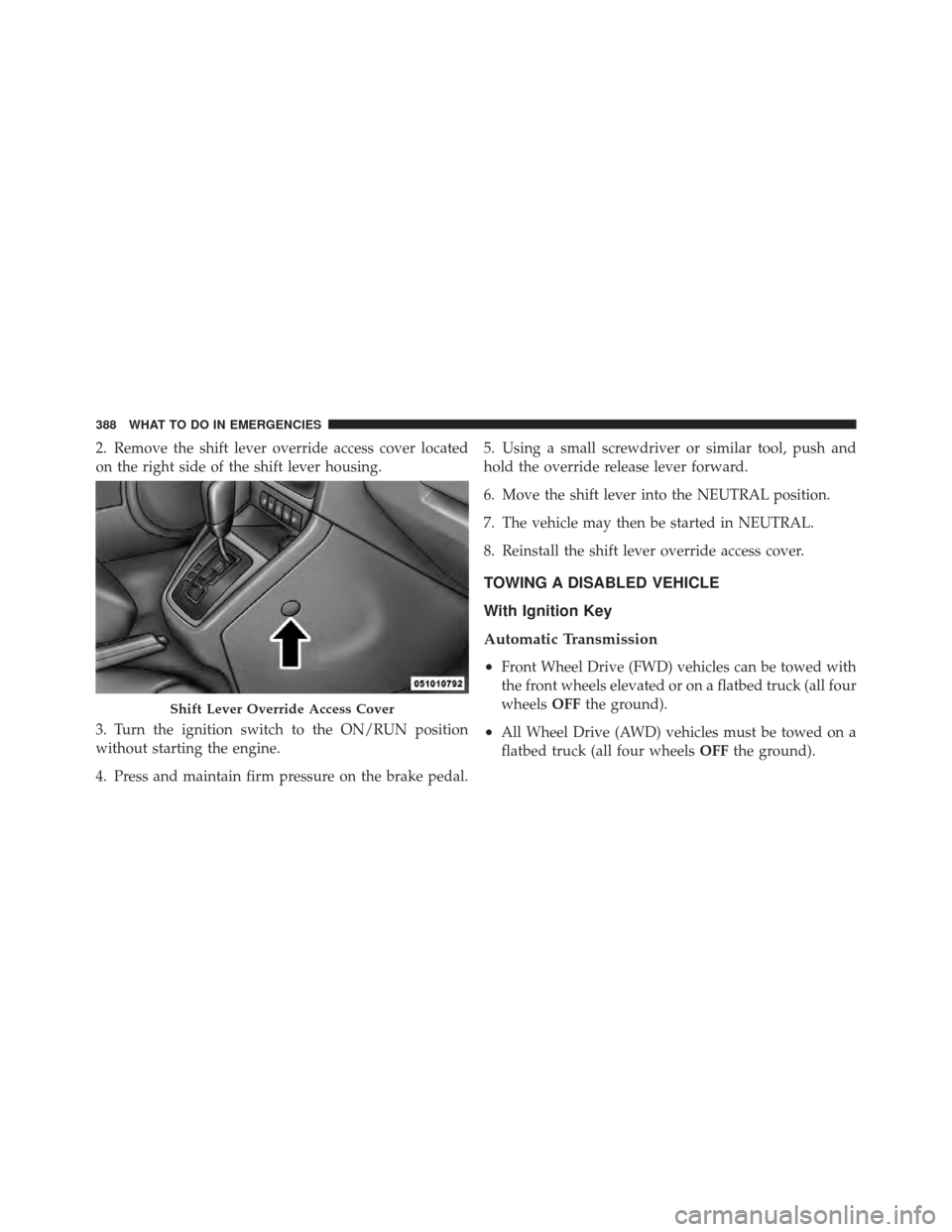
2. Remove the shift lever override access cover located
on the right side of the shift lever housing.
3. Turn the ignition switch to the ON/RUN position
without starting the engine.
4. Press and maintain firm pressure on the brake pedal.5. Using a small screwdriver or similar tool, push and
hold the override release lever forward.
6. Move the shift lever into the NEUTRAL position.
7. The vehicle may then be started in NEUTRAL.
8. Reinstall the shift lever override access cover.
TOWING A DISABLED VEHICLE
With Ignition Key
Automatic Transmission
•
Front Wheel Drive (FWD) vehicles can be towed with
the front wheels elevated or on a flatbed truck (all four
wheels
OFFthe ground).
•All Wheel Drive (AWD) vehicles must be towed on a
flatbed truck (all four wheels OFFthe ground).
Shift Lever Override Access Cover
388 WHAT TO DO IN EMERGENCIES
Page 391 of 486
CAUTION!
DO NOT flat tow any vehicle equipped with an
automatic transmission. Damage to the drivetrain
will result.
Manual Transmission
•
Front Wheel Drive (FWD) or All Wheel Drive (AWD)
vehicles can be flat towed (all four wheels on the
ground) with the transmission in NEUTRAL.
•FWD vehicles can be towed with the front wheels
elevated.
•FWD or AWD vehicles can be towed on a flatbed truck
(all wheelsOFFthe ground).
All Transmissions
If you must use the accessories (wipers, defroster, etc.)
while being towed (wipers, defrosters, etc.), the key must
be in the ON position, not the ACC position. Make
certain the transmission remains in NEUTRAL.
If the vehicle’s battery is discharged, see “Shift Lever
Override” in “What To Do In Emergencies” for instruc-
tions on shifting the automatic transmission out of the
PARK position for towing.
6
WHAT TO DO IN EMERGENCIES 389
Page 394 of 486

▫Exhaust System ..................... 407
▫ Cooling System ..................... 409
▫ Brake System ....................... 415
▫ Automatic Transmission (CVT) –
If Equipped ........................ 417
▫ Manual Transmission – If Equipped ....... 418
▫ Appearance Care And Protection From
Corrosion .......................... 419
� Fuses .............................. 424
▫ Integrated Power Module .............. 424
� Vehicle Storage ....................... 428
� Replacement Bulbs .................... 429 �
Bulb Replacement ..................... 429
▫ Front Headlamps, Parking, And Turn Signal
Lamps ............................ 429
▫ Fog Lamps ......................... 430
▫ Rear Tail, Turn Signal, And Backup Lamps . . 431
▫ License Lamps ...................... 433
▫ Center High-Mounted Stoplamp ......... 434
� Fluid Capacities ...................... 435
� Fluids, Lubricants, And Genuine Parts ....... 436
▫ Engine ............................ 436
▫ Chassis ........................... 437
392 MAINTAINING YOUR VEHICLE
Page 397 of 486

ONBOARD DIAGNOSTIC SYSTEM — OBD II
Your vehicle is equipped with a sophisticated onboard
diagnostic system called OBD II. This system monitors
the performance of the emissions, engine, and automatic
transmission control systems. When these systems are
operating properly, your vehicle will provide excellent
performance and fuel economy, as well as engine emis-
sions well within current government regulations.
If any of these systems require service, the OBD II system
will turn on the “Malfunction Indicator Light” (MIL). It
will also store diagnostic codes and other information to
assist your service technician in making repairs. Al-
though your vehicle will usually be drivable and not
need towing, see your authorized dealer for service as
soon as possible.CAUTION!
•Prolonged driving with the MIL on could cause
further damage to the emission control system. It
could also affect fuel economy and drivability. The
vehicle must be serviced before any emissions
tests can be performed.
•If the MIL is flashing while the engine is running,
severe catalytic converter damage and power loss
will soon occur. Immediate service is required.
Loose Fuel Filler Cap Message
After fuel is added, the vehicle diagnostic system can
determine if the fuel filler cap is possibly loose or
improperly installed. A “gASCAP” message will be dis-
played in the instrument cluster. Tighten the gas cap until
a�clicking� sound is heard. This is an indication that the
gas cap is properly tightened. Press the trip odometer
RESET button to turn off the message. If the problem
7
MAINTAINING YOUR VEHICLE 395
Page 401 of 486

CAUTION! (Continued)
•Your vehicle has been built with improved fluids
that protect the performance and durability of
your vehicle and also allow extended maintenance
intervals. Do not use chemical flushes in these
components as the chemicals can damage your
engine, transmission, power steering or air condi-
tioning. Such damage is not covered by the New
Vehicle Limited Warranty. If a flush is needed
because of component malfunction, use only the
specified fluid for the flushing procedure.
Engine Oil
Checking Oil Level
To assure proper engine lubrication, the engine oil must
be maintained at the correct level. Check the oil level at
regular intervals, such as every fuel stop. The best time to
check the engine oil level is about five minutes after afully warmed engine is shut off. Do not check oil level
before starting the engine after it has sat overnight.
Checking engine oil level when the engine is cold will
give you an incorrect reading.
Checking the oil while the vehicle is on level ground and
about five minutes after a fully warmed engine is shut
off, will improve the accuracy of the oil level readings.
Maintain the oil level between the range markings on the
dipstick. The range markings will consist of a crosshatch
zone that says SAFE or a crosshatch zone that says MIN
at the low end of the range and MAX at the high end of
the range. Adding 1 qt (1L) of oil when the reading is at
the low end of the indicated range will result in the oil
level at the full end of the indicator range.
7
MAINTAINING YOUR VEHICLE 399
Page 411 of 486

To minimize the possibility of catalytic converter dam-
age:
•Do not shut off the engine or interrupt the ignition,
when the transmission is in gear and the vehicle is in
motion.
•Do not try to start the engine by pushing or towing the
vehicle.
•Do not idle the engine with any spark plug wires
disconnected or removed, such as when diagnostic
testing, or for prolonged periods during very rough
idle or malfunctioning operating conditions.
Cooling System
WARNING!
•When working near the radiator cooling fan, dis-
connect the fan motor lead or turn the ignition
switch to the OFF position. The fan is temperature
controlled and can start at any time the ignition
switch is in the ON position.
•You or others can be badly burned by hot engine
coolant (antifreeze) or steam from your radiator. If
you see or hear steam coming from under the
hood, do not open the hood until the radiator has
had time to cool. Never try to open a cooling
system pressure cap when the radiator is hot.
7
MAINTAINING YOUR VEHICLE 409
Page 417 of 486

•Do not change the thermostat for Summer or Winter
operation. If replacement is ever necessary, install
ONLY the correct type thermostat. Other designs may
result in unsatisfactory engine coolant (antifreeze) per-
formance, poor gas mileage, and increased emissions.
Brake System
In order to assure brake system performance, all brake
system components should be inspected periodically.
Refer to the “Maintenance Schedule” for the proper
maintenance intervals.
WARNING!
Riding the brakes can lead to brake failure and
possibly a collision. Driving with your foot resting or
riding on the brake pedal can result in abnormally
high brake temperatures, excessive lining wear, and
possible brake damage. You would not have your full
braking capacity in an emergency.
Brake Master Cylinder
The fluid level in the master cylinder should be checked
when performing under hood services, or immediately if
the “Brake Warning Light” is on.
Be sure to clean the top of the master cylinder area before
removing the cap. If necessary, add fluid to bring the
fluid level up to the requirements described on the brake
fluid reservoir. Fluid level can be expected to fall as the
brake pads wear. The brake fluid level should be checked
when the pads are replaced. However, low fluid level
may be caused by a leak and a checkup may be needed.
NOTE:If your vehicle is equipped with a manual
transmission , the brake fluid reservoir supplies fluid to
both the brake system and the clutch release system. The
two systems are separated in the reservoir, and a leak in
one system will not affect the other system. The manual
transmission clutch release system should not require
fluid replacement during the life of the vehicle. If the
7
MAINTAINING YOUR VEHICLE 415
Page 419 of 486
WARNING! (Continued)
•Do not allow petroleum based fluid to contami-
nate the brake fluid. Brake seal components could
be damaged, causing partial or complete brake
failure. This could result in a collision.
CAUTION!
Use of improper brake fluids will affect overall
clutch system performance. Improper brake fluids
may damage the clutch system resulting in loss of
clutch function and the ability to shift the transmis-
sion.
Automatic Transmission (CVT) – If Equipped
Selection Of Lubricant
It is important that the proper lubricant is used in the
transmission to assure optimum transmission perfor-
mance. Use only the manufacturer’s recommended trans-
mission fluid which has been formulated with special
metal to metal friction coefficient additives to provide the
proper steel belt traction on the drive and driven pulleys.
Refer to “Fluids, Lubricants, and Genuine Parts” in
“Maintaining Your Vehicle” for further information.
CAUTION!
•Do not use chemical flushes in your transmission
as the chemicals can damage your transmission
components. Such damage is not covered by the
New Vehicle Limited Warranty.(Continued)7
MAINTAINING YOUR VEHICLE 417