Page 386 of 486
3. If using another vehicle to jump-start the battery, park
the vehicle within the jumper cables reach, set the
parking brake and make sure the ignition is OFF.
WARNING!
Do not allow vehicles to touch each other as this
could establish a ground connection and personal
injury could result.
Jump-Starting Procedure
WARNING!
Failure to follow this procedure could result in per-
sonal injury or property damage due to battery ex-
plosion.
CAUTION!
Failure to follow these procedures could result in
damage to the charging system of the booster vehicle
or the discharged vehicle.
NOTE: Remove Air Intake before proceeding with this
Jump-Starting procedure.
1. Connect the positive (+)end of the jumper cable to the
positive (+)post of the discharged vehicle.
2. Connect the opposite end of the positive (+)jumper
cable to the positive (+)post of the booster battery.
3. Connect the negative end (-)of the jumper cable to the
negative (-)post of the booster battery.
384 WHAT TO DO IN EMERGENCIES
Page 389 of 486
CAUTION!
•When “rocking” a stuck vehicle by moving be-
tween DRIVE/1st gear and REVERSE, do not spin
the wheels faster than 15 mph (24 km/h), or drive-
train damage may result.
•Revving the engine or spinning the wheels too fast
may lead to transmission overheating and failure.
It can also damage the tires. Do not spin the
wheels above 30 mph (48 km/h) while in gear (no
transmission shifting occurring).
WARNING!
Fast spinning tires can be dangerous. Forces gener-
ated by excessive wheel speeds may cause damage, or
even failure, of the axle and tires. A tire could
explode and injure someone. Do not spin your vehi-
cle’s wheels faster than 30 mph (48 km/h) or for
longer than 30 seconds continuously without stop-
ping when you are stuck and do not let anyone near
a spinning wheel, no matter what the speed.
SHIFT LEVER OVERRIDE
If a malfunction occurs and the shift lever cannot be
moved out of the PARK position, you can use the
following procedure to temporarily move the shift lever:
1. Firmly set the parking brake.
6
WHAT TO DO IN EMERGENCIES 387
Page 390 of 486
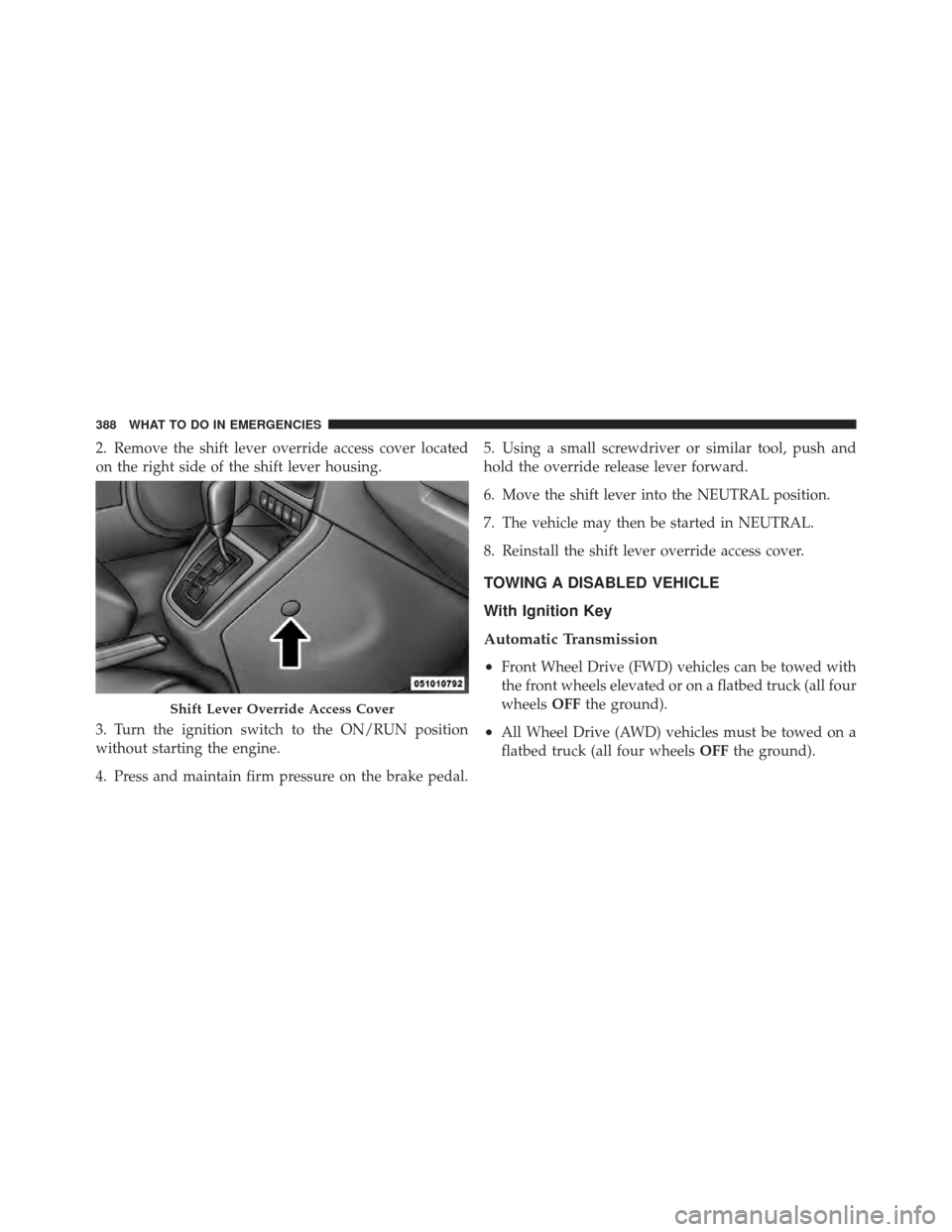
2. Remove the shift lever override access cover located
on the right side of the shift lever housing.
3. Turn the ignition switch to the ON/RUN position
without starting the engine.
4. Press and maintain firm pressure on the brake pedal.5. Using a small screwdriver or similar tool, push and
hold the override release lever forward.
6. Move the shift lever into the NEUTRAL position.
7. The vehicle may then be started in NEUTRAL.
8. Reinstall the shift lever override access cover.
TOWING A DISABLED VEHICLE
With Ignition Key
Automatic Transmission
•
Front Wheel Drive (FWD) vehicles can be towed with
the front wheels elevated or on a flatbed truck (all four
wheels
OFFthe ground).
•All Wheel Drive (AWD) vehicles must be towed on a
flatbed truck (all four wheels OFFthe ground).
Shift Lever Override Access Cover
388 WHAT TO DO IN EMERGENCIES
Page 394 of 486

▫Exhaust System ..................... 407
▫ Cooling System ..................... 409
▫ Brake System ....................... 415
▫ Automatic Transmission (CVT) –
If Equipped ........................ 417
▫ Manual Transmission – If Equipped ....... 418
▫ Appearance Care And Protection From
Corrosion .......................... 419
� Fuses .............................. 424
▫ Integrated Power Module .............. 424
� Vehicle Storage ....................... 428
� Replacement Bulbs .................... 429 �
Bulb Replacement ..................... 429
▫ Front Headlamps, Parking, And Turn Signal
Lamps ............................ 429
▫ Fog Lamps ......................... 430
▫ Rear Tail, Turn Signal, And Backup Lamps . . 431
▫ License Lamps ...................... 433
▫ Center High-Mounted Stoplamp ......... 434
� Fluid Capacities ...................... 435
� Fluids, Lubricants, And Genuine Parts ....... 436
▫ Engine ............................ 436
▫ Chassis ........................... 437
392 MAINTAINING YOUR VEHICLE
Page 395 of 486
ENGINE COMPARTMENT — 2.0L
1 — Washer Fluid Reservoir6 — Battery (Under Cover)
2 — Engine Oil Fill 7 — Coolant Pressure Cap
3 — Air Cleaner Filter 8 — Engine Oil Dipstick
4 — Brake Fluid Reservoir 9 — Engine Coolant Reservoir
5 — Integrated Power Module (Fuses)
7
MAINTAINING YOUR VEHICLE 393
Page 396 of 486
ENGINE COMPARTMENT — 2.4L
1 — Washer Fluid Reservoir6 — Battery (Under Cover)
2 — Engine Oil Fill 7 — Coolant Pressure Cap
3 — Air Cleaner Filter 8 — Engine Oil Dipstick
4 — Brake Fluid Reservoir 9 — Engine Coolant Reservoir
5 — Integrated Power Module (Fuses)
394 MAINTAINING YOUR VEHICLE
Page 417 of 486

•Do not change the thermostat for Summer or Winter
operation. If replacement is ever necessary, install
ONLY the correct type thermostat. Other designs may
result in unsatisfactory engine coolant (antifreeze) per-
formance, poor gas mileage, and increased emissions.
Brake System
In order to assure brake system performance, all brake
system components should be inspected periodically.
Refer to the “Maintenance Schedule” for the proper
maintenance intervals.
WARNING!
Riding the brakes can lead to brake failure and
possibly a collision. Driving with your foot resting or
riding on the brake pedal can result in abnormally
high brake temperatures, excessive lining wear, and
possible brake damage. You would not have your full
braking capacity in an emergency.
Brake Master Cylinder
The fluid level in the master cylinder should be checked
when performing under hood services, or immediately if
the “Brake Warning Light” is on.
Be sure to clean the top of the master cylinder area before
removing the cap. If necessary, add fluid to bring the
fluid level up to the requirements described on the brake
fluid reservoir. Fluid level can be expected to fall as the
brake pads wear. The brake fluid level should be checked
when the pads are replaced. However, low fluid level
may be caused by a leak and a checkup may be needed.
NOTE:If your vehicle is equipped with a manual
transmission , the brake fluid reservoir supplies fluid to
both the brake system and the clutch release system. The
two systems are separated in the reservoir, and a leak in
one system will not affect the other system. The manual
transmission clutch release system should not require
fluid replacement during the life of the vehicle. If the
7
MAINTAINING YOUR VEHICLE 415
Page 418 of 486

brake fluid reservoir is low and the brake system does
not indicate any leaks or other problems, it may be a
result of a leak in the hydraulic clutch release system. See
your local authorized dealer for service.
Use only manufacturer’s recommended brake fluid. Re-
fer to “Fluids, Lubricants, and Genuine Parts” in “Main-
taining Your Vehicle” for further information.
WARNING!
•Use only manufacturer’s recommended brake fluid.
Refer to “Fluids, Lubricants, and Genuine Parts” in
“Maintaining Your Vehicle” for further informa-
tion. Using the wrong type of brake fluid can
severely damage your brake system and/or impair
its performance. The proper type of brake fluid for
your vehicle is also identified on the original fac-
tory installed hydraulic master cylinder reservoir.
(Continued)
WARNING! (Continued)
•To avoid contamination from foreign matter or
moisture, use only new brake fluid or fluid that
has been in a tightly closed container. Keep the
master cylinder reservoir cap secured at all times.
Brake fluid in a open container absorbs moisture
from the air resulting in a lower boiling point.
This may cause it to boil unexpectedly during hard
or prolonged braking, resulting in sudden brake
failure. This could result in a collision.
•Overfilling the brake fluid reservoir can result in
spilling brake fluid on hot engine parts, causing
the brake fluid to catch fire. Brake fluid can also
damage painted and vinyl surfaces, care should be
taken to avoid its contact with these surfaces.(Continued)
416 MAINTAINING YOUR VEHICLE