Page 309 of 494
WARNING! (Continued)
•The ABS cannot prevent collisions, including
those resulting from excessive speed in turns,
following another vehicle too closely, or hydro-
planing.
•The capabilities of an ABS-equipped vehicle must
never be exploited in a reckless or dangerous
manner, which could jeopardize the user’s safety
or the safety of others.The “Anti-Lock Brake Warning Light” moni-
tors the Anti-Lock Brake System. The light will
come on when the ignition switch is turned to
the ON position and may stay on for as long as
four seconds.
If the “Anti-Lock Brake Warning Light” remains on or
comes on while driving, it indicates that the anti-lock
portion of the brake system is not functioning and that service is required. However, the conventional brake
system will continue to operate normally if the “Brake
Warning Light” is not on.
If the “Anti-Lock Brake Warning Light” is on, the brake
system should be serviced as soon as possible to restore
the benefits of anti-lock brakes. If the “Anti-Lock Brake
Warning Light” does not come on when the ignition
switch is turned to the ON position, have the bulb
repaired as soon as possible.
If both the “Brake Warning Light” and the “Anti-Lock
Brake Warning Light” remain on, the Anti-Lock Brake
(ABS) and Electronic Brake Force Distribution (EBD)
Systems are not functioning. Immediate repair to the ABS
system is required. See your authorized dealer.
When the vehicle is driven over 7 mph (11 km/h), you
may hear a slight clicking sound as well as some related
motor noises. These noises are the system performing its
self-check cycle to ensure that the ABS system is working
5
STARTING AND OPERATING 307
Page 398 of 494
▫Adding Washer Fluid ................. 413
▫ Exhaust System ..................... 413
▫ Cooling System ..................... 416
▫ Brake System ....................... 421
▫ Automatic Transmission ............... 423
▫ Appearance Care And Protection From
Corrosion .......................... 426
▫ Cleaning Center Console Cupholders ...... 432
� Fuses .............................. 432
▫ Totally Integrated Power Module ......... 432
� Vehicle Storage ....................... 437 �
Replacement Bulbs .................... 438
� Bulb Replacement ..................... 438
▫ Headlamp ......................... 438
▫ Fog Lamps ......................... 440
▫ Backup Lamps ...................... 441
▫ License Plate Lamp ................... 442
� Fluid Capacities ...................... 442
� Fluids, Lubricants, And Genuine Parts ....... 443
▫ Engine ............................ 443
▫ Chassis ........................... 444
396 MAINTAINING YOUR VEHICLE
Page 402 of 494
persists, the message will appear the next time the
vehicle is started. This might indicate a damaged cap. If
the problem is detected twice in a row, the system will
turn on the “Malfunction Indicator Light (MIL).” Resolv-
ing the problem will turn the MIL light off.
EMISSIONS INSPECTION AND MAINTENANCE
PROGRAMS
In some localities, it may be a legal requirement to pass
an inspection of your vehicle’s emissions control system.
Failure to pass could prevent vehicle registration.For states that require an Inspection and Mainte-
nance (I/M), this check verifies the “Malfunction
Indicator Light (MIL)” is functioning and is not
on when the engine is running, and that the OBD II
system is ready for testing. Normally, the OBD II system will be ready. The OBD II
system may
notbe ready if your vehicle was recently
serviced, recently had a dead battery or a battery replace-
ment. If the OBD II system should be determined not
ready for the I/M test, your vehicle may fail the test.
Your vehicle has a simple ignition key-actuated test,
which you can use prior to going to the test station. To
check if your vehicle’s OBD II system is ready, you must
do the following:
1. Turn the ignition switch to the ON position, but do not
crank or start the engine.
2. If you crank or start the engine, you will have to start
this test over.
3. As soon as you turn the ignition switch to the ON
position, you will see the MIL symbol come on as part of
a normal bulb check.
400 MAINTAINING YOUR VEHICLE
Page 440 of 494

REPLACEMENT BULBS
All the inside bulbs are brass or glass wedge base.
Aluminum base bulbs are not approved and should not
be used for replacement.
LIGHT BULBS – Interior Bulb No.
Front Courtesy/Reading Lamp..........578/W5W
Center Courtesy/Reading Lamp ..........578/W5W
Visor Vanity Lamp ...................... A6220
Glove Box Lamp ....................... A6220
Shift Indicator Lamp ................. IKLE14140
Rear Compartment (Trunk) Lamp ............. 579
NOTE: For lighted switches, see your authorized dealer
for replacement. LIGHT BULBS – Exterior Bulb No.
Low Beam Headlamp
..................... 9006
High Beam Headlamp .................... 9005
Front Park/Turn Signal/Side Marker Lamp ....3757A
Front Fog Lamp ......................... H11
Front Side Marker Lamp .................WY5W
Center High Mounted Stop (CHMSL) Lamp ..... LED
(Serviced at Authorized Dealer)
Rear Tail/Stop/Turn Signal Lamp ............ LED
(Serviced at Authorized Dealer)
Backup Lamp ........................... 921
License Lamp .......................... W5W
BULB REPLACEMENT
Headlamp
1. Raise the hood and locate the connector behind the
headlamp.
438 MAINTAINING YOUR VEHICLE
Page 441 of 494
NOTE:It may be necessary to remove the air cleaner
filter housing and position the totally integrated power
module aside prior to replacing the low beam headlamp
on the driver’s side of the vehicle.
2. Reach into engine compartment and from behind the
lamp assembly and grasp the connector. 3. Rotate bulb and connector14turn and pull outward
from assembly.
CAUTION!
Do not touch the new bulb with your fingers. Oil
contamination will severely shorten bulb life.
7
MAINTAINING YOUR VEHICLE 439
Page 442 of 494
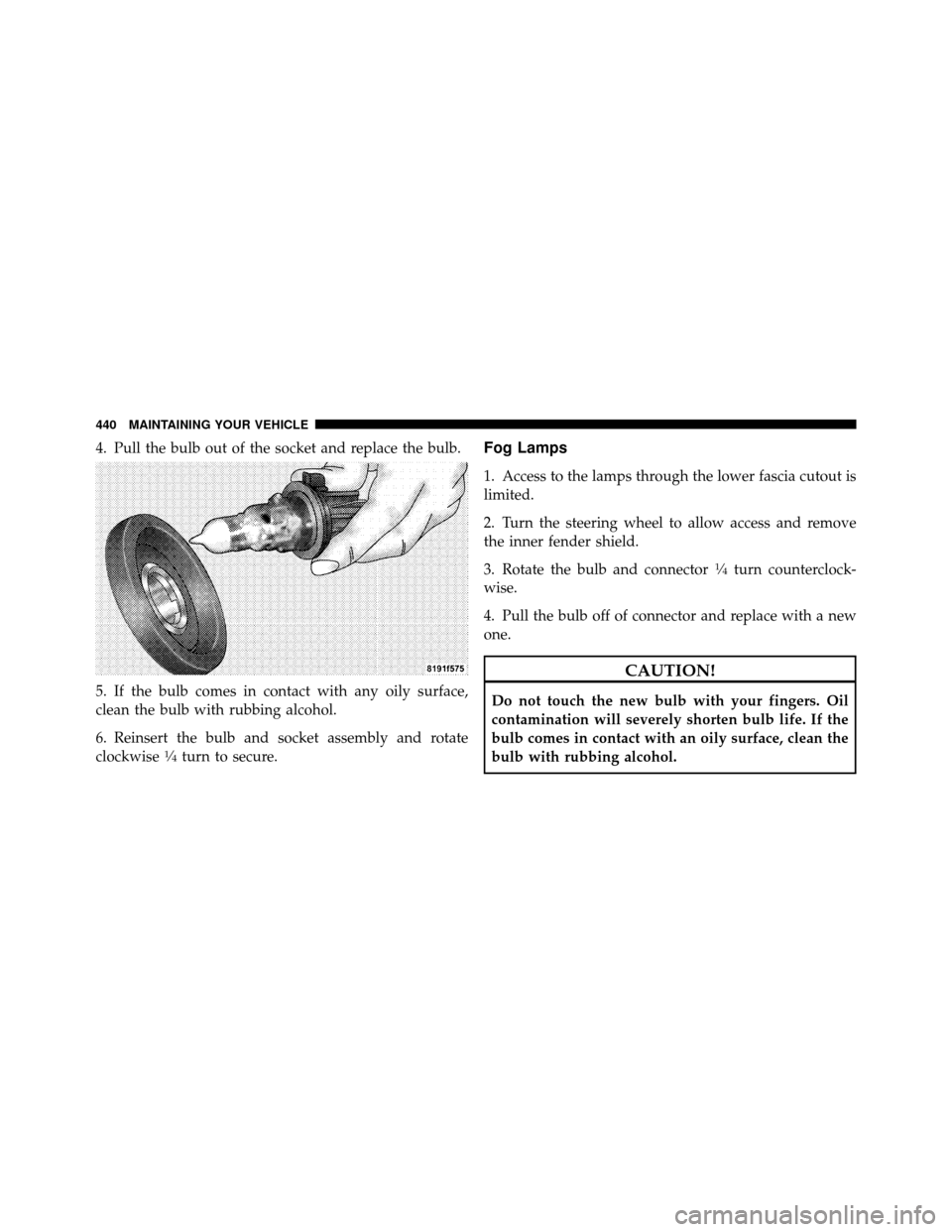
4. Pull the bulb out of the socket and replace the bulb.
5. If the bulb comes in contact with any oily surface,
clean the bulb with rubbing alcohol.
6. Reinsert the bulb and socket assembly and rotate
clockwise
14turn to secure.
Fog Lamps
1. Access to the lamps through the lower fascia cutout is
limited.
2. Turn the steering wheel to allow access and remove
the inner fender shield.
3. Rotate the bulb and connector
14turn counterclock-
wise.
4. Pull the bulb off of connector and replace with a new
one.
CAUTION!
Do not touch the new bulb with your fingers. Oil
contamination will severely shorten bulb life. If the
bulb comes in contact with an oily surface, clean the
bulb with rubbing alcohol.
440 MAINTAINING YOUR VEHICLE
Page 443 of 494
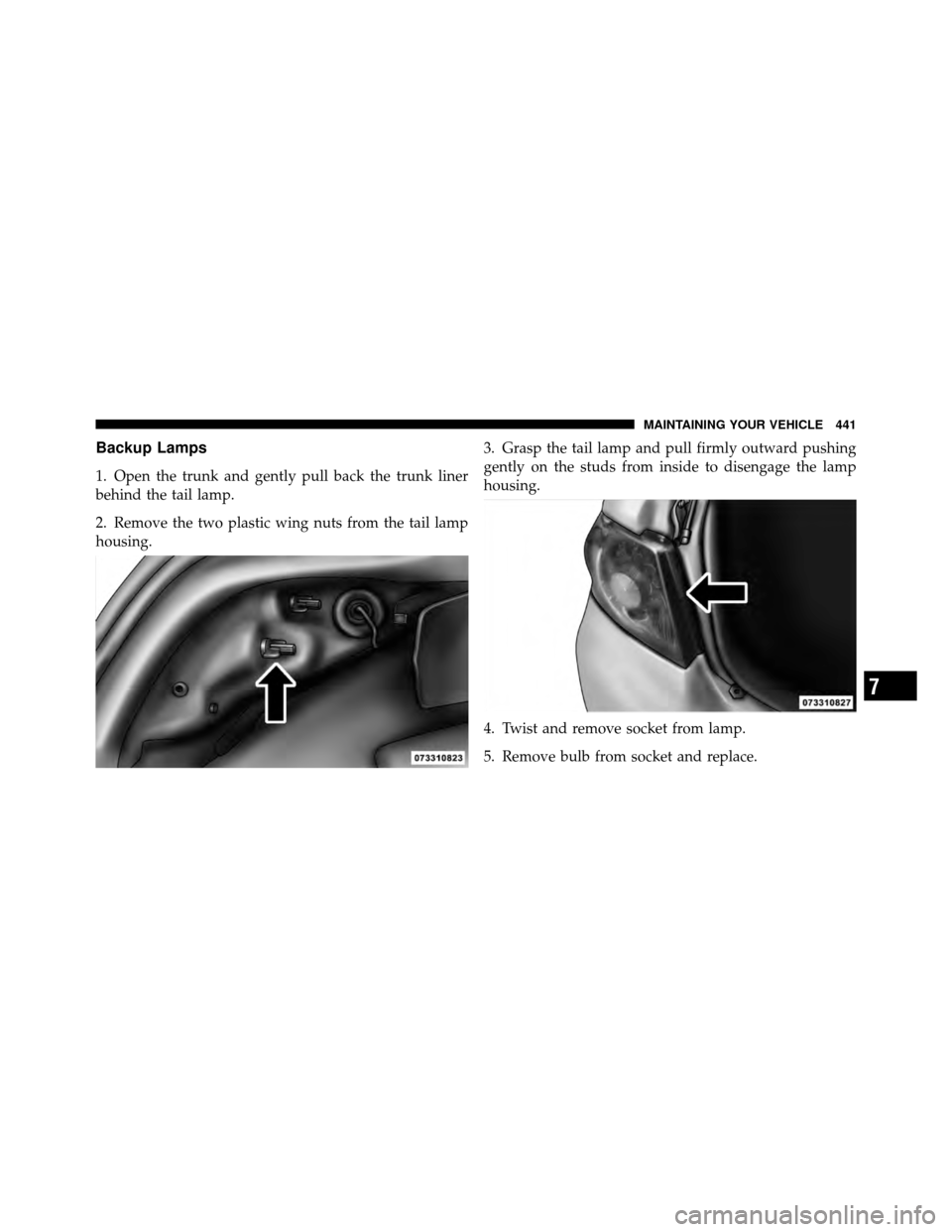
Backup Lamps
1. Open the trunk and gently pull back the trunk liner
behind the tail lamp.
2. Remove the two plastic wing nuts from the tail lamp
housing.3. Grasp the tail lamp and pull firmly outward pushing
gently on the studs from inside to disengage the lamp
housing.
4. Twist and remove socket from lamp.
5. Remove bulb from socket and replace.
7
MAINTAINING YOUR VEHICLE 441
Page 444 of 494
License Plate Lamp
1. Remove two retaining screws holding the light lens in
place.2. Gently pry the lamp assembly loose.
3. Pull bulb from socket, replace and reattach the lamp
assembly with the two retaining screws.
FLUID CAPACITIES
U.S.
Metric
Fuel (Approximate)
All Engines — (Except 2.4L PZEV) 16.9 Gallons64 Liters
2.4L PZEV (Partial Zero Emissions Vehicle) 18.5 Gallons70 Liters
Engine Oil with Filter
2.4L Engine (SAE 5W-20, API Certified) 4.5 Quarts4.4 Liters
3.6L Engine (SAE 5W-30, API Certified) 6 Quarts5.6 Liters
Cooling System*
2.4L Engine (MOPAR� Antifreeze/Coolant 5
Year/100,000 Mile Formula or equivalent) 7.7 Quarts
7.3 Liters
3.6L Engine (MOPAR� Antifreeze/Coolant 5
Year/100,000 Mile Formula or equivalent) 11.6 Quarts
11 Liters
* Includes heater and coolant recovery bottle filled to MAX level.
442 MAINTAINING YOUR VEHICLE