Page 20 of 324
Monitoring
On switching on, the dial needles go to the
extent of their travel then return to 0.
A.
With the ignition on, the fuel gauge bars for
the fuel remaining should light up.
B.
With the engine running, the associated
low level warning lamp should go off.
C.
With the ignition on, the oil level indicator
should display "OIL OK"
for a few
seconds.
If the levels are not correct, top up the level
which is low.
Instrument panels
26, 28
1.
With the ignition on, the orange and red
warning lamps come on.
2.
With the engine running, these warning
lamps should go off.
If a warning lamp remains on, refer to the page
concerned.
Warning lamps
30, 35
Illumination of the indicator lamp indicates the
state of the corresponding function.
A.
Deactivation of the ESP/ASR system.
Switch panel
14 4
B.
Deactivation of Stop & Start.
167
Page 25 of 324

23
Limit the causes of excess
consumption
Spread loads throughout the vehicle; place the
heaviest items in the bottom of the boot, as
close as possible to the rear seats.
Limit the loads carried in the vehicle and
reduce wind resistance (roof bars, roof rack,
bicycle carrier, trailer...). Use a roof box in
preference.
Remove roof bars and roof racks after use.
At the end of winter, remove snow tyres and
refit your summer tyres.
Observe the recommendations
on maintenance
Check the tyre pressures regularly, when
cold, referring to the label in the door
aperture, driver's side.
Carry out this check in par ticular:
- before a long journey,
- at each change of season,
- after a long period out of use.
Don't forget the spare wheel and the tyres on
any trailer or caravan.
Have your vehicle ser viced regularly (engine
oil, oil filter, air filter...) and obser ve the
schedule of operations recommended by the
manufacturer.
When refuelling, do not continue after the 3 rd
cut-off of the nozzle to avoid any over flow.
At the wheel of your new vehicle, it is only
after the first 1 800 miles (3 000 kilometres)
that you will see the fuel consumption settle
down to a consistent average.
Switch off the headlamps and front foglamps
when the level of light does not require their
use.
Avoid running the engine before moving off,
particularly in winter; your vehicle will warm
up much faster while driving.
As a passenger, if you avoid connecting
your multimedia devices (film, music, video
game...), you will contribute towards limiting
the consumption of electrical energy, and so
of fuel.
Disconnect your portable devices before
leaving the vehicle.
Page 29 of 324
27Monitoring
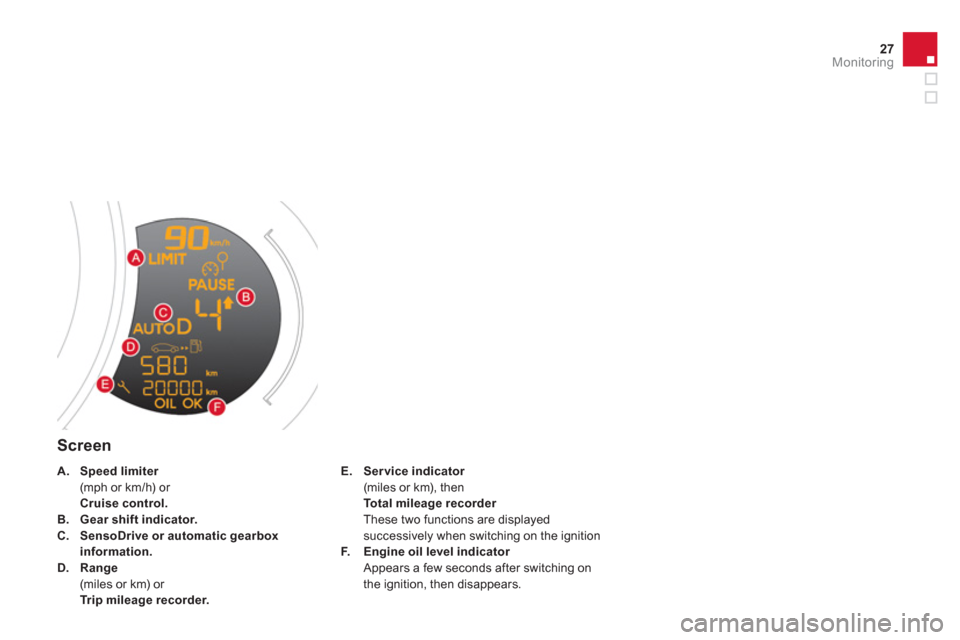
Screen
E.
Ser vice indicator
(miles or km), then
Total mileage recorder
These two functions are displayed
successively when switching on the ignition
F.
Engine oil level indicator
Appears a few seconds after switching on
the ignition, then disappears.
A.
Speed limiter
(mph or km/h) or
Cruise control.
B.
Gear shift indicator.
C.
SensoDrive
or automatic gearbox
information.
D.
Range
(miles or km) or
Trip mileage recorder.
Page 31 of 324
29Monitoring
Screen
C.
Ser vice indicator
(miles or km), then
Total mileage recorder .
These two functions are displayed
successively when switching on
the ignition.
D.
Engine oil level indicator.
Appears a few seconds after switching on
the ignition, then disappears.
A.
Speed limiter
(mph or km/h) or
Cruise control.
B.
Range
(miles or km) or
Trip mileage recorder.
Page 37 of 324

35Monitoring
Warning lamps
When the engine is running or the vehicle is
being driven, the illumination of one of the
following warning lamps indicates a fault which
requires action on the par t of the driver. Any fault resulting in the illumination of a warning lamp must be investigated fur ther by
reading the associated message in the multifunction screen.
If you encounter any problems, do not hesitate to contact a CITROËN dealer or a qualified
workshop.
Warning lamp
is on
Cause
Action/Observations
STOP
fixed, alone or
associated with
another warning lamp,
accompanied by an
audible signal and
a message on the
screen. Illumination of the warning lamp is
associated with a serious braking
system or engine coolant temperature
problem. Stop as soon as it is safe to do so as the engine may
cut out when driving.
Park, switch off the ignition and call a CITROËN dealer
or a qualified workshop.
Service
temporarily. Minor problems have occurred for
which there is no specific warning
lamp. Identify the problem by reading the message shown in
the screen, such as, for example:
- the engine oil level,
- the screenwash level,
- the remote control battery,
- saturation of the par ticle emission filter on Diesel
vehicles (see "Checks - § par ticle emissions
filter").
For any other faults, contact a CITROËN dealer or a
qualified workshop.
fixed. Major problems have occurred for
which there is no specific warning
lamp. Identify the problem by reading the message shown
in the screen and contact a CITROËN dealer or a
qualified workshop.
Page 45 of 324

43Monitoring
System which informs the driver whether the
engine oil level is correct or not.
This information is indicated for a few seconds
when the ignition is switched on, after the
service information.
Engine oil level indicator
The level shown will only be correct
if the vehicle is on level ground and
the engine has been off for more than
30 minutes.
Oil level correct
Oil level low
This is indicated by the flashing of "OIL"
, linked
with the ser vice warning lamp, accompanied
by an audible signal and a message in the
multifunction screen.
If the low oil level is confirmed by a check using
the dipstick, the level must be topped up to
prevent damage to the engine.
Oil level indicator fault
This is indicated by the flashing of "OIL --"
.
Contact a CITROËN dealer or a qualified
workshop.
There are 2 marks on the
dipstick:
- A
= max; never exceed this
level (risk of damage to the
engine),
- B
= min; top up the level via
the oil filler cap, using the
grade of oil suited to your
engine.
Dipstick
Refer to the "Checks" section to locate the
dipstick and the oil filler cap on your engine.
Page 185 of 324

183Checks
Checking levels
Check all of these levels regularly and top them up if necessary, unless other wise indicated.
If a level drops significantly, have the corresponding system checked by a CITROËN dealer or a qualified workshop.
Oil level
Engine oil change
Refer to the Maintenance and Warranty Guide
for details of the inter val for this operation.
In order to maintain the reliability of the engine
and emission control system, the use of
additives in the engine oil is prohibited.
Oil grade
The oil must be suitable for your engine
and conform to the manufacturer's
recommendations.
Brake fluid level
Changing the fl uid
Refer to the Maintenance and Warranty Guide
for details of the inter val for this operation.
Fluid specifi cation
The brake fluid must conform to the
manufacturer's recommendations and meet the
DOT4 standard.
The brake fluid level should be close
to the "MA X" mark. If it is not, check
the brake pad wear. The reading will only be correct if the
vehicle is on level ground and the
engine has been off for more than
30 minutes.
The check is carried out either when the ignition
is switched on using the oil level indicator in the
instrument panel, or using the dipstick.
It is normal to top up the engine
oil between ser vices. CITROËN
recommends that you check the oil
level and top up if necessary, every
3 000 miles (5 000 kilometres).
Page 187 of 324
185Checks
Diesel additive level
(Diesel engine with particle
emission filter)
Topping up
This additive must be topped up by a CITROËN
dealer or a qualified workshop without delay.
Used products
Avoid prolonged contact of used oil or
fluids with the skin.
Most of these fluids are harmful to
health or indeed very corrosive.
Do not discard used oil or fluids into
sewers or onto the ground.
Take used oil to a CITROËN dealer or
a qualified workshop (France) or to an
authorised waste disposal site. A additive reser voir low level is
indicated by fixed illumination of
this warning lamp, accompanied by an audible
warning and a message in the multifunction
screen.