2011 CITROEN C4 PICASSO Vent
[x] Cancel search: VentPage 137 of 352

Downloaded from www.Manualslib.com manuals search engine VIII
135
SAFETY
AIRBAGS
System designed to maximise the
safety of the occupants (with the
exception of the rear centre pas-
senger) in the event of violent col-
lisions. It supplements the action of
the force-limiting seat belts.
If a collision occurs, the electronic
detectors record and analyse the
front and side impacts sustained in
the impact detection zones:
- in the case of a serious impact,
the airbags are deployed instant-
ly and protect the occupants of
the vehicle (with the exception of
the rear centre passenger); im-
mediately after the impact, the
airbags defl ate rapidly so that
they do not hinder visibility or the
exit of the occupants,
- in the case of a minor or rear im-
pact or in certain roll-over con-
ditions, the airbags will not be
deployed; the seat belt alone
is suffi cient to provide optimum
protection in these situations.
The airbags do not operate
when the ignition is switched
off.
This equipment will only operate
once. If a second impact occurs
(during the same or a subsequent ac-
cident), the airbag will not operate.
Impact detection zones
A.
Front impact zone.
B.
Side impact zone.
Deployment of the airbag(s) is ac-
companied by a slight emission of
harmless smoke and a noise, due to
the activation of the pyrotechnic car-
tridge incorporated in the system.
This smoke is not harmful, but sen-
sitive individuals may experience
slight irritation.
The noise of the detonation may
result in a slight loss of hearing for
a short time.
Front airbags
System which protects the head and
chest of the driver and front passen-
ger in the event of a front impact.
The driver's airbag is fi tted in the
centre of the steering wheel; the
front passenger's airbag is fi tted in
the dashboard above the glove box.
Deployment
The airbags are deployed simultane-
ously, unless the passenger's front
airbag is deactivated, in the event of
a serious front impact applied to all
or part of the front impact zone A
,
in the longitudinal centreline of the
vehicle on a horizontal plane and di-
rected from the front to the rear of
the vehicle.
The front airbag infl ates between the
front occupant of the vehicle and the
dashboard to cushion their forward
movement.
Page 138 of 352

Downloaded from www.Manualslib.com manuals search engine VIII
136
SAFETY
Deactivation
This warning lamp comes on
in the instrument panel when
the ignition is on and until the
airbag is reactivated.
To ensure the safety of your child,
it is imperative that the passenger
airbag is deactivated when you in-
stall a "rearwards-facing" child seat
on the front passenger seat.
Otherwise, the child would risk be-
ing seriously injured or killed if the
airbag were deployed.
Activation
When you remove the child seat,
turn switch 1
to the "ON"
position to
reactivate the airbag and so ensure
the safety of your front passenger in
the event of an impact.
Operating fault
If this warning lamp comes
on on the instrument panel,
accompanied by an audible
warning and a message in
the multifunction screen, contact a
CITROËN dealer or a qualifi ed work-
shop to have the system checked. The
airbags may no longer be deployed in
the event of a serious impact. Only the front passenger's airbag
can be deactivated:
)
with the ignition off
, insert the
key in the passenger airbag de-
activation switch 1
,
)
turn it to the "OFF"
position,
)
then, remove the key keeping
the switch in this position.
If this warning lamp fl ashes,
contact a CITROËN dealer
or a qualifi ed workshop.
If both airbag warning lamps come
on continuously, do not install a
"rearwards-facing" child seat on
the front passenger seat.
Have it checked by a CITROËN
dealer or a qualifi ed workshop.
Page 139 of 352

Downloaded from www.Manualslib.com manuals search engine VIII
137
SAFETY
*
According to country.
Lateral airbags *
System which protects the driver
and front passenger in the event of
a serious side impact in order to limit
the risk of injury to the chest.
Each lateral airbag is fi tted in the
front seat back frame, on the door
side.
Operation
It is deployed unilaterally in the
event of a serious side impact ap-
plied to all or part of the side impact
zone B
, perpendicular to the longi-
tudinal centreline of the vehicle on
a horizontal plane and directed from
the outside towards the inside of the
vehicle.
The lateral airbag infl ates between
the front occupant of the vehicle and
the corresponding door trim panel.
Impact detection zones
A.
Front impact zone.
B.
Side impact zone.
Curtain airbags *
System which protects the driver
and passengers (with the exception
of the rear centre passenger) in the
event of a serious side impact in or-
der to limit the risk of head injuries.
Each curtain airbag is fi tted in the
pillars and the upper part of the pas-
senger compartment.
Operation
It is deployed at the same time as
the corresponding lateral airbag in
the event of a serious side impact
applied to all or part of the side im-
pact zone B
, perpendicular to the
longitudinal centreline of the vehicle
on a horizontal plane and directed
from the outside towards the inside
of the vehicle.
The curtain airbag infl ates between
the front or rear occupant of the ve-
hicle and the windows.
In the event of a minor impact or
bump on the side of the vehicle or
if the vehicle rolls over, the airbag
may not be deployed.
The airbag is not deployed in the
event of a rear or front collision.
If this warning lamp comes
on in the instrument panel,
accompanied by an audible
signal and a message on
the multifunction screen, contact a
CITROËN dealer or a qualifi ed work-
shop to have the system checked. The
airbags may no longer be deployed in
the event of a serious impact.
Operating fault
* According to country.
Page 144 of 352

Downloaded from www.Manualslib.com manuals search engine IX
142
DRIVING
Dynamic emergency braking
In the event of a failure of the vehi-
cle’s main braking system or in an
exceptional situation (e.g. driver tak-
en ill, under instruction, etc) a con-
tinuous pull on the control lever A
will stop the vehicle.
The electronic stability programme
(ESP) provides stability during dy-
namic emergency braking.
If the dynamic emergency braking
malfunctions, one of the following
messages will be displayed in the
multifunction screen:
- "Parking brake faulty".
- "Parking brake control faulty". If a failure of the ESP sys-
tem is signalled by the il-
lumination of this warning
lamp, then braking stability
is not guaranteed. In this event, sta-
bility must be assured by the driver
by repeating alternate "pull-release"
actions on control lever A
.
The dynamic emergency
braking must only be used in
exceptional circumstances.
Page 145 of 352

Downloaded from www.Manualslib.com manuals search engine IX
143
DRIVING
Emergency release
In the event of a malfunction of the
electric parking brake or the battery
running fl at, an emergency mecha-
nism can release the parking brake.
)
Immobilise the vehicle, with the
engine running, by engaging fi rst
gear (manual gearbox), posi-
tion P
(automatic gearbox) or M
or R
(6-speed electronic gearbox
system).
)
Switch off the engine, but leave
the ignition on.
If the vehicle cannot be immo-
bilised, do not do anything and
contact a CITROËN dealer or a
qualifi ed workshop without delay.
)
Fetch the vehicle blocks E
and
the release tool F
(handle) from
the toolbox.
)
If on a gradient: chock the vehi-
cle by placing the blocks in front
of or behind the front wheels, on
the falling side of the gradient.
If on level ground: chock the
vehicle by placing the blocks in
front of and behind one of the
front wheels.
)
Slide the front left-hand seat
back as far as possible.
)
Lift up the fl oor plug
B
on the
carpet in front of the seat.
)
Pierce the tab C
on the tube D
with the release tool F
.
)
Place the end of the handle F
in
the tube D
.
)
Turn the release tool F clock-
wise.
For safety reasons
, it is
essential
to continue turning the
device as far as it will go. The
parking brake is released.
)
Remove the release tool F
and
store it with the blocks E
in the
toolbox.
- The operation of the parking
brake reinitialises itself when
the ignition is switched off then
on again. If the reinitialisation of
the parking brake proves impos-
sible, contact a CITROËN dealer
or a qualifi ed workshop.
- The subsequent time required
for application may be longer
than during normal operation.
When the release tool F
is engaged, do not operate the control lever or the ignition switch.
Immobilisation of the vehicle is no longer assured once the manual emergency release has been used.
The emergency release system cannot be used to apply the parking brake mechanically.
Take care not to allow moisture or dust in the proximity of the plug.
For safety reasons, contact a CITROËN dealer or a qualifi ed workshop as soon as possible to have the plug replaced.
Page 154 of 352

Downloaded from www.Manualslib.com manuals search engine IX
152
DRIVING
Acceleration
For optimum acceleration (e.g. to
overtake another vehicle), simply
press the pedal beyond the point of
resistance at the end of its travel, by
pressing down fi rmly.
Vehicle stationary, with the
engine running
In the event of a prolonged stop with
the engine running, the gearbox
changes automatically to neutral N
.
Stopping the vehicle
Before stopping the engine, you can
choose:
)
to leave the vehicle in neutral;
move the gear lever to position N
.
)
to leave the vehicle with a gear
engaged ( R
, A
or M
); place the
gear lever in the chosen position
prior to stopping the engine. In
this case, the vehicle cannot be
moved.
In all cases, it is essential to apply
the parking brake. Check that the
parking brake warning lamp is on in
the instrument panel.
Do not use the accelera-
tor to hold your vehicle on
a gradient. Use either the
brake pedal or the parking
brake.
Before doing anything in the en-
gine compartment, check that the
gear lever is in neutral N
. The paddles cannot be used to se-
lect neutral or reverse gear, or to exit
reverse gear.
- If the vehicle stops or reduces
speed (for example when ap-
proaching a stop sign), the gear-
box changes down automatically,
to fi rst gear if needed.
- In manual mode, it is not neces-
sary to release the accelerator
completely during gear changes.
- A request to change gear is ac-
cepted only if the engine speed
permits it.
- For safety reasons, depending
on the engine speed, a change
down may be performed auto-
matically.
In situations of high engine
speeds (heavy accelera-
tion), a change up will not
occur unless the driver op-
erates the paddle.
Page 157 of 352
Downloaded from www.Manualslib.com manuals search engine IX
155
DRIVING
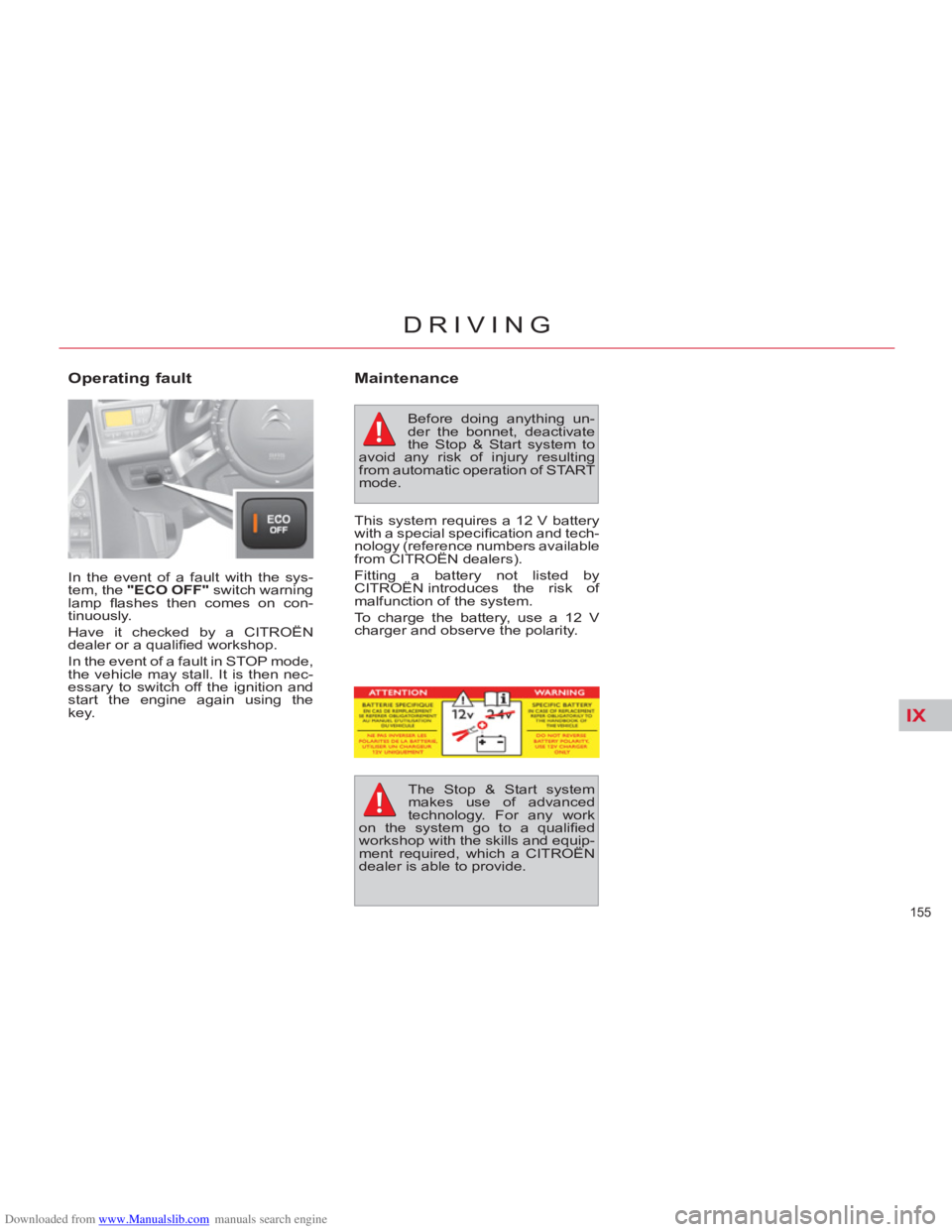
In the event of a fault with the sys-
tem, the "ECO OFF"
switch warning
lamp fl ashes then comes on con-
tinuously.
Have it checked by a CITROËN
dealer or a qualifi ed workshop.
In the event of a fault in STOP mode,
the vehicle may stall. It is then nec-
essary to switch off the ignition and
start the engine again using the
key.
Maintenance
Operating fault
Before doing anything un-
der the bonnet, deactivate
the Stop & Start system to
avoid any risk of injury resulting
from automatic operation of START
mode.
This system requires a 12 V battery
with a special specifi cation and tech-
nology (reference numbers available
from CITROËN dealers).
Fitting a battery not listed by
CITROËN introduces the risk of
malfunction of the system.
To charge the battery, use a 12 V
charger and observe the polarity.
The Stop & Start system
makes use of advanced
technology. For any work
on the system go to a qualifi ed
workshop with the skills and equip-
ment required, which a CITROËN
dealer is able to provide.
Page 159 of 352

Downloaded from www.Manualslib.com manuals search engine IX
157
DRIVING
)
To start the engine, press the
brake pedal and place the gear
lever in position P
.
)
Operate the starter.
)
When the engine is running,
place the gear lever on R
, D
or
M
as required.
)
Check, in the instrument panel,
the position engaged.
)
Release the brake pedal and ac-
celerate.
If the gear lever is not in position P
, a
message "Place automatic gearbox
in position P
" is displayed in the mul-
tifunction screen. It is accompanied
by an audible signal and fl ashing of
P
in the instrument panel.
Moving off
To avoid any difference between the
position of the gear lever and the
true position of the gearbox, always
come out of position P
with the igni-
tion on and your foot on the brake.
)
When this warning lamp
comes on in the instru-
ment panel, press the
brake pedal to disen-
gage the gear lever from
position P
.
Park
)
To select position P,
move the
gear lever back to the highest
position (towards R
), then push
it forwards and then to the left.
)
To exit position P
, move the gear
lever to the right and then to the
position you want.
)
Only engage this position when
the vehicle is completely sta-
tionary. In this position, the front
wheels are locked. Make sure
that the gear lever is correctly
positioned.
Reverse gear
Neutral
Only engage this position
when the vehicle is station-
ary. To prevent snatching,
do not accelerate too soon
after selection.
Never select position N
if
the vehicle is moving.
Never select positions P
or
R
unless the vehicle is sta-
tionary.
If, while the vehicle is moving, po-
sition N
is engaged inadvertently,
allow the engine to idle before en-
gaging position D
or M
. This position of the gear le-
ver is used to prevent the
vehicle from moving when
you are stationary.
Foot on the brake