Page 433 of 536
ENGINE COMPARTMENT — 3.6L
1 — Integrated Power Module (Fuses)5 — Air Cleaner Filter
2 — Engine Oil Dipstick 6 — Engine Oil Fill
3 — Brake Fluid Reservoir Access Cover 7 — Remote Jump Start (Positive Battery Post)
4 — Engine Coolant Reservoir 8 — Washer Fluid Reservoir
7
MAINTAINING YOUR VEHICLE 431
Page 434 of 536
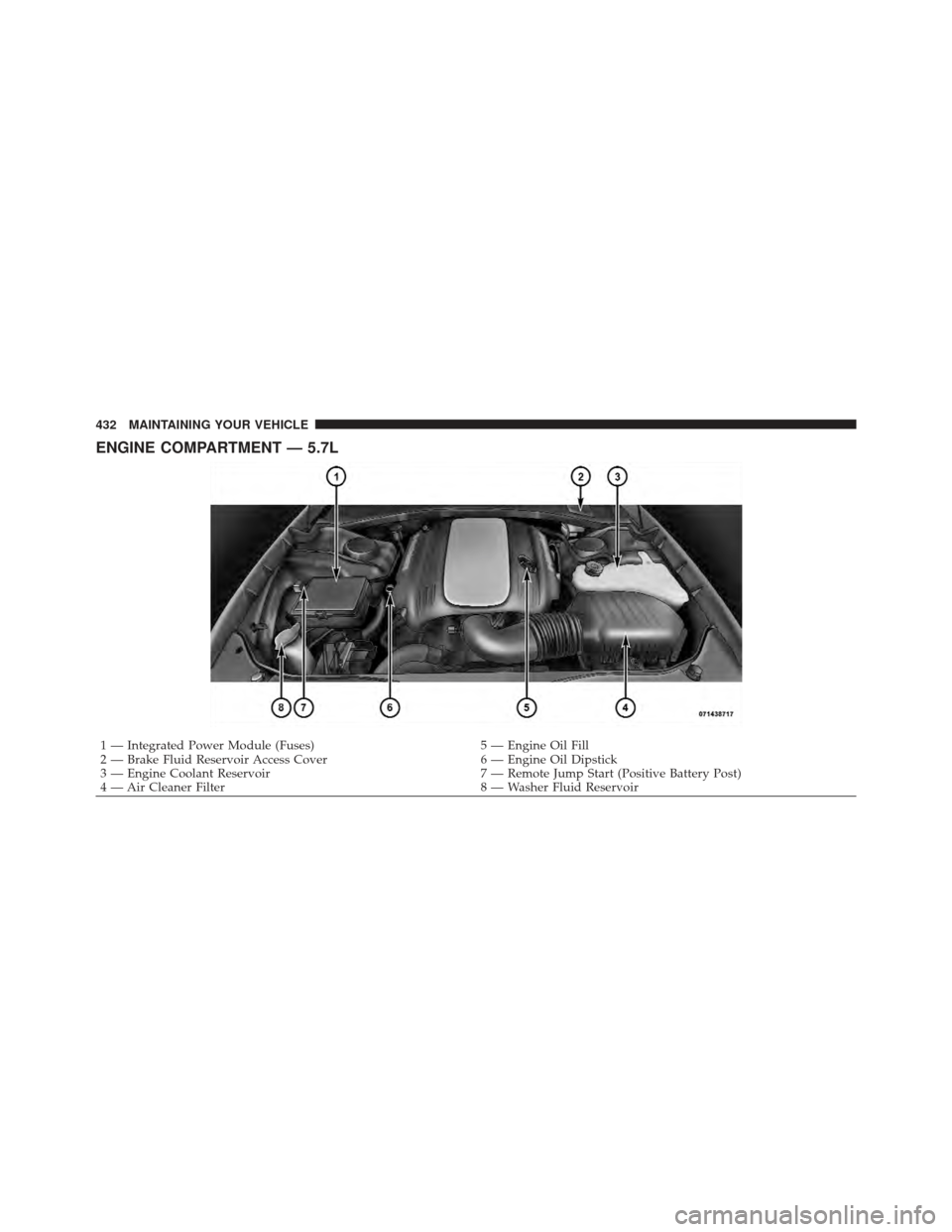
ENGINE COMPARTMENT — 5.7L
1 — Integrated Power Module (Fuses)5 — Engine Oil Fill
2 — Brake Fluid Reservoir Access Cover 6 — Engine Oil Dipstick
3 — Engine Coolant Reservoir 7 — Remote Jump Start (Positive Battery Post)
4 — Air Cleaner Filter 8 — Washer Fluid Reservoir
432 MAINTAINING YOUR VEHICLE
Page 458 of 536

Brake System
In order to assure brake system performance, all brake
system components should be inspected periodically.
Refer to the “Maintenance Schedule” for the proper
maintenance intervals.
WARNING!
Riding the brakes can lead to brake failure and
possibly a collision. Driving with your foot resting or
riding on the brake pedal can result in abnormally
high brake temperatures, excessive lining wear, and
possible brake damage. You would not have your full
braking capacity in an emergency.
Master Cylinder – Brake Fluid Level Check
Check the fluid level in the master cylinder immediately
if the brake system warning light indicates system fail-
ure.Check the fluid level in the master cylinder when per-
forming underhood services.
Clean the top of the master cylinder area before removing
the cap. Add fluid to bring the level up to the top of the
“FULL” mark on the side of the master cylinder reservoir.
Overfilling of fluid is not recommended because it may
cause leaking in the system.
Add enough fluid to bring the level up to the require-
ments described on the brake fluid reservoir. With disc
brakes, fluid level can be expected to fall as the brake
pads wear. However, low fluid level may be caused by a
leak and a checkup may be needed.
Use only manufacturer’s recommended brake fluid. Re-
fer to “Fluids, Lubricants, and Genuine Parts” in “Main-
taining Your Vehicle” for further information.
456 MAINTAINING YOUR VEHICLE
Page 459 of 536

WARNING!
•Use only manufacturer’s recommended brake
fluid. Refer to “Fluids, Lubricants, and Genuine
Parts” in “Maintaining Your Vehicle” for further
information. Using the wrong type of brake fluid
can severely damage your brake system and/or
impair its performance. The proper type of brake
fluid for your vehicle is also identified on the
original factory installed hydraulic master cylin-
der reservoir.(Continued)
WARNING! (Continued)
•To avoid contamination from foreign matter or
moisture, use only new brake fluid or fluid that
has been in a tightly closed container. Keep the
master cylinder reservoir cap secured at all times.
Brake fluid in a open container absorbs moisture
from the air resulting in a lower boiling point.
This may cause it to boil unexpectedly during hard
or prolonged braking, resulting in sudden brake
failure. This could result in a collision.
•Overfilling the brake fluid reservoir can result in
spilling brake fluid on hot engine parts, causing
the brake fluid to catch fire. Brake fluid can also
damage painted and vinyl surfaces, care should be
taken to avoid its contact with these surfaces.(Continued)
7
MAINTAINING YOUR VEHICLE 457
Page 460 of 536

WARNING! (Continued)
•Do not allow petroleum based fluid to contami-
nate the brake fluid. Brake seal components could
be damaged, causing partial or complete brake
failure. This could result in a collision.
Use only brake fluid that has been in a tightly closed
container to avoid contamination from foreign matter or
moisture.
Automatic Transmission
Selection of Lubricant
It is important that the proper lubricant is used in the
transmission to assure optimum transmission perfor-
mance. Use only manufacturer ’s recommended transmis-
sion fluid. Refer to “Fluids, Lubricants, and Genuine
Parts” in “Maintaining Your Vehicle” for further informa-
tion. It is important that the transmission fluid be main-
tained at the prescribed level using the recommended fluid. No chemical flushes should be used in any trans-
mission; only the approved lubricant may be used.
Special Additives
Automatic Transmission Fluid (ATF) is an engineered
product and its performance may be impaired by supple-
mental additives. Therefore, do not add any fluid addi-
tives to the transmission. The only exception to this
policy is the use of special dyes to aid in detecting fluid
leaks. In addition, avoid using transmission sealers as
they may adversely affect seals.
CAUTION!
Do not use chemical flushes in your transmission as
the chemicals can damage your transmission compo-
nents. Such damage is not covered by the New
Vehicle Limited Warranty.
458 MAINTAINING YOUR VEHICLE
Page 465 of 536

•If you carry special cargo such as chemicals, fertilizers,
de-icer salt, etc., be sure that such materials are well
packaged and sealed.
•If a lot of driving is done on gravel roads, consider
mud or stone shields behind each wheel.
•Use MOPAR�Touch Up Paint or equivalent on
scratches as soon as possible. Your authorized dealer
has touch up paint to match the color of your vehicle.
Wheel and Wheel Trim Care
All wheels and wheel trim, especially aluminum and
chrome-plated wheels should be cleaned regularly with a
mild soap and water to prevent corrosion. To remove
heavy soil and/or excessive brake dust, use MOPAR �
Wheel Cleaner or equivalent or select a nonabrasive,
non-acidic cleaner. Do not use scouring pads, steel wool,
a bristle brush, or metal polishes. Only MOPAR �or
equivalent is recommended. Do not use oven cleaner. Avoid automatic car washes that use acidic solutions or
harsh brushes that may damage the wheels’ protective
finish.
Stain Repel Fabric Cleaning Procedure – If
Equipped
Stain Repel seats may be cleaned in the following man-
ner:
•Remove as much of the stain as possible by blotting
with a clean, dry towel.
•Blot any remaining stain with a clean, damp towel.
•For tough stains, apply MOPAR�
Total Clean or a mild
soap solution to a clean, damp cloth and remove the
stain. Use a fresh, damp towel to remove soap residue.
•For grease stains, apply MOPAR� Multi-Purpose
Cleaner or equivalent high quality cleaner to a clean,
damp cloth and remove the stain. Use a fresh, damp
towel to remove soap residue.
7
MAINTAINING YOUR VEHICLE 463
Page 469 of 536
CAUTION!
•When installing the integrated power module
cover, it is important to ensure the cover is prop-
erly positioned and fully latched. Failure to do so
may allow water to get into the integrated power
module and possibly result in an electrical system
failure.
•When replacing a blown fuse, it is important to
use only a fuse having the correct amperage rating.
The use of a fuse with a rating other than indicated
may result in a dangerous electrical system over-
load. If a properly rated fuse continues to blow, it
indicates a problem in the circuit that must be
corrected.
Cavity CartridgeFuseMini-
Fuse Description
1 — — Fuse – Spare
2 40 Amp Green — Radiator Fan #1
3 50 Amp Red — Power Steering #1
4 30 Amp Pink — Starter
5 40 Amp Green — Anti-Lock Brakes
6 — — Fuse – Spare
7 — — Fuse – Spare
8 — — Fuse – Spare
9 — 20 Amp YellowAll-Wheel Drive
Module – If Equipped
10 — 10 Amp RedSecurity
7
MAINTAINING YOUR VEHICLE 467
Page 470 of 536
Cavity CartridgeFuseMini-
Fuse Description
11 — 20 Amp YellowHorns
12 — 10 Amp RedAir Conditioning
Clutch
13 — — Fuse – Spare
14 — 25 Amp NaturalAnti-Lock Brakes
15 — 25 Amp NaturalTransmission
16 — — Fuse – Spare
18 50 Amp Red — Radiator Fan #2
19 50 Amp Red — Power Steering #2
20 30 Amp Pink — Wiper MotorCavity Cartridge
FuseMini-
Fuse Description
21 30 Amp Pink — Headlamp Washers
22 — — Fuse – Spare
23 — — Fuse – Spare
24 — — Fuse – Spare
28 — 25 Amp NaturalFuel Pump
29 — 15 Amp BlueTransmission/Shifter
30 — — Fuse – Spare
31 — 25 Amp NaturalEngine Module
32 — — Fuse – Spare
33 — — Fuse – Spare
34 — 25 Amp NaturalPowertrain #1
468 MAINTAINING YOUR VEHICLE