Page 392 of 490
If the transmission is not operable, or the vehicle must
be towed faster than 25 mph (40 km/h) or farther than 15
mi (24 km), it must be towed with the front wheels OFF
the ground (using a flatbed truck, towing dolly, or
wheel lift equipment with the front wheels raised).
CAUTION!
Towing faster than 25 mph (40 km/h) or farther than
15 mi (24 km) with front wheels on the ground can
cause severe damage to the transmission. Such dam-
age is not covered by the New Vehicle Limited
Warranty.
Without The Ignition Key
Special care must be taken when the vehicle is towed
with the ignition in the LOCK position. Flatbed towing is
the preferred towing method. However, if a flatbed
towing vehicle is not available, wheel lift towing equip-
ment may be used. Rear towing (with the front wheels on
the ground) is not allowed, as transmission damage will
occur. If rear towing is the only alternative, the front
wheels must be placed on a towing dolly. Proper towing
equipment is necessary to prevent damage to the vehicle.
CAUTION!
Failure to follow these towing methods could result
in damage to the transmission. Such damage is not
covered by the New Vehicle Limited Warranty.
390 WHAT TO DO IN EMERGENCIES
Page 409 of 490
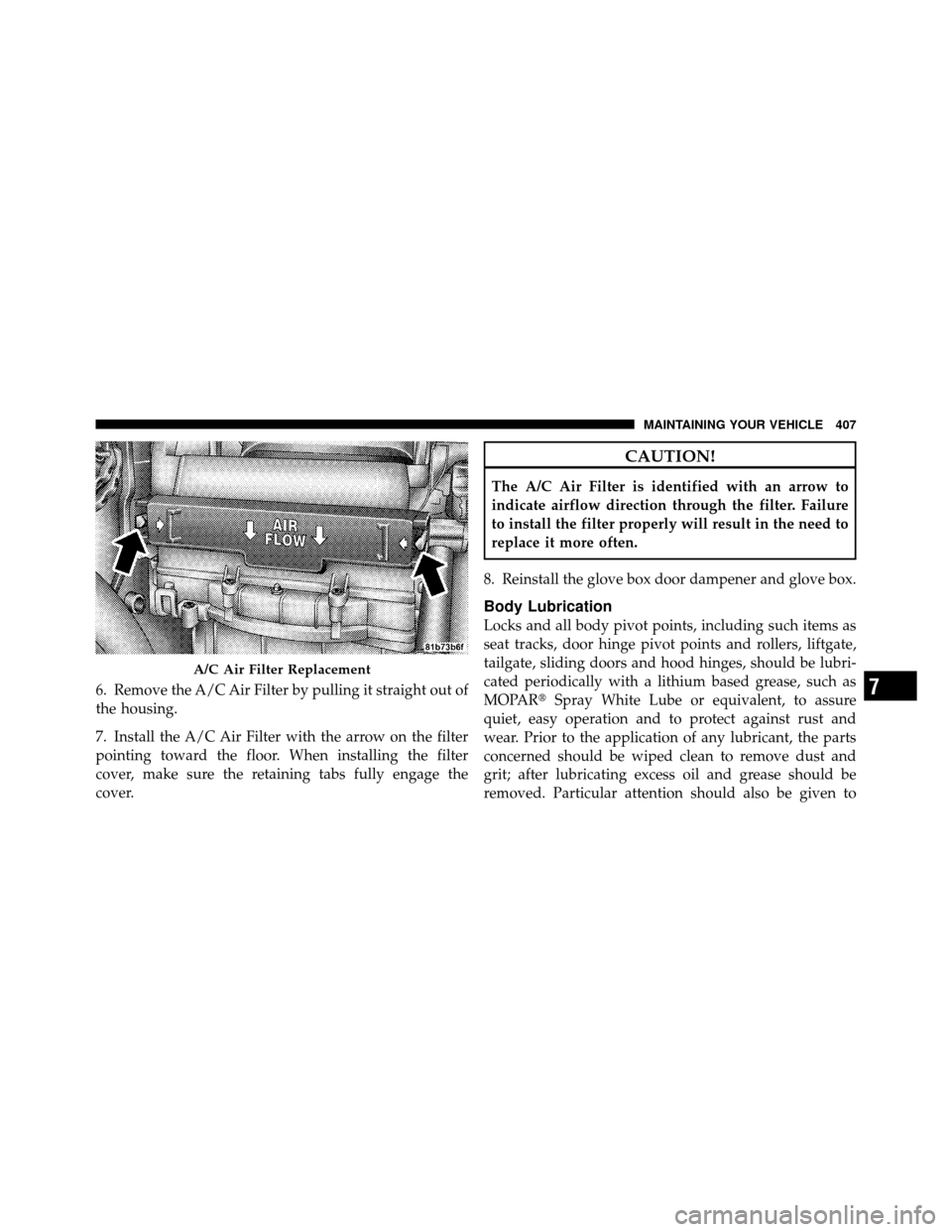
6. Remove the A/C Air Filter by pulling it straight out of
the housing.
7. Install the A/C Air Filter with the arrow on the filter
pointing toward the floor. When installing the filter
cover, make sure the retaining tabs fully engage the
cover.
CAUTION!
The A/C Air Filter is identified with an arrow to
indicate airflow direction through the filter. Failure
to install the filter properly will result in the need to
replace it more often.
8. Reinstall the glove box door dampener and glove box.
Body Lubrication
Locks and all body pivot points, including such items as
seat tracks, door hinge pivot points and rollers, liftgate,
tailgate, sliding doors and hood hinges, should be lubri-
cated periodically with a lithium based grease, such as
MOPAR� Spray White Lube or equivalent, to assure
quiet, easy operation and to protect against rust and
wear. Prior to the application of any lubricant, the parts
concerned should be wiped clean to remove dust and
grit; after lubricating excess oil and grease should be
removed. Particular attention should also be given to
A/C Air Filter Replacement
7
MAINTAINING YOUR VEHICLE 407
Page 410 of 490

hood latching components to ensure proper function.
When performing other underhood services, the hood
latch, release mechanism and safety catch should be
cleaned and lubricated.
The external lock cylinders should be lubricated twice a
year, preferably in the Fall and Spring. Apply a small
amount of a high quality lubricant, such as MOPAR�
Lock Cylinder Lubricant or equivalent directly into the
lock cylinder.
Windshield Wiper Blades
Clean the rubber edges of the wiper blades and the
windshield periodically with a sponge or soft cloth and a
mild non-abrasive cleaner or use the washer solvent. This
will remove accumulations of salt, waxes, or road film
and help reduce streaking and smearing. Operation of the wipers on dry glass for long periods
may cause deterioration of the wiper blades. Always use
washer fluid when using the wipers to remove salt or dirt
from a dry windshield.
Avoid using the wiper blades to remove frost or ice from
the windshield. Make sure that they are not frozen to the
glass before turning them on to avoid damaging the
blade.
Keep the blade rubber out of contact with petroleum
products such as engine oil, gasoline, etc.
NOTE:
Life expectancy of wiper blades varies depend-
ing on geographical area and frequency of use. Poor
performance of blades may be present with chattering,
marks, water lines or wet spots. If any of these conditions
are present, clean the wiper blades or replace as
necessary.
408 MAINTAINING YOUR VEHICLE
Page 414 of 490

Cooling System
WARNING!
•When working near the radiator cooling fan, dis-
connect the fan motor lead or turn the ignition
switch to the LOCK position. The fan is tempera-
ture controlled and can start at anytime the igni-
tion switch is in the ON position.
•You or others can be badly burned by hot engine
coolant (antifreeze) or steam from your radiator. If
you see or hear steam coming from under the
hood, do not open the hood until the radiator has
had time to cool. Never try to open a cooling
system pressure cap when the radiator is hot.
Coolant Checks
Check engine coolant (antifreeze) protection every
12 months (before the onset of freezing weather, where
applicable). If the engine coolant (antifreeze) is dirty orrusty in appearance, the system should be drained,
flushed, and refilled with fresh engine coolant (anti-
freeze). Check the front of the A/C condenser for any
accumulation of bugs, leaves, etc. If dirty, clean by gently
spraying water from a garden hose vertically down the
face of the condenser.
Check the coolant recovery bottle tubing for brittle rub-
ber, cracking, tears, cuts, and tightness of the connection
at the bottle and radiator. Inspect the entire system for
leaks.
Cooling System – Drain, Flush, And Refill
If the engine coolant (antifreeze) is dirty or contains a
considerable amount of sediment, clean and flush with a
reliable cooling system cleaner. Follow with a thorough
rinsing to remove all deposits and chemicals. Properly
dispose of the old engine coolant (antifreeze).
Refer to the “Maintenance Schedule” for the proper
maintenance intervals.
412 MAINTAINING YOUR VEHICLE
Page 432 of 490
CavityCartridge
Fuse Mini
Fuse Description
9 40 Amp
Green Battery Feed – Power
Seats – If Equipped/
PZEV Air Pump – If
Equipped
10 — 20 Amp
Yellow Instrument Panel/
Power Locks/Interior
Lights
11 — 15 Amp
Lt Blue Selectable Power
Outlet (Inside Center
Arm Rest)
12 — 20 Amp
Yellow —
13 — 20 Amp
Yellow Ignition
14 — 10 Amp
Red Instrument PanelCavity Cartridge
Fuse Mini
Fuse Description
15 40 Amp
Green — Radiator Fan Relay
16 — 15 Amp
Lt. Blue Cigar Lighter/
Sunroof – If
Equipped
17 — 10 Amp
Red Wireless Control
Module (WCM)/
Clock/Steering Con-
trol Module (SCM)
18 40 Amp
Green —Auto Shutdown
(ASD) Relay
19 — 20 Amp
Yellow Audio Amplifier – If
Equipped
20 — 15 Amp
Lt. Blue Radio
21 — 10 Amp
Red Siren – If Equipped
430 MAINTAINING YOUR VEHICLE
Page 434 of 490
CavityCartridge
Fuse Mini
Fuse Description
32 30 Amp
Pink —Auto Shutdown
(ASD) Relay 1
33 — 10 Amp
Red Switch Bank/
Diagnostic Link
Connector/
Powertrain Control
Module (PCM)
34 30 Amp
Pink —Anti-Lock Brakes
(ABS) Module – If
Equipped/Electronic
Stability Control
(ESC) Module – If
EquippedCavity
Cartridge
Fuse Mini
Fuse Description
35 40 Amp
Green —Anti-Lock Brakes
(ABS) Module – If
Equipped/Electronic
Stability Control
(ESC) Module – If
Equipped
36 30 Amp
Pink —Passenger Door Mod-
ule (PDM)/Driver
Door Module (DDM)
37 — 25 Amp
Natural Power Top Module –
If Equipped
432 MAINTAINING YOUR VEHICLE
Page 437 of 490

this, you should not attempt to service a headlamp bulb
yourself. If a headlamp bulb fails, take your vehicle to
an authorized dealer for service.
WARNING!
A transient high tension occurs at the bulb sockets of
HID headlamps when the headlamp switch is turned
ON. It may cause serious electrical shock or electro-
cution if not serviced properly. See your authorized
dealer for service.
NOTE: On vehicles equipped with HID headlamps,
when the headlamps are turned on, there is a blue hue to
the lights. This diminishes and becomes more white after
approximately 10 seconds, as the system charges.
Front Turn Signal
1. Raise and prop open the hood.
2. Rotate the bulb’s electrical connector one-quarter turn
counterclockwise and remove it from the headlamp
housing.
3. Remove the bulb from the connector socket and install
the replacement bulb.
4. Install the bulb and connector assembly into the
headlamp housing and rotate the connector one-quarter
turn clockwise to lock it in place.
Front Fog Lamp
NOTE: Access to the lamps through the lower fascia
cutout is limited. We recommend you access the lamps by
turning the steering wheel to allow access and remove
the inner fender shield.
7
MAINTAINING YOUR VEHICLE 435
Page 438 of 490
1. Rotate the bulb’s electrical connector one-quarter turn
counterclockwise and remove it from the fog lamp hous-
ing.
2. Remove the bulb from the connector socket and install
the replacement bulb.
CAUTION!
Do not touch the new bulb with your fingers. Oil
contamination will severely shorten bulb life. If the
bulb comes in contact with an oily surface, clean the
bulb with rubbing alcohol.
3. Install the bulb and connector assembly into the fog
lamp housing and rotate the connector one-quarter turn
clockwise to lock it in place.
Backup Lamps
1. Open the trunk and gently pull back the trunk liner
behind the tail lamp.
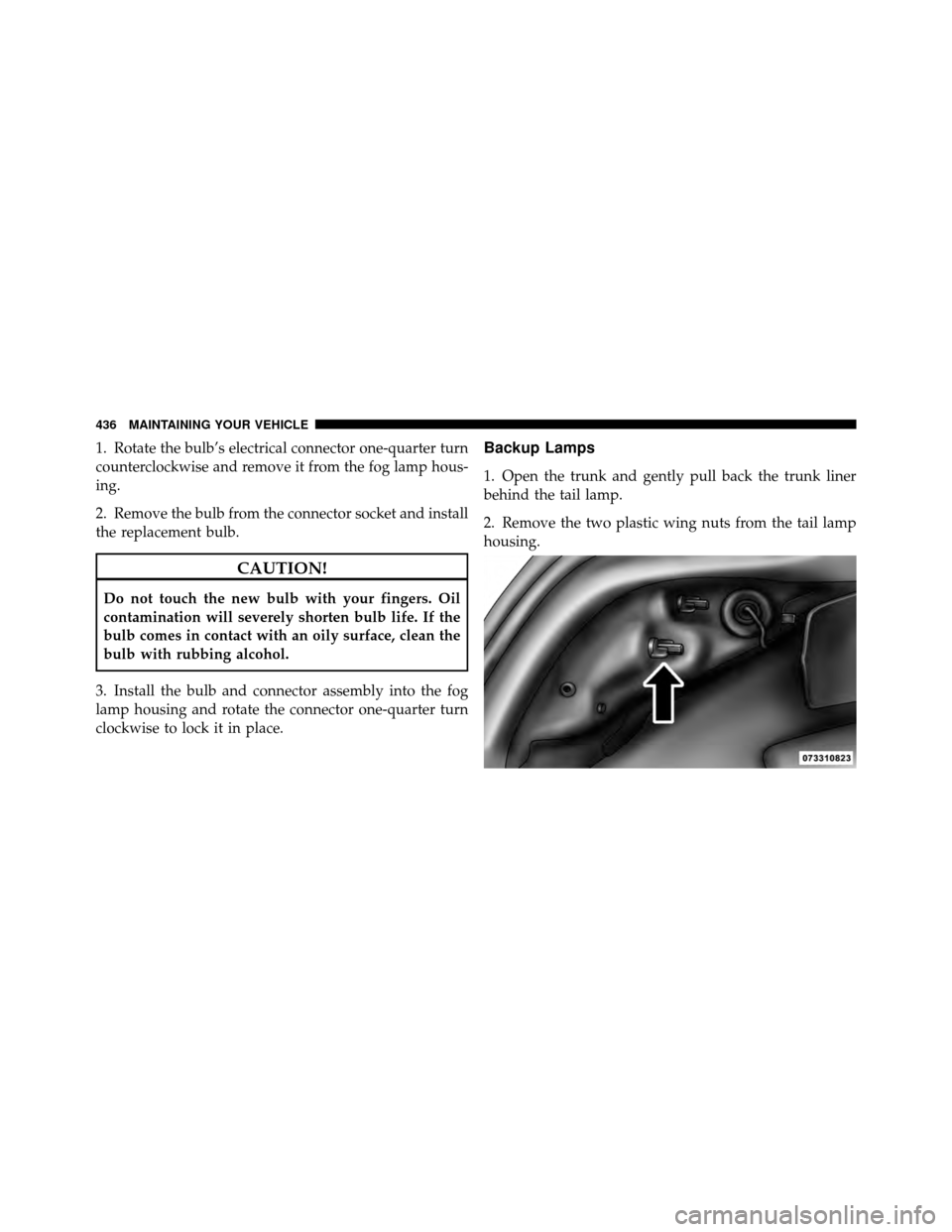
2. Remove the two plastic wing nuts from the tail lamp
housing.
436 MAINTAINING YOUR VEHICLE