Page 279 of 505
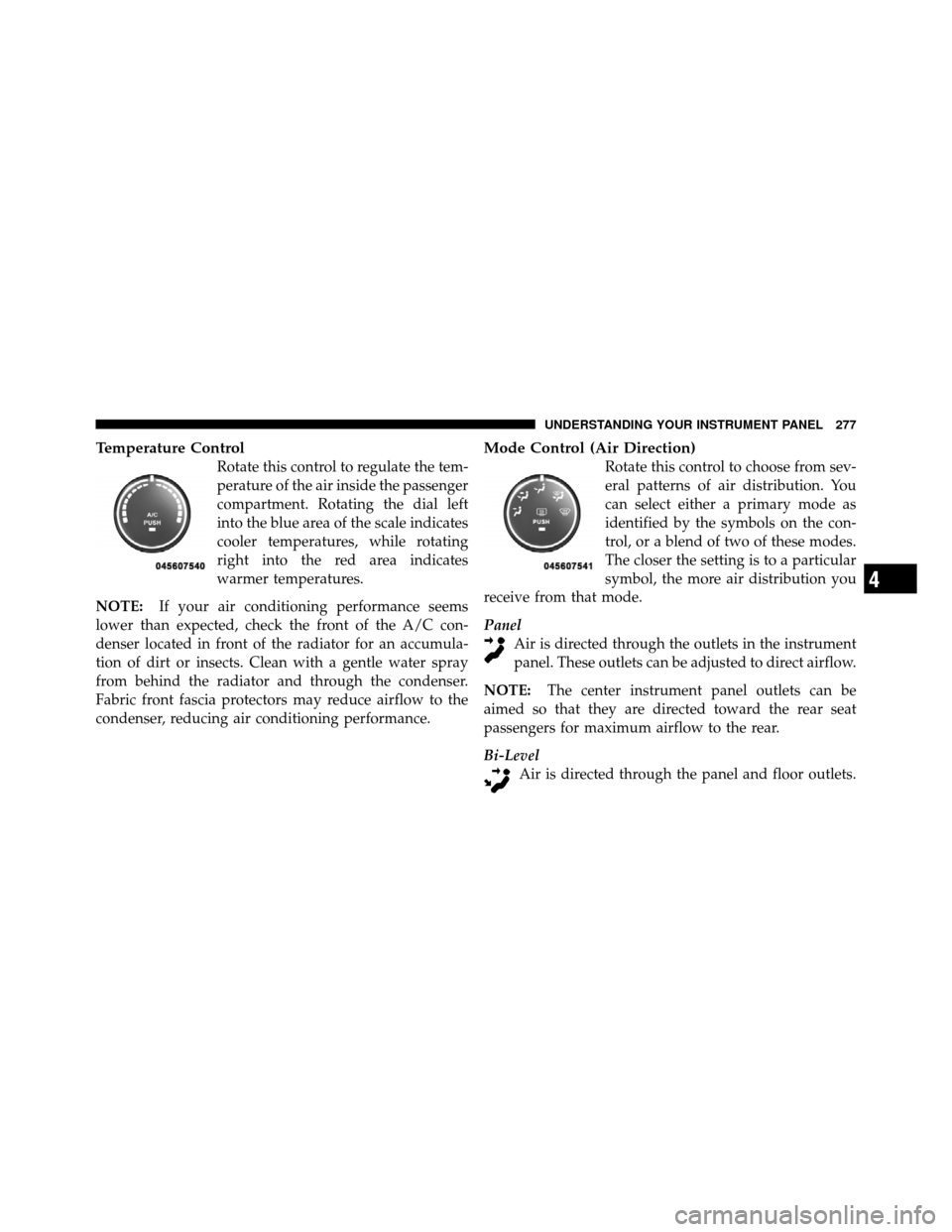
Temperature Control
Rotate this control to regulate the tem-
perature of the air inside the passenger
compartment. Rotating the dial left
into the blue area of the scale indicates
cooler temperatures, while rotating
right into the red area indicates
warmer temperatures.
NOTE: If your air conditioning performance seems
lower than expected, check the front of the A/C con-
denser located in front of the radiator for an accumula-
tion of dirt or insects. Clean with a gentle water spray
from behind the radiator and through the condenser.
Fabric front fascia protectors may reduce airflow to the
condenser, reducing air conditioning performance.
Mode Control (Air Direction)
Rotate this control to choose from sev-
eral patterns of air distribution. You
can select either a primary mode as
identified by the symbols on the con-
trol, or a blend of two of these modes.
The closer the setting is to a particular
symbol, the more air distribution you
receive from that mode.
Panel Air is directed through the outlets in the instrument
panel. These outlets can be adjusted to direct airflow.
NOTE: The center instrument panel outlets can be
aimed so that they are directed toward the rear seat
passengers for maximum airflow to the rear.
Bi-Level Air is directed through the panel and floor outlets.
4
UNDERSTANDING YOUR INSTRUMENT PANEL 277
Page 286 of 505
The operator can override the AUTO mode setting to
change airflow distribution by rotating the Mode Control
knob (on the right) to one of the following positions.
•PanelAir is directed through the outlets in the instrument
panel. These outlets can be adjusted to direct airflow.
NOTE: The center instrument panel outlets can be
aimed so that they are directed toward the rear seat
passengers for maximum airflow to the rear.
•Bi-Level Air is directed through the panel and floor outlets.
NOTE: For all settings, except full cold or full hot, there
is a difference in temperature between the upper and
lower outlets. The warmer air flows to the floor outlets.
This feature gives improved comfort during sunny but
cool conditions.
•Floor Air is directed through the floor outlets with a
small amount flowing through the defrost and side
window demist outlets.
•Mix Air is directed through the floor, defrost, and side
window demist outlets. This setting works best in
cold or snowy conditions that require extra heat to
the windshield. This setting is good for maintaining
comfort while reducing moisture on the windshield.
•Defrost Air is directed through the windshield and side
window demist outlets. Use this mode with maxi-
mum blower and temperature settings for best wind-
shield and side window defrosting.
284 UNDERSTANDING YOUR INSTRUMENT PANEL
Page 289 of 505
Window Fogging
Interior fogging on the windshield can be quickly re-
moved by turning the mode selector to Defrost. The Mix
mode can be used to maintain a clear windshield and
provide sufficient heating. If side window fogging be-
comes a problem, increase blower speed. Vehicle win-
dows tend to fog on the inside in mild but rainy or humid
weather.
NOTE:Recirculate without A/C should not be used for
long periods as fogging may occur.
Side Window Demisters
A side window demister outlet is located at each end of
the instrument panel. These non-adjustable outlets direct
air toward the side windows when the system is in the
FLOOR, MIX, or DEFROST mode. The air is directed at
the area of the windows through which you view the
outside mirrors.
Outside Air Intake
Make sure the air intake, located directly in front of the
windshield, is free of obstructions such as leaves. Leaves
collected in the air intake may reduce airflow, and if they
enter the plenum, they could plug the water drains. In
winter months, make sure the air intake is clear of ice,
slush, and snow.
A/C Air Filter — If Equipped
The A/C Filter prevents most dust and pollen from
entering the cabin. The filter acts on air coming from
outside the vehicle and recirculated air within the pas-
senger compartment. Refer to “Maintenance Procedures”
in “Maintaining Your Vehicle” for A/C Air Filter service
information or see your authorized dealer for service.
Refer to “Maintenance Schedules” for filter service
intervals.
4
UNDERSTANDING YOUR INSTRUMENT PANEL 287
Page 294 of 505
�Flexible Fuel (3.6L Engine Only) —
If Equipped .......................... 357
▫ E-85 General Information ............... 357
▫ Ethanol Fuel (E-85) ................... 358
▫ Fuel Requirements ................... 359
▫ Selection Of Engine Oil For Flexible Fuel
Vehicles (E-85) And Gasoline Vehicles ...... 359
▫ Starting ........................... 360
▫ Cruising Range ...................... 360
▫ Replacement Parts ................... 360
▫ Maintenance ........................ 361 �
Adding Fuel ......................... 361
▫ Fuel Filler Cap (Gas Cap) .............. 361
▫ Loose Filler Cap Message .............. 363
� Vehicle Loading ...................... 363
▫ Vehicle Certification Label .............. 363
▫ Gross Vehicle Weight Rating (GVWR) ...... 364
▫ Gross Axle Weight Rating (GAWR) ........ 364
▫ Overloading ........................ 365
▫ Loading ........................... 365
� Trailer Towing ........................ 365
▫ Common Towing Definitions ............ 366
▫ Trailer Hitch Classification .............. 368
292 STARTING AND OPERATING
Page 295 of 505
▫Trailer Towing Weights
(Maximum Trailer Weight Ratings) ........ 369
▫ Trailer And Tongue Weight ............. 370
▫ Towing Requirements ................. 371
▫ Towing Tips ........................ 375 �
Recreational Towing
(Behind Motorhome, Etc.) ................ 376
▫ Towing This Vehicle
Behind Another Vehicle ................ 376
5
STARTING AND OPERATING 293
Page 297 of 505
For vehicles equipped with Tip Start (Six-Speed Trans-
mission),turn the ignition switch to the START position
and release it as soon as the starter engages. The starter
motor will continue to run, and it will disengage auto-
matically when the engine is running. If the engine fails
to start, the starter will disengage automatically in 10 sec-
onds. If this occurs, turn the ignition switch to the LOCK
position, wait 10 to 15 seconds, then repeat the “Normal
Starting” procedure.
Extreme Cold Weather (Below –20°F or �29°C)
To ensure reliable starting at these temperatures, use of
an externally powered electric engine block heater (avail-
able from your dealer) is recommended.
If Engine Fails To Start
WARNING!
•Never pour fuel or other flammable liquids into
the throttle body air inlet opening in an attempt to
start the vehicle. This could result in a flash fire
causing serious personal injury.
•Do not attempt to push or tow your vehicle to get it
started. Vehicles equipped with an automatic trans-
mission cannot be started this way. Unburned fuel
could enter the catalytic converter and once the
engine has started, ignite and damage the converter
and vehicle. If the vehicle has a discharged battery,
booster cables may be used to obtain a start from a
booster battery or the battery in another vehicle.
This type of start can be dangerous if done improp-
erly. Refer to “Jump Starting” in “What To Do In
Emergencies” for further information.
5
STARTING AND OPERATING 295
Page 303 of 505

When parking on a flat surface, place the shift lever into
the PARK position first, and then apply the parking
brake.
When parking on a hill, it is important to set the parking
brake before placing the shift lever in PARK, otherwise
the load on the transmission locking mechanism may
make it difficult to move the shift lever out of PARK. As
an added precaution, turn the front wheels toward the
curb on a downhill grade and away from the curb on an
uphill grade.
WARNING!
•Never use the PARK position as a substitute for
the parking brake. Always apply the parking
brake fully when parked to guard against vehicle
movement and possible injury or damage.(Continued)
WARNING! (Continued)
•Never leave children alone in a vehicle. Leaving
unattended children in a vehicle is dangerous for a
number of reasons. A child or others could be
seriously or fatally injured. Do not leave the
ignition key in the ignition switch. A child could
operate power windows, other controls, or move
the vehicle.
CAUTION!
DO NOT race the engine when shifting from PARK
or NEUTRAL positions into another gear range as
this can damage the drivetrain.
REVERSE
This range is for moving the vehicle backward. Use only
after the vehicle has come to a complete stop.
5
STARTING AND OPERATING 301
Page 304 of 505
NEUTRAL
This range is used when vehicle is standing for pro-
longed periods with engine running. Engine may be
started in this range. Set the parking brake and shift the
transmission into PARK if you must leave the vehicle.
WARNING!
Do not coast in NEUTRAL and never turn off the
ignition switch to coast down a hill. These are unsafe
practices that limit your response to changing traffic
or road conditions. You might lose control of the
vehicle and have a collision.
DRIVE – Six-Speed Transmission
This range should be used for most city and highway
driving. It provides the smoothest upshifts, downshifts,
and best fuel economy. However, use the AutoStick�
mode and select the appropriate gear when frequent
transmission shifting occurs in the DRIVE range. For example: When operating the vehicle under heavy load-
ing conditions, (i.e., in hilly terrain, traveling into strong
headwinds, or while towing heavy trailers). Under these
conditions, reducing shifting by selecting the appropriate
gear in AutoStick�
will improve the performance and
extend transmission life by reducing excessive shifting
and heat build-up.
DRIVE – Four-Speed Transmission
This range should be used for most city and highway
driving, it provides the smoothest upshifts, downshifts,
and best fuel economy. However, select the �3�range
when frequent transmission shifting occurs while using
the DRIVE range, such as when operating the vehicle
under heavy loading conditions, (i.e., in hilly terrain,
traveling into strong headwinds, or while towing heavy
trailers). Under these conditions, using the �3�range will
improve performance and extend transmission life by
reducing excessive shifting and heat build-up.
302 STARTING AND OPERATING