2011 CHEVROLET TAHOE air condition
[x] Cancel search: air conditionPage 8 of 98

Black plate (4,1)Chevrolet Tahoe and GMC Yukon/Yukon Denali Hybrid - 2011
1-4 In Brief
A chime will sound if the driver door
is opened while in Auto Stop as a
reminder that the ignition switch is
not in the LOCK/OFF position.
Always turn the ignition switch to
LOCK/OFF and remove the key
from the ignition switch when exiting
the vehicle.
Auto Start
The vehicle also has an Auto Start
feature. The engine will remain off
while in Auto Stop mode until
vehicle conditions require the
engine to run. The near-instant
starting of the engine from Auto
Stop mode is called Auto Start.
EV Mode
The vehicle also has an EV mode
which uses only the electric motor to
move the vehicle. With light
acceleration, the vehicle will drive in
EV mode. EV mode is unavailable
when the vehicle is out of fuel.
For more information on Auto Stop,
Auto Start, and EV Mode, see
Starting the Vehicle on page 9‑2.
Regenerative Braking
Regenerative braking enables the
electric drive motor to operate as a
generator when coasting or braking.
Energy from the moving vehicle
recharges the hybrid battery.
The hydraulic disc brakes work with
the regenerative braking to insure
effective braking.
The braking system is computer
controlled and blends the
regenerative braking with the
conventional hydraulic disc brakes
to meet any requirements for
deceleration. Because the controller
applies the hydraulic brakes through
its high pressure accumulator, you
may occasionally hear the motor
driven pump when it recharges the
system. This is normal. In the event
of a controller problem, the brake
pedal may be harder to push and
the stopping distance may be
longer.
SeeRegenerative Braking on
page 9‑15.
Battery
This vehicle has a standard 12-volt
battery and a high voltage hybrid
battery. When a new standard
12-volt battery is needed, see your
dealer for one that has the
replacement number shown on the
original battery's label. Only a
trained service technician with the
proper knowledge and tools should
inspect, test, or replace the hybrid
battery. See your dealer if the hybrid
battery needs service. See Battery
on page 10‑12.
Service
Never try to do your own service on
hybrid components. You can be
injured and the vehicle can be
damaged if you try to do your own
service work. Service and repair of
these hybrid components should
only be performed by a trained
service technician with the proper
knowledge and tools. See Doing
Your Own Service Work on
page 10‑2.
Page 29 of 98

Black plate (1,1)Chevrolet Tahoe and GMC Yukon/Yukon Denali Hybrid - 2011
Climate Controls 8-1
Climate Controls
Climate Control Systems
Climate Control Systems . . . . . . 8-1
Climate Control
Systems
For more information on the
vehicle's climate control system, see
“Climate Control System”in the
owner manual.
Electric Air Conditioning
Compressor
This hybrid vehicle has an
electrically powered air conditioning
compressor. This allows for
continuous air conditioning
operation and passenger comfort,
even while the hybrid engine cycles
on and off.
When operating the climate control
system, select the AUTO mode and
the desired temperature setting. The
climate control system automatically
adjusts the fan speed and airflow
direction. The climate control
system continues to adjust the
climate control settings chosen for
best use of electrical power. At mild temperatures, select a
warmer air conditioner temperature
or turn the air conditioner off to get
maximum fuel economy. Continuous
air conditioner use can cause the
vehicle to Auto Start more
frequently. During hot weather,
driving with the windows closed and
the air conditioner set to Auto mode,
will result in better Hybrid system
performance.
Some noise may be heard
occasionally from the compressor,
especially when air conditioning use
is high and the engine has
turned off.
Page 34 of 98

Black plate (4,1)Chevrolet Tahoe and GMC Yukon/Yukon Denali Hybrid - 2011
9-4 Driving and Operating
Engine Coolant Heater
The engine coolant heater can
provide easier starting and better
fuel economy during engine
warm-up in cold weather conditions
at or below−18°C (0°F). Vehicles
with an engine heater should be
plugged in at least four hours before
starting. An internal thermostat in
the plug-end of the cord may exist
which will prevent engine coolant
heater operation at temperatures
above −18°C (0°F).
Using the Engine Coolant
Heater
1. Turn off the engine.
2. Open the hood and unwrap the
electrical cord. The cord is
secured to a wiring harness
between the engine and the
Hybrid Auxiliary Underhood
Fuse Block with a clip. Carefully
remove the wire tie which
secures the electrical cord. Do
not cut the electrical cord. 3. Plug the cord into a normal,
grounded 110-volt AC outlet.
{WARNING
Plugging the cord into an
ungrounded outlet could cause an
electrical shock. Also, the wrong
kind of extension cord could
overheat and cause a fire. You
could be seriously injured. Plug
the cord into a properly grounded
three-prong 110-volt AC outlet.
If the cord will not reach, use a
heavy-duty three-prong extension
cord rated for at least 15 amps.
4. Before starting the engine, be sure to unplug and store the
cord as it was before to keep it
away from moving engine parts.
If you do not, it could be
damaged. The length of time the heater should
remain plugged in depends on
several factors. Ask a dealer in the
area where you will be parking the
vehicle for the best advice on this.
Shifting Into Park
{WARNING
It can be dangerous to get out of
the vehicle if the shift lever is not
fully in P (Park) with the parking
brake firmly set. The vehicle can
roll. If you have left the engine
running, the vehicle can move
suddenly. You or others could be
injured. To be sure the vehicle will
not move, even when you are on
fairly level ground, use the steps
that follow. With four-wheel drive,
if the transfer case is in
N (Neutral), the vehicle will be
free to roll, even if the shift lever
is in P (Park). So, be sure the
transfer case is in a drive
(Continued)
Page 38 of 98

Black plate (8,1)Chevrolet Tahoe and GMC Yukon/Yukon Denali Hybrid - 2011
9-8 Driving and Operating
R (Reverse):Use this gear to
back up.
Notice: Shifting to R (Reverse)
while the vehicle is moving
forward could damage the
transmission. The repairs would
not be covered by the vehicle
warranty. Shift to R (Reverse) only
after the vehicle is stopped.
To rock the vehicle back and forth to
get out of snow, ice, or sand without
damaging the transmission, see “If
the Vehicle is Stuck” in the owner
manual.
N (Neutral): In this position, the
engine and transmission are not
connected with the wheels. To
restart the engine when the vehicle
is already moving, use
N (Neutral) only.{WARNING
Shifting into a drive gear while the
engine is running at high speed is
dangerous. Unless your foot is
firmly on the brake pedal, the
vehicle could move very rapidly.
You could lose control and hit
people or objects. Do not shift
into a drive gear while the engine
is running at high speed.
Notice: Shifting out of P (Park) or
N (Neutral) with the engine
running at high speed may
damage the transmission. The
repairs would not be covered by
the vehicle warranty. Be sure the
engine is not running at high
speed when shifting the vehicle. D (Drive):
This position is for
normal driving. It provides the best
fuel economy. If you need more
power for passing, and you are:
.Going less than about 55 km/h
(35 mph), push the accelerator
pedal about halfway down.
.Going about 55 km/h (35 mph) or
more, push the accelerator all
the way down.
D (Drive) or M (Manual Mode) can
be used when towing a trailer,
carrying a heavy load, driving on
steep hills, or for off-road driving.
You may want to shift the
transmission to a lower gear
selection if the transmission shifts
too often.
Downshifting the transmission in
slippery road conditions could result
in skidding. See “Loss of Control” in
the owner manual.
When temperatures are very cold,
the transmission's gear shifting may
be delayed, providing more stable
shifts until the engine warms up.
Page 39 of 98

Black plate (9,1)Chevrolet Tahoe and GMC Yukon/Yukon Denali Hybrid - 2011
Driving and Operating 9-9
Shifts may be more noticeable with
a cold transmission. This difference
in shifting is normal.
M (Manual Mode):This position
lets drivers select the range of gears
appropriate for current driving
conditions. If the vehicle has this
feature, see Manual Mode on
page 9‑9.
Notice: Spinning the tires or
holding the vehicle in one
place on a hill using only the
accelerator pedal may damage
the transmission. The repair will
not be covered by the vehicle
warranty. If you are stuck, do not
spin the tires. When stopping on
a hill, use the brakes to hold the
vehicle in place.
The vehicle has a shift stabilization
feature that adjusts the transmission
shifting to the current driving
conditions to reduce rapid upshifts
and downshifts. If the shift
stabilization feature determines that
a current vehicle speed cannot be
maintained, the transmission does not upshift. In some cases, this may
appear to be a delayed shift,
however the transmission is
operating normally.
Manual Mode
Range Selection Mode
The Range Selection Mode controls
the vehicle's transmission.
To use this feature:
1. Move the shift lever to the
M (Manual Mode).
2. Press the plus/minus button to upshift or downshift selecting the
desired range of gears.
A number displays next to the M,
indicating the current gear that has
been selected. The number
displayed in the gear indicator is the
highest gear that can be used. The
vehicle can automatically shift to
lower gears as it adjusts to driving
conditions. When 3 (Third) is
selected, 1 (First) through 3 (Third)
gears are automatically shifted by
the vehicle, but 4 (Fourth) cannot be
used until it is selected.
The Range Selection Mode controls
the vehicle and engine speed while
driving down a hill or towing a trailer,
by allowing you to select a desired
range of gears.
Page 60 of 98
Black plate (12,1)Chevrolet Tahoe and GMC Yukon/Yukon Denali Hybrid - 2011
10-12 Vehicle Care
5. Add the pre‐mixed DEX‐COOL,available at your dealer, until the
coolant level is maintained at the
FULL COLD mark. This should
take no longer than two minutes
of hybrid cooling pump
operation.
If the level cannot be kept at the
FULL COLD level, the vehicle
may need service. See your
dealer.
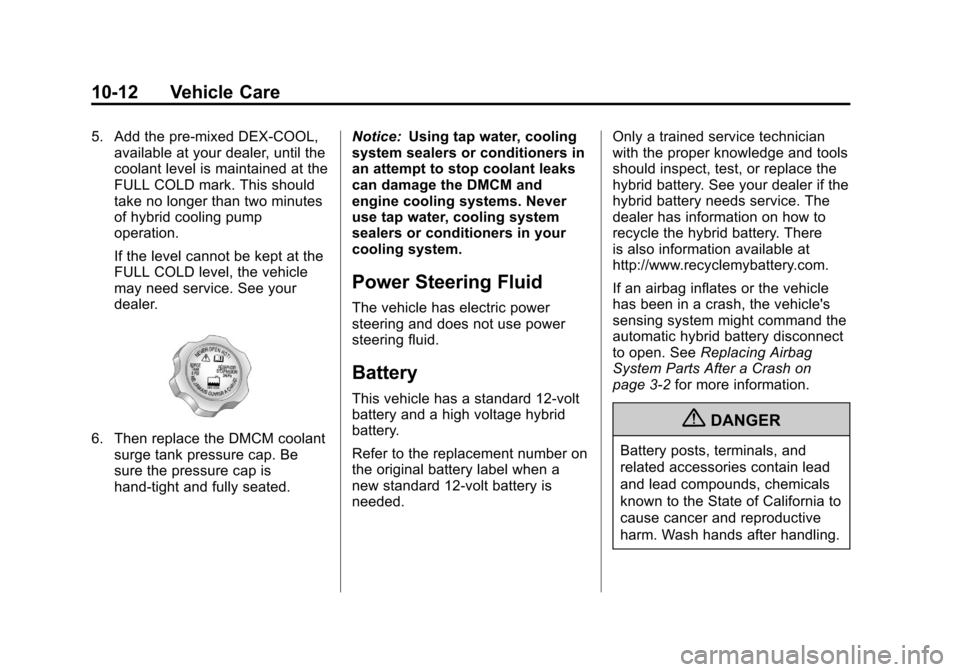
6. Then replace the DMCM coolant
surge tank pressure cap. Be
sure the pressure cap is
hand-tight and fully seated. Notice:
Using tap water, cooling
system sealers or conditioners in
an attempt to stop coolant leaks
can damage the DMCM and
engine cooling systems. Never
use tap water, cooling system
sealers or conditioners in your
cooling system.
Power Steering Fluid
The vehicle has electric power
steering and does not use power
steering fluid.
Battery
This vehicle has a standard 12‐volt
battery and a high voltage hybrid
battery.
Refer to the replacement number on
the original battery label when a
new standard 12‐volt battery is
needed. Only a trained service technician
with the proper knowledge and tools
should inspect, test, or replace the
hybrid battery. See your dealer if the
hybrid battery needs service. The
dealer has information on how to
recycle the hybrid battery. There
is also information available at
http://www.recyclemybattery.com.
If an airbag inflates or the vehicle
has been in a crash, the vehicle's
sensing system might command the
automatic hybrid battery disconnect
to open. See
Replacing Airbag
System Parts After a Crash on
page 3‑2 for more information.
{DANGER
Battery posts, terminals, and
related accessories contain lead
and lead compounds, chemicals
known to the State of California to
cause cancer and reproductive
harm. Wash hands after handling.
Page 66 of 98

Black plate (18,1)Chevrolet Tahoe and GMC Yukon/Yukon Denali Hybrid - 2011
10-18 Vehicle Care
affects vehicle handling and ride
comfort. Never load your vehicle
with more weight than it was
designed to carry.
When to Check
Check your tires once a month
or more.
How to Check
Use a good quality pocket-type
gauge to check tire pressure. You
cannot tell if your tires are properly
inflated simply by looking at them.
Radial tires may look properly
inflated even when they're
underinflated. Check the tire's
inflation pressure when the tires are
cold. Cold means your vehicle has
been sitting for at least three hours
or driven no more than 1.6 km
(1 mile).
Remove the valve cap from the tire
valve stem. Press the tire gauge
firmly onto the valve to get a
pressure measurement. If the cold
tire inflation pressure matches the
recommended pressure on the tireand loading information label, no
further adjustment is necessary.
If the pressure is low, add air until
you reach the recommended
amount.
If you overfill the tire, release air by
pushing on the metal stem in the
center of the tire valve. Recheck the
tire pressure with the tire gauge.
Be sure to put the valve caps back
on the valve stems. They help
prevent leaks by keeping out dirt
and moisture.
Tire Pressure Monitor
Operation
This vehicle may have a Tire
Pressure Monitor System (TPMS).
The TPMS is designed to warn the
driver when a low tire pressure
condition exists. TPMS sensors are
mounted onto each tire and wheel
assembly. The TPMS sensors
monitor the air pressure in the
vehicle's tires and transmit the tire
pressure readings to a receiver
located in the vehicle.
When a low tire pressure condition
is detected, the TPMS will illuminate
the low tire pressure warning
symbol located on the instrument
panel cluster. If the warning light
comes on, stop as soon as possible
and inflate the tires to the
recommended pressure shown on
the tire loading information label.
See
“Vehicle Load Limits” in the
owner manual for more information.
At the same time a message to
check the pressure in a specific tire
appears on the Driver Information
Center (DIC) display. The low tire
pressure warning light and the DIC
warning message come on at each
ignition cycle until the tires are
Page 67 of 98

Black plate (19,1)Chevrolet Tahoe and GMC Yukon/Yukon Denali Hybrid - 2011
Vehicle Care 10-19
inflated to the correct inflation
pressure. Using the DIC, tire
pressure levels can be viewed by
the driver. For additional information
and details about the DIC operation
and displays seeDriver Information
Center (DIC) on page 5‑11.
The low tire pressure warning light
may come on in cool weather when
the vehicle is first started, and then
turn off as you start to drive. This
could be an early indicator that the
air pressure in the tire(s) are getting
low and need to be inflated to the
proper pressure.
A Tire and Loading Information
label, attached to your vehicle,
shows the size of your vehicle's
original equipment tires and the
correct inflation pressure for your
vehicle's tires when they are cold.
See “Vehicle Load Limits” for an
example of the Tire and Loading
Information label and its location on
your vehicle. Also see Tire Pressure
on page 10‑17. Your vehicle's TPMS can warn you
about a low tire pressure condition
but it does not replace normal tire
maintenance. See
“Tire Inspection,”
“Tire Rotation” and“Tires” in the
owner manual for more information.
Notice: Tire sealant materials are
not all the same. A non-approved
tire sealant could damage the Tire
Pressure Monitor System (TPMS)
sensors. TPMS sensor damage
caused by using an incorrect tire
sealant is not covered by the
vehicle warranty. Always use only
the GM approved tire sealant
available through your dealer or
included in the vehicle.
Your vehicle, when new, included a
factory‐installed Tire Sealant and
Compressor Kit. This kit uses a GM
approved liquid tire sealant. See
Tire Sealant and Compressor Kit on
page 10‑24.TPMS Malfunction Light and
Message
The TPMS will not function properly
if one or more of the TPMS sensors
are missing or inoperable. When the
system detects a malfunction, the
low tire warning light flashes for
about one minute and then stays on
for the remainder of the ignition
cycle. A DIC warning message is
also displayed. The low tire warning
light and DIC warning message
come on at each ignition cycle until
the problem is corrected. Some of
the conditions that can cause the
malfunction light and DIC message
to come on are:
.The TPMS sensor matching
process was started but not
completed or not completed
successfully after rotating the
vehicle's tires. The DIC message
and TPMS malfunction light
should go off once the TPMS
sensor matching process is
performed successfully. See
“TPMS Sensor Matching
Process” later in this section.