2011 CHEVROLET SUBURBAN ECU
[x] Cancel search: ECUPage 386 of 542
Black plate (98,1)Chevrolet Tahoe/Suburban Owner Manual - 2011
9-98 Driving and Operating
the weights on the vehicle's axles
and the Gross Vehicle Weight
(GVW), are not exceeded.
The plow your vehicle can carry
depends on many things, such as:
.The options your vehicle came
with, and the weight of those
options.
.The weight and number of
passengers you intend to carry.
.The weight of items you have
added to your vehicle.
.The total weight of any
additional cargo you intend to
carry.
Say, for example, you have a 700 lb
(318 kg) snow plow. The total weight
of all occupants and cargo inside
the cab should not exceed 300 lb
(135 kg). This means that you may
only be able to carry one passenger.
But, even this may be too much if
you have got other equipment
already adding to the weight of your
vehicle. Here are some guidelines for safely
carrying a snow plow on your
vehicle:
.Make sure the weight on the
front and rear axles does not
exceed the axle rating for each.
.For the front axle, if more cargo
or passengers must be carried,
appropriate counter ballast must
be installed rear of the rear axle.
Counter ballast must be properly
secured so it will not move
during driving.
.Follow the snow plow
manufacturer's
recommendations regarding rear
ballast. Rear ballast may be
required to ensure a proper front
and rear weight distribution ratio,
even though the actual weight at
the front axle may be less than
the front axle rating.
.The snow plow manufacturer or
installer can assist you in
determining the amount of rear
ballast required, to help make
sure your snowplow/vehicle
combination does not exceed
the GVW rating, the front and
rear axle ratings, and the front
and rear weight distribution ratio.
.The total vehicle must not
exceed the GVW rating.
Front axle reserve capacity is the
difference between your front Gross
Axle Weight Rating (GAWR) and the
front axle weight of your vehicle with
full fuel and passengers. Basically, it
is the amount of weight you can add
to your front axle before reaching
your front GAWR.
Page 411 of 542
Black plate (21,1)Chevrolet Tahoe/Suburban Owner Manual - 2011
Vehicle Care 10-21
5. Replace the pressure cap. Besure the pressure cap is
hand-tight and fully seated.
6. Verify coolant level after engine is shut off and the coolant is
cold. If necessary, repeat coolant
fill procedure Steps 1 through 6.
Notice: If the pressure cap is not
tightly installed, coolant loss and
possible engine damage may
occur. Be sure the cap is properly
and tightly secured.
Engine Overheating
The vehicle has several indicators
to warn of engine overheating.
There is a coolant temperature
gauge on your vehicle's instrument
panel. See Engine Coolant
Temperature Gauge on page 5‑17. In addition, ENGINE OVERHEATED
STOP ENGINE, ENGINE
OVERHEATED IDLE ENGINE, and
a ENGINE POWER IS REDUCED
message comes on in the Driver
Information Center (DIC) on the
instrument panel. See
Engine
Cooling System Messages on
page 5‑40 andEngine Power
Messages on page 5‑42.
If the decision is made not to lift the
hood when this warning appears,
but instead get service help right
away. See Roadside Assistance
Program (U.S. and Canada) on
page 13‑7 orRoadside Assistance
Program (Mexico) on page 13‑10.
If the decision is made to lift the
hood, make sure the vehicle is
parked on a level surface.
Then check to see if the engine
cooling fans are running. If the
engine is overheating, both fans
should be running. If they are not,
do not continue to run the engine
and have the vehicle serviced. Notice:
Engine damage from
running the engine without
coolant is not covered by the
vehicle warranty. See Overheated
Engine Protection Operating
Mode on page 10‑23 for
information on driving to a safe
place in an emergency.
Notice: If the engine catches fire
while driving with no coolant, the
vehicle can be badly damaged.
The costly repairs would not be
covered by the vehicle warranty.
See Overheated Engine
Protection Operating Mode on
page 10‑23 for information on
driving to a safe place in an
emergency.
Page 461 of 542

Black plate (71,1)Chevrolet Tahoe/Suburban Owner Manual - 2011
Vehicle Care 10-71
WARNING (Continued)
Use another type of traction
device only if its manufacturer
recommends it for use on your
vehicle and tire size combination
and road conditions. Follow that
manufacturer's instructions. To
help avoid damage to your
vehicle, drive slowly, readjust or
remove the device if it is
contacting your vehicle, and do
not spin your vehicle's wheels.
If you do find traction devices that
will fit, install them on the rear
tires.Notice:
If your vehicle has P265/
70R17 size tires, use tire chains
only where legal and only when
you must. Use chains that are the
proper size for your vehicle's
tires. Install them on the rear
tires only.
Do not use chains on the front
tires.
Tighten them as tightly as
possible with the ends securely
fastened. Drive slowly and follow
the chain manufacturer's
instructions. If you can hear the
chains contacting your vehicle,
stop and retighten them. If the
contact continues, slow down
until it stops. Driving too fast or
spinning the wheels with chains
on will damage your vehicle.
If a Tire Goes Flat
It is unusual for a tire to blowout
while you are driving, especially if
you maintain your vehicle's tires
properly. If air goes out of a tire, it is
much more likely to leak out slowly.
But if you should ever have a
blowout, here are a few tips about
what to expect and what to do:
If a front tire fails, the flat tire
creates a drag that pulls the vehicle
toward that side. Take your foot off
the accelerator pedal and grip the
steering wheel firmly. Steer to
maintain lane position, and then
gently brake to a stop, well off the
road, if possible.
A rear blowout, particularly on a
curve, acts much like a skid and
may require the same correction
you would use in a skid. In any rear
blowout remove your foot from the
accelerator pedal. Get the vehicle
under control by steering the way
you want the vehicle to go. It may
Page 474 of 542
Black plate (84,1)Chevrolet Tahoe/Suburban Owner Manual - 2011
10-84 Vehicle Care
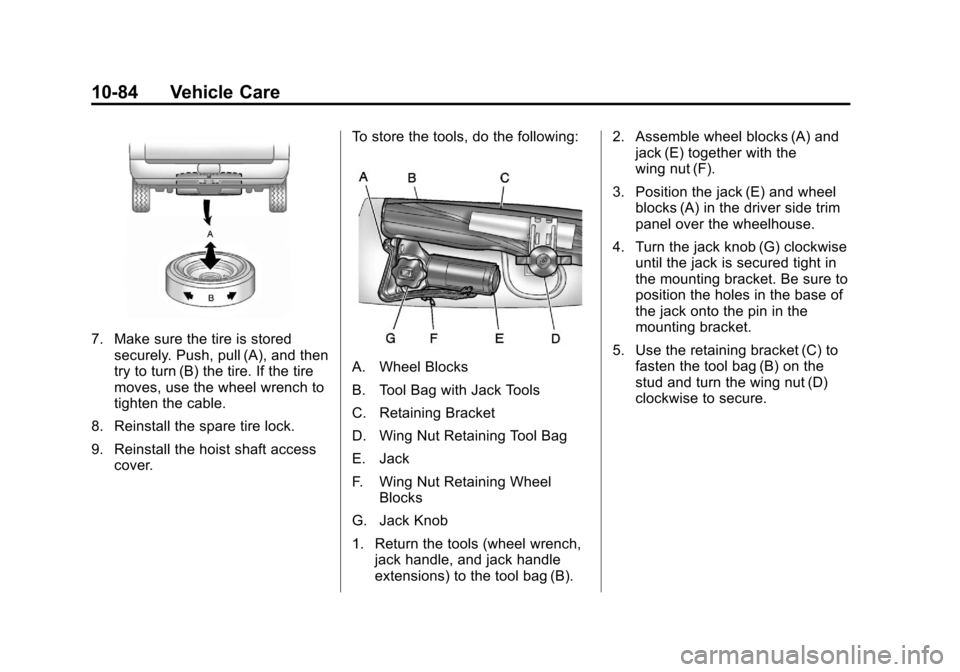
7. Make sure the tire is storedsecurely. Push, pull (A), and then
try to turn (B) the tire. If the tire
moves, use the wheel wrench to
tighten the cable.
8. Reinstall the spare tire lock.
9. Reinstall the hoist shaft access cover. To store the tools, do the following:
A. Wheel Blocks
B. Tool Bag with Jack Tools
C. Retaining Bracket
D. Wing Nut Retaining Tool Bag
E. Jack
F. Wing Nut Retaining Wheel
Blocks
G. Jack Knob
1. Return the tools (wheel wrench, jack handle, and jack handle
extensions) to the tool bag (B). 2. Assemble wheel blocks (A) and
jack (E) together with the
wing nut (F).
3. Position the jack (E) and wheel blocks (A) in the driver side trim
panel over the wheelhouse.
4. Turn the jack knob (G) clockwise until the jack is secured tight in
the mounting bracket. Be sure to
position the holes in the base of
the jack onto the pin in the
mounting bracket.
5. Use the retaining bracket (C) to fasten the tool bag (B) on the
stud and turn the wing nut (D)
clockwise to secure.
Page 476 of 542
Black plate (86,1)Chevrolet Tahoe/Suburban Owner Manual - 2011
10-86 Vehicle Care
3. Loosen the cable by turning thewrench counterclockwise three
or four turns.
4. Repeat this procedure at least two times. If the spare tire
lowers to the ground, continue
with Step 5 under “Removing the
Spare Tire and Tools” underTire
Changing on page 10‑73.
5. If the spare does not lower, turn the wrench counterclockwise
until approximately 15 cm (6 in)
of cable is exposed.
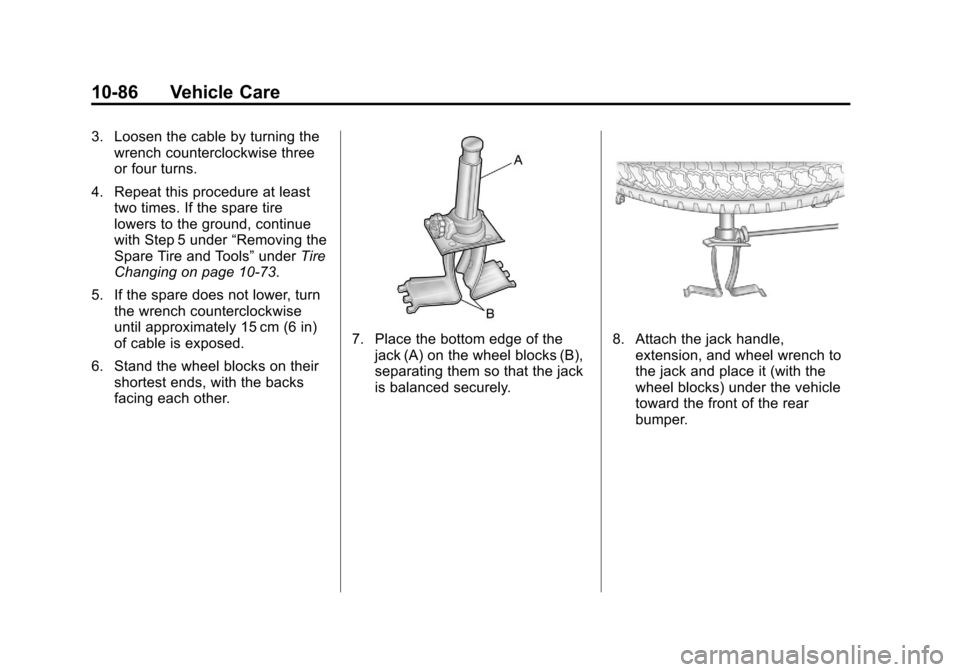
6. Stand the wheel blocks on their shortest ends, with the backs
facing each other.
7. Place the bottom edge of thejack (A) on the wheel blocks (B),
separating them so that the jack
is balanced securely.8. Attach the jack handle,extension, and wheel wrench to
the jack and place it (with the
wheel blocks) under the vehicle
toward the front of the rear
bumper.
Page 484 of 542
Black plate (94,1)Chevrolet Tahoe/Suburban Owner Manual - 2011
10-94 Vehicle Care
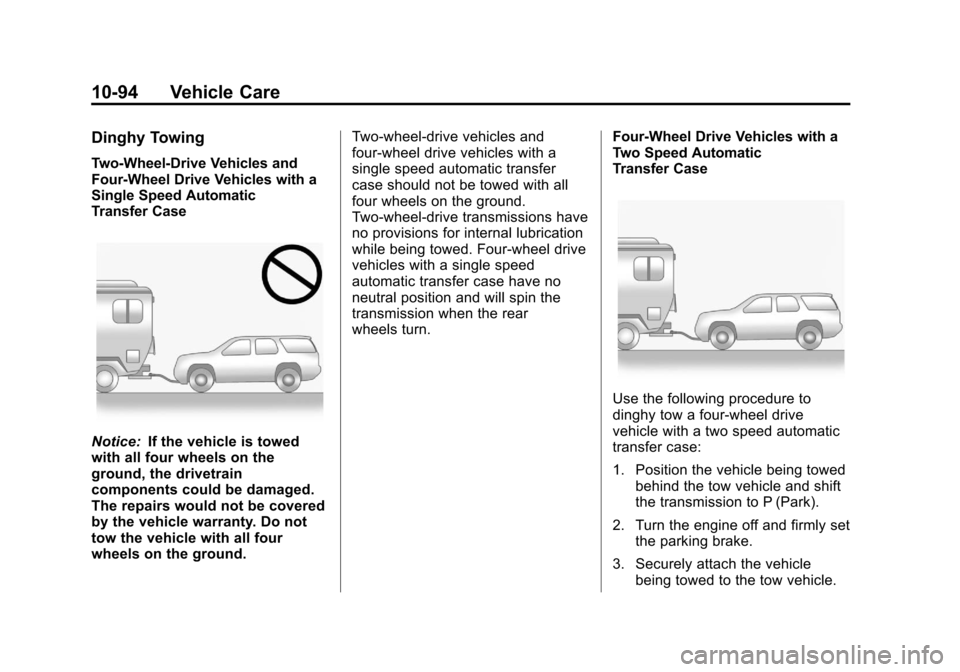
Dinghy Towing
Two-Wheel-Drive Vehicles and
Four-Wheel Drive Vehicles with a
Single Speed Automatic
Transfer Case
Notice:If the vehicle is towed
with all four wheels on the
ground, the drivetrain
components could be damaged.
The repairs would not be covered
by the vehicle warranty. Do not
tow the vehicle with all four
wheels on the ground. Two-wheel-drive vehicles and
four-wheel drive vehicles with a
single speed automatic transfer
case should not be towed with all
four wheels on the ground.
Two-wheel-drive transmissions have
no provisions for internal lubrication
while being towed. Four-wheel drive
vehicles with a single speed
automatic transfer case have no
neutral position and will spin the
transmission when the rear
wheels turn.
Four-Wheel Drive Vehicles with a
Two Speed Automatic
Transfer Case
Use the following procedure to
dinghy tow a four-wheel drive
vehicle with a two speed automatic
transfer case:
1. Position the vehicle being towed
behind the tow vehicle and shift
the transmission to P (Park).
2. Turn the engine off and firmly set the parking brake.
3. Securely attach the vehicle being towed to the tow vehicle.
Page 486 of 542
Black plate (96,1)Chevrolet Tahoe/Suburban Owner Manual - 2011
10-96 Vehicle Care
To dolly tow a two‐wheel‐drive
vehicle or a four-wheel drive vehicle
with a single speed automatic
transfer case, the vehicle must be
towed with the rear wheels on the
dolly. See“Rear Towing (Rear
Wheels Off the Ground)” later in this
section for more information.
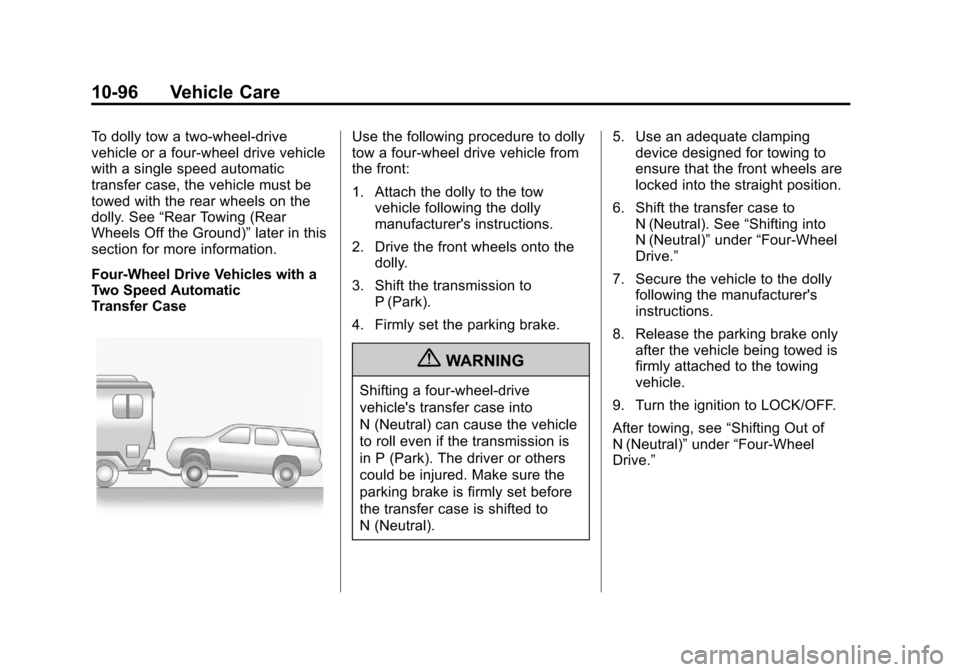
Four-Wheel Drive Vehicles with a
Two Speed Automatic
Transfer CaseUse the following procedure to dolly
tow a four-wheel drive vehicle from
the front:
1. Attach the dolly to the tow vehicle following the dolly
manufacturer's instructions.
2. Drive the front wheels onto the dolly.
3. Shift the transmission to P (Park).
4. Firmly set the parking brake.
{WARNING
Shifting a four-wheel-drive
vehicle's transfer case into
N (Neutral) can cause the vehicle
to roll even if the transmission is
in P (Park). The driver or others
could be injured. Make sure the
parking brake is firmly set before
the transfer case is shifted to
N (Neutral). 5. Use an adequate clamping
device designed for towing to
ensure that the front wheels are
locked into the straight position.
6. Shift the transfer case to N (Neutral). See “Shifting into
N (Neutral)” under“Four-Wheel
Drive.”
7. Secure the vehicle to the dolly following the manufacturer's
instructions.
8. Release the parking brake only after the vehicle being towed is
firmly attached to the towing
vehicle.
9. Turn the ignition to LOCK/OFF.
After towing, see “Shifting Out of
N (Neutral)” under“Four-Wheel
Drive.”
Page 487 of 542
Black plate (97,1)Chevrolet Tahoe/Suburban Owner Manual - 2011
Vehicle Care 10-97
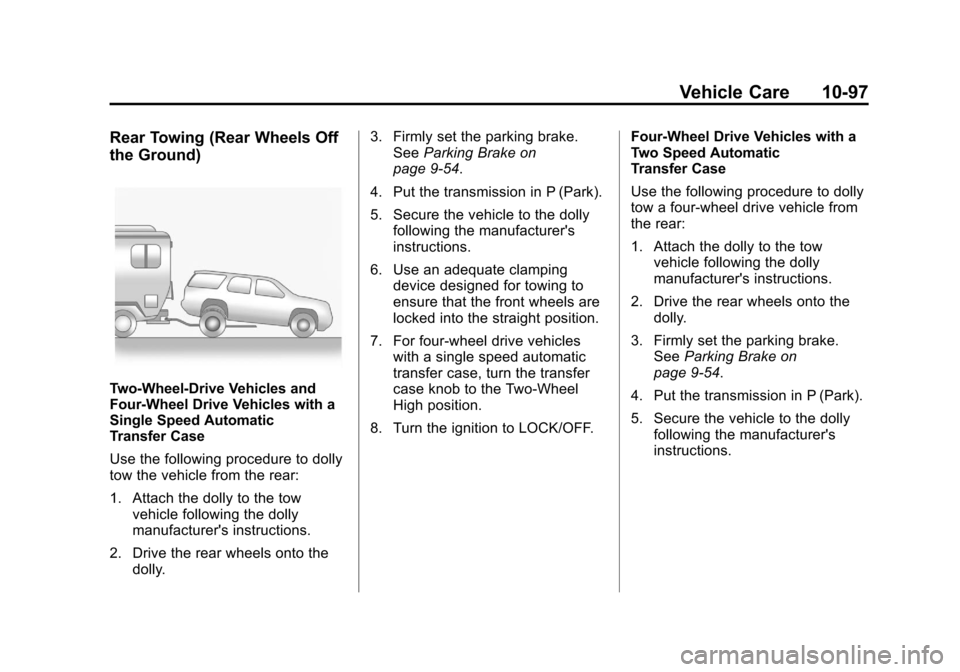
Rear Towing (Rear Wheels Off
the Ground)
Two-Wheel-Drive Vehicles and
Four-Wheel Drive Vehicles with a
Single Speed Automatic
Transfer Case
Use the following procedure to dolly
tow the vehicle from the rear:
1. Attach the dolly to the towvehicle following the dolly
manufacturer's instructions.
2. Drive the rear wheels onto the dolly. 3. Firmly set the parking brake.
See Parking Brake on
page 9‑54.
4. Put the transmission in P (Park).
5. Secure the vehicle to the dolly following the manufacturer's
instructions.
6. Use an adequate clamping device designed for towing to
ensure that the front wheels are
locked into the straight position.
7. For four-wheel drive vehicles with a single speed automatic
transfer case, turn the transfer
case knob to the Two-Wheel
High position.
8. Turn the ignition to LOCK/OFF. Four-Wheel Drive Vehicles with a
Two Speed Automatic
Transfer Case
Use the following procedure to dolly
tow a four-wheel drive vehicle from
the rear:
1. Attach the dolly to the tow
vehicle following the dolly
manufacturer's instructions.
2. Drive the rear wheels onto the dolly.
3. Firmly set the parking brake. See Parking Brake on
page 9‑54.
4. Put the transmission in P (Park).
5. Secure the vehicle to the dolly following the manufacturer's
instructions.