2011 CHEVROLET SILVERADO four wheel drive
[x] Cancel search: four wheel drivePage 454 of 588

Black plate (32,1)Chevrolet Silverado Owner Manual - 2011
10-32 Vehicle Care
Battery
If the vehicle is a Hybrid, see
the Hybrid Supplement for more
information.
This vehicle has a maintenance free
battery (or batteries). Refer to the
replacement number on the original
battery label when a new battery is
needed. SeeEngine Compartment
Overview
on page 10‑6for battery
location.
{DANGER
Battery posts, terminals, and
related accessories contain lead
and lead compounds, chemicals
known to the State of California
to cause cancer and reproductive
harm. Wash hands after handling.
Vehicle Storage
{WARNING
Batteries have acid that can burn
you and gas that can explode.
You can be badly hurt if you are
not careful. See Jump Starting
on
page 10‑96
for tips on working
around a battery without
getting hurt.
Infrequent Usage: Remove the
black, negative (−) cable from the
battery to keep the battery from
running down.
Extended Storage: Remove the
black, negative (−) cable from the
battery or use a battery trickle
charger.
Four-Wheel Drive
Transfer Case
When to Check Lubricant
Refer to Scheduled Maintenance
on
page 11‑2to determine when to
check the lubricant.
How to Check Lubricant
Electric Shift Transfer Case
A. Fill Plug
B. Drain Plug
Page 491 of 588

Black plate (69,1)Chevrolet Silverado Owner Manual - 2011
Vehicle Care 10-69
.Replacement tires or wheels do
not match your vehicle's original
equipment tires or wheels. Tires
and wheels other than those
recommended for your vehicle
could prevent the TPMS from
functioning properly. SeeBuying
New Tires on page 10‑75.
.Operating electronic devices or
being near facilities using radio
wave frequencies similar to the
TPMS could cause the TPMS
sensors to malfunction.
If the TPMS is not functioning it
cannot detect or signal a low tire
condition. See your dealer for
service if the TPMS malfunction
light and DIC message comes on
and stays on.
TPMS Sensor Matching
Process
Each TPMS sensor has a unique
identification code. Any time you
rotate your vehicle's tires or replace
one or more of the TPMS sensors,
the identification codes will need to
be matched to the new tire/wheel
position. The sensors are matched
to the tire/wheel positions in the
following order: driver side front tire,
passenger side front tire, passenger
side rear tire, and driver side rear
tire using a TPMS diagnostic tool.
See your dealer for service.
The TPMS sensors can also be
matched to each tire/wheel position
by increasing or decreasing the
tire's air pressure. If increasing the
tire's air pressure, do not exceed
the maximum inflation pressure
indicated on the tire's sidewall. To decrease air-pressure out of a
tire you can use the pointed end of
the valve cap, a pencil-style air
pressure gage, or a key.
You have two minutes to match
the first tire/wheel position, and
five minutes overall to match all
four tire/wheel positions. If it takes
longer than two minutes, to match
the first tire and wheel, or more than
five minutes to match all four tire
and wheel positions the matching
process stops and you need to
start over.
The TPMS sensor matching process
is outlined below:
1. Set the parking brake.
2. Turn the ignition switch to ON/
RUN with the engine off.
Page 492 of 588

Black plate (70,1)Chevrolet Silverado Owner Manual - 2011
10-70 Vehicle Care
3. Press the Remote KeylessEntry (RKE) transmitter's LOCK
and UNLOCK buttons at the
same time for approximately
five seconds. The horn sounds
twice to signal the receiver
is in relearn mode and TIRE
LEARNING ACTIVE message
displays on the DIC screen.
If your vehicle does not
have RKE, press the Driver
Information Center (DIC) vehicle
information button until the
PRESS
VTO RELEARN TIRE
POSITIONS message displays.
The horn sounds twice to signal
the receiver is in relearn mode
and TIRE LEARNING ACTIVE
message displays on the DIC
screen.
If your vehicle does not have
RKE or DIC buttons, press
the trip odometer reset stem
located on the instrument panel
cluster until the PRESS
VTO RELEARN TIRE POSITIONS
message displays. The horn
sounds twice to signal the
receiver is in relearn mode
and TIRE LEARNING ACTIVE
message displays on the DIC
screen.
4. Start with the driver side front tire.
5. Remove the valve cap from the valve cap stem. Activate the
TPMS sensor by increasing
or decreasing the tire's air
pressure for five seconds,
or until a horn chirp sounds.
The horn chirp, which may take
up to 30 seconds to sound,
confirms that the sensor
identification code has been
matched to this tire and wheel
position.
6. Proceed to the passenger side front tire, and repeat the
procedure in Step 5. 7. Proceed to the passenger
side rear tire, and repeat the
procedure in Step 5.
8. Proceed to the driver side rear tire, and repeat the procedure in
Step 5. The horn sounds two
times to indicate the sensor
identification code has been
matched to the driver side rear
tire, and that the TPMS sensor
matching process is no longer
active. The TIRE LEARNING
ACTIVE message on the DIC
display screen goes off.
9. Turn the ignition switch to LOCK/OFF.
10. Set all four tires to the recommended air pressure
level as indicated on the Tire
and Loading Information label.
11. Put the valve caps back on the valve stems.
Page 504 of 588

Black plate (82,1)Chevrolet Silverado Owner Manual - 2011
10-82 Vehicle Care
A rear blowout, particularly on a
curve, acts much like a skid and
may require the same correction
you would use in a skid. In any rear
blowout remove your foot from the
accelerator pedal. Get the vehicle
under control by steering the way
you want the vehicle to go. It may
be very bumpy and noisy, but you
can still steer. Gently brake to a
stop, well off the road if possible.
{WARNING
Driving on a flat tire will cause
permanent damage to the tire.
Re-inflating a tire after it has
been driven on while severely
under-inflated or flat may cause
a blowout and a serious crash.
Never attempt to re-inflate a tire
that has been driven on while
severely under-inflated or flat.
Have your dealer or an authorized
tire service center repair or
replace the flat tire as soon as
possible.
{WARNING
Lifting a vehicle and getting
under it to do maintenance or
repairs is dangerous without the
appropriate safety equipment and
training. If a jack is provided with
the vehicle, it is designed only for
changing a flat tire. If it is used for
anything else, you or others could
be badly injured or killed if the
vehicle slips off the jack. If a jack
is provided with the vehicle, only
use it for changing a flat tire.
If a tire goes flat, the next part
shows how to use the jacking
equipment to change a flat tire
safely.
If a tire goes flat, avoid further tire
and wheel damage by driving slowly
to a level place. Turn on the hazard
warning flashers. See Hazard
Warning Flashers
on page 6‑5.
{WARNING
Changing a tire can be
dangerous. The vehicle can
slip off the jack and roll over
or fall on you or other people.
You and they could be badly
injured or even killed. Find a level
place to change your tire. To help
prevent the vehicle from moving:
1. Set the parking brake firmly.
2. Put an automatic transmission shift lever in
P (Park), or shift a manual
transmission to 1 (First) or
R (Reverse).
3. If you have a four-wheel-drive vehicle,
be sure the transfer case is
in a drive gear –not in
N (Neutral).
(Continued)
Page 517 of 588
Black plate (95,1)Chevrolet Silverado Owner Manual - 2011
Vehicle Care 10-95
Full-Size Spare Tire
Your vehicle, when new, had a
fully-inflated spare tire. A spare
tire may lose air over time, so
check its inflation pressure regularly.
SeeTire Pressure
on page 10‑63andVehicle Load Limitson
page 9‑23for information regarding
proper tire inflation and loading your
vehicle. For instruction on how to
remove, install or store a spare tire,
see “Removing the Flat Tire and
Installing the Spare” and“Storing a
Flat or Spare Tire and Tools” under
Tire Changing on page 10‑83. Notice:
If the vehicle has
four-wheel drive and the different
size spare tire is installed on the
vehicle, do not drive in four-wheel
drive until you can have your flat
tire repaired and/or replaced.
You could damage the vehicle,
and the repair costs would not
be covered by your warranty.
Never use four-wheel drive when
the different size spare tire is
installed on the vehicle.
Your vehicle may have a different
size spare tire than the road tires
originally installed on your vehicle.
This spare tire was developed for
use on your vehicle, so it is all right
to drive on it. If your vehicle has
four-wheel drive and the different
size spare tire is installed, keep the
vehicle in two-wheel drive. After installing the spare tire on your
vehicle, you should stop as soon as
possible and make sure the spare
tire is correctly inflated. Have the
damaged or flat road tire repaired or
replaced as soon as you can and
installed back onto your vehicle.
This way, the spare tire will be
available in case you need it again.
Do not mix tires and wheels of
different sizes, because they will
not fit. Keep your spare tire and its
wheel together. If your vehicle has a
spare tire that does not match your
vehicle's original road tires and
wheels in size and type, do not
include the spare in the tire rotation.
Page 519 of 588

Black plate (97,1)Chevrolet Silverado Owner Manual - 2011
Vehicle Care 10-97
3. Get the vehicles close enoughso the jumper cables can reach,
but be sure the vehicles are not
touching each other. If they are,
it could cause an unwanted
ground connection. You would
not be able to start your vehicle,
and the bad grounding could
damage the electrical systems.
To avoid the possibility of the
vehicles rolling, set the parking
brake firmly on both vehicles
involved in the jump start
procedure. Put the automatic
transmission in P (Park) or a
manual transmission in Neutral
before setting the parking brake.
If you have a four-wheel-drive
vehicle, be sure the transfer
case is in a drive gear, not in
Neutral. Notice:
If you leave the radio or
other accessories on during the
jump starting procedure, they
could be damaged. The repairs
would not be covered by the
warranty. Always turn off the
radio and other accessories
when jump starting the vehicle.
4. Turn off the ignition on both
vehicles. Unplug unnecessary
accessories plugged into the
cigarette lighter or the accessory
power outlets. Turn off the radio
and all the lamps that are not
needed. This will avoid sparks
and help save both batteries.
And it could save the radio! 5. Open the hood on the
other vehicle and locate the
positive (+) and negative (−)
terminal locations on that
vehicle.
The positive (+) terminal, is
located under a red plastic
cover at the positive battery
post. To uncover the positive (+)
terminal, open the red plastic
cover.
If your vehicle has a gasoline
engine, the remote negative (−)
terminal is a stud located on the
Page 524 of 588
Black plate (102,1)Chevrolet Silverado Owner Manual - 2011
10-102 Vehicle Care
Dinghy Towing
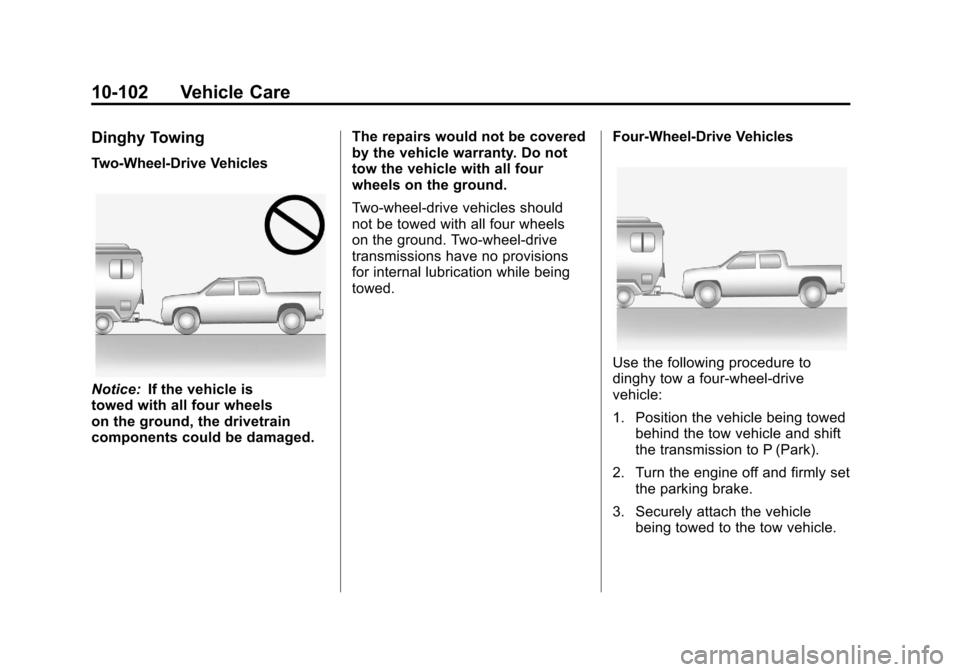
Two-Wheel-Drive Vehicles
Notice:If the vehicle is
towed with all four wheels
on the ground, the drivetrain
components could be damaged. The repairs would not be covered
by the vehicle warranty. Do not
tow the vehicle with all four
wheels on the ground.
Two-wheel-drive vehicles should
not be towed with all four wheels
on the ground. Two-wheel-drive
transmissions have no provisions
for internal lubrication while being
towed.
Four-Wheel-Drive Vehicles
Use the following procedure to
dinghy tow a four-wheel-drive
vehicle:
1. Position the vehicle being towed
behind the tow vehicle and shift
the transmission to P (Park).
2. Turn the engine off and firmly set the parking brake.
3. Securely attach the vehicle being towed to the tow vehicle.
Page 525 of 588

Black plate (103,1)Chevrolet Silverado Owner Manual - 2011
Vehicle Care 10-103
{WARNING
Shifting a four-wheel-drive
vehicle's transfer case into
N (Neutral) can cause the vehicle
to roll even if the transmission is
in P (Park). The driver or others
could be injured. Make sure the
parking brake is firmly set before
the transfer case is shifted to
N (Neutral).
4. Shift the transfer case to N (Neutral). See “Shifting into
Neutral” underFour-Wheel Drive
on page 9‑53for the proper
procedure to select the Neutral
position for the vehicle.
5. Release the parking brake only after the vehicle being towed is
firmly attached to the towing
vehicle.
6. Turn the ignition to LOCK/OFF and remove the key —the
steering wheel will still turn. After towing, see
“Shifting Out of
Neutral” underFour-Wheel Drive
on
page 9‑53for the proper procedure
to take the vehicle out of the Neutral
position.
Dolly Towing
Front Towing (Front Wheels Off
the Ground) –Two-Wheel-Drive
Vehicles
Notice: If a two-wheel-drive
vehicle is towed with the rear
wheels on the ground, the transmission could be damaged.
The repairs would not be covered
by the vehicle warranty. Never
tow the vehicle with the rear
wheels on the ground.
Two-wheel-drive vehicles should not
be towed with the rear wheels on
the ground. Two-wheel-drive
transmissions have no provisions
for internal lubrication while being
towed.
To dolly tow a two‐wheel‐drive
vehicle, the vehicle must be towed
with the rear wheels on the dolly.
See
“Rear Towing (Rear Wheels Off
the Ground)” later in this section for
more information.