2011 CHEVROLET SILVERADO instrument cluster
[x] Cancel search: instrument clusterPage 221 of 588

Black plate (5,1)Chevrolet Silverado Owner Manual - 2011
Lighting 6-5
The vehicle has a light sensor
located on the top of the instrument
panel in the defroster grille which
regulates when the automatic
headlamps turn on. Do not
cover the sensor, otherwise
the headlamps will come on
whenever the ignition is on.
The system may also turn on the
headlamps when driving through a
parking garage or heavy overcast
weather. This is normal.
There is a delay in the transition
between the daytime and nighttime
operation of the Daytime Running
Lamps (DRL) and the automatic
headlamp systems so that driving
under bridges or bright overhead
street lights does not affect the
system. The DRL and automatic
headlamp system are only affected
when the light sensor detects a
change in lighting lasting longer
than the delay.
If the vehicle is started in a dark
garage, the automatic headlamp
system comes on immediately.Once the vehicle leaves the garage,
it takes approximately one minute
for the automatic headlamp system
to change to DRL if it is bright
enough outside. During that delay,
the instrument panel cluster may
not be as bright as usual. Make sure
the instrument panel brightness
control is in the full bright position.
See
Instrument Panel Illumination
Control on page 6‑7.
To idle the vehicle with the
automatic headlamp system off,
turn the control to the off position.
The headlamps will also stay
on after you exit the vehicle.
This feature can be programmed
using the Driver Information Center
(DIC). See Vehicle Personalization
(with DIC Buttons) on page 5‑53.
If the vehicle is not equipped
with DIC buttons, exit lighting
is automatic. When it is dark
enough outside, the exterior lamps
remain on for 30 seconds after the
ignition is moved from ON/RUN to
LOCK/OFF. For vehicles without a radio, the
instrument panel light remains on
for 30 seconds with the driver door
closed. For vehicles with a radio,
the instrument panel light remains
on for 10 minutes with the driver
door closed. See
Retained
Accessory Power (RAP)
on
page 9‑35.
The regular headlamp system can
be turned on when needed.
Hazard Warning Flashers
|
(Hazard Warning Flashers):
Press this button located on top of
the steering column, to make the
front and rear turn signal lamps
flash on and off. This warns others
that you are having trouble. Press
again to turn the flashers off.
When the hazard warning flashers
are on, the vehicle's turn signals will
not work.
Page 222 of 588

Black plate (6,1)Chevrolet Silverado Owner Manual - 2011
6-6 Lighting
Turn and Lane-Change
Signals
An arrow on the instrument panel
cluster flashes in the direction of the
turn or lane change.
Move the lever all the way up or
down to signal a turn.
Raise or lower the lever for less
than one second until the arrow
starts to flash to signal a lane
change. This causes the turn
signals to automatically flash
three times. It will flash six times
if Tow/Haul Mode is active.Holding the turn signal lever for
more than one second will cause
the turn signals to flash until you
release the lever.
The lever returns to its starting
position whenever it is released.
If after signaling a turn or a lane
change the arrows flash rapidly or
do not come on, a signal bulb could
be burned out.
Have the bulbs replaced. If the bulb
is not burned out, check the fuse.
See
Fuses and Circuit Breakers
on
page 10‑48.
Turn Signal On Chime
If the turn signal is left on for more
than 1.2 km (0.75 miles), a chime
sounds at each flash of the turn
signal, if the vehicle has a radio.
The message TURN SIGNAL ON
will also appear in the Driver
Information Center (DIC). To turn
the chime and message off, move
the turn signal lever to the off
position.
Fog Lamps
For vehicles with fog lamps, the
control is located next to the exterior
lamps control on the instrument
panel, to the left of the steering
column.
The ignition must be in the ON/RUN
position for the fog lamps to
come on.
#(Fog Lamps): Press to turn the
fog lamps on or off. A light will come
on in the instrument panel cluster.
When the fog lamps are turned on,
the parking lamps automatically
turn on.
When the headlamps are changed
to high beam, the fog lamps also go
off. When the high-beam headlamps
are turned off, the fog lamps will
come on again.
Some localities have laws that
require the headlamps to be on
with the fog lamps.
Page 328 of 588

Black plate (34,1)Chevrolet Silverado Owner Manual - 2011
9-34 Driving and Operating
In an emergency:
1. Brake using a firm and steadypressure. Do not pump the
brakes repeatedly. This may
deplete power assist, requiring
increased brake pedal force.
2. Shift the vehicle to neutral. This can be done while the
vehicle is moving. After shifting
to neutral, firmly apply the
brakes and steer the vehicle
to a safe location.
3. Come to a complete stop. Shift to P (Park) with an
automatic transmission,
or neutral with a manual
transmission. Turn the ignition
to LOCK/OFF.
4. Set the parking brake. See Parking Brake on page 9‑68
On vehicles with an automatic
transmission, the shift lever must be
in P (Park) to turn the ignition switch
to LOCK/OFF. The steering can bind with the
wheels turned off center. If this
happens, move the steering wheel
from right to left while turning the
key to ACC/ACCESSORY. If this
doesn't work, then the vehicle needs
service.
Notice:
Using a tool to force the
key to turn in the ignition could
cause damage to the switch or
break the key. Use the correct
key, make sure it is all the way in,
and turn it only with your hand.
If the key cannot be turned by
hand, see your dealer.
B (ACC/ACCESSORY): This
position lets things like the radio
and the windshield wipers operate
while the engine is off. Use this
position if the vehicle must be
pushed or towed.
C (ON/RUN): This position can
be used to operate the electrical
accessories and to display some instrument panel cluster warning
and indicator lights. The switch
stays in this position when the
engine is running. The transmission
is also unlocked in this position on
automatic transmission vehicles.
If you leave the key in the ACC/
ACCESSORY or ON/RUN position
with the engine off, the battery could
be drained. You may not be able to
start the vehicle if the battery is
allowed to drain for an extended
period of time.
D (START):
This is the position that
starts the engine. When the engine
starts, release the key. The ignition
switch returns to ON/RUN for
driving.
If the vehicle is equipped with a
radio, a warning tone will sound
when the driver door is opened,
the ignition is in ACC/ACCESSORY
or LOCK/OFF and the key is in the
ignition.
Page 337 of 588

Black plate (43,1)Chevrolet Silverado Owner Manual - 2011
Driving and Operating 9-43
{WARNING
It can be dangerous to get out
of the vehicle if the automatic
transmission shift lever is not fully
in P (Park) with the parking brake
firmly set. The vehicle can roll.
Do not leave the vehicle when
the engine is running unless you
have to. If you have left the
engine running, the vehicle can
move suddenly. You or others
could be injured. To be sure the
vehicle will not move, even when
you are on fairly level ground,
always set the parking brake and
move the shift lever to P (Park).
{WARNING
Four-wheel drive vehicles with the
transfer case in N (Neutral) will
allow the vehicle to roll, even if
the automatic transmission shift
lever is in P (Park). So, be sure
the transfer case is in a drive
gear—not in N (Neutral). Always
set the parking brake.
Follow the proper steps to be
sure the vehicle will not move.
See Shifting Into Park
on
page 9‑38.
If pulling a trailer, see Driving
Characteristics and Towing Tips
on
page 9‑90.
Automatic
Transmission
If the vehicle is a hybrid, see
the hybrid supplement for more
information.
Vehicles with an automatic
transmission have an electronic
shift position indicator within
the instrument panel cluster.
This display comes on when
the ignition key is turned to
the ON/RUN position.
Page 343 of 588
Black plate (49,1)Chevrolet Silverado Owner Manual - 2011
Driving and Operating 9-49
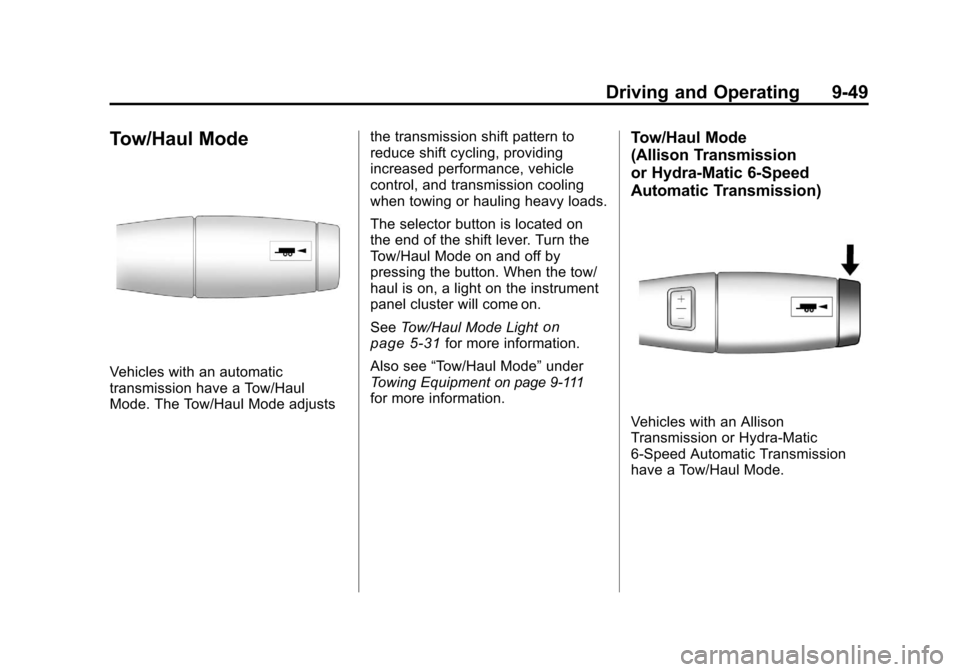
Tow/Haul Mode
Vehicles with an automatic
transmission have a Tow/Haul
Mode. The Tow/Haul Mode adjuststhe transmission shift pattern to
reduce shift cycling, providing
increased performance, vehicle
control, and transmission cooling
when towing or hauling heavy loads.
The selector button is located on
the end of the shift lever. Turn the
Tow/Haul Mode on and off by
pressing the button. When the tow/
haul is on, a light on the instrument
panel cluster will come on.
See
Tow/Haul Mode Light
on
page 5‑31for more information.
Also see “Tow/Haul Mode” under
Towing Equipment
on page 9‑111for more information.
Tow/Haul Mode
(Allison Transmission
or Hydra-Matic 6-Speed
Automatic Transmission)
Vehicles with an Allison
Transmission or Hydra-Matic
6-Speed Automatic Transmission
have a Tow/Haul Mode.
Page 344 of 588

Black plate (50,1)Chevrolet Silverado Owner Manual - 2011
9-50 Driving and Operating
The Tow/Haul Mode adjusts the
transmission shift pattern to reduce
shift cycling, providing increased
performance, vehicle control, and
transmission cooling when towing
or hauling heavy loads.
Turn the Tow/Haul Mode on and
off by pressing the button, located
on the end of the shift lever. When
the tow/haul is on, a light on the
instrument panel cluster will
come on.
SeeTow/Haul Mode Light
on
page 5‑31for more information.
Also see “Tow/Haul Mode” under
Towing Equipment
on page 9‑111for more information.
Grade Braking
(Allison Transmission
or Hydra-Matic 6-Speed
Automatic Transmission)
The Grade Braking shift modes can
be activated by pressing the button
on the end of the shift control lever.
While in Range Selection Mode,
Grade Braking is deactivated
allowing the driver to select a
desired range of gears.
Grade Braking is only active while
the Tow/Haul Mode is selected and
you are not in the Range Selection
Mode. See “Tow/Haul Mode” listed
previously and Manual Mode
on
page 9‑47for more information
on the Range Selection Mode. Grade Braking assists in
maintaining desired vehicle speeds
when driving on downhill grades by
automatically implementing a shift
schedule that utilizes the engine
and transmission to slow the
vehicle. This reduces wear on the
braking system and increases
control of the vehicle. Grade
Braking monitors vehicle speed,
acceleration, engine torque and
brake pedal usage. Using this
information, it detects when the
truck is on a downhill grade and
the driver desires to slow the
vehicle by pressing the brake.
This feature is active when
the exhaust brake is enabled
(if equipped).
Also see
Towing Equipment
on
page 9‑111for more information.
Page 365 of 588

Black plate (71,1)Chevrolet Silverado Owner Manual - 2011
Driving and Operating 9-71
The system should initialize before
the vehicle reaches 32 km/h
(20 mph). In some cases, it may
take approximately 3.2 km (2 miles)
of driving before the system
initializes.
If cruise control is being used when
StabiliTrak activates, the cruise
control automatically disengages.
The cruise control can be
re-engaged when road conditions
allow. SeeCruise Control
on
page 9‑73for more information.
If the system fails to turn on or
activate, the StabiliTrak light
along with one of the following
messages will be displayed on the
Driver Information Center (DIC):
TRACTION CONTROL OFF,
SERVICE TRACTION CONTROL,
STABILITRAK OFF, SERVICE
STABILITRAK. If these DIC
messages appear, make sure
the StabiliTrak system has not
been turned off using the StabiliTrak
on/off button. Then turn the vehicle
off, wait 15 seconds, and turn it
back on again to reset the system. If any of these messages still
appear on the DIC, the vehicle
should be taken in for service.
For more information on the DIC
messages, see
Ride Control System
Messages on page 5‑49.The StabiliTrak light will flash on the
instrument panel cluster when the
system is both on and activated.
The system may be heard or felt
while it is working; this is normal.
The traction control disable button
is located on the instrument panel
below the climate controls. The Traction Control System (TCS)
part of StabiliTrak can be turned
off by pressing and releasing the
StabiliTrak button. To disable both
TCS and StabiliTrak, press and
hold
5untilFilluminates and the
appropriate DIC message displays.
TCS and StabiliTrak can be turned
on by pressing and releasing the
StabiliTrak button if they are not
automatically shut off for any other
reason.
When TCS or StabiliTrak is
turned off, the StabiliTrak light
and the appropriate message
will be displayed on the DIC to
warn the driver. The vehicle will still
have brake-traction control when
traction control is off, but will not
be able to use the engine speed
management system. See “Traction
Control Operation” next for more
information.
When the traction control system
has been turned off, system noises
may still be heard as a result of the
brake-traction control coming on.
Page 368 of 588

Black plate (74,1)Chevrolet Silverado Owner Manual - 2011
9-74 Driving and Operating
The cruise control buttons are
located on the left side of the
steering wheel.
I(On/Off):Press to turn the
system on or off. The indicator light
is on when cruise control is on and
turns off when cruise control is off.
+ RES (Resume/Accelerate):
Press briefly to resume to a
previously set speed, or press and
hold to accelerate.
SET −(Set/Coast): Press to set
the speed and activate cruise
control or make the vehicle
decelerate.
[(Cancel): Press to disengage
cruise control without erasing the
set speed from memory.
Setting Cruise Control
The cruise control light on the
instrument panel cluster will come
on after the cruise control has been
set to the desired speed.
{WARNING
If you leave your cruise control on
when you are not using cruise,
you might hit a button and go into
cruise when you do not want to.
You could be startled and even
lose control. Keep the cruise
control switch off until you want
to use cruise control.
1. Press
I.
2. Get up to the desired speed. 3. Press the SET−
button located
on the steering wheel and
release it.
4. Take your foot off the accelerator.
Resuming a Set Speed
If the cruise control is set at a
desired speed and then the brakes
are applied, the cruise control is
disengaged without erasing the
set speed from memory.
Once the vehicle speed reaches
about 40 km/h (25 mph) or more,
press the +RES button on the
steering wheel. The vehicle returns
to the previous set speed and stays
there.