Black plate (80,1)Chevrolet Silverado Owner Manual - 2011
10-80 Vehicle Care
Wheel Replacement
Replace any wheel that is bent,
cracked, or badly rusted or
corroded. If wheel nuts keep coming
loose, the wheel, wheel bolts and
wheel nuts should be replaced.
If the wheel leaks air, replace it
(except some aluminum wheels,
which can sometimes be repaired).
See your dealer if any of these
conditions exist.
Your dealer will know the kind of
wheel you need.
Each new wheel should have
the same load-carrying capacity,
diameter, width, offset and be
mounted the same way as the
one it replaces.
If you need to replace any of the
wheels, wheel bolts, wheel nuts
or Tire Pressure Monitor System
(TPMS) sensors, replace them only
with new GM original equipment
parts. This way, you will be sure to
have the right wheel, wheel bolts,
wheel nuts, and TPMS sensors for
the vehicle.{WARNING
Using the wrong replacement
wheels, wheel bolts, or wheel
nuts on your vehicle can be
dangerous. It could affect the
braking and handling of your
vehicle, make your tires lose
air and make you lose control.
You could have a collision in
which you or others could be
injured. Always use the correct
wheel, wheel bolts, and wheel
nuts for replacement.
Notice: The wrong wheel can
also cause problems with bearing
life, brake cooling, speedometer
or odometer calibration,
headlamp aim, bumper height,
vehicle ground clearance, and
tire or tire chain clearance to
the body and chassis. Whenever a wheel, wheel
bolt or wheel nut is replaced
on a dual wheel setup, check
the wheel nut torque after
100, 1,000 and 6,000 miles
(160, 1 600 and 10 000 km)
of driving. For proper torque,
see
“Wheel Nut Torque” under
Capacities and Specifications
on
page 12‑2.
See If a Tire Goes Flat
on
page 10‑81for more information.
Used Replacement Wheels
{WARNING
Putting a used wheel on the
vehicle is dangerous. You cannot
know how it has been used
or how far it has been driven.
It could fail suddenly and cause
a crash. If you have to replace a
wheel, use a new GM original
equipment wheel.
Black plate (91,1)Chevrolet Silverado Owner Manual - 2011
Vehicle Care 10-91
WARNING (Continued)
hubs and hub‐piloted wheels
for damage. Because of loose
running wheels, piloting pad
damage may occur and require
replacement of the entire hub, for
proper centering of the wheels.
When replacing studs, hubs,
wheel nuts or wheels, be sure to
use GM original equipment parts.
{WARNING
Wheel nuts that are improperly or
incorrectly tightened can cause
the wheels to become loose or
come off. The wheel nuts should
be tightened with a torque wrench
to the proper torque specification
after replacing. Follow the torque(Continued)
WARNING (Continued)
specification supplied by the
aftermarket manufacturer when
using accessory locking wheel
nuts. SeeCapacities and
Specifications
on page 12‑2
for original equipment wheel
nut torque specifications.
Notice: Improperly tightened
wheel nuts can lead to brake
pulsation and rotor damage.
To avoid expensive brake repairs,
evenly tighten the wheel nuts
in the proper sequence and to
the proper torque specification.
See Capacities and Specifications
on page 12‑2for the wheel nut
torque specification.
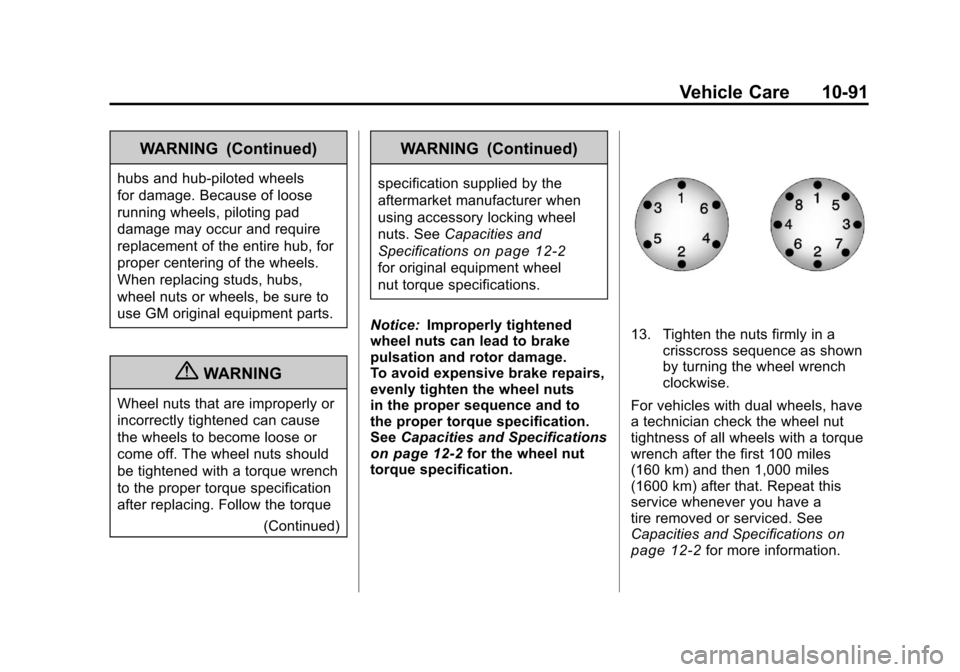
13. Tighten the nuts firmly in a crisscross sequence as shown
by turning the wheel wrench
clockwise.
For vehicles with dual wheels, have
a technician check the wheel nut
tightness of all wheels with a torque
wrench after the first 100 miles
(160 km) and then 1,000 miles
(1600 km) after that. Repeat this
service whenever you have a
tire removed or serviced. See
Capacities and Specifications
on
page 12‑2for more information.
Black plate (5,1)Chevrolet Silverado Owner Manual - 2011
Service and Maintenance 11-5
Additional Required Services
At the First 160 km/100 Miles,
1 600 km/1,000 Miles, and
10 000 km/6,000 Miles
.For vehicles with dual
wheels: Check dual wheel
nut torque. For proper
torque, seeCapacities and
Specifications on page 12‑2.
Every 12 000 km/7,500 Miles
.Rotate tires. Tires should
be rotated every 12 000 km/
7,500 miles. See Tire Rotation
on page 10‑71. At Each Fuel Stop
.Engine oil level check.
See
Engine Oil on page 10‑7.
.Engine coolant level check.
SeeEngine Coolanton
page 10‑20.
.Windshield washer fluid level
check. See Washer Fluidon
page 10‑28.
Once a Month
.Tire inflation pressures check.
See Tire Pressure on
page 10‑63.
.Tire wear inspection. See Tire
Inspection on page 10‑71.
.Sunroof track and seal
inspection, if equipped.
See Sunroof (Extended Cab)
on
page 2‑22or Sunroof (Crew
Cab) on page 2‑23. Once a Year
.See
Starter Switch Checkon
page 10‑37.
.See Automatic Transmission
Shift Lock Control Function
Check on page 10‑38.
.See Ignition Transmission Lock
Check on page 10‑38.
.See Park Brake and P (Park)
Mechanism Checkon
page 10‑39.
.Accelerator pedal check for
damage, high effort, or binding.
Replace if needed.
.Underbody flushing service.
Black plate (4,1)Chevrolet Silverado Owner Manual - 2011
12-4 Technical Data
ApplicationCapacities
Metric English
Transmission Fluid - Automatic (Pan Removal and Filter Replacement)
4-Speed Transmission 4L60-E Electronic Transmission 4.7 L 5.0 qt
6-Speed Transmission 6L80-E 5.7 L 6.0 qt
6-Speed Transmission 6L90-E 6.0 L 6.3 qt
6-Speed Transmission Allison 7.0 L 7.4 qt
Transmission Fluid - Manual (Drain and Refill) 1500 Series 4.4 L 4.6 qt
3500 Series 3.5 L 3.7 qt
Wheel Nut Torque 190 Y140 ft lb
All capacities are approximate. When adding, be sure to fill to the approximate level, as recommended in this
manual. Recheck fluid level after filling.