2011 CHEVROLET IMPALA check oil
[x] Cancel search: check oilPage 257 of 376
Black plate (11,1)Chevrolet Impala Owner Manual - 2011
Vehicle Care 10-11
For the oil life system to work
properly, the system must be reset
every time the oil is changed.
When the system has calculated
that oil life has been diminished, it
indicates that an oil change is
necessary. A CHANGE ENGINE
OIL SOON message comes on.
SeeDIC Warnings and Messages.
Change the oil as soon as possible
within the next 1 000 km (600 miles).
It is possible that, if driving under
the best conditions, the oil life
system might indicate that an oil
change is not necessary for up to a
year. The engine oil and filter must
be changed at least once a year
and, at this time, the system must
be reset. Your dealer has trained
service people who will perform this
work and reset the system. It is also
important to check the oil regularly
over the course of an oil drain
interval and keep it at the
proper level. If the system is ever reset
accidentally, the oil must be
changed at 5 000 km (3,000 miles)
since the last oil change.
Remember to reset the oil life
system whenever the oil is changed.
How to Reset the Engine Oil
Life System
Reset the system whenever the
engine oil is changed so that the
system can calculate the next
engine oil change. Always reset the
engine oil life to 100% after every oil
change. It will not reset itself.
To reset the system:
1. Display OIL LIFE REMAINING
on the DIC.
2. Press and hold the SET/RESET button on the DIC for more than
five seconds. The oil life will
change to 100%.
If the CHANGE ENGINE OIL SOON
message comes back on when the
vehicle is started, the engine oil life
system has not reset. Repeat the
procedure.
Automatic Transmission
Fluid
When to Check and Change
Automatic Transmission Fluid
A good time to check the automatic
transmission fluid level is when the
engine oil is changed.
Change the fluid and filter at the
intervals listed in Scheduled
Maintenance on page 11‑2, and be
sure to use the transmission fluid
listed in Recommended Fluids and
Lubricants on page 11‑6.
How to Check Automatic
Transmission Fluid
Because this operation can be a
little difficult, it may be decided to
have this done at the dealer service
department.
If not taken to the dealer, be sure
to follow all the instructions here,
or a false reading on the dipstick
could result.
Page 259 of 376
Black plate (13,1)Chevrolet Impala Owner Manual - 2011
Vehicle Care 10-13
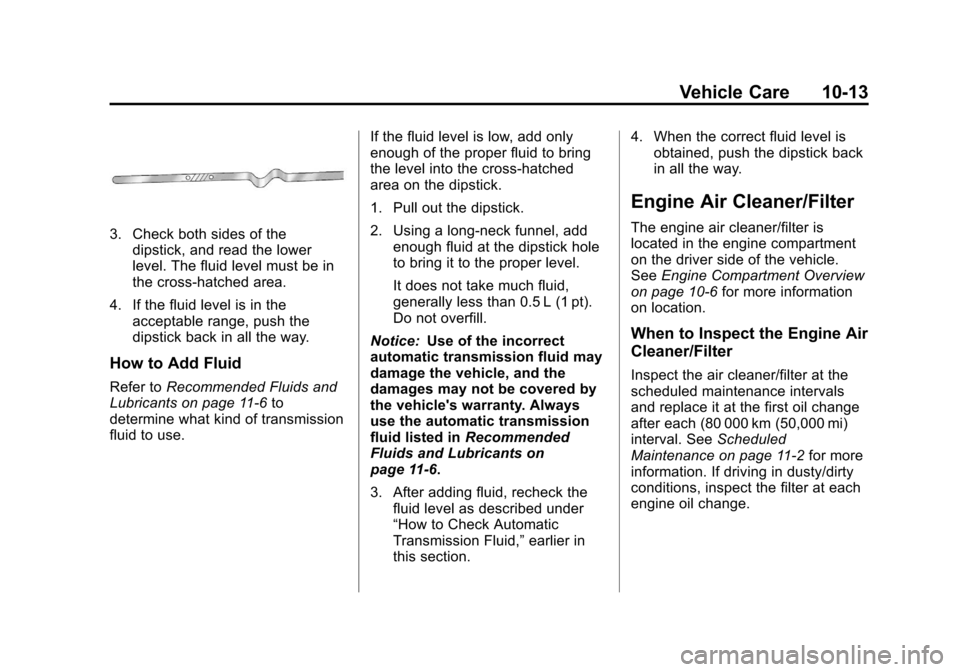
3. Check both sides of thedipstick, and read the lower
level. The fluid level must be in
the cross-hatched area.
4. If the fluid level is in the acceptable range, push the
dipstick back in all the way.
How to Add Fluid
Refer to Recommended Fluids and
Lubricants on page 11‑6 to
determine what kind of transmission
fluid to use. If the fluid level is low, add only
enough of the proper fluid to bring
the level into the cross-hatched
area on the dipstick.
1. Pull out the dipstick.
2. Using a long-neck funnel, add
enough fluid at the dipstick hole
to bring it to the proper level.
It does not take much fluid,
generally less than 0.5 L (1 pt).
Do not overfill.
Notice: Use of the incorrect
automatic transmission fluid may
damage the vehicle, and the
damages may not be covered by
the vehicle's warranty. Always
use the automatic transmission
fluid listed in Recommended
Fluids and Lubricants on
page 11‑6.
3. After adding fluid, recheck the fluid level as described under
“How to Check Automatic
Transmission Fluid,” earlier in
this section. 4. When the correct fluid level is
obtained, push the dipstick back
in all the way.
Engine Air Cleaner/Filter
The engine air cleaner/filter is
located in the engine compartment
on the driver side of the vehicle.
See Engine Compartment Overview
on page 10‑6 for more information
on location.
When to Inspect the Engine Air
Cleaner/Filter
Inspect the air cleaner/filter at the
scheduled maintenance intervals
and replace it at the first oil change
after each (80 000 km (50,000 mi)
interval. See Scheduled
Maintenance on page 11‑2 for more
information. If driving in dusty/dirty
conditions, inspect the filter at each
engine oil change.
Page 262 of 376
Black plate (16,1)Chevrolet Impala Owner Manual - 2011
10-16 Vehicle Care
Engine Coolant
The cooling system in the vehicle is
filled with DEX-COOL®engine
coolant. This coolant is designed to
remain in the vehicle for 5 years or
240 000 km (150,000 mi), whichever
occurs first.
The following explains the cooling
system and how to check and add
coolant when it is low. If there is a
problem with engine overheating,
see Engine Overheating on
page 10‑19
What to Use
{WARNING
Adding only plain water or some
other liquid to the cooling system
can be dangerous. Plain water
and other liquids, can boil before
the proper coolant mixture will.
(Continued)
WARNING (Continued)
The vehicle's coolant warning
system is set for the proper
coolant mixture. With plain water
or the wrong mixture, the engine
could get too hot but you would
not get the overheat warning. The
engine could catch fire and you or
others could be burned. Use a
50/50 mixture of clean, drinkable
water and DEX-COOL coolant.
Use a 50/50 mixture of clean,
drinkable water and DEX-COOL
coolant. If using this mixture,
nothing else needs to be added.
This mixture:
.Gives freezing protection down
to −37°C (−47°F), outside
temperature.
.Gives boiling protection up to
129°C (265°F), engine
temperature.
.Protects against rust and
corrosion.
.Will not damage aluminum parts.
.Helps keep the proper engine
temperature.
Notice: If an improper coolant
mixture is used, the engine could
overheat and be badly damaged.
The repair cost would not be
covered by the vehicle warranty.
Too much water in the mixture
can freeze and crack the engine,
radiator, heater core, and
other parts.
Notice: If extra inhibitors
and/or additives are used in the
vehicle's cooling system, the
vehicle could be damaged. Use
only the proper mixture of the
engine coolant listed in this
manual for the cooling system.
See Recommended Fluids and
Lubricants on page 11‑6 for more
information.
Page 263 of 376
Black plate (17,1)Chevrolet Impala Owner Manual - 2011
Vehicle Care 10-17
Checking Coolant
The vehicle must be on a level
surface when checking the
coolant level.
Check to see if coolant is visible in
the coolant recovery tank. If the
coolant inside the coolant recovery
tank is boiling, do not do anything
else until it cools down. If coolant is
visible but the coolant level is not at
or above the COLD FILL line, add a
50/50 mixture of clean, drinkable
water and DEX-COOL coolant at
the coolant recovery tank, but be
sure the cooling system is cool
before this is done.
The coolant recovery tank
is located in the rear of the
engine compartment on the
passenger side of the vehicle.
SeeEngine Compartment Overview
on page 10‑6. When the engine is cold, the coolant
level should be at or above the
COLD FILL line on the coolant
recovery tank. To check the coolant
level, look for the COLD FILL line on
the side of the coolant recovery tank
that faces the engine. If the level is
not correct, there may be a leak in
the cooling system.
How to Add Coolant to the
Recovery Tank
{WARNING
You can be burned if you spill
coolant on hot engine parts.
Coolant contains ethylene glycol
and it will burn if the engine parts
are hot enough. Do not spill
coolant on a hot engine.
Notice: This vehicle has a
specific coolant fill procedure.
Failure to follow this procedure
could cause the engine to
overheat and be severely
damaged. If coolant is needed, add the proper
DEX-COOL coolant mixture at the
coolant recovery tank.
When the coolant level in the
coolant recovery tank is at the
COLD FILL line, start the vehicle.
If the overheat warning continues,
there is one more thing you can try.
The proper coolant mixture can be
added directly to the cooling system
through the coolant fill neck on the
engine, but be sure the system is
cool before doing it.
Page 267 of 376
Black plate (21,1)Chevrolet Impala Owner Manual - 2011
Vehicle Care 10-21
If there is no sign of steam, idle the
engine for three minutes while
parked. If the warning is still
displayed, turn off the engine until it
cools down. Also, see "Overheated
Engine Protection Operating Mode"
in this section.
Overheated Engine
Protection
Operating Mode
This emergency operating mode
allows the vehicle to be driven
to a safe place in an emergency
situation. If an overheated engine
condition exists, an overheat
protection mode which alternates
firing groups of cylinders helps
prevent engine damage. In this
mode, a significant loss in power
and engine performance will be
noticed. The coolant temperature
gauge will indicate an overheat
condition exists. Driving
extended km (mi) and/or towing a
trailer in the overheat protection
mode should be avoided.Notice:
After driving in the
overheated engine protection
operating mode, to avoid engine
damage, allow the engine to cool
before attempting any repair.
The engine oil will be severely
degraded. Repair the cause of
coolant loss, change the oil and
reset the oil life system. See
Engine Oil on page 10‑8.
Power Steering Fluid
The power steering fluid reservoir
is located toward the rear of the
engine compartment on the
passenger side of the vehicle.
See Engine Compartment Overview
on page 10‑6 for reservoir location.
When to Check Power
Steering Fluid
It is not necessary to regularly
check power steering fluid unless
there is a leak suspected in the
system or an unusual noise is
heard. A fluid loss in this system
could indicate a problem. Have the
system inspected and repaired.
How to Check Power
Steering Fluid
To check the power steering fluid,
do the following:
1. Turn the key off and let the
engine compartment cool down.
2. Wipe the cap and the top of the reservoir clean.
3. Unscrew the cap and wipe the dipstick with a clean rag.
4. Replace the cap and completely tighten it.
5. Remove the cap again and look at the fluid level on the dipstick.
Page 333 of 376
Black plate (3,1)Chevrolet Impala Owner Manual - 2011
Service and Maintenance 11-3
Reset the oil life system whenever
the oil is changed. SeeEngine Oil
Life System on page 10‑10.
Every Engine Oil Change
.Change engine oil and filter.
Reset oil life system. See
Engine Oil on page 10‑8 and
Engine Oil Life System on
page 10‑10. An Emission
Control Service.
.Engine coolant level check. See
Engine Coolant on page 10‑16.
.Engine cooling system
inspection. Visual inspection of
hoses, pipes, fittings, and
clamps and replacement,
if needed.
.Windshield washer fluid level
check. See Washer Fluid on
page 10‑22.
.Windshield wiper blade
inspection for wear, cracking,
or contamination and windshield
and wiper blade cleaning,
if contaminated. See Exterior
Care on page 10‑76. Worn or damaged wiper blade
replacement. See
Wiper Blade
Replacement on page 10‑27.
.Tire inflation pressures check.
See Tire Pressure on
page 10‑44.
.Tire wear inspection. See Tire
Inspection on page 10‑51.
.Rotate tires if necessary. See
Tire Rotation on page 10‑51.
.Fluids visual leak check (or
every 12 months, whichever
occurs first). A leak in any
system must be repaired and
the fluid level checked.
.Engine air cleaner filter
inspection. See Engine Air
Cleaner/Filter on page 10‑13.
.Brake system inspection
(or every 12 months, whichever
occurs first).
.Steering and suspension
inspection. Visual inspection for
damaged, loose, or missing
parts or signs of wear.
.Body hinges and latches, key
lock cylinders, folding seat
hardware, and rear compartment
hinges lubrication. See
Recommended Fluids and
Lubricants on page 11‑6. More
frequent lubrication may be
required when the vehicle is
exposed to a corrosive
environment. Applying silicone
grease on weatherstrips with a
clean cloth makes them last
longer, seal better, and not stick
or squeak.
.Restraint system component
check. See Safety System
Check on page 3‑24.
.Fuel system inspection for
damage or leaks.
.Exhaust system and nearby heat
shields inspection for loose or
damaged components.
Page 334 of 376
Black plate (4,1)Chevrolet Impala Owner Manual - 2011
11-4 Service and Maintenance
Additional Required Services
Every 12 000 km/7,500 Miles
.Rotate tires. Tires should be
rotated every 12 000 km/
7,500 miles. SeeTire Rotation
on page 10‑51.
At Each Fuel Stop
.Engine oil level check. See
Engine Oil on page 10‑8.
.Engine coolant level check. See
Engine Coolant on page 10‑16.
.Windshield washer fluid level
check. See Washer Fluid on
page 10‑22.
Once a Month
.Tire inflation pressures check.
See Tire Pressure on
page 10‑44.
.Tire wear inspection. See Tire
Inspection on page 10‑51.
.Sunroof track and seal
inspection, if equipped.
See Sunroof on page 2‑19. Once a Year
.See
Starter Switch Check on
page 10‑26.
.See Automatic Transmission
Shift Lock Control Function
Check on page 10‑26.
.See Ignition Transmission Lock
Check on page 10‑27.
.See Park Brake and P (Park)
Mechanism Check on
page 10‑27.
.Accelerator pedal check for
damage, high effort, or binding.
Replace if needed.
.Throttle system inspection for
interference, binding or for
damaged or missing parts.
Replace parts as needed.
Replace any components that
have high effort or excessive
wear. Do not lubricate
accelerator or cruise control
cables.
.Underbody flushing service. First Engine Oil Change After
Every 40 000 km/25,000 Miles
.Passenger compartment air filter
replacement (or every
24 months, whichever occurs
first). More frequent replacement
may be needed if you drive in
areas with heavy traffic, areas
with poor air quality, or areas
with high dust levels.
Replacement may also be
needed if you notice reduced air
flow, windows fogging up,
or odors. Your dealer can help
you determine when it is the
right time to replace the filter.
Page 335 of 376
Black plate (5,1)Chevrolet Impala Owner Manual - 2011
Service and Maintenance 11-5
First Engine Oil Change After
Every 80 000 km/50,000 Miles
.Engine air cleaner filter
replacement. SeeEngine Air
Cleaner/Filter on page 10‑13.
.Automatic transmission fluid and
filter change (severe service) for
vehicles mainly driven in heavy
city traffic in hot weather, in hilly
or mountainous terrain, when
frequently towing a trailer,
or used for taxi, police,
or delivery service.
See Automatic Transmission
Fluid on page 10‑11.
.Evaporative control system
inspection. Check all fuel and
vapor lines and hoses for proper
hook‐up, routing, and condition.
Check that the purge valve,
if the vehicle has one, works
properly. Replace as needed. An
Emission Control Service. The
U.S. Environmental Protection
Agency or the California Air
Resources Board has
determined that the failure to perform this maintenance item
will not nullify the emission
warranty or limit recall liability
prior to the completion of the
vehicle's useful life. We,
however, urge that all
recommended maintenance
services be performed at the
indicated intervals and the
maintenance be recorded.
First Engine Oil Change After
Every 160 000 km/100,000 Miles
.Automatic transmission fluid and
filter change (normal service).
See Automatic Transmission
Fluid on page 10‑11.
.Spark plug replacement and
spark plug wires inspection. See
Engine Coolant on page 10‑16.
An Emission Control Service. First Engine Oil Change After
Every 240 000 km/150,000 Miles
.Engine cooling system drain,
flush, and refill (or every five
years, whichever occurs first).
See
Engine Coolant on
page 10‑16. An Emission
Control Service.
.Engine drive belts inspection for
fraying, excessive cracks,
or obvious damage (or every
10 years, whichever occurs
first). Replace, if needed.