2011 CHEVROLET COLORADO jump start
[x] Cancel search: jump startPage 2 of 392

Black plate (2,1)Chevrolet Colorado Owner Manual - 2011
2011 Chevrolet Colorado Owner ManualM
Driving and Operating. . . . . . . . 9-1
Driving Information . . . . . . . . . . . . . 9-2
Starting and Operating . . . . . . . 9-26
Engine Exhaust . . . . . . . . . . . . . . 9-33
Automatic Transmission . . . . . . 9-35
Manual Transmission . . . . . . . . . 9-37
Drive Systems . . . . . . . . . . . . . . . . 9-39
Brakes . . . . . . . . . . . . . . . . . . . . . . . 9-43
Ride Control Systems . . . . . . . . 9-46
Cruise Control . . . . . . . . . . . . . . . . 9-49
Fuel . . . . . . . . . . . . . . . . . . . . . . . . . . 9-51
Towing . . . . . . . . . . . . . . . . . . . . . . . 9-56
Conversions and Add-Ons . . . 9-66 Vehicle Care
. . . . . . . . . . . . . . . . . 10-1
General Information . . . . . . . . . . 10-3
Vehicle Checks . . . . . . . . . . . . . . . 10-4
Headlamp Aiming . . . . . . . . . . . 10-35
Bulb Replacement . . . . . . . . . . 10-36
Electrical System . . . . . . . . . . . . 10-40
Wheels and Tires . . . . . . . . . . . 10-46
Jump Starting . . . . . . . . . . . . . . . 10-86
Towing . . . . . . . . . . . . . . . . . . . . . . 10-90
Appearance Care . . . . . . . . . . . 10-95
Service and Maintenance . . . 11-1
General Information . . . . . . . . . . 11-1
Scheduled Maintenance . . . . . . 11-2
Recommended Fluids,
Lubricants, and Parts . . . . . . . 11-6
Maintenance Records . . . . . . . 11-10 Technical Data
. . . . . . . . . . . . . . . 12-1
Vehicle Identification . . . . . . . . . 12-1
Vehicle Data . . . . . . . . . . . . . . . . . . 12-2
Customer Information . . . . . . . 13-1
Customer Information . . . . . . . . 13-1
Reporting Safety Defects . . . . 13-14
Vehicle Data Recording and
Privacy . . . . . . . . . . . . . . . . . . . . 13-16
Index . . . . . . . . . . . . . . . . . . . . . i-1
Page 206 of 392

Black plate (32,1)Chevrolet Colorado Owner Manual - 2011
9-32 Driving and Operating
the pressure from the parking pawl
in the transmission, so you can pull
the shift lever out of P (Park).
Shifting Out of Park
(Automatic Transmission)
The vehicle has an automatic
transmission shift lock control
system. You have to fully apply the
brake pedal before you can shift
from P (Park) when the ignition is
ON/RUN. SeeAutomatic
Transmission on page 9‑35.
The shift lock control system is
designed to do the following:
.Prevent the ignition key from
being removed unless the shift
lever is in P (Park).
.Prevent movement of the shift
lever out of P (Park), unless the
ignition is in ON/RUN and the
brake pedal is applied.
The shift lock control system is
always functional except in the case
of a dead battery or low voltage
(less than 9 V) battery. If the vehicle has an uncharged
battery or a battery with low voltage,
try charging or jump starting the
battery. See
Jump Starting on
page 10‑86 for more information.
To shift out of P (Park) use the
following:
1. Apply the brake pedal.
2. Move the shift lever to the desired position.
If you still are unable to shift out of
P (Park):
1. Ease the pressure on the shift lever.
2. While holding down the brake pedal, push the shift lever all the
way into P (Park).
3. Move the shift lever to the desired position.
If you are still having a problem
shifting, then have the vehicle
serviced.
Parking (Manual
Transmission)
If the vehicle has a manual
transmission, before you get out of
the vehicle, move the shift lever into
R (Reverse), and firmly apply the
parking brake. Once the shift lever
has been placed into R (Reverse)
with the clutch pedal pressed in,
turn the ignition key to LOCK/OFF,
remove the key and release the
clutch.
If you are parking on a hill, or if the
vehicle is pulling a trailer, see
Driving Characteristics and Towing
Tips on page 9‑56.
Page 242 of 392
Black plate (2,1)Chevrolet Colorado Owner Manual - 2011
10-2 Vehicle Care
Electrical System
Electrical SystemOverload . . . . . . . . . . . . . . . . . . 10-40
Fuses and Circuit Breakers . . . . . . . . . . . . . . . . . . 10-40
Engine Compartment Fuse
Block . . . . . . . . . . . . . . . . . . . . . 10-41
Wheels and Tires
Tires . . . . . . . . . . . . . . . . . . . . . . . . 10-46
Tire Sidewall Labeling . . . . . . 10-47
Tire Designations . . . . . . . . . . . 10-49
Tire Terminology andDefinitions . . . . . . . . . . . . . . . . 10-50
Tire Pressure . . . . . . . . . . . . . . . 10-53
Tire Pressure for High-Speed Operation . . . . . . . . . . . . . . . . . 10-54
Tire Pressure Monitor
System . . . . . . . . . . . . . . . . . . . 10-55
Tire Pressure Monitor Operation . . . . . . . . . . . . . . . . . 10-56
Tire Inspection . . . . . . . . . . . . . . 10-59
Tire Rotation . . . . . . . . . . . . . . . 10-60 When It Is Time for New
Tires . . . . . . . . . . . . . . . . . . . . . . 10-61
Buying New Tires . . . . . . . . . . . 10-62
Different Size Tires and Wheels . . . . . . . . . . . . . . . . . . . 10-64
Uniform Tire Quality Grading . . . . . . . . . . . . . . . . . . . 10-64
Wheel Alignment and Tire Balance . . . . . . . . . . . . . . . . . . . 10-66
Wheel Replacement . . . . . . . . 10-66
Tire Chains . . . . . . . . . . . . . . . . . 10-68
If a Tire Goes Flat . . . . . . . . . . 10-69
Tire Changing . . . . . . . . . . . . . . 10-71
Secondary Latch System . . . 10-82
Compact Spare Tire . . . . . . . . 10-84
Full-Size Spare Tire . . . . . . . . 10-85
Jump Starting
Jump Starting . . . . . . . . . . . . . . 10-86
Towing
Towing the Vehicle . . . . . . . . . 10-90
Recreational Vehicle Towing . . . . . . . . . . . . . . . . . . . . 10-90
Appearance Care
Exterior Care . . . . . . . . . . . . . . . 10-95
Interior Care . . . . . . . . . . . . . . . 10-100
Floor Mats . . . . . . . . . . . . . . . . 10-103
Page 247 of 392

Black plate (7,1)Chevrolet Colorado Owner Manual - 2011
Vehicle Care 10-7
A. Windshield Washer Fluid. See“Adding Washer Fluid” under
Washer Fluid on page 10‑26.
B. Engine Coolant Recovery Tank. See Engine Coolant on
page 10‑19.
C. Engine Air Cleaner/Filter on
page 10‑17.
D. Power Steering Fluid Reservoir (low in engine compartment).
See Power Steering Fluid on
page 10‑25. E. Automatic Transmission Fluid
Dipstick (If Equipped). See
“Checking the Fluid Level”
under Automatic Transmission
Fluid on page 10‑13.
F. Engine Oil Fill Cap. See “When
to Add Engine Oil” under
Engine Oil on page 10‑9.
G. Radiator Pressure Cap. See Cooling System on page 10‑18.
H. Remote Negative (−) Terminal (GND). See Jump Starting on
page 10‑86. I. Engine Oil Dipstick. See
“Checking Engine Oil” under
Engine Oil on page 10‑9.
J. Remote Positive (+) Terminal. See Jump Starting on
page 10‑86.
K. Brake Fluid Reservoir. See Brake Fluid on page 10‑28.
L. Engine Compartment Fuse
Block on page 10‑41.
M. Battery on page 10‑30.
N. Hydraulic Clutch Fluid Reservoir (If Equipped). See Hydraulic
Clutch on page 10‑17.
Page 270 of 392
Black plate (30,1)Chevrolet Colorado Owner Manual - 2011
10-30 Vehicle Care
Battery
Refer to the replacement number
shown on the original battery label
when a new battery is needed. See
Engine Compartment Overview on
page 10‑6for battery location.
{DANGER
Battery posts, terminals, and
related accessories contain lead
and lead compounds, chemicals
known to the State of California to
cause cancer and reproductive
harm. Wash hands after handling.
Vehicle Storage
{WARNING
Batteries have acid that can burn
you and gas that can explode.
You can be badly hurt if you are
not careful. See Jump Starting on
(Continued)
WARNING (Continued)
page 10‑86 for tips on working
around a battery without
getting hurt.
Infrequent Usage: Remove the
black, negative (−) cable from the
battery to keep the battery from
running down.
Extended Storage: Remove the
black, negative (−) cable from the
battery or use a battery trickle
charger.
Four-Wheel Drive
Transfer Case
When to Check Lubricant
Refer to the Maintenance Schedule
to determine how often to check the
lubricant. See Scheduled
Maintenance on page 11‑2. How to Check Lubricant
To get an accurate reading, the
vehicle should be on a level
surface.
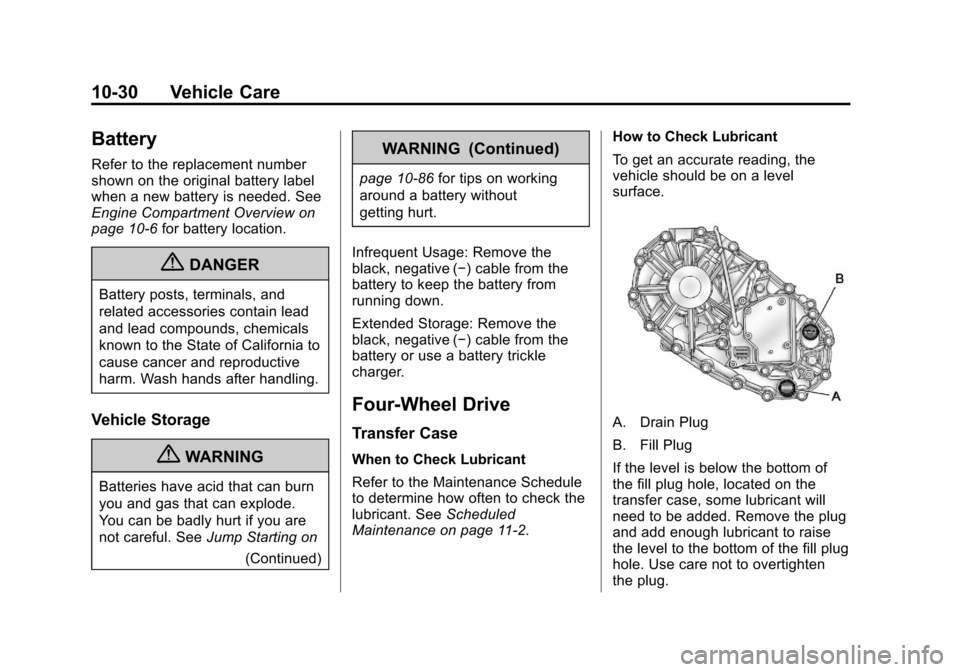
A. Drain Plug
B. Fill Plug
If the level is below the bottom of
the fill plug hole, located on the
transfer case, some lubricant will
need to be added. Remove the plug
and add enough lubricant to raise
the level to the bottom of the fill plug
hole. Use care not to overtighten
the plug.
Page 326 of 392
Black plate (86,1)Chevrolet Colorado Owner Manual - 2011
10-86 Vehicle Care
Your vehicle may have a different
size spare tire than the road tires
originally installed on your vehicle.
This spare was developed for use
on your vehicle, so it is alright to
drive on it. If your vehicle has
four-wheel drive and the different
size spare tire is installed, keep the
vehicle in two-wheel drive.
Notice:If the vehicle has
four-wheel drive and the different
size spare tire is installed on the
vehicle, do not drive in four-wheel
drive until you can have your flat
tire repaired and/or replaced. You
could damage the vehicle, and
the repair costs would not be
covered by your warranty. Never
use four-wheel drive when the
different size spare tire is
installed on the vehicle. After installing the spare tire on your
vehicle, you should stop as soon as
possible and make sure the spare is
correctly inflated. The spare tire is
made to perform well at speeds up
to 62 mph (100 km/h) for distances
up to 500 miles (804 km). For heavy
payloads or towing, and for low
traction or four-wheel-drive
conditions, repair or replace the
full-size tire. Have the damaged or
flat road tire repaired or replaced as
soon as you can and installed back
onto your vehicle. This way, the
spare tire will be available in case
you need it again.
Do not mix tires and wheels of
different sizes, because they will not
fit. Keep your spare tire and its
wheel together.Jump Starting
For more information about the
vehicle battery, see
Battery on
page 10‑30.
If the vehicle battery has run down,
you may want to use another
vehicle and some jumper cables to
start your vehicle. Be sure to use
the following steps to do it safely.
{WARNING
Batteries can hurt you. They can
be dangerous because:
.They contain acid that can
burn you.
.They contain gas that can
explode or ignite.
.They contain enough
electricity to burn you.
If you do not follow these steps
exactly, some or all of these
things can hurt you.
Page 327 of 392

Black plate (87,1)Chevrolet Colorado Owner Manual - 2011
Vehicle Care 10-87
Notice:Ignoring these steps
could result in costly damage to
the vehicle that would not be
covered by the warranty.
Trying to start the vehicle by
pushing or pulling it will not
work, and it could damage the
vehicle.
1. Check the other vehicle. It must
have a 12‐volt battery with a
negative ground system.
Notice: Only use a vehicle that
has a 12-volt system with a
negative ground for jump
starting. If the other vehicle does
not have a 12-volt system with a
negative ground, both vehicles
can be damaged.
2. Get the vehicles close enough so the jumper cables can reach,
but be sure the vehicles are not
touching each other. If they are,
it could cause a ground
connection you do not want. You
would not be able to start your vehicle, and the bad grounding
could damage the electrical
systems.
To avoid the possibility of the
vehicles rolling, set the parking
brake firmly on both vehicles
involved in the jump start
procedure. Put an automatic
transmission in P (Park) or a
manual transmission in Neutral
before setting the parking brake.
If you have a four-wheel-drive
vehicle, be sure the transfer
case is not in Neutral.
Notice: If the radio or other
accessories are left on during the
jump starting procedure, they
could be damaged. The repairs
would not be covered by the
warranty. Always turn off the
radio and other accessories when
jump starting the vehicle. 3. Turn off the ignition on both
vehicles. Unplug unnecessary
accessories plugged into the
cigarette lighter or the accessory
power outlets. Turn off the radio
and all lamps that are not
needed. This will avoid sparks
and help save both batteries.
And it could save the radio!
4. Open the hoods and locate the positive (+) and negative (−)
terminal locations on the other
vehicle. Your vehicle has a
remote positive (+) and a remote
negative (−) jump starting
terminal. See Engine
Compartment Overview on
page 10‑6 for more information
on the terminal locations.
Page 329 of 392

Black plate (89,1)Chevrolet Colorado Owner Manual - 2011
Vehicle Care 10-89
8. Now connect the blacknegative (−) cable to the
negative (−) terminal of the
good battery. Use a remote
negative (−) terminal if the
vehicle has one.
Do not let the other end touch
anything until the next step. The
other end of the negative (−)
cable does not go to the dead
battery. It goes to a heavy,
unpainted metal engine part,
or to a remote negative (−)
terminal on the vehicle with the
dead battery.
9. Connect the other end of the negative (−) cable at least 45 cm
(18 inches) away from the dead
battery, but not near engine
parts that move. The electrical
connection is just as good there,
and the chance of sparks getting
back to the battery is much less.
Your vehicle has a remote
negative (−) terminal for this
purpose. 10. Now start the vehicle with the
good battery and run the
engine for a while.
11. Try to start the vehicle that had the dead battery. If it will not
start after a few tries, it
probably needs service.
Notice: If the jumper cables are
connected or removed in the
wrong order, electrical shorting
may occur and damage the
vehicle. The repairs would not be
covered by the vehicle warranty.
Always connect and remove the
jumper cables in the correct
order, making sure that the
cables do not touch each other or
other metal.
Jumper Cable Removal
A. Heavy, Unpainted Metal Engine Part or Remote Negative (−)
Terminal
B. Good Battery or Remote Positive (+) and Remote
Negative (−) Terminals
C. Dead Battery or Remote Positive (+) Terminal