Page 222 of 328
Black plate (20,1)Chevrolet Aveo Owner Manual - 2011
10-20 Vehicle Care
How to Add Coolant to the
Coolant Surge Tank
{WARNING
You can be burned if you spill
coolant on hot engine parts.
Coolant contains ethylene glycol
and it will burn if the engine parts
are hot enough. Do not spill
coolant on a hot engine.
Notice: This vehicle has a
specific coolant fill procedure.
Failure to follow this procedure
could cause the engine to
overheat and be severely
damaged.
{WARNING
An electric engine cooling fan
under the hood can start up even
when the engine is not running
and can cause injury. Keep
hands, clothing, and tools away
from any underhood electric fan.
{WARNING
Steam and scalding liquids from a
hot cooling system can blow out
and burn you badly. They are
under pressure, and if you turn
the surge tank pressure
cap —even a little —they can
come out at high speed. Never
turn the cap when the cooling
system, including the surge tank
pressure cap, is hot. Wait for the
cooling system and surge tank
pressure cap to cool if you ever
have to turn the pressure cap.
If no coolant is visible in the surge
tank, add coolant as follows:
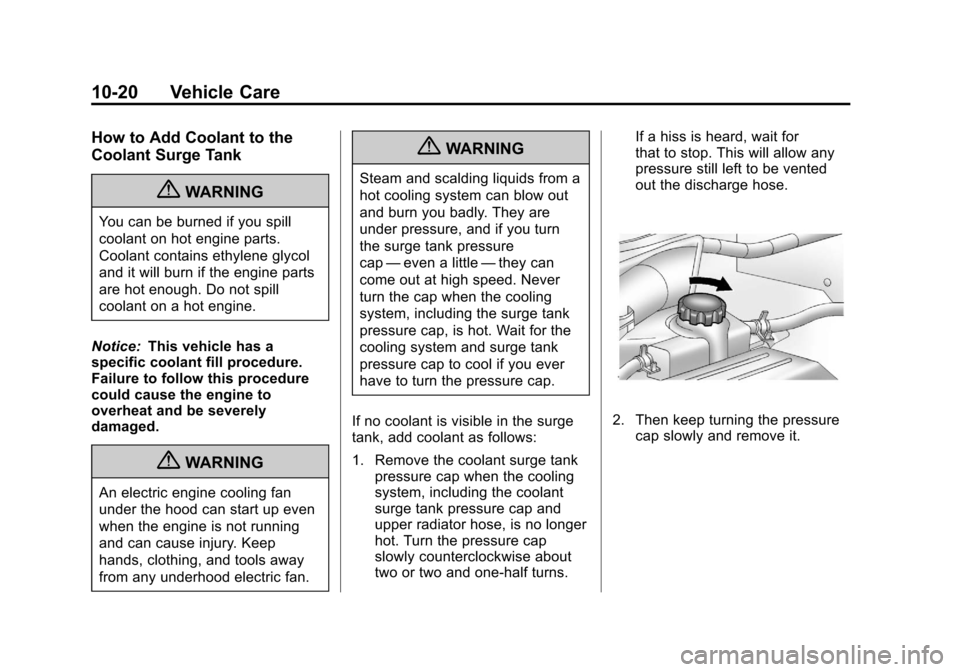
1. Remove the coolant surge tank pressure cap when the cooling
system, including the coolant
surge tank pressure cap and
upper radiator hose, is no longer
hot. Turn the pressure cap
slowly counterclockwise about
two or two and one-half turns. If a hiss is heard, wait for
that to stop. This will allow any
pressure still left to be vented
out the discharge hose.
2. Then keep turning the pressure
cap slowly and remove it.
Page 223 of 328
Black plate (21,1)Chevrolet Aveo Owner Manual - 2011
Vehicle Care 10-21
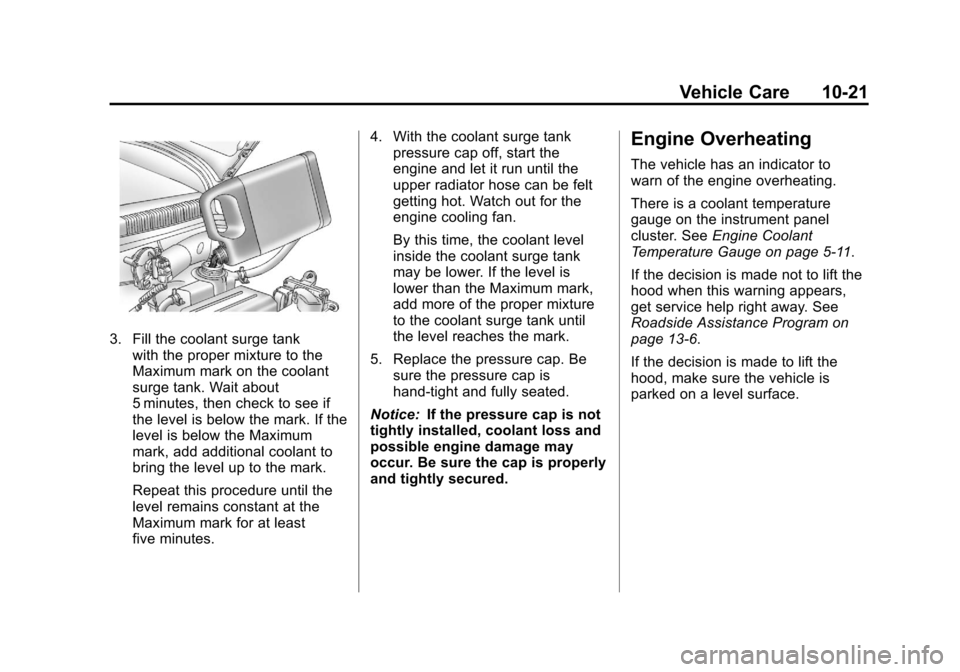
3. Fill the coolant surge tankwith the proper mixture to the
Maximum mark on the coolant
surge tank. Wait about
5 minutes, then check to see if
the level is below the mark. If the
level is below the Maximum
mark, add additional coolant to
bring the level up to the mark.
Repeat this procedure until the
level remains constant at the
Maximum mark for at least
five minutes. 4. With the coolant surge tank
pressure cap off, start the
engine and let it run until the
upper radiator hose can be felt
getting hot. Watch out for the
engine cooling fan.
By this time, the coolant level
inside the coolant surge tank
may be lower. If the level is
lower than the Maximum mark,
add more of the proper mixture
to the coolant surge tank until
the level reaches the mark.
5. Replace the pressure cap. Be sure the pressure cap is
hand-tight and fully seated.
Notice: If the pressure cap is not
tightly installed, coolant loss and
possible engine damage may
occur. Be sure the cap is properly
and tightly secured.
Engine Overheating
The vehicle has an indicator to
warn of the engine overheating.
There is a coolant temperature
gauge on the instrument panel
cluster. See Engine Coolant
Temperature Gauge on page 5‑11.
If the decision is made not to lift the
hood when this warning appears,
get service help right away. See
Roadside Assistance Program on
page 13‑6.
If the decision is made to lift the
hood, make sure the vehicle is
parked on a level surface.
Page 224 of 328
Black plate (22,1)Chevrolet Aveo Owner Manual - 2011
10-22 Vehicle Care
Then check to see if the engine
cooling fan is running. If the engine
is overheating, the fan should be
running. If it is not, do not continue
to run the engine. Have the vehicle
serviced.
Notice:Engine damage from
running the engine without
coolant is not covered by the
warranty.
Notice: If the engine catches fire
because of being driven with no
coolant, the vehicle can be badly
damaged. The costly repairs
would not be covered by the
vehicle warranty.If Steam is Coming from the
Engine Compartment
{WARNING
Steam from an overheated engine
can burn you badly, even if you
just open the hood. Stay away
from the engine if you see or hear
steam coming from it. Just turn it
off and get everyone away from
the vehicle until it cools down.
Wait until there is no sign of
steam or coolant before you open
the hood.
If you keep driving when the
engine is overheated, the liquids
in it can catch fire. You or others
could be badly burned. Stop the
engine if it overheats, and get out
of the vehicle until the engine
is cool.
If No Steam is Coming from
the Engine Compartment
If an engine overheat warning is
displayed but no steam can be seen
or heard, the problem may not be
too serious. Sometimes the engine
can get a little too hot when the
vehicle:
.Climbs a long hill on a hot day
.Stops after high-speed driving
.Idles for long periods in traffic
If the overheat warning is displayed
with no sign of steam:
1. Turn the air conditioning off, if equipped.
2. Turn the heater on to the highest temperature and to the highest
fan speed. Open the windows as
necessary.
3. If in a traffic jam, let the engine idle in N (Neutral) while stopped.
If it is safe to do so, pull off
the road, shift to P (Park) or
N (Neutral) and let the
engine idle.
Page 239 of 328
Black plate (37,1)Chevrolet Aveo Owner Manual - 2011
Vehicle Care 10-37
Engine Compartment
Fuse Block
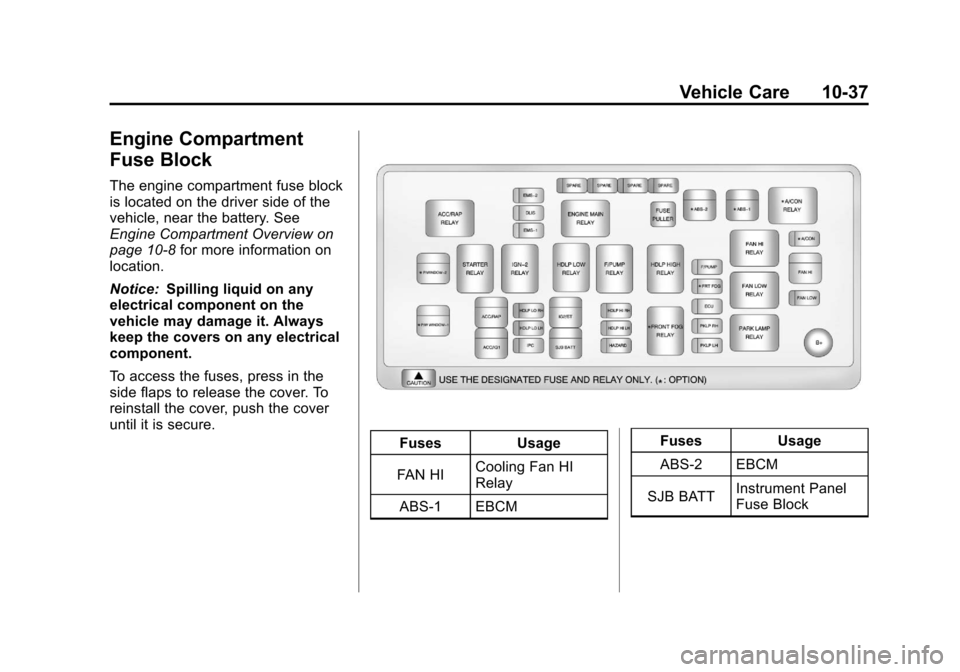
The engine compartment fuse block
is located on the driver side of the
vehicle, near the battery. See
Engine Compartment Overview on
page 10‑8for more information on
location.
Notice: Spilling liquid on any
electrical component on the
vehicle may damage it. Always
keep the covers on any electrical
component.
To access the fuses, press in the
side flaps to release the cover. To
reinstall the cover, push the cover
until it is secure.
Fuses Usage
FAN HI Cooling Fan HI
Relay
ABS‐1 EBCM Fuses
Usage
ABS‐2 EBCM
SJB BATT Instrument Panel
Fuse Block
Page 240 of 328
Black plate (38,1)Chevrolet Aveo Owner Manual - 2011
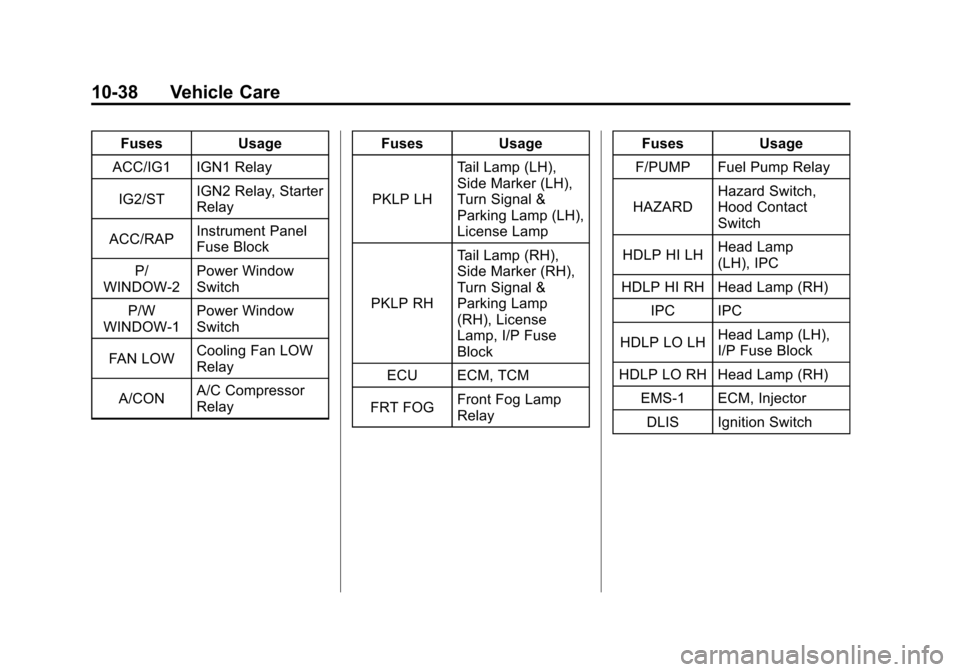
10-38 Vehicle Care
FusesUsage
ACC/IG1 IGN1 Relay
IG2/ST IGN2 Relay, Starter
Relay
ACC/RAP Instrument Panel
Fuse Block
P/
WINDOW‐2 Power Window
Switch
P/W
WINDOW‐1 Power Window
Switch
FAN LOW Cooling Fan LOW
Relay
A/CON A/C Compressor
Relay Fuses
Usage
PKLP LH Tail Lamp (LH),
Side Marker (LH),
Turn Signal &
Parking Lamp (LH),
License Lamp
PKLP RH Tail Lamp (RH),
Side Marker (RH),
Turn Signal &
Parking Lamp
(RH), License
Lamp, I/P Fuse
Block
ECU ECM, TCM
FRT FOG Front Fog Lamp
Relay Fuses
Usage
F/PUMP Fuel Pump Relay
HAZARD Hazard Switch,
Hood Contact
Switch
HDLP HI LH Head Lamp
(LH), IPC
HDLP HI RH Head Lamp (RH) IPC IPC
HDLP LO LH Head Lamp (LH),
I/P Fuse Block
HDLP LO RH Head Lamp (RH) EMS‐1 ECM, InjectorDLIS Ignition Switch
Page 241 of 328
Black plate (39,1)Chevrolet Aveo Owner Manual - 2011
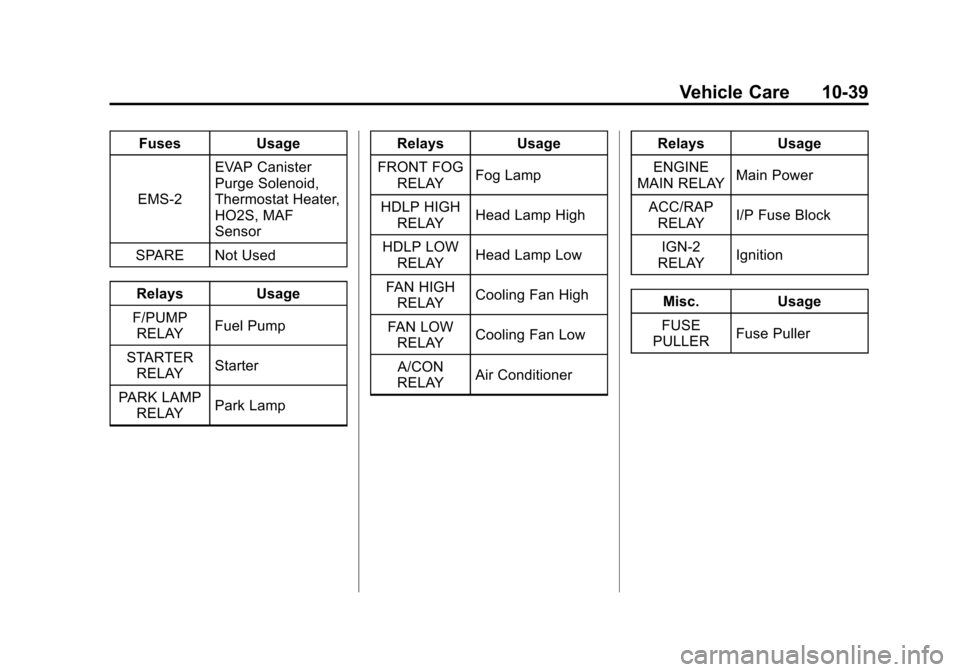
Vehicle Care 10-39
FusesUsage
EMS‐2 EVAP Canister
Purge Solenoid,
Thermostat Heater,
HO2S, MAF
Sensor
SPARE Not Used
Relays Usage
F/PUMP RELAY Fuel Pump
STARTER RELAY Starter
PARK LAMP RELAY Park Lamp Relays
Usage
FRONT FOG RELAY Fog Lamp
HDLP HIGH RELAY Head Lamp High
HDLP LOW RELAY Head Lamp Low
FAN HIGH RELAY Cooling Fan High
FAN LOW RELAY Cooling Fan Low
A/CON
RELAY Air Conditioner Relays
Usage
ENGINE
MAIN RELAY Main Power
ACC/RAP RELAY I/P Fuse Block
IGN‐2
RELAY Ignition
Misc. Usage
FUSE
PULLER Fuse Puller
Page 262 of 328
Black plate (60,1)Chevrolet Aveo Owner Manual - 2011
10-60 Vehicle Care
Wheel Replacement
Replace any wheel that is bent,
cracked, or badly rusted or
corroded. If wheel nuts keep coming
loose, the wheel, wheel bolts, and
wheel nuts should be replaced.
If the wheel leaks air, replace it,
except some aluminum wheels,
which can sometimes be repaired.
See your dealer if any of these
conditions exist.
Your dealer will know the kind of
wheel you need.
Each new wheel should have the
same load-carrying capacity,
diameter, width, offset, and be
mounted the same way as the
one it replaces.If you need to replace any of the
wheels, wheel bolts, wheel nuts,
or Tire Pressure Monitor System
(TPMS) sensors, replace them only
with new GM original equipment
parts. This way, you will be sure to
have the right wheel, wheel bolts,
wheel nuts, and TPMS sensors for
the vehicle.
{WARNING
Using the wrong replacement
wheels, wheel bolts, or wheel
nuts on the vehicle can be
dangerous. It could affect the
braking and handling of the
vehicle, make the tires lose air
and make you lose control. You
could have a collision in which
you or others could be injured.
Always use the correct wheel,
wheel bolts, and wheel nuts for
replacement.Notice:
The wrong wheel can
also cause problems with bearing
life, brake cooling, speedometer
or odometer calibration,
headlamp aim, bumper height,
vehicle ground clearance, and tire
or tire chain clearance to the
body and chassis.
See If a Tire Goes Flat on
page 10‑61 for more information.
Page 289 of 328
Black plate (3,1)Chevrolet Aveo Owner Manual - 2011
Service and Maintenance 11-3
Reset the oil life system whenever
the oil is changed. SeeEngine Oil
Life System on page 10‑12.
Every Engine Oil Change
.Change engine oil and filter.
Reset oil life system. See
Engine Oil on page 10‑9 and
Engine Oil Life System on
page 10‑12. An Emission
Control Service.
.Engine coolant level check. See
Engine Coolant on page 10‑18.
.Engine cooling system
inspection. Visual inspection of
hoses, pipes, fittings, and
clamps and replacement,
if needed.
.Windshield washer fluid level
check. See Washer Fluid on
page 10‑24.
.Windshield wiper blade
inspection for wear, cracking,
or contamination and windshield
and wiper blade cleaning,
if contaminated. See Exterior
Care on page 10‑76. Worn
or damaged wiper blade
replacement. See Wiper Blade
Replacement on page 10‑30.
.Tire inflation pressures check.
See Tire Pressure on
page 10‑48.
.Tire wear inspection. See Tire
Inspection on page 10‑53.
.Rotate tires if necessary. See
Tire Rotation on page 10‑54.
.Fluids visual leak check (or
every 12 months, whichever
occurs first). A leak in any
system must be repaired and
the fluid level checked.
.Engine air cleaner filter
inspection. See Engine Air
Cleaner/Filter on page 10‑16.
.Brake system inspection
(or every 12 months, whichever
occurs first).
.Steering and suspension
inspection. Visual inspection
for damaged, loose, or missing
parts or signs of wear.
.Body hinges and latches, key
lock cylinders, and trunk lid
hinges and latches lubrication.
See Recommended Fluids and
Lubricants on page 11‑6. More
frequent lubrication may be
required when the vehicle
is exposed to a corrosive
environment. Applying silicone
grease on weatherstrips with a
clean cloth makes them last
longer, seal better, and not stick
or squeak.
.Restraint system component
check. See Safety System
Check on page 3‑23.
.Fuel system inspection for
damage or leaks.