2011 CADILLAC SRX brake
[x] Cancel search: brakePage 386 of 498
Black plate (48,1)Cadillac SRX Owner Manual - 2011
10-48 Vehicle Care
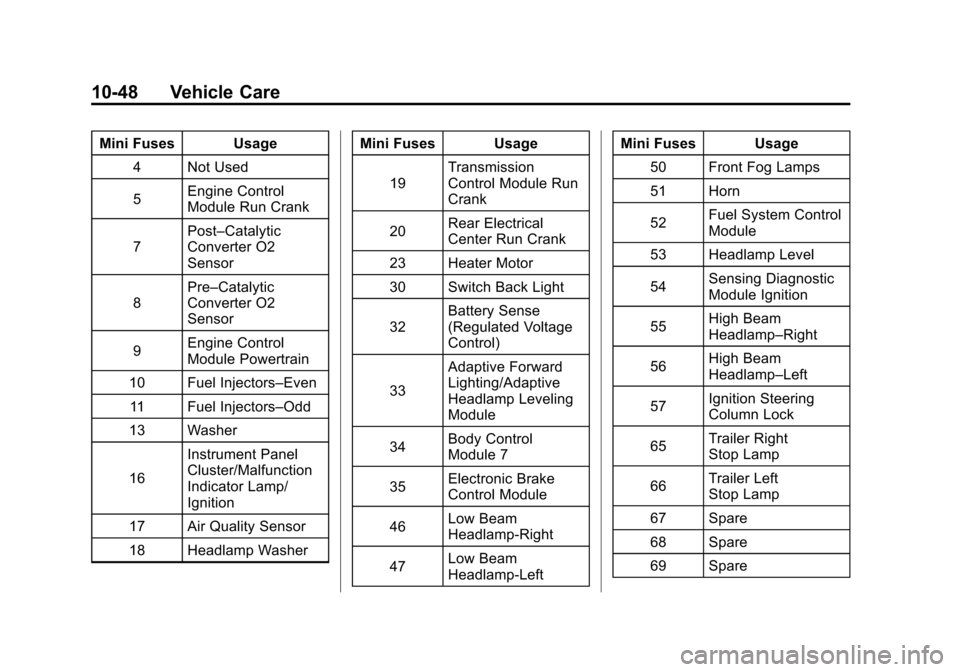
Mini Fuses Usage4 Not Used
5 Engine Control
Module Run Crank
7 Post–Catalytic
Converter O2
Sensor
8 Pre–Catalytic
Converter O2
Sensor
9 Engine Control
Module Powertrain
10 Fuel Injectors–Even 11 Fuel Injectors–Odd
13 Washer
16 Instrument Panel
Cluster/Malfunction
Indicator Lamp/
Ignition
17 Air Quality Sensor
18 Headlamp Washer Mini Fuses Usage
19 Transmission
Control Module Run
Crank
20 Rear Electrical
Center Run Crank
23 Heater Motor
30 Switch Back Light
32 Battery Sense
(Regulated Voltage
Control)
33 Adaptive Forward
Lighting/Adaptive
Headlamp Leveling
Module
34 Body Control
Module 7
35 Electronic Brake
Control Module
46 Low Beam
Headlamp‐Right
47 Low Beam
Headlamp‐Left Mini Fuses Usage
50 Front Fog Lamps
51 Horn
52 Fuel System Control
Module
53 Headlamp Level
54 Sensing Diagnostic
Module Ignition
55 High Beam
Headlamp–Right
56 High Beam
Headlamp–Left
57 Ignition Steering
Column Lock
65 Trailer Right
Stop Lamp
66 Trailer Left
Stop Lamp
67 Spare
68 Spare
69 Spare
Page 391 of 498

Black plate (53,1)Cadillac SRX Owner Manual - 2011
Vehicle Care 10-53
FusesUsage
RDM Rear Drive Module PRK
LPS TRLR Trailer Park Lamps
FUEL
PUMP Fuel Pump
* SEC Security
INFOTMNT Infotainment
* TRLR EXP Trailer Export WPR REAR Rear Wiper
MIR
WDO MDL Mirror Window
Module
* SPARE Not Used CNSTR VENT Canister Vent
LGM
LOGIC Lift Gate Module
Logic Fuses
Usage
CAMERA Rear Vision Camera FRT
VENT SEAT Front Ventilated
Seats
TRLR MDL Trailer Module
SADS MDL Semi Active
Damping System
Module
RR
HTD SEAT Rear Heated Seats
FRT
HTD SEAT Front Heated Seats
THEFT HORN Theft Horn
* LGATE Liftgate SHUNT Shunt REAR
DEFOG Rear Defog
* BCM
THEFT Body Control
Module Theft Fuses
Usage
* TRLR 2 Trailer 2
UGDO Universal Garage
Door Opener
RT WDO Right Window PRK
BRK MDL Park Brake Module
SPARE Not Used
LT WDO Left Window IGN/
THEFT 1 Ignition/Theft 1
LGATE MDL Liftgate Module
IGN/
THEFT 2 Ignition/Theft 2
SPARE Not Used
HTD MIR Heated Mirror
AUX PWR Auxiliary Power
Outlet
Page 396 of 498

Black plate (58,1)Cadillac SRX Owner Manual - 2011
10-58 Vehicle Care
(E) Rim Diameter:Diameter of
the wheel in inches.
(F) Service Description
:These
characters represent the load
index and speed rating of the
tire. The load index represents
the load carrying capacity a tire
is certified to carry. The speed
rating is the maximum speed a
tire is certified to carry a load.
Tire Terminology and
Definitions
Air Pressure:The amount
of air inside the tire pressing
outward on each square inch
of the tire. Air pressure is
expressed in psi (pounds per
square inch) or kPa (kilopascal).
Accessory Weight
:This
means the combined weight
of optional accessories.
Some examples of optional
accessories are, automatic
transmission, power steering, power brakes, power windows,
power seats, and air
conditioning.
Aspect Ratio
:The relationship
of a tire's height to its width.
Belt
:A rubber coated layer of
cords that is located between
the plies and the tread. Cords
may be made from steel or other
reinforcing materials.
Bead
:The tire bead contains
steel wires wrapped by steel
cords that hold the tire onto
the rim.
Bias Ply Tire
:A pneumatic
tire in which the plies are laid
at alternate angles less than
90 degrees to the centerline
of the tread.
Cold Tire Pressure
:The
amount of air pressure in a tire,
measured in kPa (kilopascal)
or psi (pounds per square inch) before a tire has built up heat
from driving. See
Tire Pressure
on page 10‑61.
Curb Weight
:The weight of a
motor vehicle with standard and
optional equipment including
the maximum capacity of fuel,
oil, and coolant, but without
passengers and cargo.
DOT Markings
:A code
molded into the sidewall of
a tire signifying that the tire
is in compliance with the U.S.
Department of Transportation
(DOT) motor vehicle safety
standards. The DOT code
includes the Tire Identification
Number (TIN), an alphanumeric
designator which can also
identify the tire manufacturer,
production plant, brand, and
date of production.
GVWR
:Gross Vehicle Weight
Rating. See Vehicle Load Limits
on page 9‑12.
Page 405 of 498

Black plate (67,1)Cadillac SRX Owner Manual - 2011
Vehicle Care 10-67
To decrease air-pressure out of a
tire you can use the pointed end of
the valve cap, a pencil-style air
pressure gauge, or a key.
You have two minutes to match
the first tire/wheel position, and
five minutes overall to match all
four tire/wheel positions. If it takes
longer than two minutes, to match
the first tire and wheel, or more than
five minutes to match all four tire
and wheel positions the matching
process stops and you need to
start over.
The TPMS sensor matching process
is outlined below:
1. Set the parking brake.
2. Place the vehicle power mode inON/RUN/START. See Ignition
Positions on page 9‑18.
3. Select the vehicle information menu using the menu button.
4. Select the tire pressure screen using the up/down thumbwheel. 5. Press and hold SET to begin the
sensor matching process.
6. Press SET to confirm selection. The horn sounds twice to signal
the receiver is in relearn mode
and TIRE LEARNING ACTIVE
message displays on the DIC
screen.
7. Start with the driver side front tire.
8. Remove the valve cap from the valve cap stem. Activate the
TPMS sensor by increasing
or decreasing the tire's air
pressure for five seconds,
or until a horn chirp sounds.
The horn chirp, which may
take up to 30 seconds to
sound, confirms that the sensor
identification code has been
matched to this tire and wheel
position.
9. Proceed to the passenger side front tire, and repeat the
procedure in Step 5. 10. Proceed to the passenger
side rear tire, and repeat the
procedure in Step 5.
11. Proceed to the driver side rear tire, and repeat the procedure
in Step 5. The horn sounds
two times to indicate the
sensor identification code has
been matched to the driver
side rear tire, and the TPMS
sensor matching process
is no longer active. The TIRE
LEARNING ACTIVE message
on the DIC display screen
goes off.
12. Press STOP to turn the ignition off.
13. Set all four tires to the recommended air pressure
level as indicated on the Tire
and Loading Information label.
14. Put the valve caps back on the valve stems.
Page 409 of 498

Black plate (71,1)Cadillac SRX Owner Manual - 2011
Vehicle Care 10-71
GM's exclusive TPC Spec
system considers over a dozen
critical specifications that impact
the overall performance of
your vehicle, including brake
system performance, ride
and handling, traction control,
and tire pressure monitoring
performance. GM's TPC Spec
number is molded onto the
tire's sidewall near the tire size.
If the tires have an all‐season
tread design, the TPC Spec
number will be followed by an
MS for mud and snow. SeeTire
Sidewall Labeling on page 10‑55
for additional information.
GM recommends replacing tires
in sets of four. This is because
uniform tread depth on all tires
will help keep your vehicle performing most like it did
when the tires were new.
Replacing less than a full set
of tires can affect the braking
and handling performance of
your vehicle. See
Tire Inspection
on page 10‑68 andTire Rotation
on page 10‑68 for information
on proper tire rotation.
{WARNING
Tires could explode during
improper service. You or others
could be injured or killed if you
attempt to mount or dismount
a tire. Only your dealer or an
authorized tire service center
should mount and dismount
the tires.
{WARNING
Mixing tires could cause you
to lose control while driving.
If you mix tires of different
sizes, brands, or types
(radial and bias-belted tires),
the vehicle may not handle
properly, and you could have
a crash. Using tires of different
sizes, brands, or types may
also cause damage to your
vehicle. Be sure to use the
correct size, brand, and type
of tires on all wheels. It is
all right to drive with your
compact spare temporarily, as
it was developed for use on
your vehicle. See Compact
Spare Tire on page 10‑93.
Page 410 of 498

Black plate (72,1)Cadillac SRX Owner Manual - 2011
10-72 Vehicle Care
{WARNING
If you use bias-ply tires on the
vehicle, the wheel rim flanges
could develop cracks after
many miles of driving. A tire
and/or wheel could fail
suddenly, causing a crash.
Use only radial-ply tires with
the wheels on the vehicle.
If you must replace your
vehicle's tires with those that do
not have a TPC Spec number,
make sure they are the same
size, load range, speed rating,
and construction type (radial
and bias‐belted tires) as your
vehicle's original tires. Vehicles that have a tire
pressure monitoring system
could give an inaccurate
low‐pressure warning if
non‐TPC Spec rated tires
are installed on your vehicle.
Non‐TPC Spec rated tires may
give a low‐pressure warning
that is higher or lower than the
proper warning level you would
get with TPC Spec rated tires.
See
Tire Pressure Monitor
System on page 10‑63.
Your vehicle's original
equipment tires are listed on
the Tire and Loading Information
label. See Vehicle Load
Limits on page 9‑12 for more
information about the Tire and
Loading Information label and
its location on your vehicle.Different Size Tires and
Wheels
If you add wheels or tires that are
a different size than your original
equipment wheels and tires, this
could affect the way your vehicle
performs, including its braking,
ride and handling characteristics,
stability, and resistance to rollover.
Additionally, if your vehicle has
electronic systems such as antilock
brakes, rollover airbags, traction
control, and electronic stability
control, the performance of these
systems can be affected.
Page 413 of 498

Black plate (75,1)Cadillac SRX Owner Manual - 2011
Vehicle Care 10-75
Warning: The temperature grade
for this tire is established for a
tire that is properly inflated and
not overloaded. Excessive
speed, underinflation,
or excessive loading, either
separately or in combination,
can cause heat buildup and
possible tire failure.
Wheel Alignment and Tire
Balance
The tires and wheels on the vehicle
were aligned and balanced carefully
at the factory to give the longest tire
life and best overall performance.
Adjustments to wheel alignment and
tire balancing will not be necessary
on a regular basis. However, if there
is unusual tire wear or the vehicle
pulls to one side or the other, the
alignment should be checked. If the
vehicle vibrates when driving on a
smooth road, the tires and wheels
might need to be rebalanced. See
your dealer for proper diagnosis.
Wheel Replacement
Replace any wheel that is bent,
cracked, or badly rusted or
corroded. If wheel nuts keep coming
loose, the wheel, wheel bolts, and
wheel nuts should be replaced.
If the wheel leaks air, replace it,
except some aluminum wheels,
which can sometimes be repaired.
See your dealer if any of these
conditions exist.
Your dealer will know the kind of
wheel you need.
Each new wheel should have
the same load-carrying capacity,
diameter, width, offset, and be
mounted the same way as the
one it replaces.
If you need to replace any of the
wheels, wheel bolts, wheel nuts,
or Tire Pressure Monitor System
(TPMS) sensors, replace them only
with new GM original equipment
parts. This way, you will be sure to
have the right wheel, wheel bolts,
wheel nuts, and TPMS sensors for
the vehicle.{WARNING
Using the wrong replacement
wheels, wheel bolts, or wheel
nuts on your vehicle can be
dangerous. It could affect the
braking and handling of your
vehicle, make your tires lose
air and make you lose control.
You could have a collision in
which you or others could be
injured. Always use the correct
wheel, wheel bolts, and wheel
nuts for replacement.
Notice: The wrong wheel can
also cause problems with
bearing life, brake cooling,
speedometer or odometer
calibration, headlamp aim,
bumper height, vehicle ground
clearance, and tire or tire chain
clearance to the body and
chassis.
See If a Tire Goes Flat on
page 10‑77 for more information.
Page 414 of 498

Black plate (76,1)Cadillac SRX Owner Manual - 2011
10-76 Vehicle Care
Used Replacement Wheels
{WARNING
Putting a used wheel on the
vehicle is dangerous. You cannot
know how it has been used or
how far it has been driven.
It could fail suddenly and cause
a crash. If you have to replace a
wheel, use a new GM original
equipment wheel.
Tire Chains
{WARNING
Do not use tire chains. There is
not enough clearance. Tire chains
used on a vehicle without the
proper amount of clearance can
cause damage to the brakes,
suspension or other vehicle parts.
The area damaged by the tire
chains could cause you to lose
control of the vehicle and you or
others may be injured in a crash.(Continued)
WARNING (Continued)
Use another type of traction
device only if its manufacturer
recommends it for use on the
vehicle and tire size combination
and road conditions. Follow that
manufacturer's instructions.
To help avoid damage to the
vehicle, drive slowly, readjust
or remove the device if it is
contacting the vehicle, and do not
spin the vehicle's wheels. If you
do find traction devices that will
fit, install them on the front tires.