Page 48 of 470
Black plate (16,1)Cadillac DTS Owner Manual - 2011
Occupants who are not buckled up can be thrown out of
the vehicle in a crash. And they can strike others in the
vehicle who are wearing safety belts.
First, before you or your passenger(s) wear a safety
belt, there is important information you should know.
Sit up straight and always keep your feet on the floor
in front of you. The lap part of the belt should be worn
low and snug on the hips, just touching the thighs.In a crash, this applies force to the strong pelvic bones
and you would be less likely to slide under the lap belt.
If you slid under it, the belt would apply force on your
abdomen. This could cause serious or even fatal
injuries. The shoulder belt should go over the shoulder
and across the chest. These parts of the body are best
able to take belt restraining forces.
The shoulder belt locks if there is a sudden stop or
crash.
2-16
Page 56 of 470

Black plate (24,1)Cadillac DTS Owner Manual - 2011
Lap-Shoulder Belt
All seating positions in the vehicle have a lap-shoulder
except for the center front passenger position
(if equipped), which has a lap belt. SeeLap Belt
on
page 2‑29for more information.
The following instructions explain how to wear a
lap-shoulder belt properly. 1. Adjust the seat, if the seat is adjustable, so you can sit up straight. To see how, see “Seats”in the
Index.
2. Pick up the latch plate and pull the belt across you. Do not let it get twisted.
The lap-shoulder belt may lock if you pull the belt
across you very quickly. If this happens, let the
belt go back slightly to unlock it. Then pull the belt
across you more slowly.
If the shoulder portion of a passenger belt is pulled
out all the way, the child restraint locking feature
may be engaged. If this happens, just let the belt
go back all the way and start again.
Engaging the child restraint locking feature in
the right front seating position may affect the
passenger sensing system. See Passenger
Sensing System
on page 2‑64for more
information.
3. Push the latch plate into the buckle until it clicks.
If the latch plate will not go fully into the buckle,
check if the correct buckle is being used.
Pull up on the latch plate to make sure it is secure.
If the belt is not long enough, see Safety Belt
Extender
on page 2‑31.
Position the release button on the buckle so that
the safety belt could be quickly unbuckled if
necessary.
2-24
Page 58 of 470

Black plate (26,1)Cadillac DTS Owner Manual - 2011
Shoulder Belt Height Adjuster
The vehicle has a shoulder belt height adjuster for the
driver and right front passenger seating positions.
Adjust the height so the shoulder portion of the belt is
on the shoulder and not falling off of it. The belt should
be close to, but not contacting, the neck. Improper
shoulder belt height adjustment could reduce the
effectiveness of the safety belt in a crash. SeeHow to
Wear Safety Belts Properly on page 2‑15.
Press the release
button (A) and move the
height adjuster to the
desired position. The
adjuster can be moved
up by pushing up on the
shoulder belt guide. After the adjuster is set to the desired position, try to
move it down without pressing the release button to
make sure it has locked into position.
Safety Belt Pretensioners
This vehicle has safety belt pretensioners for front
outboard occupants. Although the safety belt
pretensioners cannot be seen, they are part of the
safety belt assembly. They can help tighten the safety
belts during the early stages of a moderate to severe
frontal or near frontal crash if the threshold conditions
for pretensioner activation are met. And, if your vehicle
has side impact airbags, safety belt pretensioners can
help tighten the safety belts in a side crash.
Pretensioners work only once. If the pretensioners
activate in a crash, they will need to be replaced, and
probably other new parts for the vehicle's safety belt
system. See
Replacing Restraint System Parts After a
Crash on page 2‑71.
2-26
Page 77 of 470

Black plate (45,1)Cadillac DTS Owner Manual - 2011
{WARNING:
Do not attach more than one child restraint to a
single anchor. Attaching more than one child
restraint to a single anchor could cause the
anchor or attachment to come loose or even
break during a crash. A child or others could be
injured. To reduce the risk of serious or fatal
injuries during a crash, attach only one child
restraint per anchor.
{WARNING:
Children can be seriously injured or strangled if a
shoulder belt is wrapped around their neck and
the safety belt continues to tighten. Buckle any
unused safety belts behind the child restraint so
children cannot reach them. Pull the shoulder belt
all the way out of the retractor to set the lock,
if your vehicle has one, after the child restraint
has been installed.Notice:
Do not let the LATCH attachments rub
against the vehicle’ s safety belts. This may damage
these parts. If necessary, move buckled safety belts
to avoid rubbing the LATCH attachments.
Do not fold the empty rear seat with a safety belt
buckled. This could damage the safety belt or the
seat. Unbuckle and return the safety belt to its
stowed position, before folding the seat.
1. Attach and tighten the lower attachments to the lower anchors. If the child restraint does not have
lower attachments or the desired seating position
does not have lower anchors, secure the child
restraint with the top tether and the safety belts.
Refer to your child restraint manufacturer
instructions and the instructions in this manual.
1. 1. Find the lower anchors for the desired seating position.
1. 2. Put the child restraint on the seat.
1. 3. Attach and tighten the lower attachments on the child restraint to the lower anchors.
2-45
Page 80 of 470
Black plate (48,1)Cadillac DTS Owner Manual - 2011
3. Push the latch plate into the buckle until it clicks.Position the release button on the buckle so that
the safety belt could be quickly unbuckled if
necessary.4. Pull the shoulder belt all the way out of theretractor to set the lock. When the retractor lock is
set, the belt can be tightened but not pulled out of
the retractor.
2-48
Page 81 of 470

Black plate (49,1)Cadillac DTS Owner Manual - 2011
5. To tighten the belt, push down on the childrestraint, pull the shoulder portion of the belt to
tighten the lap portion of the belt, and feed the
shoulder belt back into the retractor. When
installing a forward-facing child restraint, it may
be helpful to use your knee to push down on the
child restraint as you tighten the belt.
Try to pull the belt out of the retractor to make sure
the retractor is locked. If the retractor is not locked,
repeat Steps 4 and 5. 6. If the child restraint has a top tether, follow the
child restraint manufacturer's instructions regarding
the use of the top tether. See Lower Anchors and
Tethers for Children (LATCH)
on page 2‑41for
more information.
7. Before placing a child in the child restraint, make sure it is securely held in place. To check, grasp
the child restraint at the safety belt path and
attempt to move it side‐to‐side and back‐and‐forth.
When the child restraint is properly installed, there
should be no more than 2.5 cm (1 in) of movement.
To remove the child restraint, unbuckle the vehicle
safety belt and let it return to the stowed position.
If the top tether is attached to a top tether anchor,
disconnect it.
2-49
Page 84 of 470
Black plate (52,1)Cadillac DTS Owner Manual - 2011
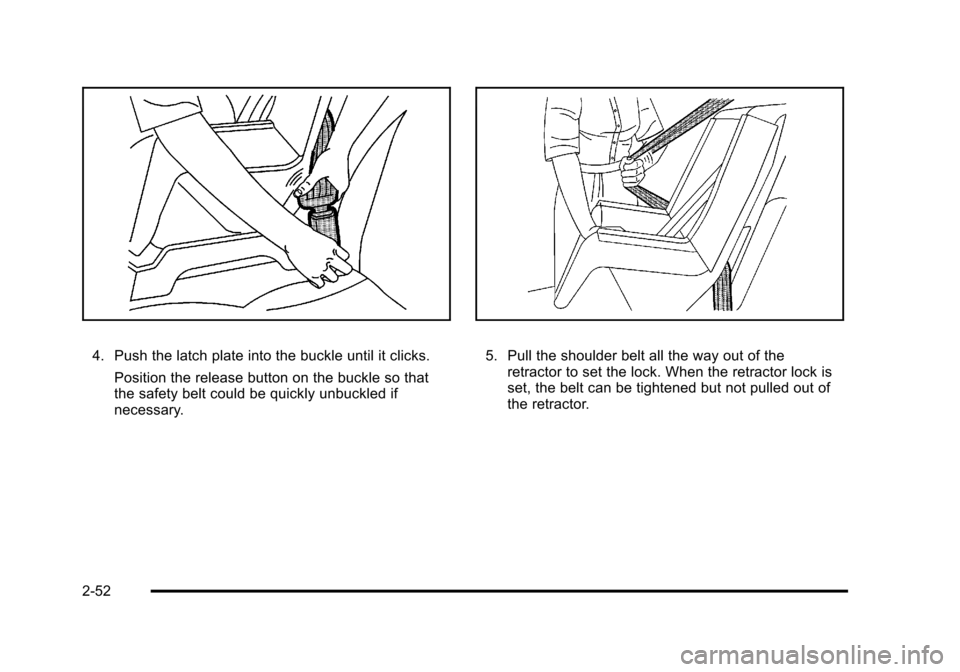
4. Push the latch plate into the buckle until it clicks.Position the release button on the buckle so that
the safety belt could be quickly unbuckled if
necessary.5. Pull the shoulder belt all the way out of theretractor to set the lock. When the retractor lock is
set, the belt can be tightened but not pulled out of
the retractor.
2-52
Page 85 of 470

Black plate (53,1)Cadillac DTS Owner Manual - 2011
6. To tighten the belt, push down on the childrestraint, pull the shoulder portion of the belt to
tighten the lap portion of the belt, and feed the
shoulder belt back into the retractor. When
installing a forward-facing child restraint, it may
be helpful to use your knee to push down on the
child restraint as you tighten the belt.
Try to pull the belt out of the retractor to make sure
the retractor is locked. If the retractor is not locked,
repeat Steps 5 and 6. 7. Before placing a child in the child restraint, make
sure it is securely held in place. To check, grasp
the child restraint at the safety belt path and
attempt to move it side to side and back and forth.
When the child restraint is properly installed, there
should be no more than 2.5 cm (1 in) of movement.
If the airbags are off, the off indicator in the passenger
airbag status indicator will come on and stay on when
the vehicle is started.
If a child restraint has been installed and the on
indicator is lit, see “If the On Indicator is Lit for a Child
Restraint ”under Passenger Sensing System
on
page 2‑64for more information.
To remove the child restraint, unbuckle the vehicle
safety belt and let it return to the stowed position.
2-53