2011 BUICK REGAL wheel size
[x] Cancel search: wheel sizePage 299 of 368

Black plate (59,1)Buick Regal Owner Manual - 2011
Vehicle Care 10-59
Different Size Tires and
Wheels
If wheels or tires are installed that
are a different size than the original
equipment wheels and tires, vehicle
performance, including its braking,
ride and handling characteristics,
stability, and resistance to rollover
may be affected. If the vehicle has
electronic systems such as antilock
brakes, rollover airbags, traction
control, and electronic stability
control, the performance of these
systems can also be affected.
{WARNING
If different sized wheels are used,
there may not be an acceptable
level of performance and safety
if tires not recommended for
those wheels are selected. This
increases the chance of a crash
and serious injury. Only use GM
specific wheel and tire systems(Continued)
WARNING (Continued)
developed for the vehicle, and
have them properly installed by
a GM certified technician.
See Buying New Tires on
page 10‑57 andAccessories and
Modifications on page 10‑3 for
additional information.
Uniform Tire Quality
Grading
Quality grades can be found
where applicable on the tire
sidewall between tread shoulder
and maximum section width. For
example:
Treadwear 200 Traction AA
Temperature A
The following information relates
to the system developed by the
United States National Highway
Traffic Safety Administration (NHTSA), which grades tires
by treadwear, traction, and
temperature performance. This
applies only to vehicles sold in
the United States. The grades
are molded on the sidewalls of
most passenger car tires. The
Uniform Tire Quality Grading
(UTQG) system does not apply
to deep tread, winter-type snow
tires, space-saver, or temporary
use spare tires, tires with
nominal rim diameters of
10 to 12 inches (25 to 30 cm),
or to some limited-production
tires.
While the tires available on
General Motors passenger cars
and light trucks may vary with
respect to these grades, they
must also conform to federal
safety requirements and
additional General Motors Tire
Performance Criteria (TPC)
standards.
Page 302 of 368

Black plate (62,1)Buick Regal Owner Manual - 2011
10-62 Vehicle Care
Tire Chains
{WARNING
Do not use tire chains. There is
not enough clearance. Tire chains
used on a vehicle without the
proper amount of clearance can
cause damage to the brakes,
suspension, or other vehicle
parts. The area damaged by the
tire chains could cause loss of
control and a crash.
Use another type of traction
device only if its manufacturer
recommends it for the vehicle's
tire size combination and
road conditions. Follow that
manufacturer's instructions. To
avoid vehicle damage, drive
slow and readjust or remove the
traction device if it contacts the
vehicle. Do not spin the wheels.
If traction devices are used, install
them on the front tires.
If a Tire Goes Flat
It is unusual for a tire to blow out
while driving, especially if the tires
are maintained properly. If air goes
out of a tire, it is much more likely to
leak out slowly. But if there ever is a
blowout, here are a few tips about
what to expect and what to do:
If a front tire fails, the flat tire
creates a drag that pulls the vehicle
toward that side. Take your foot off
the accelerator pedal and grip the
steering wheel firmly. Steer to
maintain lane position, and then
gently brake to a stop, well off the
road, if possible.
A rear blowout, particularly on a
curve, acts much like a skid and
may require the same correction as
used in a skid. Stop pressing the
accelerator pedal and steer to
straighten the vehicle. It may be
very bumpy and noisy. Gently brake
to a stop, well off the road,
if possible.{WARNING
Driving on a flat tire will cause
permanent damage to the tire.
Re-inflating a tire after it has
been driven on while severely
underinflated or flat may cause a
blowout and a serious crash.
Never attempt to re-inflate a tire
that has been driven on while
severely underinflated or flat.
Have your dealer or an authorized
tire service center repair or
replace the flat tire as soon as
possible.
Page 308 of 368
Black plate (68,1)Buick Regal Owner Manual - 2011
10-68 Vehicle Care
{WARNING
Wheel nuts that are improperly or
incorrectly tightened can cause
the wheels to become loose or
come off. The wheel nuts should
be tightened with a torque wrench
to the proper torque specification
after replacing. Follow the torque
specification supplied by the
aftermarket manufacturer when
using accessory locking wheel
nuts. SeeCapacities and
Specifications on page 12‑2 for
original equipment wheel nut
torque specifications.
Notice: Improperly tightened
wheel nuts can lead to brake
pulsation and rotor damage. To
avoid expensive brake repairs,
evenly tighten the wheel nuts in
the proper sequence and to the
proper torque specification. See
Capacities and Specifications on
page 12‑2 for the wheel nut
torque specification.
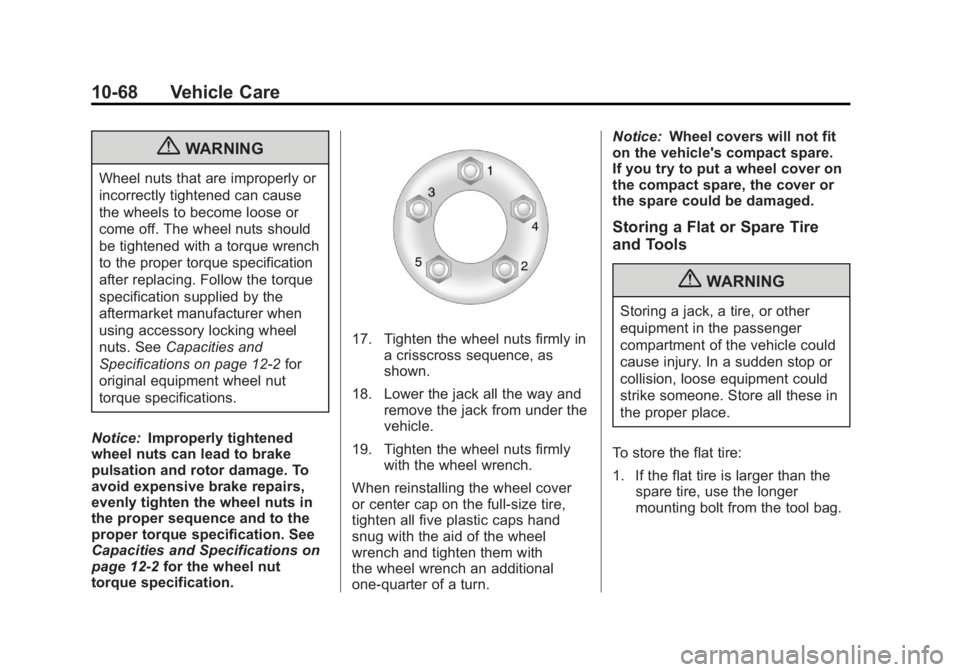
17. Tighten the wheel nuts firmly in a crisscross sequence, as
shown.
18. Lower the jack all the way and remove the jack from under the
vehicle.
19. Tighten the wheel nuts firmly with the wheel wrench.
When reinstalling the wheel cover
or center cap on the full-size tire,
tighten all five plastic caps hand
snug with the aid of the wheel
wrench and tighten them with
the wheel wrench an additional
one‐quarter of a turn. Notice:
Wheel covers will not fit
on the vehicle's compact spare.
If you try to put a wheel cover on
the compact spare, the cover or
the spare could be damaged.
Storing a Flat or Spare Tire
and Tools
{WARNING
Storing a jack, a tire, or other
equipment in the passenger
compartment of the vehicle could
cause injury. In a sudden stop or
collision, loose equipment could
strike someone. Store all these in
the proper place.
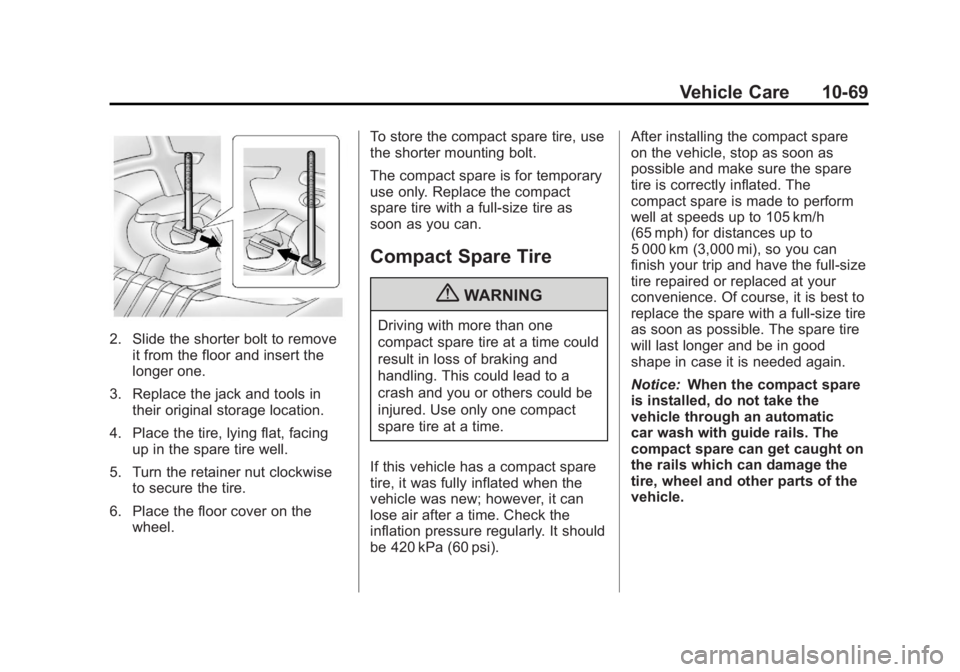
To store the flat tire:
1. If the flat tire is larger than the spare tire, use the longer
mounting bolt from the tool bag.
Page 309 of 368
Black plate (69,1)Buick Regal Owner Manual - 2011
Vehicle Care 10-69
2. Slide the shorter bolt to removeit from the floor and insert the
longer one.
3. Replace the jack and tools in their original storage location.
4. Place the tire, lying flat, facing up in the spare tire well.
5. Turn the retainer nut clockwise to secure the tire.
6. Place the floor cover on the wheel. To store the compact spare tire, use
the shorter mounting bolt.
The compact spare is for temporary
use only. Replace the compact
spare tire with a full-size tire as
soon as you can.
Compact Spare Tire
{WARNING
Driving with more than one
compact spare tire at a time could
result in loss of braking and
handling. This could lead to a
crash and you or others could be
injured. Use only one compact
spare tire at a time.
If this vehicle has a compact spare
tire, it was fully inflated when the
vehicle was new; however, it can
lose air after a time. Check the
inflation pressure regularly. It should
be 420 kPa (60 psi). After installing the compact spare
on the vehicle, stop as soon as
possible and make sure the spare
tire is correctly inflated. The
compact spare is made to perform
well at speeds up to 105 km/h
(65 mph) for distances up to
5 000 km (3,000 mi), so you can
finish your trip and have the full-size
tire repaired or replaced at your
convenience. Of course, it is best to
replace the spare with a full-size tire
as soon as possible. The spare tire
will last longer and be in good
shape in case it is needed again.
Notice:
When the compact spare
is installed, do not take the
vehicle through an automatic
car wash with guide rails. The
compact spare can get caught on
the rails which can damage the
tire, wheel and other parts of the
vehicle.
Page 367 of 368

Black plate (11,1)Buick Regal Owner Manual - 2011
INDEX i-11
T
Tachometer . . . . . . . . . . . . . . . . . . . . . 5-9
TaillampsBulb Replacement . . . . . . . . . . 10-33
Text Telephone (TTY) Users . . . 13-4
Theft-Deterrent Systems . . . . . . . . 2-9 Immobilizer . . . . . . . . . . . . . . . . . . . . 2-9
Time . . . . . . . . . . . . . . . . . . . . . . . . . . . . 5-5
Tires Buying New Tires . . . . . . . . . . . 10-57
Chains . . . . . . . . . . . . . . . . . . . . . . 10-62
Changing . . . . . . . . . . . . . . . . . . . 10-63
Compact Spare . . . . . . . . . . . . . 10-69
Designations . . . . . . . . . . . . . . . 10-45
Different Size . . . . . . . . . . . . . . . 10-59
If a Tire Goes Flat . . . . . . . . . . 10-62
Inflation Monitor System . . . . 10-52
Inspection . . . . . . . . . . . . . . . . . . 10-55
Messages . . . . . . . . . . . . . . . . . . . . 5-30
Pressure . . . . . . . . . . . . . . . . . . . . 10-50
Pressure Light . . . . . . . . . . . . . . . . 5-19 Tires (cont.)
Pressure Monitor System . . . 10-51
Rotation . . . . . . . . . . . . . . . . . . . . 10-55
Sidewall Labeling . . . . . . . . . . . 10-43
Terminology and
Definitions . . . . . . . . . . . . . . . . . 10-46
Uniform Tire Quality Grading . . . . . . . . . . . . . . . . . . . 10-59
Wheel Alignment and Tire
Balance . . . . . . . . . . . . . . . . . . . 10-61
Wheel Replacement . . . . . . . . 10-61
When It Is Time for New Tires . . . . . . . . . . . . . . . . . . . . . . 10-56
Winter . . . . . . . . . . . . . . . . . . . . . . 10-43
Towing General Information . . . . . . . . . . 9-50
Recreational Vehicle . . . . . . . . 10-74
Vehicle . . . . . . . . . . . . . . . . . . . . . 10-74
Traction Control System (TCS) . . . . . . . . 9-34
Control System (TCS)/StabiliTrak
®Light . . . . . . . . . . . . 5-18
Off Light . . . . . . . . . . . . . . . . . . . . . . 5-18 Transmission
Automatic . . . . . . . . . . . . . . . . . . . . . 9-25
Fluid, Automatic . . . . . . . . . . . . 10-14
Fluid, Manual . . . . . . . . . . . . . . . 10-14
Messages . . . . . . . . . . . . . . . . . . . . 5-30
Transportation Program, Courtesy . . . . . . . . . . . . . . . . . . . . . 13-8
Trip Odometer . . . . . . . . . . . . . . . . . . 5-9
Trunk . . . . . . . . . . . . . . . . . . . . . . . . . . . 2-7
Turn and Lane-Change Signals . . . . . . . . . . . . . . . . . . . . . . . . 6-3
Turn Signal Bulb Replacement . . . . . . . . . . 10-33
U
Ultrasonic Parking Assist . . . . . . 9-42
Ultrasonic Parking SensorLight . . . . . . . . . . . . . . . . . . . . . . . . . 5-17
Uniform Tire Quality Grading . . . . . . . . . . . . . . . . . . . . . 10-59
Using This Manual . . . . . . . . . . . . . . . . iii
Page 368 of 368

Black plate (12,1)Buick Regal Owner Manual - 2011
i-12 INDEX
V
VehicleCanadian Owners . . . . . . . . . . . . . . . iii
Control . . . . . . . . . . . . . . . . . . . . . . . . 9-3
IdentificationNumber (VIN) . . . . . . . . . . . . . . . 12-1
Load Limits . . . . . . . . . . . . . . . . . . . 9-12
Messages . . . . . . . . . . . . . . . . . . . . 5-25
Personalization . . . . . . . . . . . . . . . 5-31
Security . . . . . . . . . . . . . . . . . . . . . . . 2-9
Towing . . . . . . . . . . . . . . . . . . . . . . 10-74
Vehicle Care Tire Pressure . . . . . . . . . . . . . . . 10-49
Vehicle Identification Service Parts IdentificationLabel . . . . . . . . . . . . . . . . . . . . . . . . 12-1
Ventilation, Air . . . . . . . . . . . . . . . . . . 8-4
Visors . . . . . . . . . . . . . . . . . . . . . . . . . 2-14
W
Warning Brake System Light . . . . . . . . . . . 5-16
Warning Lights, Gauges, and Indicators . . . . . . . . . . . . . . . . . . . . . 5-7
Warnings . . . . . . . . . . . . . . . . . . . . . . . . . iii Cautions and Danger . . . . . . . . . . . . iii
Hazard Flashers . . . . . . . . . . . . . . . 6-3
Washer Fluid . . . . . . . . . . . . . . . . . 10-24
Wheels Alignment and Tire
Balance . . . . . . . . . . . . . . . . . . . 10-61
Different Size . . . . . . . . . . . . . . . 10-59
Replacement . . . . . . . . . . . . . . . 10-61 When It Is Time for New
Tires . . . . . . . . . . . . . . . . . . . . . . . . 10-56
Where to Put the Restraint . . . . 3-48
Windows . . . . . . . . . . . . . . . . . . . . . . 2-12 Messages . . . . . . . . . . . . . . . . . . . . 5-31
Power . . . . . . . . . . . . . . . . . . . . . . . . 2-12
Windshield
Wiper/Washer . . . . . . . . . . . . . . . . . 5-3
Winter Driving . . . . . . . . . . . . . . . . . . . . . . . . . 9-9
Winter Tires . . . . . . . . . . . . . . . . . . 10-43
Wiper Blade Replacement . . . . 10-30