2011 BUICK LUCERNE flat tire
[x] Cancel search: flat tirePage 358 of 450

Black plate (72,1)Buick Lucerne Owner Manual - 2011
The rubber in tires ages over time, even if they are not
being used. This is also true for the spare tire, if your
vehicle has one. Multiple conditions affect how fast this
aging takes place, including temperatures, loading
conditions, and inflation pressure maintenance. Tires
will typically need to be replaced due to wear before
they may need to be replaced due to age. Consult the
tire manufacturer for more information on when tires
should be replaced.
Vehicle Storage
Tires age when stored normally mounted on a parked
vehicle. Park a vehicle that will be stored for at least
a month in a cool, dry, clean area away from direct
sunlight to slow aging. This area should be free of
grease, gasoline or other substances that can
deteriorate rubber.
Parking for an extended period can cause flat spots
on the tires that may result in vibrations while driving.
When storing a vehicle for at least a month, remove the
tires or raise the vehicle to reduce the weight from the
tires.
Buying New Tires
GM has developed and matched specific tires for
your vehicle. The original equipment tires installed
on your vehicle, when it was new, were designed
to meet General Motors Tire Performance Criteria
Specification (TPC Spec) system rating. If you
need replacement tires, GM strongly recommends
that you get tires with the same TPC Spec rating.
This way, your vehicle will continue to have tires
that are designed to give the same performance
and vehicle safety, during normal use, as the
original tires.
GM's exclusive TPC Spec system considers over
a dozen critical specifications that impact the
overall performance of your vehicle, including
brake system performance, ride and handling,
traction control, and tire pressure monitoring
performance. GM's TPC Spec number is molded
onto the tire's sidewall near the tire size. If the
tires have an all‐season tread design, the TPC
Spec number will be followed by an MS for
mud and snow. SeeTire Sidewall Labeling
on
page 6‑58
for additional information.
6-72
Page 362 of 450

Black plate (76,1)Buick Lucerne Owner Manual - 2011
Traction–AA, A, B, C
The traction grades, from highest to lowest,
are AA, A, B, and C. Those grades represent
the tire's ability to stop on wet pavement as
measured under controlled conditions on
specified government test surfaces of asphalt
and concrete. A tire marked C may have poor
traction performance. Warning: The traction grade
assigned to this tire is based on straight-ahead
braking traction tests, and does not include
acceleration, cornering, hydroplaning, or peak
traction characteristics.
Temperature –A, B, C
The temperature grades are A (the highest), B,
and C, representing the tire's resistance to the
generation of heat and its ability to dissipate heat
when tested under controlled conditions on a
specified indoor laboratory test wheel. Sustained
high temperature can cause the material of the
tire to degenerate and reduce tire life, and
excessive temperature can lead to sudden tire
failure. The grade C corresponds to a level of
performance which all passenger car tires must
meet under the Federal Motor Safety Standard
No. 109. Grades B and A represent higher levels
of performance on the laboratory test wheel than the minimum required by law. Warning: The
temperature grade for this tire is established for a
tire that is properly inflated and not overloaded.
Excessive speed, underinflation, or excessive
loading, either separately or in combination, can
cause heat buildup and possible tire failure.
Wheel Alignment and Tire Balance
The tires and wheels on your vehicle were aligned
and balanced carefully at the factory to give you
the longest tire life and best overall performance.
Adjustments to wheel alignment and tire balancing will
not be necessary on a regular basis. However, if you
notice unusual tire wear or your vehicle pulling to
one side or the other, the alignment might need to be
checked. If you notice your vehicle vibrating when
driving on a smooth road, the tires and wheels might
need to be rebalanced. See your dealer for proper
diagnosis.
Wheel Replacement
Replace any wheel that is bent, cracked, or badly
rusted or corroded. If wheel nuts keep coming loose,
the wheel, wheel bolts, and wheel nuts should be
replaced. If the wheel leaks air, replace it (except some
aluminum wheels, which can sometimes be repaired).
See your dealer if any of these conditions exist.
6-76
Page 363 of 450

Black plate (77,1)Buick Lucerne Owner Manual - 2011
Your dealer will know the kind of wheel you need.
Each new wheel should have the same load-carrying
capacity, diameter, width, offset, and be mounted the
same way as the one it replaces.
If you need to replace any of your wheels, wheel bolts,
wheel nuts, or Tire Pressure Monitor System (TPMS)
sensors, replace them only with new GM original
equipment parts. This way, you will be sure to have the
right wheel, wheel bolts, wheel nuts, and TPMS sensors
for your vehicle.
{WARNING:
Using the wrong replacement wheels, wheel bolts,
or wheel nuts can be dangerous. It could affect
the braking and handling of the vehicle. Tires can
lose air, and cause loss of control, causing a
crash. Always use the correct wheel, wheel bolts,
and wheel nuts for replacement.Notice:
The wrong wheel can also cause problems
with bearing life, brake cooling, speedometer or
odometer calibration, headlamp aim, bumper height,
vehicle ground clearance, and tire or tire chain
clearance to the body and chassis.
See Changing a Flat Tire
on page 6‑88for more
information.
Used Replacement Wheels
{WARNING:
Replacing a wheel with a used one is dangerous.
How it has been used or how far it has been
driven may be unknown. It could fail suddenly and
cause a crash. When replacing wheels, use a new
GM original equipment wheel.
6-77
Page 364 of 450

Black plate (78,1)Buick Lucerne Owner Manual - 2011
Tire Chains
{WARNING:
If your vehicle has P235/55R17, or P245/50R18
size tires, do not use tire chains. There is not
enough clearance.
Tire chains used on a vehicle without the proper
amount of clearance can cause damage to the
brakes, suspension, or other vehicle parts. The
area damaged by the tire chains could cause you
to lose control of your vehicle and you or others
may be injured in a crash.
Use another type of traction device only if its
manufacturer recommends it for use on your
vehicle and tire size combination and road
conditions. Follow that manufacturer's
instructions. To help avoid damage to your
vehicle, drive slowly, readjust or remove the
device if it is contacting your vehicle, and do
not spin your vehicle's wheels.
If you do find traction devices that will fit, install
them on the front tires.Notice:
If your vehicle has P225/60R16 size tires,
use tire chains only where legal and only when you
must. Use only SAE Class S‐type chains that are the
proper size for your tires. Install them on the front
tires and tighten them as tightly as possible with the
ends securely fastened. Drive slowly and follow the
chain manufacturer's instructions. If you can hear
the chains contacting your vehicle, stop and
retighten them. If the contact continues, slow down
until it stops. Driving too fast or spinning the wheels
with chains on will damage your vehicle.
If a Tire Goes Flat
It is unusual for a tire to blowout while you are driving,
especially if you maintain your vehicle's tires properly.
If air goes out of a tire, it is much more likely to leak out
slowly. But if you should ever have a blowout, here are
a few tips about what to expect and what to do:
If a front tire fails, the flat tire creates a drag that pulls
the vehicle toward that side. Take your foot off the
accelerator pedal and grip the steering wheel firmly.
Steer to maintain lane position, and then gently brake to
a stop, well off the road, if possible.
6-78
Page 365 of 450

Black plate (79,1)Buick Lucerne Owner Manual - 2011
A rear blowout, particularly on a curve, acts much like
a skid and may require the same correction you would
use in a skid. In any rear blowout remove your foot from
the accelerator pedal. Get the vehicle under control by
steering the way you want the vehicle to go. It may be
very bumpy and noisy, but you can still steer. Gently
brake to a stop, well off the road, if possible.
{WARNING:
Driving on a flat tire will cause permanent damage
to the tire. Re-inflating a tire after it has been
driven on while severely underinflated or flat may
cause a blowout and a serious crash. Never
attempt to re-inflate a tire that has been driven on
while severely underinflated or flat. Have your
dealer or an authorized tire service center repair
or replace the flat tire as soon as possible.
{WARNING:
Lifting a vehicle and getting under it to do
maintenance or repairs is dangerous without the
appropriate safety equipment and training. If a
jack is provided with the vehicle, it is designed
only for changing a flat tire. If it is used for
anything else, you or others could be badly
injured or killed if the vehicle slips off the jack.
If a jack is provided with the vehicle, only use it for
changing a flat tire.
This vehicle may come with a jack and spare tire or a
tire sealant and compressor kit. To use the jack and
spare tire, see Changing a Flat Tire
on page 6‑88.
To use the tire sealant and compressor kit, see Tire
Sealant and Compressor Kit
on page 6‑80.
6-79
Page 366 of 450

Black plate (80,1)Buick Lucerne Owner Manual - 2011
Tire Sealant and Compressor Kit
{WARNING:
Idling a vehicle in an enclosed area with poor
ventilation is dangerous. Engine exhaust may
enter the vehicle. Engine exhaust contains
Carbon Monoxide (CO) which cannot be seen
or smelled. It can cause unconsciousness and
even death. Never run the engine in an enclosed
area that has no fresh air ventilation. For more
information, seeEngine Exhaust on page 3‑30.
{WARNING:
Overinflating a tire could cause the tire to
rupture and you or others could be injured. Be
sure to read and follow the tire sealant and
compressor kit instructions and inflate the tire to
its recommended pressure. Do not exceed the
recommended pressure.
{WARNING:
Storing the tire sealant and compressor kit or
other equipment in the passenger compartment of
the vehicle could cause injury. In a sudden stop or
collision, loose equipment could strike someone.
Store the tire sealant and compressor kit in its
original location.
If this vehicle has a tire sealant and compressor kit,
there may not be a spare tire, tire changing equipment,
and on some vehicles there may not be a place to store
a tire.
The tire sealant and compressor can be used to
temporarily seal punctures up to 6 mm (¼ in) in the
tread area of the tire. It can also be used to inflate an
under inflated tire.
If the tire has been separated from the wheel, has
damaged sidewalls, or has a large puncture, the tire
is too severely damaged for the tire sealant and
compressor kit to be effective. See Roadside
Assistance Program on page 8‑7.
6-80
Page 368 of 450
Black plate (82,1)Buick Lucerne Owner Manual - 2011
Using the Tire Sealant and Compressor
Kit to Temporarily Seal and Inflate a
Punctured Tire
Follow the directions closely for correct sealant usage.
When using the tire sealant and compressor kit
during cold temperatures, warm the kit in a heated
environment for five minutes. This will help to inflate the
tire faster.
If a tire goes flat, avoid further tire and wheel damage
by driving slowly to a level place. Turn on the hazard
warning flashers. SeeHazard Warning Flashers
on
page 4‑3. See
If a Tire Goes Flat
on page 6‑78for other
important safety warnings.
Do not remove any objects that have penetrated
the tire.
Always do a safety check first. See If a Tire Goes Flat
on page 6‑78. Do not remove any objects that have
penetrated the tire.
1. Remove the tire sealant and compressor kit from its storage location. See Tire Sealant and
Compressor Kit Storage on page 6‑87.
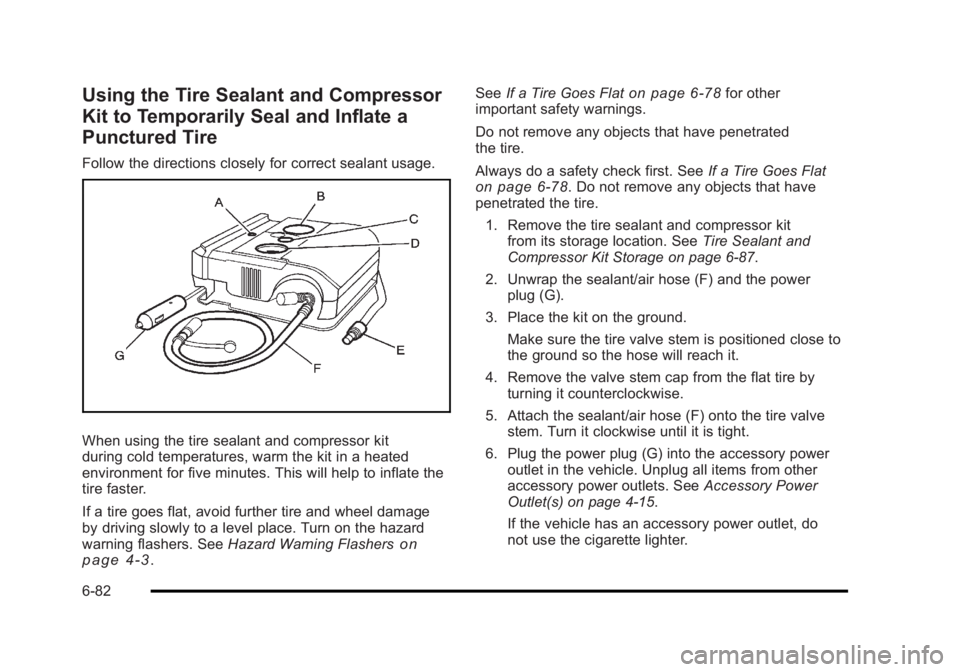
2. Unwrap the sealant/air hose (F) and the power plug (G).
3. Place the kit on the ground.
Make sure the tire valve stem is positioned close to
the ground so the hose will reach it.
4. Remove the valve stem cap from the flat tire by turning it counterclockwise.
5. Attach the sealant/air hose (F) onto the tire valve stem. Turn it clockwise until it is tight.
6. Plug the power plug (G) into the accessory power outlet in the vehicle. Unplug all items from other
accessory power outlets. See Accessory Power
Outlet(s) on page 4‑15.
If the vehicle has an accessory power outlet, do
not use the cigarette lighter.
6-82
Page 369 of 450

Black plate (83,1)Buick Lucerne Owner Manual - 2011
If the vehicle only has a cigarette lighter, use the
cigarette lighter.
Do not pinch the power plug cord in the door or
window.
7. Start the vehicle. The vehicle must be running while using the air compressor.
8. Turn the selector switch (B) clockwise to the Sealant + Air position.
9. Press the on/off (A) button to turn the tire sealant and compressor kit on.
The compressor will inject sealant and air into
the tire.
The pressure gauge (D) will initially show a high
pressure while the compressor pushes the sealant
into the tire. Once the sealant is completely
dispersed into the tire, the pressure will quickly
drop and start to rise again as the tire inflates with
air only.
10. Inflate the tire to the recommended inflation pressure using the pressure gauge (D). The
recommended inflation pressure can be found
on the Tire and Loading Information label. See
Inflation - Tire Pressure on page 6‑64. The pressure gauge (D) may read higher than
the actual tire pressure while the compressor is
on. Turn the compressor off to get an accurate
pressure reading. The compressor may be turned
on/off until the correct pressure is reached.
Notice: If the recommended pressure cannot be
reached after approximately 25 minutes, the vehicle
should not be driven farther. The tire is too severely
damaged and the tire sealant and compressor kit
cannot inflate the tire. Remove the power plug from
the accessory power outlet and unscrew the
inflating hose from the tire valve. See Roadside
Assistance Program on page 8‑7.
11. Press the on/off button (A) to turn the tire sealant and compressor kit off.
The tire is not sealed and will continue to
leak air until the vehicle is driven and the
sealant is distributed in the tire, therefore,
Steps 12 through 18 must be done immediately
after Step 11.
Be careful while handling the tire sealant and
compressor kit as it could be warm after usage.
12. Unplug the power plug (G) from the accessory power outlet in the vehicle.
13. Turn the sealant/air hose (F) counterclockwise to remove it from the tire valve stem.
14. Replace the tire valve stem cap.
6-83