2011 BUICK LUCERNE page 7
[x] Cancel search: page 7Page 359 of 450

Black plate (73,1)Buick Lucerne Owner Manual - 2011
GM recommends replacing tires in sets of four.
This is because uniform tread depth on all tires
will help keep your vehicle performing most like
it did when the tires were new. Replacing less
than a full set of tires can affect the braking
and handling performance of your vehicle. See
Tire Inspection and Rotation
on page 6‑70for
information on proper tire rotation.
{WARNING:
Tires could explode during improper service.
Attempting to mount or dismount a tire could
cause injury or death. Only your dealer or
authorized tire service center should mount or
dismount the tires.
{WARNING:
Mixing tires could cause you to lose
control while driving. If you mix tires of
different sizes, brands, or types (radial and
bias-belted tires), the vehicle may not handle
properly, and you could have a crash. Using
tires of different sizes, brands, or types may
also cause damage to your vehicle. Be sure
to use the correct size, brand, and type of
tires on all wheels. It is all right to drive with
your compact spare temporarily, as it was
developed for use on your vehicle. See
Compact Spare Tire
on page 6‑97.
6-73
Page 360 of 450

Black plate (74,1)Buick Lucerne Owner Manual - 2011
{WARNING:
Using bias-ply tires on the vehicle may
cause the wheel rim flanges to develop
cracks after many miles of driving. A tire
and/or wheel could fail suddenly and cause
a crash. Use only radial-ply tires with the
wheels on the vehicle.
If you must replace your vehicle's tires with those
that do not have a TPC Spec number, make sure
they are the same size, load range, speed rating,
and construction type (radial and bias‐belted tires)
as your vehicle's original tires.
Vehicles that have a tire pressure monitoring
system could give an inaccurate low‐pressure
warning if non‐TPC Spec rated tires are installed
on your vehicle. Non‐TPC Spec rated tires may
give a low‐pressure warning that is higher or lower
than the proper warning level you would get with
TPC Spec rated tires. See Tire Pressure Monitor
System
on page 6‑65. Your vehicle's original equipment tires are listed
on the Tire and Loading Information Label. See
Loading the Vehicle
on page 5‑18, for more
information about the Tire and Loading
Information Label and its location on your vehicle.
Different Size Tires and Wheels
If you add wheels or tires that are a different size than
your original equipment wheels and tires, this may
affect the way your vehicle performs, including its
braking, ride and handling characteristics, stability, and
resistance to rollover. Additionally, if your vehicle has
electronic systems such as, antilock brakes, traction
control, and electronic stability control, the performance
of these systems can be affected.
{WARNING:
If different sized wheels are used, there may not
be an acceptable level of performance and safety
if tires not recommended for those wheels are
selected. This increases the chance of a crash
and serious injury. Only use GM specific wheel
and tire systems developed for the vehicle, and
have them properly installed by a GM certified
technician.
6-74
Page 361 of 450

Black plate (75,1)Buick Lucerne Owner Manual - 2011
SeeBuying New Tireson page 6‑72andAccessories
and Modificationson page 6‑3for additional
information.
Uniform Tire Quality Grading
Quality grades can be found where applicable
on the tire sidewall between tread shoulder and
maximum section width. For example:
Treadwear 200 Traction AA
Temperature A
The following information relates to the system
developed by the United States National
Highway Traffic Safety Administration (NHTSA),
which grades tires by treadwear, traction, and
temperature performance. This applies only to
vehicles sold in the United States. The grades are
molded on the sidewalls of most passenger car
tires. The Uniform Tire Quality Grading (UTQG)
system does not apply to deep tread, winter-type
snow tires, space-saver, or temporary use
spare tires, tires with nominal rim diameters
of 10 to 12 inches (25 to 30 cm), or to some
limited-production tires. While the tires available on General Motors
passenger cars and light trucks may vary with
respect to these grades, they must also conform
to federal safety requirements and additional
General Motors Tire Performance Criteria (TPC)
standards.
All Passenger Car Tires Must Conform to Federal
Safety Requirements In Addition To These
Grades.
Treadwear
The treadwear grade is a comparative rating
based on the wear rate of the tire when tested
under controlled conditions on a specified
government test course. For example, a tire
graded 150 would wear one and a half (1½) times
as well on the government course as a tire
graded 100. The relative performance of tires
depends upon the actual conditions of their use,
however, and may depart significantly from the
norm due to variations in driving habits, service
practices and differences in road characteristics
and climate.
6-75
Page 363 of 450

Black plate (77,1)Buick Lucerne Owner Manual - 2011
Your dealer will know the kind of wheel you need.
Each new wheel should have the same load-carrying
capacity, diameter, width, offset, and be mounted the
same way as the one it replaces.
If you need to replace any of your wheels, wheel bolts,
wheel nuts, or Tire Pressure Monitor System (TPMS)
sensors, replace them only with new GM original
equipment parts. This way, you will be sure to have the
right wheel, wheel bolts, wheel nuts, and TPMS sensors
for your vehicle.
{WARNING:
Using the wrong replacement wheels, wheel bolts,
or wheel nuts can be dangerous. It could affect
the braking and handling of the vehicle. Tires can
lose air, and cause loss of control, causing a
crash. Always use the correct wheel, wheel bolts,
and wheel nuts for replacement.Notice:
The wrong wheel can also cause problems
with bearing life, brake cooling, speedometer or
odometer calibration, headlamp aim, bumper height,
vehicle ground clearance, and tire or tire chain
clearance to the body and chassis.
See Changing a Flat Tire
on page 6‑88for more
information.
Used Replacement Wheels
{WARNING:
Replacing a wheel with a used one is dangerous.
How it has been used or how far it has been
driven may be unknown. It could fail suddenly and
cause a crash. When replacing wheels, use a new
GM original equipment wheel.
6-77
Page 365 of 450

Black plate (79,1)Buick Lucerne Owner Manual - 2011
A rear blowout, particularly on a curve, acts much like
a skid and may require the same correction you would
use in a skid. In any rear blowout remove your foot from
the accelerator pedal. Get the vehicle under control by
steering the way you want the vehicle to go. It may be
very bumpy and noisy, but you can still steer. Gently
brake to a stop, well off the road, if possible.
{WARNING:
Driving on a flat tire will cause permanent damage
to the tire. Re-inflating a tire after it has been
driven on while severely underinflated or flat may
cause a blowout and a serious crash. Never
attempt to re-inflate a tire that has been driven on
while severely underinflated or flat. Have your
dealer or an authorized tire service center repair
or replace the flat tire as soon as possible.
{WARNING:
Lifting a vehicle and getting under it to do
maintenance or repairs is dangerous without the
appropriate safety equipment and training. If a
jack is provided with the vehicle, it is designed
only for changing a flat tire. If it is used for
anything else, you or others could be badly
injured or killed if the vehicle slips off the jack.
If a jack is provided with the vehicle, only use it for
changing a flat tire.
This vehicle may come with a jack and spare tire or a
tire sealant and compressor kit. To use the jack and
spare tire, see Changing a Flat Tire
on page 6‑88.
To use the tire sealant and compressor kit, see Tire
Sealant and Compressor Kit
on page 6‑80.
6-79
Page 366 of 450

Black plate (80,1)Buick Lucerne Owner Manual - 2011
Tire Sealant and Compressor Kit
{WARNING:
Idling a vehicle in an enclosed area with poor
ventilation is dangerous. Engine exhaust may
enter the vehicle. Engine exhaust contains
Carbon Monoxide (CO) which cannot be seen
or smelled. It can cause unconsciousness and
even death. Never run the engine in an enclosed
area that has no fresh air ventilation. For more
information, seeEngine Exhaust on page 3‑30.
{WARNING:
Overinflating a tire could cause the tire to
rupture and you or others could be injured. Be
sure to read and follow the tire sealant and
compressor kit instructions and inflate the tire to
its recommended pressure. Do not exceed the
recommended pressure.
{WARNING:
Storing the tire sealant and compressor kit or
other equipment in the passenger compartment of
the vehicle could cause injury. In a sudden stop or
collision, loose equipment could strike someone.
Store the tire sealant and compressor kit in its
original location.
If this vehicle has a tire sealant and compressor kit,
there may not be a spare tire, tire changing equipment,
and on some vehicles there may not be a place to store
a tire.
The tire sealant and compressor can be used to
temporarily seal punctures up to 6 mm (¼ in) in the
tread area of the tire. It can also be used to inflate an
under inflated tire.
If the tire has been separated from the wheel, has
damaged sidewalls, or has a large puncture, the tire
is too severely damaged for the tire sealant and
compressor kit to be effective. See Roadside
Assistance Program on page 8‑7.
6-80
Page 368 of 450
Black plate (82,1)Buick Lucerne Owner Manual - 2011
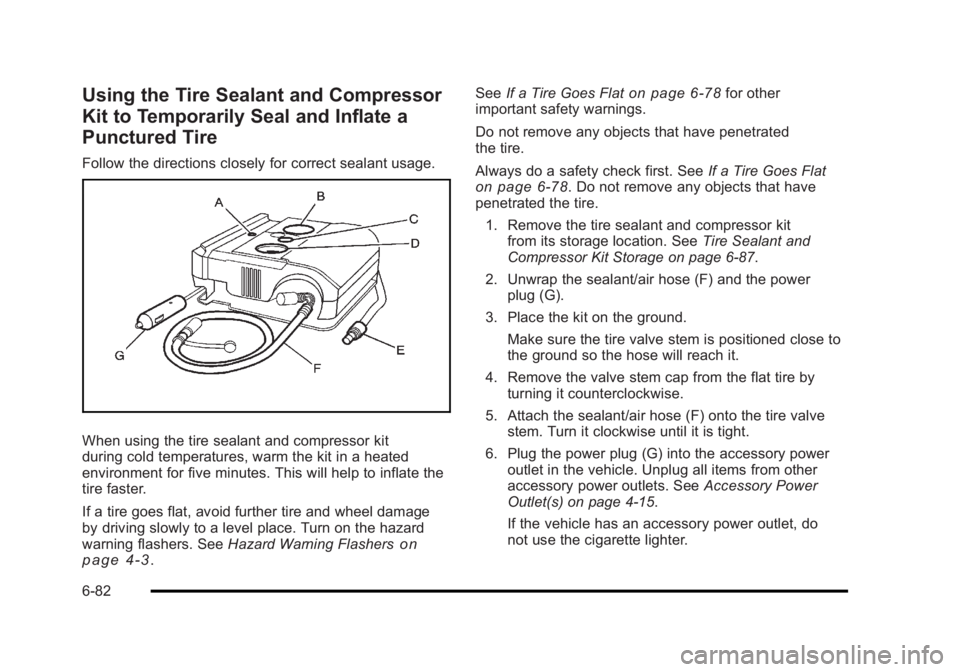
Using the Tire Sealant and Compressor
Kit to Temporarily Seal and Inflate a
Punctured Tire
Follow the directions closely for correct sealant usage.
When using the tire sealant and compressor kit
during cold temperatures, warm the kit in a heated
environment for five minutes. This will help to inflate the
tire faster.
If a tire goes flat, avoid further tire and wheel damage
by driving slowly to a level place. Turn on the hazard
warning flashers. SeeHazard Warning Flashers
on
page 4‑3. See
If a Tire Goes Flat
on page 6‑78for other
important safety warnings.
Do not remove any objects that have penetrated
the tire.
Always do a safety check first. See If a Tire Goes Flat
on page 6‑78. Do not remove any objects that have
penetrated the tire.
1. Remove the tire sealant and compressor kit from its storage location. See Tire Sealant and
Compressor Kit Storage on page 6‑87.
2. Unwrap the sealant/air hose (F) and the power plug (G).
3. Place the kit on the ground.
Make sure the tire valve stem is positioned close to
the ground so the hose will reach it.
4. Remove the valve stem cap from the flat tire by turning it counterclockwise.
5. Attach the sealant/air hose (F) onto the tire valve stem. Turn it clockwise until it is tight.
6. Plug the power plug (G) into the accessory power outlet in the vehicle. Unplug all items from other
accessory power outlets. See Accessory Power
Outlet(s) on page 4‑15.
If the vehicle has an accessory power outlet, do
not use the cigarette lighter.
6-82
Page 369 of 450

Black plate (83,1)Buick Lucerne Owner Manual - 2011
If the vehicle only has a cigarette lighter, use the
cigarette lighter.
Do not pinch the power plug cord in the door or
window.
7. Start the vehicle. The vehicle must be running while using the air compressor.
8. Turn the selector switch (B) clockwise to the Sealant + Air position.
9. Press the on/off (A) button to turn the tire sealant and compressor kit on.
The compressor will inject sealant and air into
the tire.
The pressure gauge (D) will initially show a high
pressure while the compressor pushes the sealant
into the tire. Once the sealant is completely
dispersed into the tire, the pressure will quickly
drop and start to rise again as the tire inflates with
air only.
10. Inflate the tire to the recommended inflation pressure using the pressure gauge (D). The
recommended inflation pressure can be found
on the Tire and Loading Information label. See
Inflation - Tire Pressure on page 6‑64. The pressure gauge (D) may read higher than
the actual tire pressure while the compressor is
on. Turn the compressor off to get an accurate
pressure reading. The compressor may be turned
on/off until the correct pressure is reached.
Notice: If the recommended pressure cannot be
reached after approximately 25 minutes, the vehicle
should not be driven farther. The tire is too severely
damaged and the tire sealant and compressor kit
cannot inflate the tire. Remove the power plug from
the accessory power outlet and unscrew the
inflating hose from the tire valve. See Roadside
Assistance Program on page 8‑7.
11. Press the on/off button (A) to turn the tire sealant and compressor kit off.
The tire is not sealed and will continue to
leak air until the vehicle is driven and the
sealant is distributed in the tire, therefore,
Steps 12 through 18 must be done immediately
after Step 11.
Be careful while handling the tire sealant and
compressor kit as it could be warm after usage.
12. Unplug the power plug (G) from the accessory power outlet in the vehicle.
13. Turn the sealant/air hose (F) counterclockwise to remove it from the tire valve stem.
14. Replace the tire valve stem cap.
6-83