Page 369 of 462

Black plate (57,1)Buick LaCrosse Owner Manual - 2011
Vehicle Care 10-57
Federal Communications
Commission (FCC) and
Industry Canada
SeeRadio Frequency Statement on
page 13‑20 for information
regarding Part 15 of the Federal
Communications Commission
(FCC) rules and Industry Canada
Standards RSS-210/220/310.
Tire Pressure Monitor
Operation
This vehicle may have a Tire
Pressure Monitor System (TPMS).
The TPMS is designed to warn
the driver when a low tire pressure
condition exists. TPMS sensors are
mounted onto each tire and wheel
assembly, excluding the spare tire
and wheel assembly. The TPMS
sensors monitor the air pressure
in the tires and transmits the tire
pressure readings to a receiver
located in the vehicle.
When a low tire pressure condition
is detected, the TPMS illuminates
the low tire pressure warning light
located on the instrument cluster.
If the warning light comes on, stop
as soon as possible and inflate
the tires to the recommended
pressure shown on the tire loading
information label. See Vehicle
Load Limits on page 9‑12.
A message to check the pressure in
a specific tire displays in the Driver
Information Center (DIC). The low
tire pressure warning light and the
DIC warning message come on at
each ignition cycle until the tires
are inflated to the correct inflation
pressure. Using the DIC, tire
pressure levels can be viewed. For additional information and
details about the DIC operation and
displays see
Driver Information
Center (DIC) on page 5‑25.
The low tire pressure warning light
may come on in cool weather when
the vehicle is first started, and then
turn off as the vehicle is driven.
This could be an early indicator
that the air pressure is getting low
and needs to be inflated to the
proper pressure.
A Tire and Loading Information
label, attached to your vehicle,
shows the size of the original
equipment tires and the correct
inflation pressure for the tires when
they are cold. See Vehicle Load
Limits on page 9‑12, for an example
of the Tire and Loading Information
label and its location. Also see Tire
Pressure on page 10‑54.
Page 373 of 462

Black plate (61,1)Buick LaCrosse Owner Manual - 2011
Vehicle Care 10-61
Tire Inspection
GM recommends that the tires,
including the spare tire, if the
vehicle has one, be inspected
for signs of wear or damage at
least once a month.
Replace the tire if:
.The indicators at three or
more places around the tire
can be seen.
.There is cord or fabric
showing through the tire's
rubber.
.The tread or sidewall is
cracked, cut, or snagged
deep enough to show cord
or fabric.
.The tire has a bump, bulge,
or split.
.The tire has a puncture, cut,
or other damage that cannot
be repaired well because of
the size or location of the
damage.
Tire Rotation
Tires should be rotated
every 12 000 km (7,500 mi).
SeeScheduled Maintenance on
page 11‑2.
The purpose of a regular tire
rotation is to achieve a uniform
wear for all tires on the vehicle.
This will ensure that the vehicle
continues to perform most like it
did when the tires were new. Any time you notice unusual
wear, rotate the tires as soon
as possible and check wheel
alignment. Also check for
damaged tires or wheels.
See
When It Is Time for New
Tires on page 10‑63 andWheel
Replacement on page 10‑68.
When rotating the vehicle's tires,
always use the correct rotation
pattern shown here.
Page 377 of 462

Black plate (65,1)Buick LaCrosse Owner Manual - 2011
Vehicle Care 10-65
{WARNING
Mixing tires could cause you
to lose control while driving.
If you mix tires of different
sizes, brands, or types
(radial and bias-belted tires),
the vehicle may not handle
properly, and you could have
a crash. Using tires of different
sizes, brands, or types may
also cause damage to the
vehicle. Be sure to use the
correct size, brand, and type
of tires on all wheels. It is
all right to drive with the
compact spare temporarily,
as it was developed for use
on the vehicle. See Compact
Spare Tire on page 10‑85.{WARNING
Using bias-ply tires on the
vehicle may cause the wheel
rim flanges to develop cracks
after many miles of driving.
A tire and/or wheel could fail
suddenly and cause a crash.
Use only radial-ply tires with
the wheels on the vehicle.
If you must replace the vehicle's
tires with those that do not
have a TPC Spec number,
make sure they are the same
size, load range, speed rating,
and construction type (radial and
bias‐belted tires) as the vehicle's
original tires. Vehicles that have a tire
pressure monitoring system
could give an inaccurate
low‐pressure warning if
non‐TPC Spec rated tires
are installed on the vehicle.
Non‐TPC Spec rated tires may
give a low‐pressure warning
that is higher or lower than the
proper warning level you would
get with TPC Spec rated tires.
See
Tire Pressure Monitor
System on page 10‑56.
The vehicle's original equipment
tires are listed on the Tire and
Loading Information label.
See Vehicle Load Limits on
page 9‑12 for more information
about the Tire and Loading
Information label and its
location on the vehicle.
Page 384 of 462

Black plate (72,1)Buick LaCrosse Owner Manual - 2011
10-72 Vehicle Care
Tire Sealant and
Compressor Kit
{WARNING
Idling a vehicle in an enclosed
area with poor ventilation is
dangerous. Engine exhaust may
enter the vehicle. Engine exhaust
contains Carbon Monoxide (CO)
which cannot be seen or smelled.
It can cause unconsciousness
and even death. Never run the
engine in an enclosed area
that has no fresh air ventilation.
For more information, seeEngine
Exhaust on page 9‑27.
{WARNING
Overinflating a tire could cause
the tire to rupture and you
or others could be injured.
Be sure to read and follow the
tire sealant and compressor kit
instructions and inflate the tire
to its recommended pressure.
Do not exceed the recommended
pressure.
{WARNING
Storing the tire sealant and
compressor kit or other
equipment in the passenger
compartment of the vehicle could
cause injury. In a sudden stop or
collision, loose equipment could
strike someone. Store the tire
sealant and compressor kit in
its original location. If this vehicle has a tire sealant and
compressor kit, there may not be a
spare tire, tire changing equipment,
and on some vehicles there may not
be a place to store a tire.
The tire sealant and compressor
can be used to temporarily seal
punctures up to 6 mm (¼ in) in the
tread area of the tire. It can also be
used to inflate an under inflated tire.
If the tire has been separated from
the wheel, has damaged sidewalls,
or has a large puncture, the tire is
too severely damaged for the tire
sealant and compressor kit to be
effective. See
Roadside Assistance
Program (U.S. and Canada) on
page 13‑8 orRoadside Assistance
Program (Mexico) on page 13‑10.
Read and follow all of the tire
sealant and compressor kit
instructions.
Page 396 of 462
Black plate (84,1)Buick LaCrosse Owner Manual - 2011
10-84 Vehicle Care
Storing a Flat or Spare Tire
and Tools
{WARNING
Storing a jack, a tire, or other
equipment in the passenger
compartment of the vehicle could
cause injury. In a sudden stop or
collision, loose equipment could
strike someone. Store all these
in the proper place.
To store the flat or spare tire and
tools:
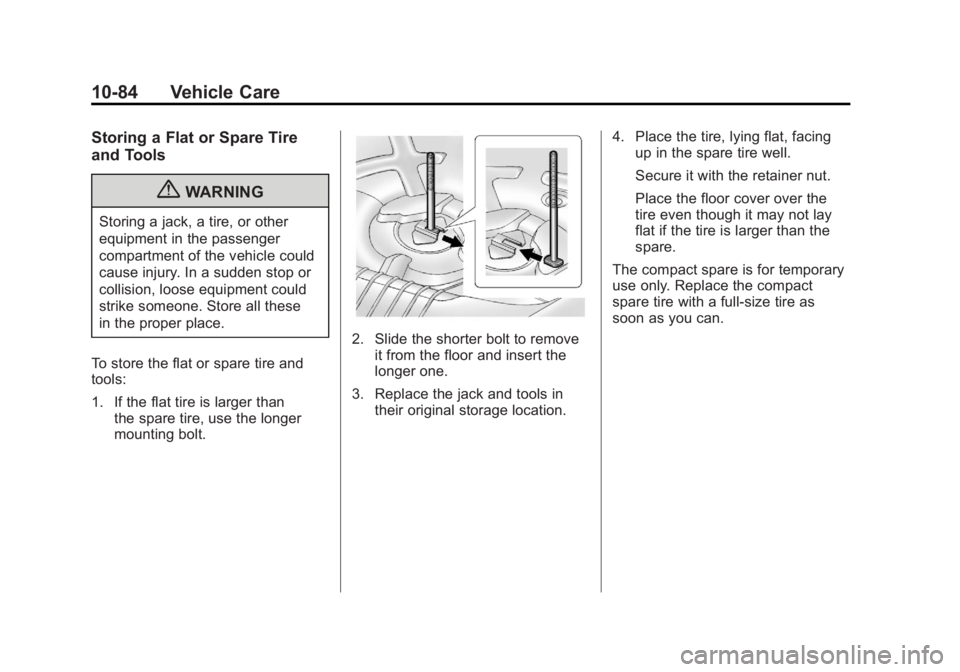
1. If the flat tire is larger than the spare tire, use the longer
mounting bolt.
2. Slide the shorter bolt to remove
it from the floor and insert the
longer one.
3. Replace the jack and tools in their original storage location. 4. Place the tire, lying flat, facing
up in the spare tire well.
Secure it with the retainer nut.
Place the floor cover over the
tire even though it may not lay
flat if the tire is larger than the
spare.
The compact spare is for temporary
use only. Replace the compact
spare tire with a full-size tire as
soon as you can.