2011 BMW X3 tire pressure
[x] Cancel search: tire pressurePage 207 of 262

Wheels and tiresTire inflation pressure
Safety information
The tire characteristics and tire inflation pres‐
sure influence the following:▷The service life of the tires.▷Road safety.▷Driving comfort.
Checking the pressure
Only check the tire inflation pressure when the
tires are cold. This means after driving no more
than 1.25 miles/2 km or when the vehicle has
been parked for at least 2 hours. When the tires
are warm, the tire inflation pressure is higher.
Check the tire inflation pressure regularly
Regularly check the tire inflation pressure
and correct it as needed: at least twice a month
and before a long trip. If you fail to observe this
precaution, you may be driving on tires with in‐
correct tire pressures, a condition that may not
only compromise your vehicle's driving stability,
but also lead to tire damage and the risk of an
accident.◀
After correcting the tire inflation pressure, rein‐
itialize the Tire Pressure Monitor.
Pressure specifications
The tire inflation pressure table, refer to
page 207, contains all pressure specifications
for the specified tire sizes at the ambient tem‐
perature. Pressure specifications apply to ap‐
proved tire sizes and recommended tire brands.
This information can be obtained from your
service center.
To identify the correct tire inflation pressure,
please note the following:
▷Tire sizes of your vehicle.▷Vehicle load.▷Maximum allowable driving speed.Tire inflation pressures up to 100 mph/
160 km/h
For speeds of up to 100 mph/160 km/h and for
optimum driving comfort, note the pressure val‐
ues in the tire inflation pressure table, refer to
page 207, and adjust as necessary.
These pressure values can also be found on the
tire inflation pressure label on the driver's door
pillar.
Maximum permissible speed
Do not exceed 100 mph/160 km/h; other‐
wise, tire damage and accidents may result.◀
Tire inflation pressure values up to
100 mph/160 km/h
X3 28iA
Tire sizePressure specifications
in psi/kPaSpecifications in
psi/kilopascal with
cold tires225/55 R 17 102
H M+S2.2 / 322.2 / 32225/60 R 17 99 H M
+S
245/50 R 18 100 V
M+S2.2 / 322.4 / 35Seite 207207
Online Edition for Part no. 01 40 2 606 190 - 12 10 500
ReferenceMobilityCommunicationEntertainmentNavigationDriving tipsControlsAt a glance
Page 208 of 262

Tire sizePressure specifications
in psi/kPa245/45 R 19 102 V
M+S2.2 / 322.6 / 38F: 245/40 R 19 98 W
R: 275/40 R 19 101
W2.2 / 32
--
2.4 / 35F: 245/40 R 19 102
V M+S
R: 275/40 R 19 105
V M+S2.2 / 32
--
2.4 / 35F: 245/40 R 20 99 Y
XL
R: 275/35 R 20 102
Y XL2.2 / 32
--
2.6 / 38T 135/80 R 18 104
M4.2 / 604.2 / 60
X3 35iA
Tire sizePressure specifications
in psi/kPaSpecifications in
psi/kilopascal with
cold tires245/50 R 18 100 V
M+S2.2 / 322.4 / 35245/45 R 19 102 V
M+S2.2 / 322.6 / 38F: 245/40 R 19 98 W
R: 275/40 R 19 101
W2.2 / 32
--
2.4 / 35F: 245/40 R 19 102
V M+S
R: 275/40 R 19 105
V M+S2.2 / 32
--
2.4 / 35Tire sizePressure specifications
in psi/kPaF: 245/40 R 20 99 Y
XL
R: 275/35 R 20 102
Y XL2.2 / 32
--
2.6 / 38T 135/80 R 18 104
M4.2 / 604.2 / 60
Tire inflation pressures at max. speeds
above 100 mph/160 km/h
Speeds above 100 mph/160 km/h
In order to drive at maximum speeds in ex‐
cess of 100 mph/160 km/h, please observe, and,
if necessary, adjust tire pressures for speeds
exceeding 100 mph/160 km/h from the relevant
table on the following pages. Otherwise tire
damage and accidents could occur.◀
Tire inflation pressure values over
100 mph/160 km/h
X3 28iA
With partial load:
Tire sizePressure specifications
in psi/kPaSpecifications in
psi/kilopascal with
cold tires225/55 R 17 102
H M+S2.2 / 322.2 / 32225/60 R 17 99 H M
+S
245/50 R 18 100 V
M+S2.2 / 322.4 / 35245/45 R 19 102 V
M+S2.2 / 322.6 / 38Seite 208208
Online Edition for Part no. 01 40 2 606 190 - 12 10 500Wheels and tires
Page 209 of 262

Tire sizePressure specifications
in psi/kPaF: 245/40 R 19 98 W
R: 275/40 R 19 101
W2.2 / 32
--
2.4 / 35F: 245/40 R 19 102
V M+S
R: 275/40 R 19 105
V M+S2.2 / 32
--
2.4 / 35F: 245/40 R 20 99 Y
XL
R: 275/35 R 20 102
Y XL2.2 / 32
--
2.6 / 38T 135/80 R 18 104
M4.2 / 604.2 / 60
With full load
Tire sizePressure specifications
in psi/kPaSpecifications in
psi/kilopascal with
cold tires225/55 R 17 102
H M+S2.2 / 322.6 / 38225/60 R 17 99 H M
+S
245/50 R 18 100 V
M+S2.4 / 352.8 / 41245/45 R 19 102 V
M+S2.6 / 383.0 / 44F: 245/40 R 19 98 W
R: 275/40 R 19 101
W2.2 / 32
--
2.6 / 38F: 245/40 R 19 102
V M+S
R: 275/40 R 19 105
V M+S2.2 / 32
--
2.6 / 38Tire sizePressure specifications
in psi/kPaF: 245/40 R 20 99 Y
XL
R: 275/35 R 20 102
Y XL-
2.6 / 382.8 / 41T 135/80 R 18 104
M4.2 / 604.2 / 60
X3 35iA
With partial load:
Tire sizePressure specifications
in psi/kPaSpecifications in
psi/kilopascal with
cold tires245/50 R 18 100 V
M+S2.2 / 322.4 / 35245/45 R 19 102 V
M+S2.2 / 322.6 / 38F: 245/40 R 19 98 W
R: 275/40 R 19 101
W2.2 / 32
--
2.4 / 35F: 245/40 R 19 102
V M+S
R: 275/40 R 19 105
V M+S2.2 / 32
--
2.4 / 35F: 245/40 R 20 99 Y
XL
R: 275/35 R 20 102
Y XL2.2 / 32
--
2.6 / 38T 135/80 R 18 104
M4.2 / 604.2 / 60
With full load:
Seite 209209
Online Edition for Part no. 01 40 2 606 190 - 12 10 500
ReferenceMobilityCommunicationEntertainmentNavigationDriving tipsControlsAt a glance
Page 210 of 262

Tire sizePressure specifications
in psi/kPaSpecifications in
psi/kilopascal with
cold tires245/50 R 18 100 V
M+S2.6 / 383.0 / 44245/45 R 19 102 V
M+S2.8 / 413.2 / 46F: 245/40 R 19 98 W
R: 275/40 R 19 101
W2.4 / 35
--
2.8 / 41F: 245/40 R 19 102
V M+S
R: 275/40 R 19 105
V M+S2.8 / 41
--
3.0 / 44F: 245/40 R 20 99 Y
XL
R: 275/35 R 20 102
Y XL2.4 / 35
--
3.0 / 44T 135/80 R 18 104
M4.2 / 604.2 / 60
Tire identification marks
Tire size
255/50 R 19 103 Y
255: nominal width in mm
50: aspect ratio in %
R: radial tire code
19: rim diameter in inches
103: load rating, not for ZR tires
Y: speed rating, before the R on ZR tires
Speed letter
T = up to 118 mph, 190 km/h
H = up to 131 mph, 210 km/h
V = up to 150 mph, 240 km/h
W = up to 167 mph, 270 km/h
Y = up to 186 mph, 300 km/h
Tire Identification Number
DOT code: DOT xxxx xxx 3510
xxxx: manufacturer code for the tire brand
xxx: tire size and tire design
3510: tire age
Tires with DOT codes meet the guidelines of the
U.S. Department of Transportation.
Tire age
DOT … 3510: the tire was manufactured in the
35th week in 2010.
Recommendation: regardless of wear, replace
tires at least every 6 years.
Uniform Tire Quality Grading
Quality grades can be found where applicable
on the tire sidewall between tread shoulder and
maximum section width.
For example: Treadwear 200; Traction AA;
Temperature A
DOT Quality Grades
Treadwear
Traction AA A B C
Temperature A B C
All passenger car tires must conform to Federal
Safety Requirements in addition to these
grades.
Treadwear
The treadwear grade is a comparative rating
based on the wear rate of the tire when tested
under controlled conditions on a specified gov‐
ernment test course. For example, a tire graded
150 would wear one and one-half, 1 g, times as
well on the government course as a tire graded
100. The relative performance of tires depends
upon the actual conditions of their use, however,
and may depart significantly from the norm due
to variations in driving habits, service practicesSeite 210210
Online Edition for Part no. 01 40 2 606 190 - 12 10 500Wheels and tires
Page 213 of 262

Retreaded tires
Possibly substantial variations in the de‐
sign and age of the tire casing structures can
limit service life and have a negative impact on
road safety.◀
Winter tires
The manufacturer of your vehicle recommends
winter tires for winter roads or at temperatures
below +45 ℉/+7 ℃.
Although so-called all-season M+S tires do pro‐
vide better winter traction than summer tires,
they do not provide the same level of perform‐
ance as winter tires.
Maximum speed of winter tires
If the maximum speed of the vehicle is higher
than the permissible speed for the winter tires,
then display a corresponding sign in the field of
vision. You can obtain this sign from the tire spe‐
cialist or from your service center.
Maximum speed for winter tires
Do not exceed the maximum speed for the
winter tires; otherwise, tire damage and acci‐
dents can occur.◀
Run-flat tires
For your own safety, only use run-flat tires. No
spare tire is available in the case of a flat tire. Your
service center will be glad to advise you.
Rotating wheels between axles
The manufacturer of your vehicle advises
against swapping wheels between the front and
rear axles.
This can impair the handling characteristics.
Storage
Store wheels and tires in a cool, dry place with
as little exposure to light as possible.
Always protect tires against all contact with oil,
grease and fuels.
Do not exceed the maximum tire inflation pres‐
sure indicated on the side wall of the tire.Run-flat tires*
Label
RSC label on the tire sidewall.
The wheels are composed of special rims and
tires that are self-supporting, to a limited de‐
gree.
The support of the sidewall allows the tire to re‐
main drivable to a restricted degree in the event
of a pressure loss.
Continued driving with a damaged tire., refer to
page 84
Changing run-flat tires
For your own safety, only use run-flat tires. No
spare tire is available in the case of a flat tire. Your
service center will be glad to advise you.
Snow chains
Fine-link snow chains
Only certain types of fine-link snow chains have
been tested by the manufacturer of your vehicle,
classified as road-safe and recommended.
Consult your service center for more informa‐
tion.
Use
Use only in pairs on the rear wheels, equipped
with the tires of the following size:
▷205/65 R 17.▷225/60 R 17.▷245/50 R 18.Seite 213213
Online Edition for Part no. 01 40 2 606 190 - 12 10 500
ReferenceMobilityCommunicationEntertainmentNavigationDriving tipsControlsAt a glance
Page 214 of 262

No snow chains with tires of size 245/45 R
19
Do not mount snow chains on tires of size
245/45 R 19; otherwise, the vehicle can become
damaged.◀
Follow the chain manufacturer's instructions.
Make sure that the snow chains are always suf‐
ficiently tight. Retighten as needed according to
the chain manufacturer's instructions.
Do not initialize the Tire Pressure Monitor after
mounting snow chains, as doing so may result
in incorrect readings.
When driving with snow chains, briefly activate
Dynamic Traction Control if necessary.
Maximum speed with snow chains
Do not exceed a speed of 30 mph/50 km/h when
using snow chains.Seite 214214
Online Edition for Part no. 01 40 2 606 190 - 12 10 500Wheels and tires
Page 226 of 262
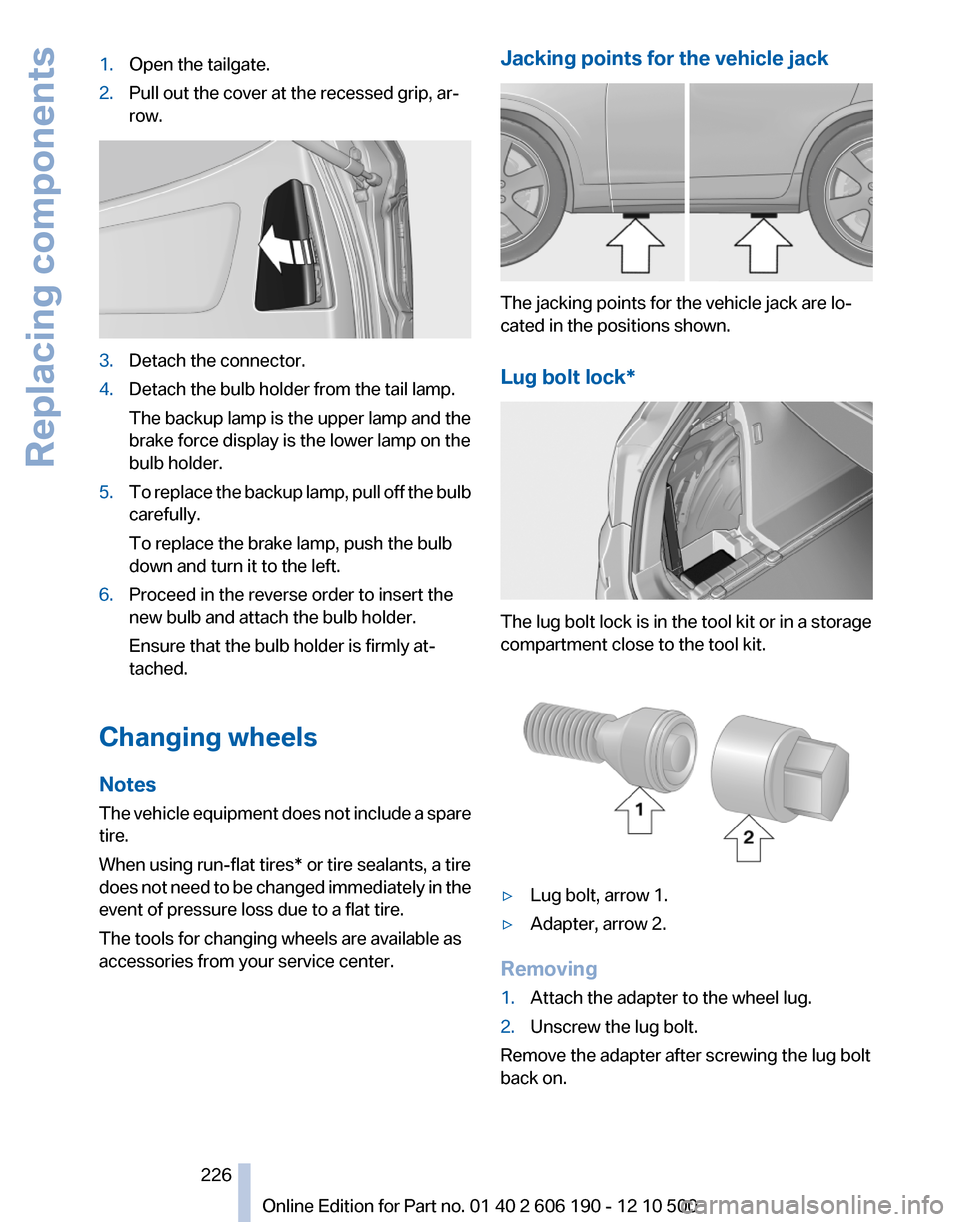
1.Open the tailgate.2.Pull out the cover at the recessed grip, ar‐
row.3.Detach the connector.4.Detach the bulb holder from the tail lamp.
The backup lamp is the upper lamp and the
brake force display is the lower lamp on the
bulb holder.5.To replace the backup lamp, pull off the bulb
carefully.
To replace the brake lamp, push the bulb
down and turn it to the left.6.Proceed in the reverse order to insert the
new bulb and attach the bulb holder.
Ensure that the bulb holder is firmly at‐
tached.
Changing wheels
Notes
The vehicle equipment does not include a spare
tire.
When using run-flat tires* or tire sealants, a tire
does not need to be changed immediately in the
event of pressure loss due to a flat tire.
The tools for changing wheels are available as
accessories from your service center.
Jacking points for the vehicle jack
The jacking points for the vehicle jack are lo‐
cated in the positions shown.
Lug bolt lock*
The lug bolt lock is in the tool kit or in a storage
compartment close to the tool kit.
▷Lug bolt, arrow 1.▷Adapter, arrow 2.
Removing
1.Attach the adapter to the wheel lug.2.Unscrew the lug bolt.
Remove the adapter after screwing the lug bolt
back on.
Seite 226226
Online Edition for Part no. 01 40 2 606 190 - 12 10 500Replacing components
Page 233 of 262

CareCar washes
Notes Steam jets or high-pressure washers
When using steam jets or high-pressure
washers, hold them a sufficient distance away
and use a maximum temperature of 140 ℉/
60 ℃.
Holding them too close or using excessively
high pressures or temperatures can cause dam‐
age or preliminary damage that may then lead to
long-term damage.
Follow the operating instructions for the high-
pressure washer.◀
Cleaning sensors/cameras with high-
pressure washers
When using high-pressure washers, do not
spray the exterior sensors and cameras, e.g.,
Park Distance Control*, for extended periods of
time and only from a distance of at least 12 in/
30 cm.◀
Wash your vehicle frequently, particularly in win‐
ter.
Intense soiling and road salt can damage the ve‐
hicle.
Washing in automatic car washes
Your vehicle can be washed in automatic car
washes right from the start.
Give preference to cloth car washes or those
that use soft brushes in order to avoid paint
damage.
Notes
Note the following:▷Make sure that the wheels and tires are not
damaged by the transport mechanisms.▷Fold in the exterior mirrors; otherwise, they
may be damaged, depending on the width of
the vehicle.▷Deactivate the rain sensor*, refer to
page 63, to avoid unintentional wiper acti‐
vation.▷In some cases, an unintentional alarm can be
triggered by the interior motion sensor of the
alarm system*. Follow the instructions on
avoiding an unintentional alarm, refer to
page 43.
Guide rails in car washes
Avoid car washes with guide rails higher
than 4 in/10 cm; otherwise, the vehicle body
could be damaged.◀
Before driving into a car wash
The vehicle is able to roll when the following
steps are taken:
Manual transmission:
Automatic transmission/Sport automatic trans‐
mission*:
1.Depress the brake pedal.2.Engage transmission position N.3.Release the parking brake, refer to page 60,
or deactivate Automatic Hold, refer to
page 61.4.Switch the engine off.
Transmission position P with the igni‐
tion off
When the ignition is switched off, position P
is engaged automatically. When in an auto‐
matic car wash, for example, ensure that the
ignition is not switched off accidentally.◀
The vehicle cannot be locked from the outside
when in transmission position N.
A signal is sounded when an attempt is made to
lock the vehicle.
Transmission position
Transmission position P is engaged automati‐
cally:
Seite 233233
Online Edition for Part no. 01 40 2 606 190 - 12 10 500
ReferenceMobilityCommunicationEntertainmentNavigationDriving tipsControlsAt a glance