2011 BMW 550I 100
[x] Cancel search: 100Page 100 of 304

and the DSC indicator lamp lights up in the in‐
strument cluster.
Indicator/warning lamps
SPORT+ is displayed in the instrument cluster.
The indicator lamp lights up: DTC Dy‐
namic Traction Control is activated.
SPORT
Consistently
sporty tuning of the suspension for
greater driving agility with maximum driving sta‐
bilization.
The program can be configured to individual
specifications.
The configuration is stored for the remote con‐
trol currently in use.
Activating SPORT
Press the button repeatedly until
SPORT appears in the tachometer.
Configuring SPORT
When the display is activated on the Control
Display, refer to page 100, the sport program
can be set to individual specifications.
After the sport program is activated, select
"Configure SPORT mode" on the displayed
panel and configure the program.
Optionally, the sport program can be configured
before it is activated:
1. "Settings"
2. "SPORT mode" 3.
Configure the program. This configuration is retrieved when the sport
program is activated.
NORMAL
For
a balanced tuning with maximum driving sta‐
bilization.
Activating NORMAL
Press the button repeatedly until the
program display in the tachometer
goes out.
In certain situations, the system automatically
changes to the NORMAL program, automatic
program change, refer to page 99.
COMFORT*
Comfort-oriented tuning of the shock absorbers
for optimal traveling comfort with maximum
driving stabilization.
Activating COMFORT Press the button repeatedly until COM‐
FORT appears in the tachometer.
Displays in the instrument cluster
Selected program The selected program is dis‐
played in the tachometer.
Program selection Pressing the button displays a list
of the selectable programs.
Display on the Control Display
Program changes can be displayed briefly on
the Control Display.
To do so, make the following settings:
1. "Settings" Seite 100
100 Online Edition for Part no. 01 40 2 606 469 - 03 11 490
Driving stability control systems
Page 117 of 304

The display appears as soon as Top View is ac‐
tivated.
If
the backup camera image was selected last, it
again appears on the display. To switch to Top
View: "Rear view camera" Select the symbol on
the Control Display.
The
setting is stored for the remote control cur‐
rently in use.
Display on the Control Display
Switching on the backup camera via
iDrive
With Top View switched on: "Rear view camera"
The
backup camera image is displayed. The set‐
ting is stored for the remote control currently in
use.
Brightness
With Top View switched on:
1. "Brightness"
2. Turn the controller until the desired setting
is reached and press the controller.
Contrast
With Top View switched on:
1. "Contrast"
2. Turn the controller until the desired setting
is reached and press the controller. Displaying the turning circle and
pathway lines
▷
The static, red turning circle line shows the
space needed to the side of the vehicle
when the steering wheel is turned all the
way.
▷ The variable, green pathway line assists you
in assessing the amount of space actually
needed to the side of the vehicle.
The pathway line is dependent on the cur‐
rent steering angle and is continuously ad‐
justed with the steering wheel movement. "Parking aid lines"
Turning circle and pathway lines are displayed.
Cameras The objectives of the Top View cameras are lo‐
cated at the bottom of the exterior mirror hous‐
ings.
The image quality may be impaired by dirt.
Clean the lens, refer to page 276.
Side View*
The concept
Side View provides an early look at cross traffic
at blind driveways and intersections. Road users
concealed by obstacles to the left and right of
the vehicle can only be detected relatively late
from the driver's seat. To improve visibility, two
cameras in the front of the vehicle record the
traffic situation on each side.
System limits
The maximum recording range of the camera is
330 ft/100 m.
Seite 117
117Online Edition for Part no. 01 40 2 606 469 - 03 11 490
Reference Mobility Communication Entertainment Navigation Driving tips
Controls At a glance
Page 122 of 304

To ensure full operability:
▷
Keep the sensors clean and free of ice.
▷ When using a pressure washer, keep the
sprayer moving and maintain a distance of
at least 12 in/30 cm from the sensors.
Night Vision with pedestrian
detection*
The concept
Night
Vision with pedestrian detection is a night
vision system.
An infrared camera records the area in front of
the vehicle and displays the image on the Con‐
trol Display.
The picture is a heat image. The system has an
integrated pedestrian detection function that
detects pedestrians and cyclists. Warm objects
that are similar in shape to human beings are
detected by the system.
Personal responsibility
Night Vision cannot replace the driver's
personal judgment of the visibility conditions
and the traffic situation. The view ahead and the
actual visibility conditions must always be the
basis on which the vehicle speed is adjusted;
otherwise, there is a risk to road safety.◀
Heat image The image shows the heat radiated by objects
in the field of view of the camera.
Warm objects have a light appearance and cold
objects, a dark appearance. The ability to detect an object depends on the
temperature
difference between the object and
the background and on the level of heat radiation
emitted by the object. Objects that are similar in
temperature to the environment or that radiate
very little heat are difficult to detect.
For safety reasons, when driving at speeds
above approx. 3 mph/5 km/h and in low ambient
light, the image is only displayed when the low
beams are switched on.
A still image is displayed at regular intervals for
a fraction of a second.
Pedestrian detection The pedestrian detection and warning system
only
operates in darkness and only when a heat
image is displayed.
Warm objects that are similar in shape to human
beings are detected by the system.
People detected by the system are displayed
with a slight yellow hue.
Under good ambient conditions, the pedestrian
detection system operates within a range of ap‐
prox. 50 ft/15 m to approx. 330 ft/100 m. Environmental influences can limit the availabil‐
ity of pedestrian detection.
Seite 122
122 Online Edition for Part no. 01 40 2 606 469 - 03 11 490
Driving comfort
Page 146 of 304
Things to remember when driving
Breaking-in period
General information
Moving parts need to be broken in to adjust to
each other.
The following instructions will help achieve a
long vehicle life and good economy.
Engine and differential
Always obey the official speed limit.
Up to 1,200 miles/2,000 km
Do not exceed the maximum engine and road
speed:
▷
For gasoline engine, 4500 rpm and
100 mph/160 km/h.
Avoid full-throttle operation and use of the
transmission's kickdown mode for the initial
miles.
From 1,200 miles/2,000 km
The engine and vehicle speed can gradually be
increased.
Tires
Due to technical factors associated with their
manufacture,
tires do not achieve their full trac‐
tion potential until after an initial breaking-in pe‐
riod.
Drive conservatively for the first 200 miles/
300 km.
Brake system
Brakes require an initial break-in period of ap‐
prox. 300 miles/500 km to achieve optimized
contact and wear patterns between brake pads
and discs. Drive moderately during this break-in
period.
Clutch
The function of the clutch reaches its optimal
level only after a distance driven of approx. 300 miles/500 km. During this break-in period,
engage the clutch gently.
Following part replacement
The
same breaking in procedures should be ob‐
served if any of the components mentioned
above have to be renewed in the course of the
vehicle's operating life.
General driving notes
Closing the trunk lid
Drive with the trunk lid closed
Only drive with the tailgate closed; other‐
wise, in the event of an accident or braking or
evasive maneuvers, passengers or other road
users may be injured or the vehicle may be dam‐
aged. In addition, exhaust fumes may enter the
passenger compartment.◀
If driving with the tailgate open cannot be
avoided:
▷ Close all windows and the glass sunroof*.
▷ Greatly increase the blower speed.
▷ Drive moderately.
Hot exhaust system Hot exhaust system
High temperatures are generated in the
exhaust system.
Do not remove the heat shields installed and
never apply undercoating to them. When driv‐
ing,
standing at idle and while parking, take care
to avoid possible contact between the hot ex‐
haust system and any highly flammable materi‐
als such as hay, leaves, grass, etc. Such contact
could lead to a fire, and with it the risk of serious
personal injury as well as property damage.
Do not touch hot exhaust pipes; otherwise, there
is the danger of getting burned.◀ Seite 146
146 Online Edition for Part no. 01 40 2 606 469 - 03 11 490
Things to remember when driving
Page 242 of 304
Wheels and tires
Tire inflation pressure
Safety information
The tire characteristics and tire inflation pres‐
sure influence the following:
▷
The service life of the tires.
▷ Road safety.
▷ Driving comfort.
Checking the pressure
Only check the tire inflation pressure when the
tires are cold. This means after driving no more
than 1.25 miles/2 km or when the vehicle has
been
parked for at least 2 hours. When the tires
are warm, the tire inflation pressure is higher.
Check the tire inflation pressure regularly
Regularly check the tire inflation pressure
and correct it as needed: at least twice a month
and before a long trip. If you fail to observe this
precaution, you may be driving on tires with in‐
correct tire pressures, a condition that may not
only compromise your vehicle's driving stability,
but also lead to tire damage and the risk of an
accident.◀
After correcting the tire inflation pressure, rein‐
itialize the Tire Pressure Monitor.
Pressure specifications
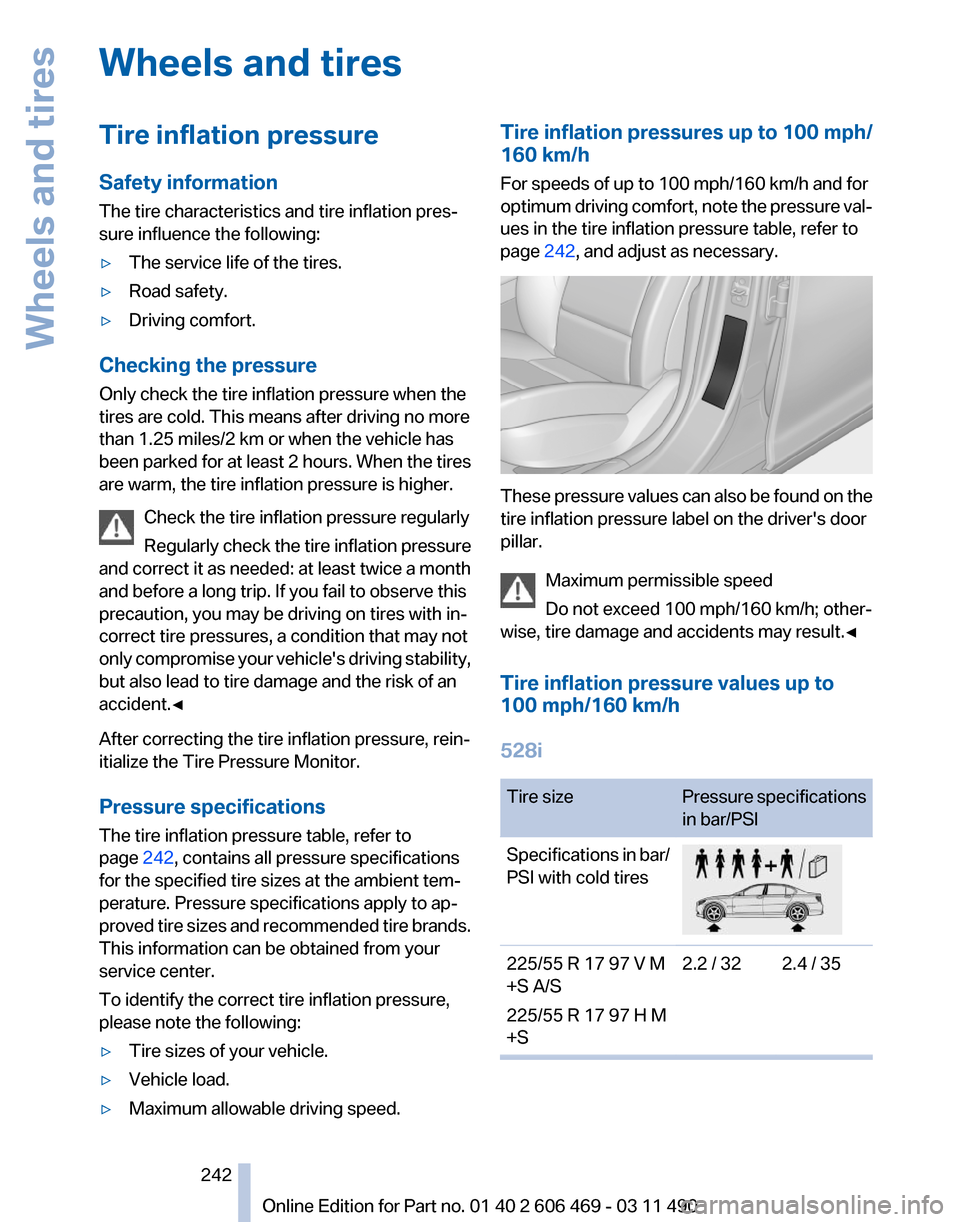
The tire inflation pressure table, refer to
page 242, contains all pressure specifications
for the specified tire sizes at the ambient tem‐
perature. Pressure specifications apply to ap‐
proved tire sizes and recommended tire brands.
This information can be obtained from your
service center.
To identify the correct tire inflation pressure,
please note the following:
▷ Tire sizes of your vehicle.
▷ Vehicle load.
▷ Maximum allowable driving speed. Tire inflation pressures up to 100 mph/
160 km/h
For speeds of up to 100 mph/160 km/h and for
optimum
driving comfort, note the pressure val‐
ues in the tire inflation pressure table, refer to
page 242, and adjust as necessary. These pressure values can also be found on the
tire inflation pressure label on the driver's door
pillar.
Maximum permissible speed
Do not exceed 100 mph/160 km/h; other‐
wise, tire damage and accidents may result.
◀
Tire inflation pressure values up to
100 mph/160 km/h
528i Tire size
Pressure specifications
in bar/PSI
Specifications in bar/
PSI with cold tires 225/55 R 17 97 V M
+S A/S
225/55 R 17 97 H M
+S
2.2 / 32 2.4 / 35 Seite 242
242 Online Edition for Part no. 01 40 2 606 469 - 03 11 490
Wheels and tires
Page 243 of 304
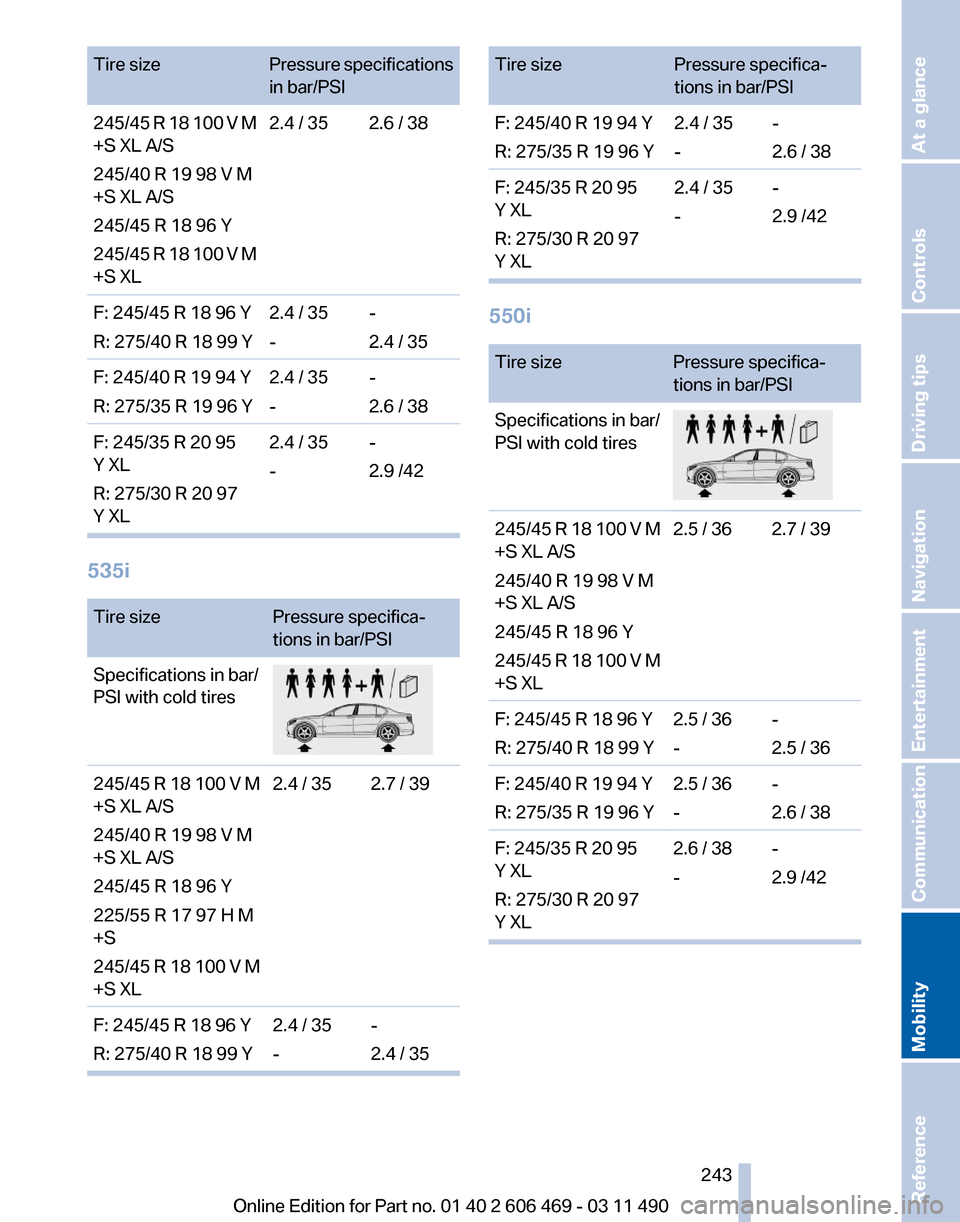
Tire size
Pressure specifications
in bar/PSI
245/45 R 18 100 V M
+S XL A/S
245/40 R 19 98 V M
+S XL A/S
245/45 R 18 96 Y
245/45
R 18 100 V M
+S XL 2.4 / 35 2.6 / 38
F: 245/45 R 18 96 Y
R: 275/40 R 18 99 Y 2.4 / 35
--
2.4 / 35
F: 245/40 R 19 94 Y
R: 275/35 R 19 96 Y 2.4 / 35
--
2.6 / 38
F: 245/35 R 20 95
Y XL
R: 275/30 R 20 97
Y XL 2.4 / 35
-
-
2.9 /42535i
Tire size
Pressure specifica‐
tions in bar/PSI
Specifications in bar/
PSI with cold tires 245/45 R 18 100 V M
+S XL A/S
245/40 R 19 98 V M
+S XL A/S
245/45 R 18 96 Y
225/55 R 17 97 H M
+S
245/45
R 18 100 V M
+S XL 2.4 / 35 2.7 / 39
F: 245/45 R 18 96 Y
R: 275/40 R 18 99 Y 2.4 / 35
--
2.4 / 35 Tire size
Pressure specifica‐
tions in bar/PSI
F: 245/40 R 19 94 Y
R: 275/35 R 19 96 Y 2.4 / 35
--
2.6 / 38
F: 245/35 R 20 95
Y XL
R: 275/30 R 20 97
Y XL 2.4 / 35
-
-
2.9 /42 550i
Tire size
Pressure specifica‐
tions in bar/PSI
Specifications in bar/
PSI with cold tires 245/45 R 18 100 V M
+S XL A/S
245/40 R 19 98 V M
+S XL A/S
245/45 R 18 96 Y
245/45
R 18 100 V M
+S XL 2.5 / 36 2.7 / 39
F: 245/45 R 18 96 Y
R: 275/40 R 18 99 Y 2.5 / 36
--
2.5 / 36
F: 245/40 R 19 94 Y
R: 275/35 R 19 96 Y 2.5 / 36
--
2.6 / 38
F: 245/35 R 20 95
Y XL
R: 275/30 R 20 97
Y XL 2.6 / 38
-
-
2.9 /42 Seite 243
243Online Edition for Part no. 01 40 2 606 469 - 03 11 490
Reference
Mobility Communication Entertainment Navigation Driving tips Controls At a glance
Page 244 of 304
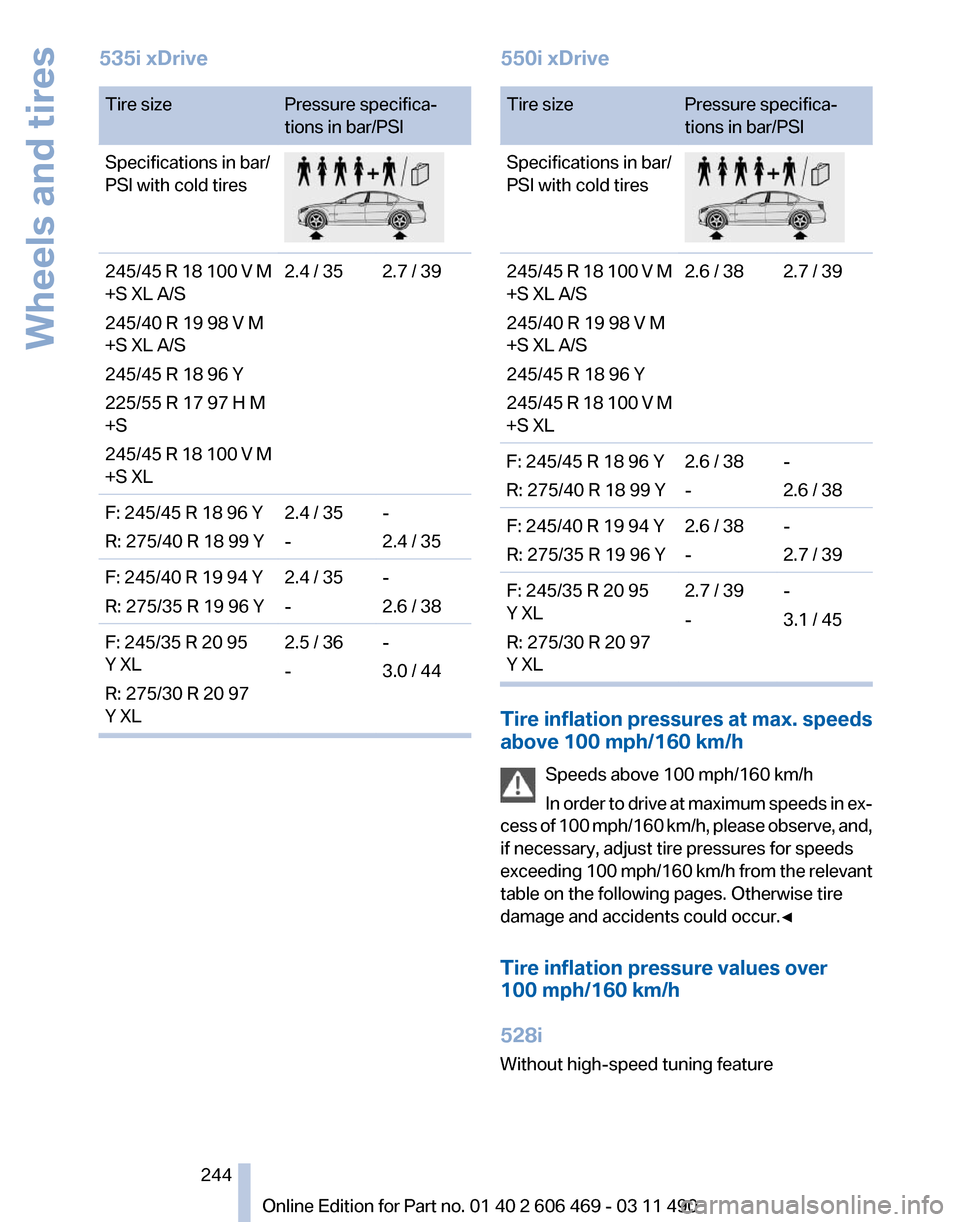
535i xDrive
Tire size
Pressure specifica‐
tions in bar/PSI
Specifications in bar/
PSI with cold tires 245/45 R 18 100 V M
+S XL A/S
245/40 R 19 98 V M
+S XL A/S
245/45 R 18 96 Y
225/55 R 17 97 H M
+S
245/45
R 18 100 V M
+S XL 2.4 / 35 2.7 / 39
F: 245/45 R 18 96 Y
R: 275/40 R 18 99 Y 2.4 / 35
--
2.4 / 35
F: 245/40 R 19 94 Y
R: 275/35 R 19 96 Y 2.4 / 35
--
2.6 / 38
F: 245/35 R 20 95
Y XL
R: 275/30 R 20 97
Y XL 2.5 / 36
-
-
3.0 / 44 550i xDrive
Tire size
Pressure specifica‐
tions in bar/PSI
Specifications in bar/
PSI with cold tires 245/45 R 18 100 V M
+S XL A/S
245/40 R 19 98 V M
+S XL A/S
245/45 R 18 96 Y
245/45
R 18 100 V M
+S XL 2.6 / 38 2.7 / 39
F: 245/45 R 18 96 Y
R: 275/40 R 18 99 Y 2.6 / 38
--
2.6 / 38
F: 245/40 R 19 94 Y
R: 275/35 R 19 96 Y 2.6 / 38
--
2.7 / 39
F: 245/35 R 20 95
Y XL
R: 275/30 R 20 97
Y XL 2.7 / 39
-
-
3.1 / 45 Tire inflation pressures at max. speeds
above 100 mph/160 km/h
Speeds above 100 mph/160 km/h
In
order to drive at maximum speeds in ex‐
cess of 100 mph/160 km/h, please observe, and,
if necessary, adjust tire pressures for speeds
exceeding 100 mph/160 km/h from the relevant
table on the following pages. Otherwise tire
damage and accidents could occur.◀
Tire inflation pressure values over
100 mph/160 km/h
528i
Without high-speed tuning feature Seite 244
244 Online Edition for Part no. 01 40 2 606 469 - 03 11 490
Wheels and tires
Page 245 of 304
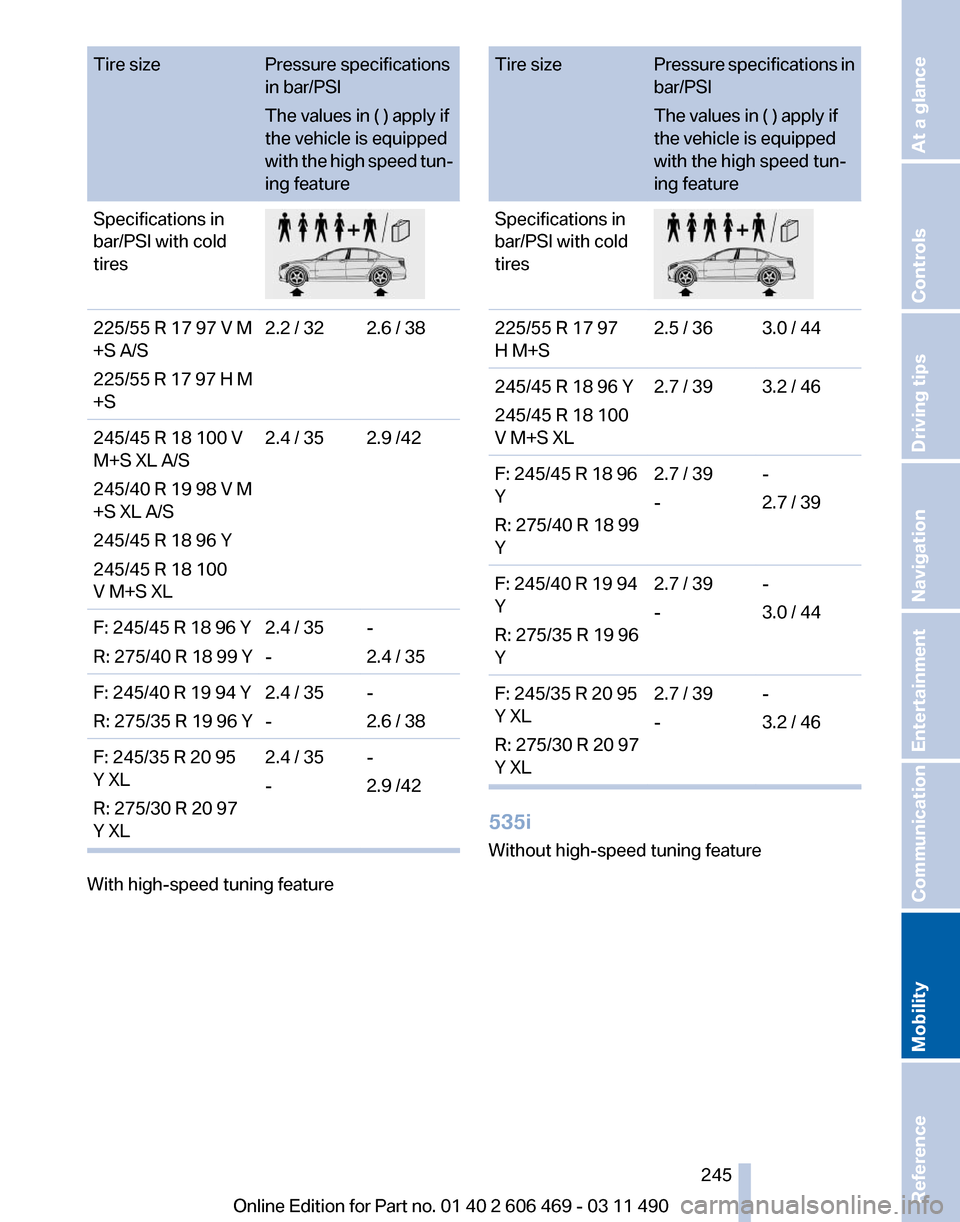
Tire size
Pressure specifications
in bar/PSI
The values in ( ) apply if
the vehicle is equipped
with
the high speed tun‐
ing feature
Specifications in
bar/PSI with cold
tires 225/55 R 17 97 V M
+S A/S
225/55
R 17 97 H M
+S 2.2 / 32 2.6 / 38
245/45 R 18 100 V
M+S XL A/S
245/40 R 19 98 V M
+S XL A/S
245/45 R 18 96 Y
245/45 R 18 100
V M+S XL 2.4 / 35 2.9 /42
F: 245/45 R 18 96 Y
R: 275/40 R 18 99 Y 2.4 / 35
--
2.4 / 35
F: 245/40 R 19 94 Y
R: 275/35 R 19 96 Y 2.4 / 35
--
2.6 / 38
F: 245/35 R 20 95
Y XL
R: 275/30 R 20 97
Y XL 2.4 / 35
-
-
2.9 /42With high-speed tuning feature Tire size
Pressure specifications in
bar/PSI
The values in ( ) apply if
the vehicle is equipped
with the high speed tun‐
ing feature
Specifications in
bar/PSI with cold
tires 225/55 R 17 97
H M+S
2.5 / 36 3.0 / 44
245/45 R 18 96 Y
245/45 R 18 100
V M+S XL 2.7 / 39 3.2 / 46
F: 245/45 R 18 96
Y
R: 275/40 R 18 99
Y 2.7 / 39
-
-
2.7 / 39
F: 245/40 R 19 94
Y
R: 275/35 R 19 96
Y 2.7 / 39
-
-
3.0 / 44
F: 245/35 R 20 95
Y XL
R: 275/30 R 20 97
Y XL 2.7 / 39
-
-
3.2 / 46 535i
Without high-speed tuning feature
Seite 245
245Online Edition for Part no. 01 40 2 606 469 - 03 11 490
Reference
Mobility Communication Entertainment Navigation Driving tips Controls At a glance