2011 AUDI S8 change time
[x] Cancel search: change timePage 235 of 302

@ For the sake of the environment
Because of the problem of proper disposa l
of brake fl uid as we ll as the special tools
requ ired and the necessary expert ise, we
recommend that you have t he brake fluid
changed by your author ized Audi dealer .
Battery
General information
Under normal operating conditions, the bat
tery in your Audi does not need any mainte
nance. With
high outside temperatures or
long daily dr ive s we recommend that you have
the electro lyte level checked by a service fa
cility . The electrolyte level shou ld a lso be
checked each time the battery is charged
¢ page 235.
Have the battery checked when you take your
ve hicle in for service . Yo u are well adv ised to
replace a battery that is older than 5 yea rs .
W ith certa in types of a irbag deployment, t he
b attery is d isconnected from the vehicle elec
tr ica l system for safety reasons¢.&.
in Re
pair, care and disposal of the airbags on
page 159.
Disconnecting the battery terminals
Some vehicle functions (power w indow regu
lators , for example) are lost if the battery ter
m inals a re d isconnected. These func tions have
to be re lea rned after the batte ry term inals a re
connected agai n. T o prevent this , the bat tery
should only be d isconnec ted from the vehicle
e lec tric al system when absolu tely necessa ry
for repairs .
Vehicles not driven for long periods
If you do not drive you r vehicle over a period
of severa l days or weeks, elec trical compo
nen ts are gr adually cut b ack o r swi tched off .
This redu ces energy cons umption and main
tains starting capab ility over a longer per io d
¢ page 195.
Be aw are tha t when you unlock yo ur vehicle ,
some of the conven ien ce f unct ions may no t
Checkin g and fillin g 233
opera te , such as the Conven ience key*, the re
mote control or the power seat adjustment .
T he convenience functions will be ava ilab le
again when you switch on the ign ition and
start the eng ine.
Winter operat ion
D uring the w inte r mon ths, bat tery capacity
tends to dec rease as temperatures drop . This
is beca use more power is a lso consumed wh ile
starting, and the headlights, rear window de
fogger, etc., are used more often.
Avoid unnecessary powe r consum ptio n, pa r
ticu lar ly in city traffic or when traveling only
short distances. Let your autho riz ed Audi
dealer check the capacity of the vehicle bat
te ry before w inter sets in¢
page 235 . A well
c h arged battery will not on ly prevent s tarti ng
problems w hen the weather is cold, but wi ll
also last longer.
(D Tips
If you r vehicle is left s tandi ng for seve ral
weeks at extremely low temperatures, the
vehicle ba ttery s hould be removed an d
s to red w here i t w ill not fr eeze . T his w ill
p revent it from be in g damaged and having
to be replaced.
Working on the battery
Be especially careful when working on or near
the bat tery.
T he battery is lo cated in the l uggage compa rt
ment unde r the floo r. B efo re you che ck a ny
thi ng in the luggage com partmen t,
read and
heed all WARNINGS
¢ .&, .
Alw ays heed t he safety warning s, when work
ing on the vehicle b atte ry or the vehicle e lec -
t rical system to prevent i njury. .,..
•
•
Page 238 of 302
236 Checking and filling
-Never charge a frozen battery. It may ex
plode because of gas trapped in the ice.
Allow a frozen battery to thaw out first.
- Do not reuse batteries which were fro
zen. The battery housing may have cracked and weakened when the battery
froze .
- Charge the battery in a well ventilated
area . Keep away from open f lame or elec
trical spark . Do not smoke. Hydrogen gas
generated by the battery is exp losive.
- To reduce the danger of explosion, never
connect or disconnect charger cables
wh ile the charger is operating.
- Fast charg ing a battery is dangerous and
should only be attempted by a compe
tent technician with the proper equip
ment.
- Battery acid that may spill during charg
ing should be washed
off with a solution
of warm water and bakin g soda to neu
tralize the acid.
Never use a fast charger as a booster to
start the engine. This will se riously dam
age sensitive electronic components, such
as control units, relays, radio, etc., as we ll
as the battery charger .
Battery replacement
The new battery must have the same specifi
cations and dimensions as the original equip
ment battery.
I ntell igent energy management in your vehi
cle is respo nsible for distributing the electr i
cal energy throughout your vehicle
c::> page 195. The intelligent energy manage
ment system wi ll keep the engine battery
charged better than vehicles without this sys
tem. To make sure the additional electrical en
ergy is available once again after you have
changed the battery, we recommend that you install batte ries of the same type and man u
facture only (the same as those installed at
the time your vehicle was delivered). Specifi- cations are listed on the
battery housing. Your
authorized dealer must code the battery in
the energy management system to enab le you
to use the energy management functions cor
rectly after replacing the battery.
T he new battery must have the same capacity,
voltage (12 volts), amperage, construction and plug sealing .
When installing the battery, make sure the ig
nition and all electrical consumers are switch
ed off.
(D Note
Make sure the ventilation hose on the side
of the battery is connected, otherwise
fumes or battery acid can leak out .
@ For the sake of the environment
Because of the prob lem of proper disposal
of a battery, we recommend your author
i zed Audi dealer change the battery for
you. Batteries contain sulfuric acid and
lead and must always be disposed of prop
erly in compliance with a ll environmental
regulations. Disposing of veh icle batter ies
improperly is very dangerous to the envi
ronment .
Windshield/headlight
washer container
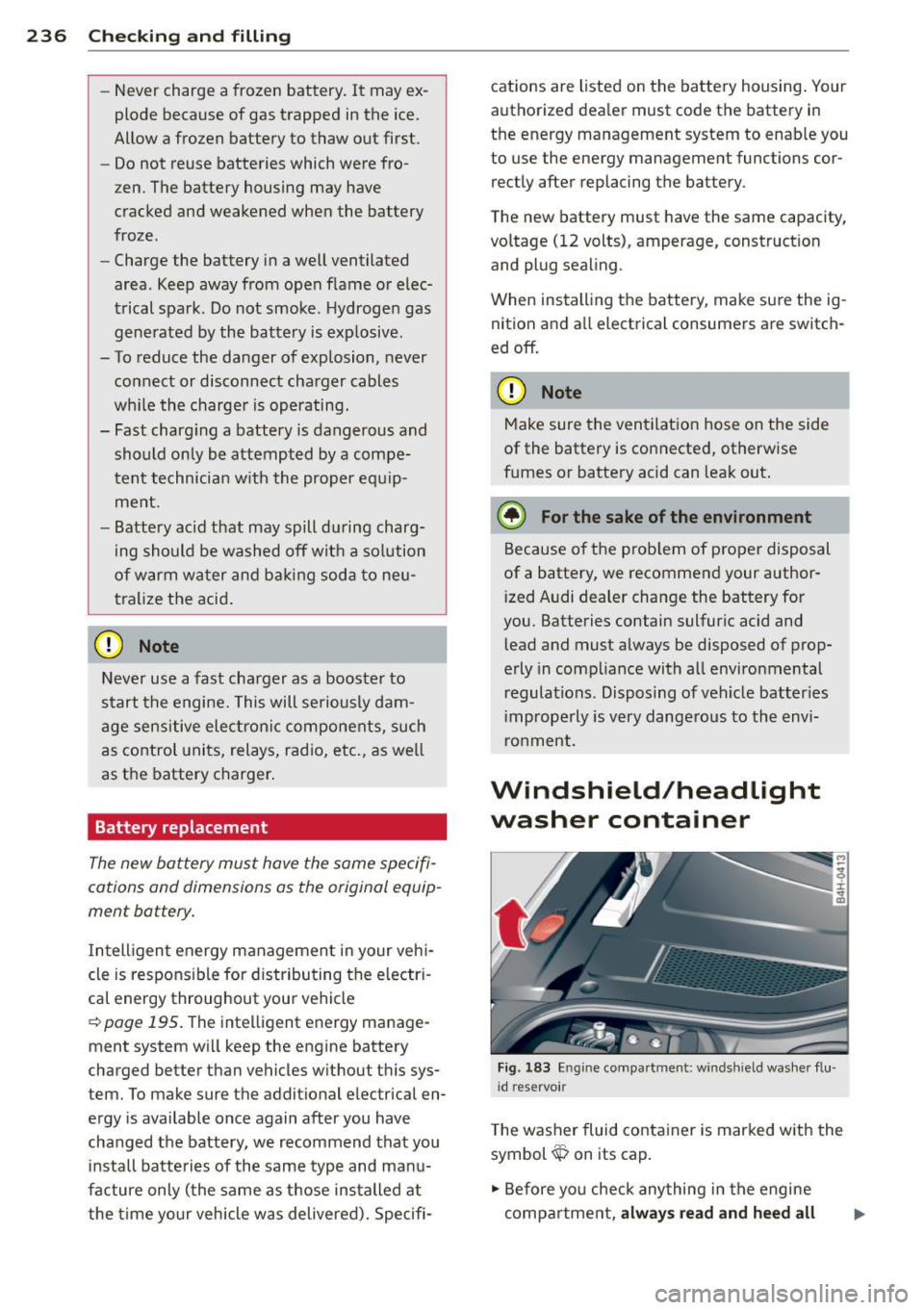
Fig. 183 En g in e compa rtm ent: w indshi eld washe r flu
i d reservo ir
T he washer fluid conta iner is marked w ith the
symbol~ on its cap .
.,. Before you check anything in the engine
compartment,
always read and heed all
Page 242 of 302

240 Tires and wheels
Maximum loaded vehicle weight
means t he sum of:
(a) Curb weight
(b) Accessory weight
(c) Vehicle capacity we ight, and
(d) P rod uction options weight
Maximum (permissible) inflation pressure
me ans t he max imum co ld inflation pressu re
to which a tire may be in flate d. Also called
"maxim um inflation p ress ure."
Normal occupant weight
means 150 lbs. (68 kilog rams) times the
nu mbe r of o ccupants seated in t he vehicle up
to the tota l sea ting capaci ty of yo ur vehicle .
Occupant distribution means dist ribution of occupants in a veh icle .
Outer diameter means t he overa ll diameter of a n in flated new
tire.
Overall width
means t he linear dis tan ce between the ex ter i
ors o f th e sidewalls of an inflated tire, in cl ud
ing e levations due to labeling, decorations, or
p rotective bands o r ribs.
Ply
means a laye r of r ubber-co ate d parall el c ords.
Production options weight
means t he comb ined we ight of those installed
regular produc tion options weigh ing ove r 5
l bs . (2 .3 kg) in excess of t hose standard items
which they repla ce, no t previously considered
in cur b weight o r acc essory weig ht, incl uding
h eavy duty brakes, r ide leve le rs, roof ra ck,
h eavy duty ba tte ry, a nd specia l trim .
Radial ply tire
means a pneumatic t ire in which the p ly co rds
t ha t ex tend to the beads are laid a t sub stan
ti ally 9 0 degrees to the ce nt erline o f the
trea d. Recommended inflation pressure
see
<=>
page 239, C old tire infl atio n pressure.
Reinforced tire
means a tire design to operate a t higher loads
and at h igher inflation pressures than t he cor
r espondi ng stan da rd tire. Reinforced tires
may be identifie d as "X L", "xl" , "EX TRA LOAD",
o r "RF " on t he sidewa ll.
Rim
means a metal su ppo rt for a tire or a t ire and
tube assembly upon which the tire beads are
seated.
Rim diameter
means nom inal d iameter of the bead seat. If
you change your wheel s ize, you w ill have to
purchase new tires to match th e new r im di
ameter .
Rim size designation
means r im diameter and width.
Rim width
means nom inal dista nce between rim flan ges .
Sidewall
means tha t port ion of a t ire betw ee n t he
t read a nd bead.
Speed rating (letter code)
means the speed at which a tire is designed to
be driven for extended periods of time. The
r a ti ngs range from 93 mph ( 150 km/h) to
186 mph (298 km/h)
~ page 250. Yo u may
not fi nd this information o n all ti res because
it is no t re quir ed by law.
T he speed rating letter code, wh ere applica
ble , is molde d on the tire sidewall a nd indi
c ates the max imum pe rmissibl e road speeds
<=> A in Winter tire s on page 2 54.
Tire pressure monitoring system*
mea ns a system that detects when o ne or
more of a veh icle 's tires are unde rinf lated an d
ill uminat es a low tir e pr es sure wa rning t ell
t a le.
Page 301 of 302
It has always been Audi's policy to continu
ously improve its products . Audi, therefore,
reserves the right to make changes in design
and specifications, and to make additions or
improvements in its products, without incur
ring any obligation to install them on prod
ucts previous ly manufactured .
Text, illustrat ions and specifications in th is
manual are based on the most up-to-date in
formation available at the time of printing.
A ll rights reserved. May not be reproduced or
translated in whole or in part without the
written consent of AUDI AG. Spec ificat ions are
subject to change w ithout notice. "Aud
i", "q uatt ro" and the four rings emblem
are registered trademarks of AUDI AG. "AB" is
trademark of AUDI AG .
Editorial deadline: 09/17/2010
@ For the sake of the environment
Printed on environmentally friendly paper
(bleached without chlorine, recyclable).
Printed in Germany
© 2010 AUDI AG