2011 AUDI S8 change wheel
[x] Cancel search: change wheelPage 247 of 302

Remember that the vehicle manufacturer, not
the tire manufacturer, determines the correct
tire pressure for the t ires on your vehicle.
It is impor tan t to check the tire pressu re when
the t ires a re cold .
- Read the requ ired ti re p ressure from the tire
pressure label. On USA veh icles, the t ire
pressure label is located on the drive r's side
B-pi llar . On Canada vehicles, the tire pres
sure label is located on the driver's side B
pillar.
- Turn the valve stem cap counter-clockwise
to remove it from the tire valve.
- Place the air pressure ga uge on the valve.
- T he tire pressures sho uld only be chec ked
and adjusted when the t ires are cold. The
s li ght ly raised pressures of warm tires must
not be reduced .
- Adjust the tire pressure to the load you are
ca rrying .
- Re insta ll the va lve stem cap on the valve.
When should I ch eck the tire pressur e?
The cor rect tire pressure is espec ially impor
tant at high speeds. The pressure should
therefo re be checked at least once a month
a nd a lways before start ing a journey. Do no t
forget to check the tire pressure for the spare
wheel
r:!> page 261 .
When should I adjust the tire pressures ?
Adjust the tire p ressure to the load you are
carry ing. Afte r changing a wheel
or replacing
wheels you have to adjust the tire pressures
on all wheels . In addition, you must then
store the new tire pressures i n the tire pres
sure monitoring system *
r:!> page 256.
A WARNING
Incorrect tire pressures and/or underinfla
tion can lead sudden tire failure, loss of contro l, col lision, ser ious persona l injury
or even death.
- When the warning symbo l
[I] appears in
the instrument cluster, stop and inspect
the tires .
Tires an d wheel s 245
-Inco rrect tire pressure and/or underinfla
tion can cause increased tire wear and
can affect the handli ng of the vehicle and
stopping ability .
- Incorrect tire pressures and/or underin
flation can a lso lead to sudden t ire fail
ure, including a blowout and sudden de
flation, caus ing loss of veh icle cont rol.
- The drive r is responsib le for the correct
tire pressures for all tires on the ve hicle.
The appli cable pressure values a re locat
ed on a sticke r o n the dr iver's s ide B -pil
lar.
- Onl y when all tir es on the vehicle are fil
led to the co rrect p ressu re, the t ire pres
sure mon itor ing* syste m can work cor
rectly.
- Th e use of incorrect tire p ress ure v alues
can lead to a cciden ts or o ther d amage.
T herefore it is essential that the drive r
observe the specified tire press ure va lues
for the tires and the correct pressures for
the function of the t i re p ress ure monito r
ing system*.
- Always inflate t ires to the recommended
and correct t ire pressure before dr iv ing
off.
- Driving with underinf lated tires bend
more, lett ing them get too hot resulting
in tread separation, sudden tire failure
a nd loss of cont rol.
- Excessive speed and/overloading can
cause heat build- up, sudden tire failure
a nd loss of cont rol.
- If the tire pressure is too low or too high,
the t ires will wear prematurely and the
veh icle w ill not handle well.
- If the tire is not flat and you do not have to change a wheel immediately, d rive at
red uced speed to t he nearest servic e sta
tion to che ck the t ire p ress ure and add
air as req uired.
0 Note
Driving w ithout valve stem caps can cause
damage to the tire valves. To prevent this,
a lways make sure that factory insta lled
•
•
Page 259 of 302

remain continuously illuminated. This se
quence will continue upon subsequent vehicle
start-ups as long as the malfunction exists.
When the malfunction indicator is illuminat
ed, the system may not be able to detect or
signal low tire pressure as intended . TPMS
malfunct ions may occur for a variety of rea
sons, including the installation of replace ment or alternate tires or wheels on the vehi
cle that prevent the TPMS from functioning
properly . Always check the TPMS malfunct ion
tellta le after replacing one or more t ires or
wheels on your vehicle to ensure that the re
placement or alternate tires and wheels allow
the TPMS to continue to function properly.
Tire pressure indicator appears
Applies to vehicles: with tire pressure monitoring system
The tire pressure indicator in the instrument
cluster informs you if the tire pressure is too
low or if there is a system malfunction.
Fig. 189 Display : underinflatio n warning
Fig. 190 Display: System malfu nctio n
Using the ABS sensors, the tire pressure moni
toring system compares the tire tread circum
ference and vibration characteristics of the in
dividual tires . If the pressure decreases in one
or more tires, this is indicated in the instru-
Tires and wheels 257
ment cluster with a warning symbol [I) and a
message
r::!) fig. 189.
The tire pressure monitoring system must be
reset via MMI each t ime the pressures are ad
justed (e.g. when switching between partial
and full load pressure) or after changing or re
placing a tire on your vehicle
r::!) page 258. You
can find the recommended tire pressures for
your vehicle on the label on driver's side 8-pil
lar
r::!) page 242 .
Tire tread circumference and vibration charac
teristics can change and cause a tire pressure
warning if:
- the tire pressure in one or more tires is too
low,
- the tire has structural damage,
- the tir e pressure was changed, wheels rotat-
ed or replaced but the TPMS was not reset
r::!) page 258 .
Warning symbols
[I) Loss of pressure in at least one tire co& .
Check the tire or tires and replace or repa ir if
necessary. The indicator light
[I) in the instru
ment cluster also illuminates
r::!) page 11.
Check/correct the pressures of all four tires
and resetTPMS via MMI.
lli§ffl (Tire Pressure Monitoring System) Tire
pressure! System malfunction.
If llilffl appears after switching the ignition
on or while driving co
fig. 190 and the indica
tor light
[I) in the instrument cluster blinks
for approximately one minute and then stays
on, there is a system malfunction . See your
authorized Audi dea ler as soon as possible .
A WARNING
-If the tire pressure indicator appears in
the instrument cluster display , one or
more of your tires is significant ly under
inflated . Reduce your speed immediately
and avoid any hard steering or braking
maneuvers. Stop as soon as possible and
check the tires and their pressures . In
flate the tire pressure to the proper pres-
sure as indicated on the vehicle's tire .,.
Page 260 of 302

258 Tires and wheels
pressure label~ page 242 . Driving on a
significantly under-inflated tire causes
the tire to overheat and can lead to tire
failure. Under-inflation also is likely to
impair the vehicle's handling and stop
ping ability.
- The driver is responsible for maintaining
the correct tire pressures. You must
check the tire pressures regularly.
- Under certain cond itions (such as a spor
ty driving style, winter condit ions or un
paved roads), the pressure monitor indi
cator may be delayed.
- Ask your author ized Audi dealer if run
flat tires may be used on your veh icle.
Your vehicle registration becomes invalid
if you use these tires when not permit
ted. Damage to your vehicle or accidents
cou ld also result.
(D Tips
- The tire pressure monitoring system
stops working when there is an ESP/ABS
malfunction.
- Using snow chains may result in a system
malfunction.
- To ensure a proper TPMS function use
AUDI Original Tires which are marked
with "AO" or "RO" on the tire sidewall.
~p age 249.
- The tire pressure monitoring system on
your Audi was syntonized using tires with
the "AO" or "RO" identification. We rec
ommend using these tires.
Reset tire pressure monitoring system
App lies to vehicles: with tire pressure monitoring system
If the tire pressure is adjusted, wheels are ro
tated or changed, the TPMS must be reset via
MMI .
.. Switch on the ignition .
.. Se lect in the MMI: !CAR !function button>
Car systems contro l button > Servicing &
checks > Tire pressure monitoring > Store
tire pressures > Yes, store now.
(D Tips
Before resetting the TPMS, the current
pressures of all four tires must correspond
to the specif ied values. Adjust the tire
pressure and reset the pressure in the tire
pressure monitoring system according to
the load you are carrying~ page 242.
- Do not store the tire pressures if you are
dr iving with snow chains. Otherwise, a
system malfunction may occur.
Page 265 of 302

other warning devices to alert other mo
torists.
- Make sure that passengers wait in a safe
place away from the vehicle and well
away from the road and traffic.
- To help prevent the vehicle from moving
suddenly and possibly slipping off the
jack, always fully set the parking brake
and block the wheel diagonally opposite
the wheel being changed. When one
front wheel is lifted off the ground, plac
ing the Automatic Transmission in "P"
(Park) will
not prevent the vehicle from
moving.
- Before you change a wheel, be sure the
ground is level and firm. If necessary,
use a sturdy board under the jack.
- After installing the spare wheel, make
sure that you replace the flat tire/wheel
in its storage area properly and tighten
the knurled retaining screw securely.
@ Tips
Before changing the wheel, you must acti·
vate the jacking mode, so that the auto
matic controls for the Adaptive Air Sus
pension do not make it more difficult to
lift the vehicle with the jack ¢
page 265.
Changing a wheel
When you change a wheel, follow these
quence described below step-by-step and in
exactly that order.
1. Activate the vehicle jack mode
¢ page 265.
2. Remove the decorative wheel cover*. For
more details see also¢
page 264, Deco
rative wheel covers
or ¢ page 264,
Wheels with wheel bolt caps.
3 . Loosen the wheel bolts¢ page 264 .
4. Locate the proper mounting point for the
jack and align the jack below that point
¢page 265.
5. Raise the car with the jack¢ page 265.
6. Remove the wheel with the flat tire and
then install
the spare ¢ page 266.
What do I do now? 263
7. Tighten all wheel bolts lightly.
8.
Lower the vehicle with the jack.
9. Use the wheel bolt wrench and
firmly
tighten all wheel bolts¢ page 264.
10. Replace the decorative wheel cover*.
11. Deactivate the vehicle jack mode in the
MMI:
ICARI function button > Car systems
control button > Servicing & checks> Air
susp.: jack mode> Off .
The vehicle jack mode switches off automati
cally at speeds above 10 km/h .
A WARNING
Always read and follow all WARNINGS and
information¢ .&
in Raising the vehicle on
page 265
and ¢ page 267.
After changing a wheel
A wheel change is not complete without the
doing the following.
.. Store and secure the wheel you replaced in
the spare wheel well.
.. Replace the tools and the jack in their prop
er location.
.. Check the
tire pressure on the spare wheel
immediately after mounting it.
.. As soon as possible, have the
tightening
torques
on all wheel bolts checked with a
torque wrench. The correct tightening tor
que is 90
ft lb (120 Nm).
.. Have the flat tire
replaced as soon as possi
ble .
(D Tips
-If you notice that the wheel bolts a re
corroded and difficult to turn while
changing a tire, they should be replaced
before you check the tightening torque.
- Drive at reduced speed until you have the
tightening torques checked.
•
•
Page 267 of 302
@ Tips
-Never use the hexagonal socket in the
handle of the screwdriver to loosen or
tighten the wheel bolts.
- If a whee l bolt is very tight, you may find
it easier to loosen by carefully pushing
down on the end of the wheel bolt
wrench w ith
one foot only. As you do so,
hold on to the car to keep your ba lance
and take ca re not to slip.
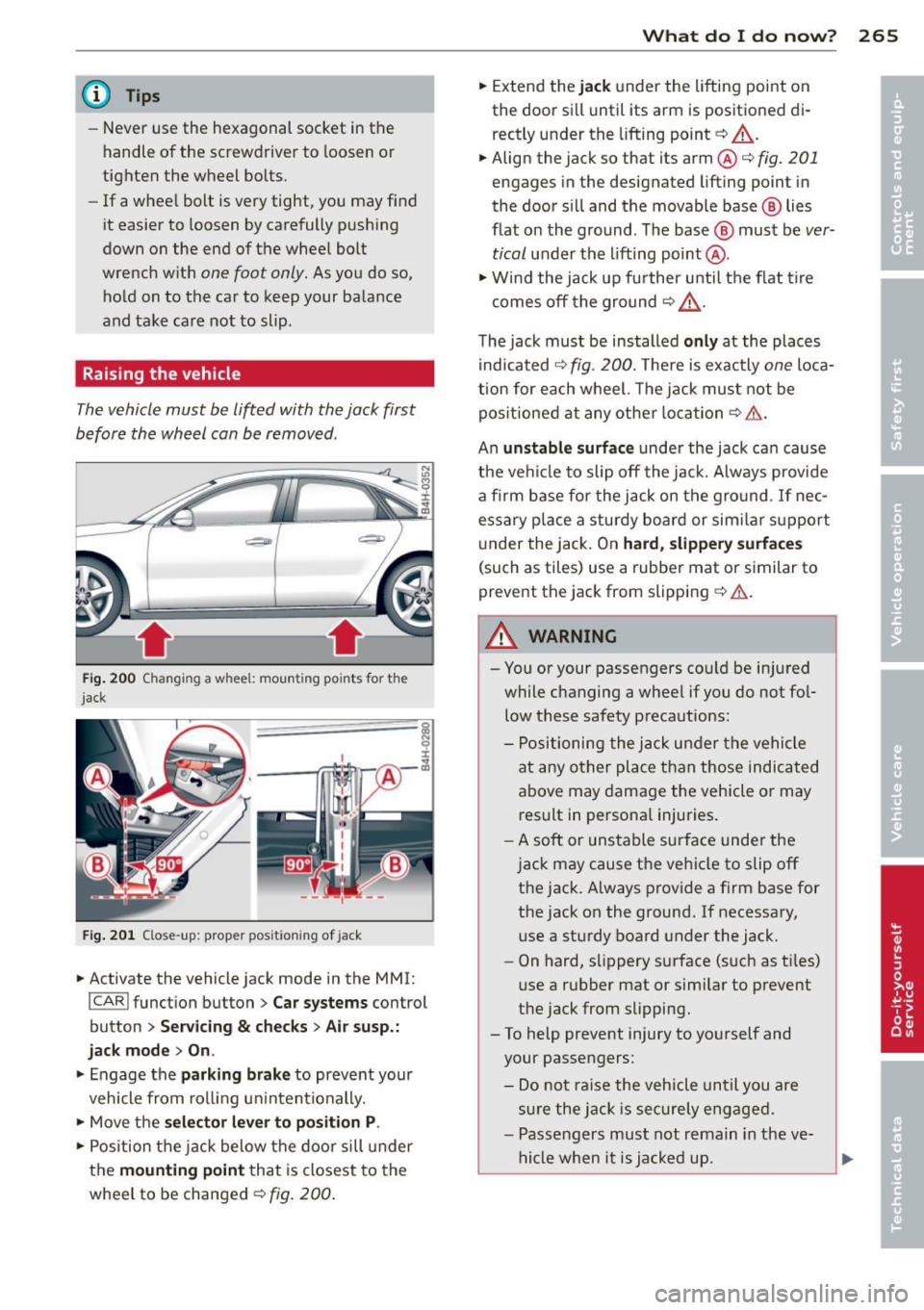
Raising the vehicle
The vehicle must be li~ed with the jack first
before the wheel can be removed .
-itr·--
Fi g. 200 Changing a whee l: mou nting po ints fo r the
jack
F ig . 20 1 Close -up: proper positioning of jack
.. Activate the vehicle jack mode in the MMI:
I CAR I function button> Car systems control
button
> Servicing & ch ecks > Ai r susp.:
jack mod e> On.
.. Engage the parking brake to prevent your
vehicle from rol ling un intentionally.
.. Move the
se lector le ver to pos ition P.
.. Position the j ack below the door sill under
the
mounting point that is closest to the
whee l to be changed ¢
fig. 200 .
What do I d o now ? 265
.. Extend the jack under the lifting point on
the door sill until its arm is positio ned di
rectly under the lifting point ¢
A.
.. Align the jack so that its arm@¢ fig. 201
engages in the designated lifting point in
the doo r si ll and the movable base @ lies
flat o n the ground. The base @ must be
ver
tical
under th e lifting point @.
.. Wi nd the jack up fu rther until the flat t ire
comes off the gro und
¢ A_ .
The jack must be installed only at the places
i ndicated
¢ fig . 200. The re is exactly one loca
tion for each wheel. The j ack mus t not be
pos it ioned at any other location
¢ & .
An unstable surface under the jack ca n cause
the vehicle to slip off the jack. Always provide
a firm base for the jack on t he g ro und . If nec
essary p lace a sturdy board or sim ilar support
u nder the jack . On
hard, slipper y surface s
(such as tiles) use a rubbe r mat or similar to
prevent the jack from slipping
¢ & .
A WARNING
- You or your passengers co uld be in jured
while c hanging a wheel if you do not fo l
low these safety precautions:
- Positioning the j ack under the vehicle
at any o ther place than those indicated
above may damage the vehicle or may result in persona l injuries .
- A soft or uns table surf ace unde r the
j ac k may cause the vehicle to slip off
the jack. Always provide a f irm base for
the jack on the ground. If necessary, use a sturdy board under the jack.
- On hard, s lippery surface (such as ti les)
use a rubber mat or similar to prevent
the jack from slipping.
- To help prevent injury to yo urself and
your passengers:
- Do n ot ra ise the veh icle until you are
s ur e the jack is securely engaged .
- Passe ngers must not remain in the ve
h icle when i t is ja cked up.
Page 268 of 302

266 What do I do now ?
-Make sure that passengers wait in a
safe p lace away from the vehicle and
well away from the road and traffic.
- Make sure jack position is correct, ad
just as necessary and then continue to ra ise the jack.
- Changes in temperature or load can af
fect the height of the vehicle.
@ Tips
The vehicle jack mode switches off auto
matica lly at speeds above 10 km/h.
Taking the wheel off/installing the spare
Follo w thes e instruct ions st ep-by -step for
changing th e wh eel .
Fig. 2 02 Chan gin g a w hee l: u sing t he sc rewdr ive r ha n
dl e (w it h th e bla de r emoved ) to tu rn th e bolts
Fi g. 20 3 Changin g a w heel : a lignm en t pin inside th e
t o p hole
After you have loosened a ll wheel bolts and
ra ised the vehicle off the ground, remove and
replace the wheel as follows:
R emoving the wheel
• Use the hexagonal socket in the screwd riv
e r handle
to comp lete ly remove the top
most wheel bolt and set it aside on a
clean
surface ¢fig. 202.
• Sc rew the th readed end of the alignment
pin
from t he tool k it hand-tight into t he
empty bolt hole
r::;, fig . 203 .
• Then remove the other whee l bolts as de
scribed above.
• Takeoff the whee l leaving the a lignment pin
in the bo lt hole
r::;, (D .
Putting on the spare wheel
• Lift the spare whee l and carefu lly s lide it
over the alignment p in to g uide it in place
¢ (D .
.,. Use the hexagonal socket in the screwdriver
ha ndle to screw in and tighten a ll whee l
bolts
slightly .
.,. Remove the alignment pin and inse rt and
tighten the rem aining wheel bol t slightly
like the res t.
• Turn the jack hand le co unter-clockwise to
lower the veh icle until the jack is fully re
leased .
.,. Use the wheel bo lt wrench to tighten all
wheel bolt s firm ly
r::;, page 264 . Tigh ten
them
crosswise, from one bolt to the (ap
proximately) opposite one, to keep the
wheel cente red .
(D Note
When remov ing or installing the whe el,
the rim cou ld hit the b rake roto r and dam
age t he ro to r. Wor k caref ully and have a
s eco nd pers on h elp you.
{i) Tips
Neve r use the hexagonal socket in the han
dle of t he s crewdr iver to lo ose n or t igh ten
t he wheel bo lts .
- P ull the revers ible blade from the screw
dr iver be fore y ou use the hexagon al
so cket in the han dle to tur n the w heel
bolts.
- W he n m oun tin g ti res w ith
unidirectional
tread design
make sure t he trea d pat
t ern is poin ted t he righ t way
r::;, page267.
- T he wheel bolts shou ld be clean and easy
to t urn. Check for dirt an d corrosion on
the mating surfaces of both the w heel .,,.
Page 284 of 302

282 Data
Data
372 hp, a-cylinder engine, with all wheel drive
Appl ies to vehicles: with 8-cy linder engine and a ll whee l drive
Engine data
Maximum output SAE net
Maximum torque SAE net
No . of cylinders
Displacement
Stroke
Bore
Compression ratio hp@rpm
l
b-ft@ rpm
CID (cm
3 )
in (mm)
i n (mm)
372 @6800
328@3500
8 cylinder
254.3 1 (4163)
3 .65 (92,8)
3.33 (84,5)
12.5: 1
Fuel Premium unleaded (91 AKI)
Recommended for maxi
mum engine performance. Further details<=>
page 218,
Gasoline
Dimen sion s (appro x.)
Length (with license plate bracket)
Width (across mirrors)
He ight (unloaded) in (mm)
in (mm)
in (mm)
T urning circle diameter (curb to curb) ft . (m)
Capacities (approx.) Fuel tank
- Total capacity gal (liters)
- Reserve (of total capacity) gal (liters)
Windshield and headlight washer quarts (liters)
fluid container
Engine oil with filter change quarts (liters)
AS
202.24 (5137)
83.11 (2111)
57 .48 (1460)
4 0.35 (12.3)
ASL
207 .4 (5267)
83.1 1 (2111)
57 .9 (1471)
4 1.67 (12, 7)
23.8 (90 .0)
3 .17 (12)
5 .28 (5)
8 .14 (7.7)