2011 AUDI S3 roof
[x] Cancel search: roofPage 232 of 320

___ C_ h_ e_c _k _i _ n _g ~ a_n _d_ f_il _l_in _ g _________________________________________ _
Under some circumstances the engine oil should even be changed
more frequently. Change oil more often if you drive mostly short
distances, operate the vehicle in dusty areas or mostly under stop
and-go traff ic conditions, or when you use your vehicle where temper
atures stay below freezing point for long periods .
Detergent additives in the oil will make fresh oil look dark after the
engine has been run ning for a short time . This is normal and is not a
reason to change the oil more often than recommended .
Damage or malfunctions due to lack of maintenance
It is essentia l that you change your oi l at the recommended intervals
using only engine oil that complies with Audi oi l standard VW 502 00
(vehicles with gasoline engine) or VW 507 00 (vehicles with diesel
engine). Your Limited New Vehicle Warranty does not cover damage
or malfunctions due to failure to follow recommended maintenance
and use requirements as set forth in the Audi Owner's Manua l and
Warranty
& Maintenance booklet. Your dealer will have to deny
warranty coverage unless you present to the dealer proof in the form
of Service or Repair Orders that all scheduled maintenance was
performed in a timely manner .•
Engine oil consumption
The engine in your vehicle depends on an adequate
amount of oil to lubricate and cool all of its moving parts.
In order to provide effective lubrication and cooling of internal
engine components, all internal combustion engines consume a
certain amount of o il. Oil consumpt ion varies from engine to engine
and may change significant ly over the life of the eng ine. Typically,
engines with a specified break- in period (see~
page 197) consume
more oi l during the break-in period than they cons ume after oil
consumption has stabilized.
Under normal cond itions, the rate of oil consumpt ion depends on the
quality and vis cosity of the oil, the RPM (revol utions pe r minute) at
which the engine is operated, the ambient temperature and road
conditions. Further factors are the amount of oi l dilution from water condensation or fuel residue and the ox
idation level of the o il. As any
eng ine is subject to wear as mileage builds up, the oil consumption
may increase over time until replacement of worn components may
become necessary.
With all these variab les coming into play, no standard rate of oil
consumption can be established or specified. There is no alternative
to regular and frequent checking of the oil level , see
Note .
If the yellow engine oil level warning symbol in the instrument
cl uster .... lights up, you should check the oil level as soon as possible
with the oil dipstick~ page 231. Top off the o il at your earliest
convenience ~
page 232.
& WARNING
Before you check anything in the engine compartment, always
read and heed all WARNINGS~
& in "Work ing in the engine
compartment" on
page 226.
0 Note
Driving with an insufficient oil level is likely to cause severe damage
to the engine .
[ i ] Tips
• The oil pressure warning display 't::r. is not an indicator of the oil
level. Do not rely on it. Instead, check the oil level in your engine at
regular intervals, preferably each time you refuel, and alway s
before going on a long trip.
• If you have the impression your eng ine consumes excessive
amounts of oi l, we recommend that you consu lt your authorized Audi
dea ler to have the cause of your concern properly diagnosed. Keep in
mind that the accurate measurement of oil consumption requires
great care and may take some time . Your authorized Audi dea le r has
instructions about how to measure oil consumption accurately. •
Page 241 of 320

___________________________________________ C_ h_e _c _k_ i_n ~g_ a_n_ d_ f_ i_ll _i_n _g __ _
nected. These functions have to be relearned after the battery termi
nals are connected again. To prevent this, the battery should only be
disconnected from the vehicle electrical system if absolutely neces
sary.
Power window one-touch
up/down function
Reprogramming
~ page 51, "Reactivating the sys
tem after battery disconnection"
Master key with remote control Synchronization~
page 43
Digital clock ~ page 9
ESP indicator light The indicator light goes out after
driving a few meters
Vehicles not driven for long periods and short
distance operation
If you do not drive your vehicle for several days or weeks, e lectrical
consumers are gradually scaled back or switched off. Th is reduces
energy use and ensures the vehicle will be able to start after long
periods of time~
page 194. Some convenience functions such as
opening with the remote control key may not be available. These
convenience functions will be available again once you switch the
ignition on and start the engine. Even when consumers are switched
off, the battery will become deeply discharged by stand-by power
consumers if the vehicle is not driven for several months . Deep
discharging results in a chemica l reaction that destroys the inside of
the battery. The battery must be charged every month to prevent th is
~ page 241. Do not disconnect the battery or the anti-theft alarm
system* will not work.
Winter operation
Cold weather places higher demands on the battery. This results in
reduced starting abi lity. Have the battery checked and recharged if
necessary before the cold weather beg ins.
Avoid unnecessary power consumption, part icularly in city traffic or
when travel ing on ly short distances. Let your author ized Audi dealer
Safety first
check the capacity of the vehicle battery before winter sets in
~ page 241. A well charged battery will not only p revent start ing
problems when the weather is cold, but will also last longer.
(D Note
• All work on the battery requires techn ical knowledge. Please
contact an Audi dealership or another authorized facility for ques
tions about the battery- danger of acid burns and explosion hazard!
• The battery m ust not be opened! Do not try to change the
battery's liquid level, otherwise detonating gas will escape from the
battery - explosion hazard!
• The AGM battery in the luggage compartment cannot leak,
because the electrolyte for this battery is absorbed into a specia l
glass mat . This leak -proof battery must not be replace with a conven
tional battery .
• Make sure the ventilation hose on the side of the battery is
connected, otherwise fumes or battery acid can leak out.
• Battery holder and terminals always have to be secured correctly .
• Before all work on the battery follow the
warnings below~ & in
"Working on the battery" on
page 239. •
Working on the battery
All work on the battery requires technical knowledge! Be
especially careful when working on or near the battery!
Before you check anything in the engine compartment,
always
read and heed all WARNINGS~ & in "Working in
the engine compartment" on
page 226 .
Always heed the safety warnings, when working on the vehicle
battery or the vehicle electrical system to prevent injury .
Vehicle care Technical data
Page 245 of 320

___________________________________________ C_ h _ e_c _k _ i_n -=g .._ a_n _ d_ f_i _ll _i _ n -=g '-- ....... fflll
=:> page 194. The intelligent energy management system will keep
the eng ine battery charged bette r then vehicles withou t this system .
To make sure the additional electrical energy is available o nce again
after you have changed the battery, we recommend t hat you install
batteries of the same type and manufacture only (the same as those
installed at the time your vehicle was delivered). Specif ications are
listed on the batte ry ho using. Your authorized dealer must code the
battery in the energy management system to enable you to use the
ene rgy management functions correct ly after replacing the battery.
If it is not poss ible to use a battery of this type, the new battery must
have the same capacity, voltage (12 volts), amperage, construct ion
and plug sealing.
We recommend that you use maintenance-free or
c y cle-re sis
tant /le ak -proof
batteries that conform to the standards TL 82S 06
(from December 1997) and
VW 7 50 73 (from August 2001).
When installing the battery, make sure the ignition and all electrical
consumers are turned off.
0 Note
• Make s ure that the gas venting hose is always connected to the
original opening on the battery side . Otherwise gasses or battery acid
co uld leak out.
• Battery mounts and clamps must a lways be secured correctly.
• Read and follow the warn ings under=:>
page 239, "Work ing on
the batte ry" before performing any work on the battery .
c£> For the sake of the environment
Because of the problem of proper disposal of a battery, we recom
mend your authorized Audi dealer change the battery for you.
Batteries contain sulfuric acid and lead and must always be d isposed
of prope rly in compliance with all env ironmenta l regulatio ns.
Disposing of vehicle batteries improperly is very dangerous to the
environment . M ake sure that the removed battery cannot overbal
ance, otherw ise sulfur ic acid might escape! •
Vehicle OP-eration
Windshield washer container
Using plain water is not adequate for filling the wind
shield washer system.
Fig . 1 70 En gine
co mpa rt ment : win d
s hi eld w as her f luid
con taine r
The windshield wash er fluid container is loca ted on the right
side of the engine compartment:::::;, fig. 170 . The washer flui d
co nta iner is mar ked with the symbol~ is on its cap.
- Before you ch eck anythin g in t he e ngine compartment,
always
read and heed all WARNINGS=> & in "Working in
the e ng ine compartment" on
page 226.
- Lift t he fi ller cap tongue to add washer fluid. You can fill
th e container to the top.
- Press the cap back onto the filler neck after filling the
container.
You can find the reservoir capacity in the table in=> page 296.
Clean water should be used when fi lling up. If possible, use soft water
to prevent scaling on the washer jets . Always add a glass cleaner solu-
tion (with frost protection in the winter).
tJ,,,
Vehicle care Do-it-yourselt service iTechnical data
Page 249 of 320

________________________________________________ T_i_re _ s_ a _ n_d_ w_ h_ e_ e_l_s __ lffll
Groove
means the spa ce between two ad jacen t tread ribs .
Load rating (code)
mea ns the max imu m load th at a tir e is ra te d to c arry fo r a give n infla
tion pressure. You may not find this information on all t ires beca use
i t is no t required by law .
Maximum load rat ing
me ans the load r ati ng for a t ire at th e maxi mum p ermis sib le in flation
pressure for that tire.
Maximum loaded vehicle weight
means the sum of:
(a) Curb weight
(b) Accessory weig ht
(c) Vehicle ca pacity we ight, and
(d) Pro duct ion op tions weigh t
Maximum (permissible) inflation pressure
means the m aximu m cold infla tio n pr essur e to whi ch a t ire may be
inflated . Also called "maximum inflat ion press ure."
Normal occupant weight
means 150 lbs. (68 k ilog rams) times t he num ber of occupants seate d
in t he vehi cle up to the total sea ting cap aci ty of yo ur vehicl e.
Occupant distribution
means d is tribut ion of occ upan ts i n a vehicle.
Outer diameter
means the ove rall d iameter of an inflated new tire.
Overall width
means the linear distance betwee n the exter iors of the s idewalls of
a n in flated tire, in cludi ng eleva tions due to la beling, dec ora tions, o r
protective bands or ribs.
Safety first
Ply
means a layer o f rubbe r-coate d para llel co rds.
Production options we ight
me ans the co m bine d we ight of tho se in stalled regu lar pr oduction
options weighi ng over 5 lbs. (2.3 kg) in excess of t hose standard
i t ems w hic h they replace, not previously considere d in c urb we igh t o r
accessory weight, includ ing heavy duty brakes , ride levelers, roof
rack, heavy duty battery, and s pecial tr im.
Radial ply tire
me ans a pneuma tic tir e in wh ich the pl y cords that extend to t he
beads are laid at substantially 90 degrees to the centerline of the
t rea d.
Recommended inflation pressure
see => page 246 , "C old tire in fla tion pr essu re".
Reinforced tire
mea ns a t ire designe d to ope rate at hig her loads an d at higher infla
tion pressures than the co rresponding standard ti re. Reinforced t ires
my be iden tifi ed as " XL", "xl", "E XTRA LOAD", o r "R F" on the s idew all.
Rim
mea ns a metal suppo rt fo r a tire or a tire and tube assemb ly up on
wh ic h the t ire beads are seated.
Rim diameter
means nom inal d iameter of the bead seat . If you change yo ur whee l
si ze, yo u w ill have to purchase new tires to ma tc h the new r im diam
eter .
Rim size designation
means r im diamete r and width.
Rim width
mea ns nom inal dis tance be twee n rim flanges.
Vehicle care Technical data
Page 284 of 320
llffll.,___F_ u_ s_e _ s_ a_n_ d_ b_u _ l_ b_ s _______________________________________________ _
-Remove the fuse using the clamp a nd replace t he blown
fuse w ith an identical new one .
- Push the two slides to t he rear=>
page 281, fig. 19 4.
Install the f use cov er ca ref ully to prevent wa ter from
enterin g.
The vario us electrical c irc uits are p rotect ed by fus es . The fuses are
clustered in a centralized unit . The unit is located behind the face
pane l at the end of the inst rument pane l. The crank for operat ing the
sunroof in case of a power failure is also stored behind the face panel
=1 page 53.
Two spare fuses and a st icker identify ing the fuses are located on the
inside of the fuse box cover.
You a re well advised to keep a supp ly of spa re fuses in your vehicle .
Fuses with the proper ampere ratings are avai lab le at your authorized
Audi dealer.
& WARNING
Do not repair fu ses and never replace a blown fuse with one that
has a higher amp rating . Th is can cause damage to the electric al
s y stem and a fire .
0 Note
If a new fuse burns o ut agai n af ter shortly h ave yo u have insta lled it ,
have the electrical system checked by your authorized Audi dealer.
[ i J Tips
• The following tab le does not list fuse locations that are not used.
• Some of the eq uipmen t items listed are option al or only available
on certain model configurations .
• Th e crank in the cover is used for eme rgency operation of the
powe r roo f*.•
Fuse Location, Instrument Panel left
Fuses which can be replaced.
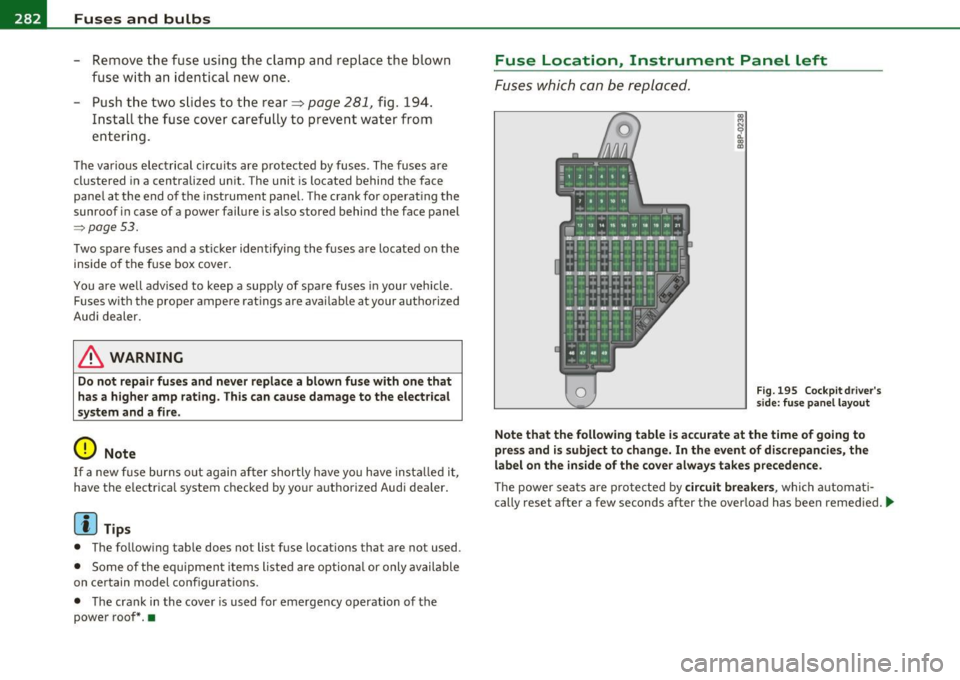
Fig.1 95 C ockpi td ri ve r's
side: fuse pan el lay out
Note that the following table i s accurate at the time of going to
pres s and is subject t o change. In the event of discrepancies, the
label on the inside of the cover alway s takes pre cedence.
The power sea ts are p ro te cte d by circuit break ers, whi ch automa ti
cally reset after a few seconds after the over load has been remedied . ..,_
Page 285 of 320

_______________________________________________ F_u _s_ e_ s_ a_ n_ d_ b_u _ l_ b _ s __ _
Equipment No. II Equipment
Amps
Manual headlight beam adjustment, automatic Diagnostic connector, rain sensor, air condition-
headlight beam adjustment, AFS control mod-
16 ing (control module), tire pressure monitor dis-10
1 ule, engine components, light switch (switch 10 play (control module)
-lig hti ng/i llum i nation), diagnosis socket 1 7 Ant i-theft alarm warning system 5
Automatic transmission, control module for CAN 18 Diagnose Starter 5
data transfer (gateway), electro-mechanical
19 All Whee l Drive 10 steering, shift gate automatic transmission, 2 10 engine relay, fuel tank control unit, engine con-22 Blower fan 40
trol unit, brakes control (ABS), Electronic Stabili-23 Driver's side power window, front 30 zation Program (ESP), Anti-Slip Regulation (ASR)
3 Airbag 5 24 Power outlet front 20
Air-conditioning (pressure sensor, air quality sen-25 Rear window defogge r 30
sor), button for Electronic Stabilization Program 26 Power outlet in luggage compartment 20
(ESP), Anti-Slip Regulation (ASR), tire pressure 27 Fuel tank control module, fuel pump 15
monitor display, oil level sensor, back-up light
28 Power window, rear 30 4 switch, front seat heating, parking aid, seat-s
occupancy recognition (on USA vehicles), garage 33 Sliding/pop-up roof 20
door opener, automatic mirror dimming, head-
Lumbar support
10 light assistant, heated windshield washer noz-
zles, air conditioning (control module)
3 7 Hea ted seats, front 20
--
5 AFS headlights (left side) 5 38 Passenger side power window, front 30
AFS headlights (right side) 5 39 Specia l function interface 5
9
Navigat ion system, radio system 15 40 Starter 40
digital radio, cell phone, TV equipment 7,5 Rear window wiper 15
11
Automatic mirror dimming, headlight assistant 10 Body control module 20
12 Central locking (front doors) 10 47 Ce ll phone package (VDA interface) 5
13
Central locking (rear doors) 10
A uto m atic c ircu it bre ake rs :
14 Electronic Stabilization Program (ESP) (control 10 The electric power w indows and the electric seat adjusters are
module), shift gate automatic transmission protected with circuit b reakers which reset automatically after the
1 5 Inter ior lights, read ing lights 10 circuit overload has been corrected . ...
Safety first Vehicle care Do-it-yourself service Technical data
Page 297 of 320

________________________________________________ G ..... e_ n_e ___ ra ___ l_i_n _ f_ o ___ r_m :....:....: a ..... t ..... i...: o ..... n---- --
left door jamb . It shows the month and year of production and the
vehicle iden tifica tion n umber of your veh icle ( perfo ration) as well as
the Gross Vehicle Weight Rating (GVWR) and the Gross Axle Weight Rating (GAWR).
The high voltage warning label
is loca ted on the loc k carr ier .
The spark ignition system complies with the
Canadian standard ICES-002. •
Weights
Gross Vehicle Weight Rating
The Gross Vehicle Weight Rating (GVWR), and the Gross Axle Weight
Ra ting (GAWR) for fron t and rear are listed on a st icker on the left
door jamb.
Th e Gross Vehicle Weight Rating includes the weight of the basic
vehicle plus f ull fue l tank, oil and coo la nt, plus max im um load, which
includes passenger we ight (150 lbs/68 kg per des ignated seating
position) a nd luggage weight .
Gross Axle Weight Rating
The Gross Axle Weight Rating is the maximum load that can be
applie d at each axle of the vehicle~& .
Vehicle capacity weight
The vehicle capacity weight (max. load) is liste d either o n the driver's
side B -pillar or inside the fuel f iller flap .
Roof weight
The maximum permiss ible roof weight is 165 lb (75 kg ). The roof
we igh t is ma de up o f the weig ht of the roof rack sys tem and the
we ight of the object being transported~
page 88, "Load ing the roof
rack" .
Safety first
& WARNING
• The actual Gross Axle Weight Rating at the front and rear axles
s hould not exceed the permis sible weights, and their combination
must not exceed the Gross Vehicle We ight Rating.
• Exceeding permi ssible weight rating s can result in vehicle
damage, accidents and personal injury .
0 Note
• The vehicle capac ity we ight figu res apply when the load is distrib
uted evenly i n the vehicle (passengers and luggage). When trans
porti ng a heavy load i n the l uggage compartment, ca rry the load as
near to the rear axle as possible so that the veh icle's handling is not
impa ired.
• Do not exceed the maximum permiss ible axle loads or the
maximum gross vehicle weig ht. Always remember that the vehicle's
hand ling will be affecte d by the extra load. Therefore, adjust your
speed a ccording ly .
• Always observe loca l reg ulations. •
Dimensions
The specifications refer to the basic mo de l. Differences may occur
depend ing on the model ty pe a nd options ordered, for exam ple, tir e
sizes .
0 Note
When d riving up steep ramps, on rough roads, over c urbs, etc . it is
impo rtan t to remember that some parts of yo ur vehicl e, s uch as
spoilers or ex haust system components, may be close to the ground.
B e careful not to d amage them .•
Do-it,yourself service Technical data
Page 298 of 320

___ D_ a_t _a _____________________________________________________ _
Data
Applie s to ve hicles : w it h 2.0 lit er TFS! 4- cy l. gaso line e ngine ,
200 hp, 2.0 liter 4-cyl. turbo gasoline engine
Engine data
Max imum outpu t SAE net
Max imum torque SAE net
No. of cy linde rs
Displacement
Stroke
Bore
Compression rat io
Fu el
Dimensions (approx .)
Length (wi th license plate bracket)
Width (across mirro rs)
He ight (unladen, incl. roof rails)
Turning circle d iameter (curb to curb)
Capacities (approx.)
Fuel tank
- Total capacity hp@rpm
lb-ft@
rpm
CID (cm
3
)
in (mm)
in (mm)
200@ 5100 -6000
207 @ 1700 -5000
4
121 (198 4)
3.65 (92.8)
3.25 (82.5)
9 .6 : 1
Premium unleaded (91 AKI) Recomm end ed for maximum engine p erformanc e. Fu r
ther details ~
page 219, "Gasoline"
in (mm)
in (mm)
i n (mm)
ft. (m)
front wheel drive
all whee l dr ive
168 .9 (4292)
78.5 (1995)
56.0 (1423)
35.1 (10 .7)
gal/liters
gal/liters 14.63 / 55.0 15.85 / 60.0