2011 AUDI R8 SPYDER ignition
[x] Cancel search: ignitionPage 141 of 244

A WARNING ,~
If, in exceptional circumstances, you must
install a forward-facing child restraint on
the front passenger's seat:
- Always make sure the forward-facing
seat has been designed and certified by
its manufacturer for use on a front seat
with a passenger front and side airbag.
-Always follow the manufacturer's in
structions provided with the child safety
seat or carrier.
- Always move the passenger seat into its
rearmost position in the seat's fore and
aft adjustment range, as far away from
the airbag as possible before installing
the child restraint. The backrest must be
adjusted to an upright position.
- Always make sure that the
PASSENGER
AIR BAG OFF light comes on and stays
on all the time whenever the ignition is
switched on.
Advanced front airbag system and children
Your vehicle is equipped with an "Advanced
Airbag System" in compliance with United
States Federal Motor Vehicle Safety Standard
(FMVSS) 208 as applicable at the time your
vehicle was manufactured.
The Advanced Airbag system in your vehicle
has been certified to meet the "low-risk" re
quirements for 3- and 6- year-old children on
the passenger side and small adults on the
driver side. The low risk deployment criteria
are intended to reduce the risk of injury
through interaction with the airbag that can
occur, for example, by being too close to the
steering wheel and instrument panel when
the airbag inflates. In addition, the system has been certified to comply with the "sup
pression" requirements of the Safety Stand
ard, to turn
off the front airbag for infants up
to 12 months who are restrained on the front
passenger seat in child restraints that are list
ed in the Standard.
Child Safety 139
Even though your vehicle is equipped with an
Advanced Airbag system, a child should al
ways ride in the seat properly restrained for
its age and si ze. The airbag on the passenger
side makes the front seat a potentially dan
gerous place for a child to ride . The front seat
is not the safest place for a child in a forward
facing child safety seat . It can be a very dan
gerous place for an infant or a larger child in a
rearward-facing seat.
Advanced Airbags and the weight
sensing mat in the front seat
The Advanced Airbag System in your vehicle detects the presence of an infant or child in a
child restraint on the front passenger seat us
ing the weight -sensing mat in the seat cush
ion and the sensor below the safety belt latch
on the front passenger seat that measures the
tension on the safety belt.
The weight -sensing mat measures total
weight of the child and the child safety seat
and a child blanket on the front passenger
seat. The weight on the front passenger seat
is related to the design of the child restraint
and its "footprint", the size and shape of the
bottom of the child restraint as it sits on the
seat. The weight of a child restraint and its
"footprint" vary for different kinds of child re
straints and for the different models of the
same kind of child restraint offered by child
restraint manufacturers .
The weight ranges for the individual types,
makes and models of child restraints that the
NHTSA has specified in the Safety Standard
together with the weight ranges of typical in
fants and typical 1 year-old child have been
stored in the control unit of the Advanced Air
bag System. When a child restraint is being
used on the front passenger seat with a typi
cal 1 year-old child, the Advanced Airbag Sys
tem compares the weight measured by the
weight sensing mat with the information stor
ed in the electronic control unit.
The electronic control unit also registers the
tension on the front passenger safety belt. ..,. •
•
Page 143 of 244
Child Safety 141
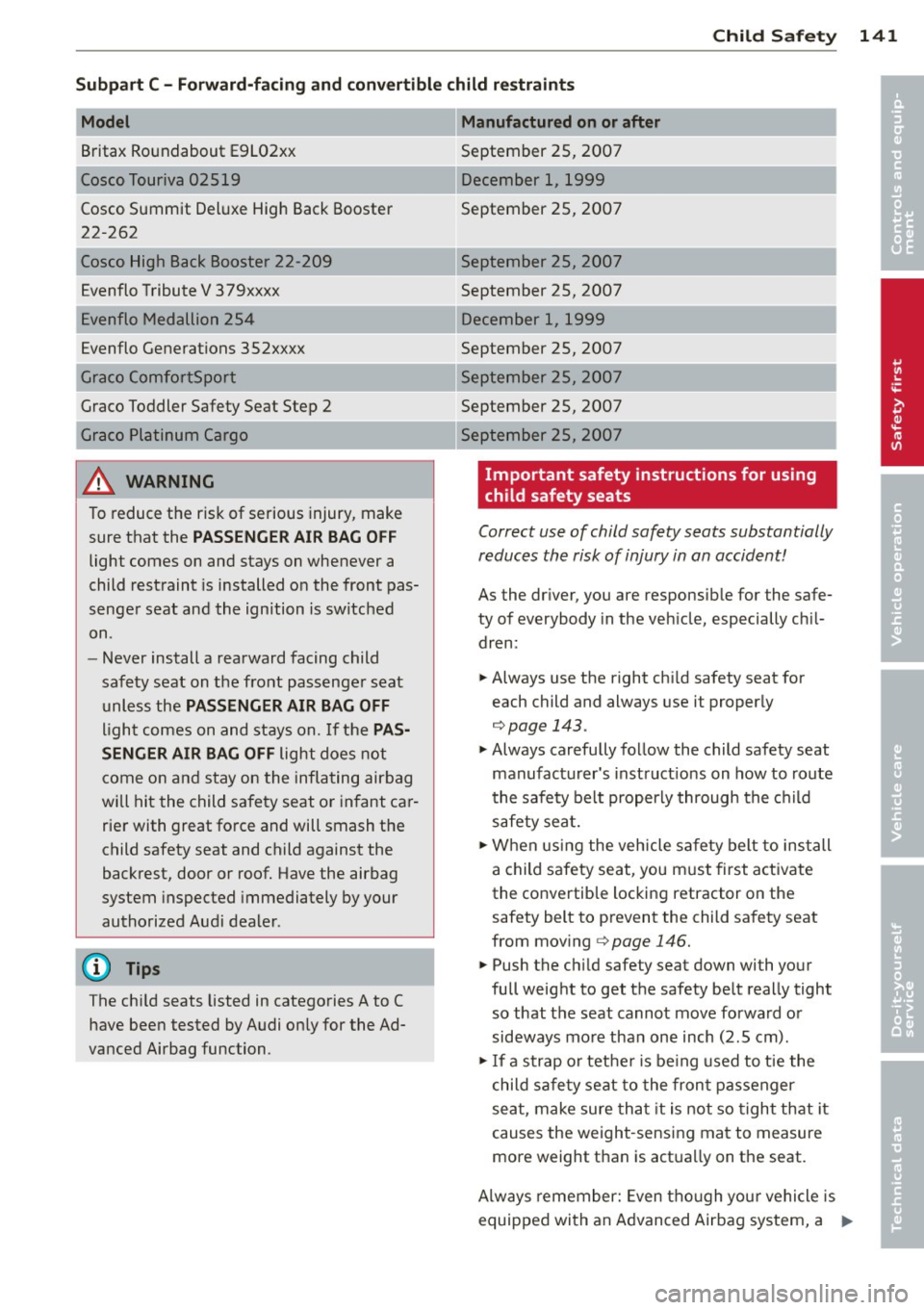
Subpart
C -Forward-facing and convertible child restraints
Model
Britax Roundabout E9L02xx
Cosco Touriva 02519
Cosco Summit Deluxe High Back Booster
22-262
Cosco High Back Booster 22-209
Manufactured on or after
September 25, 2007
December 1, 1999
September 25, 2007
September 25, 2007
September 25, 2007
Evenflo Tribute V 379xxxx
E venflo Medallion 254
----------
Evenflo Generations 352xxxx
Graco ComfortSport
----~-,
December 1, 1999
September 25, 2007
September 25, 2007
September 25, 2007
Graco Toddler Safety Seat Step 2
Graco Platinum Cargo
-------
& WARNING
To reduce the risk of serious injury, make
sure that the
PASSENGER AIR BAG OFF
light comes on and stays on whenever a
child restraint is installed on the front pas
senger seat and the ignition is switched
on .
- Never install a rearward facing child
safety seat on the front passenger seat
unless the
PASSENGER AIR BAG OFF
light comes on and stays on. If the PAS
SENGER AIR BAG OFF
light does not
come on and stay on the inflating airbag
will hit the child safety seat or infant car
rier with great force and will smash the
child safety seat and child against the
backrest, door or roof. Have the airbag
system inspected immediately by your
authorized Audi dealer .
(D Tips
The child seats listed in categories A to C
have been tested by Audi only for the Ad
vanced Airbag function. September 25, 2007
Important safety instructions for using
child safety seats
Correct use of child safety seats substantially
reduces the risk of injury in an accident!
As the driver, you are responsible for the safe
ty of everybody in the veh icle, especially ch il
dren:
.., Always use the right chi ld safety seat for
each child and always use it properly
¢page 143.
.., Always carefully follow the child safety seat
manufacturer's instruct ions on how to route
the safety belt properly through the child
safety seat.
.., When using the vehicle sa fety belt to install
a child safety seat, you must first activate
the convertib le locking retractor on the
safety belt to prevent the child safety seat
from moving ¢
page 146.
.., Push the ch ild safety seat down with your
full weight to get the safety belt really tight
so that the seat cannot move forward or
sideways more than one inch (2 .5 cm).
"'If a strap or tethe r is being used to tie the
child safety seat to the front passenger
seat , make sure that it is not so tight that it
causes the weight-sensing mat to measure
more weight than is actua lly on the seat.
Always remember: Even though your vehicle is
equipped with an Advanced Airbag system, a .,..
•
•
Page 145 of 244

-Always buc kle the c hild safety seat firmly
in place even if a child is not s itting in it.
A loose ch il d safety seat can fly ar ound
dur ing a su dden stop or in a col lisio n.
- Always read and heed all WARNINGS
whenever using a child restrained in ave
hicle is being used
<=> page 109, Safety
belts,
c> page 117, Airbag system and
¢ page 138, Child Safety.
A WARNING
To reduce the risk of serious injury, make
sure that the
PASSENGER AIR BAG OFF
light comes on and stays on whe never a
child rest rain t is installed on the front pas
senger seat and the ignition is switched
on.
- Never install a rearward facing child safety seat on the front passenger seat
unless the
PASS ENGER AIR BAG OFF
light comes on and stays on. If the PAS
SENGER AIR BAG OFF
light does not
come o n and stay on the inflating airbag
w ill hit the child safety seat o r infant car
rier with great fo rce and will smash the
child safety seat and child again st the
backrest, door or roo f. Have the airb ag
system inspected immedia tely by your
authorized Audi dea ler.
Child safety seats
Infant seats
.
Babies and infants up to about one year old
and 20 lbs. or 9 kg need special rearward-fac
ing child restraints that support the back,
neck and head in a crash.
Fi g. 1 30 Rearward -fac ing infa nt seat , prope rly in sta l
le d on t he p asse nger seat
Child S afety 143
.. When using the vehicle sa fet y belt to install
a child safety seat , you must first activate
the convertible locking retractor on the
safety belt to prevent the child safety seat
from mov ing
c> page 146.
.. Push the ch ild safety seat down with you r
full weig ht to get t he safety be lt really tight
so that the seat cannot move forwa rd o r
sideways mo re tha n one inch ( 2.5 cm).
Infants up to about one year
(20 lbs . or 9 kg)
are best protec ted in spec ial infant carriers
and ch ild safety seats designed for thei r age
gro up. Ma ny exper ts believe that infants and
sm all chi ld ren s hou ld r ide o nly in speci al re
stra ints in which the child faces the back of
the ve hicle . These infant seats sup port the ba
by's back, neck and head in a c rash
c> fig . 130 .
A WARNING
Not using a child safety seat, using t he
wrong child safety seat or improperly in
stalling a ch ild restrai nt increases the risk
of ser ious personal inju ry and death in a
crash.
- Never i nstall a rear -fac ing ch ild restrai nt
in the forward-facing d irect ion . Such re
straints are designed for the special needs of infants and very small chi ldren
and cannot pro te ct them properly if the
seat is forward- facing.
-
- Never install a rearward facing child
safe ty sea t on the fron t passenger sea t
unless t he
PASSENGER AIR BAG OFF
light comes on and stays on. If the PAS·
SENGER AIR BAG OFF
li ght does not
come on and stay on the inf lating a irbag
wi ll hit the child safety seat or infant car
rier w ith great f orce and w ill smash the
child safety seat and child agai nst t he
backrest, door or roof. Hav e the a irbag
sy stem in spected immediately by your
a uthor ized A udi de aler.
- Always rea d and heed all WAR NIN GS
wheneve r us ing a child res traine d in ave
hicle is be ing used
c> p age 109, Safety
belts, ¢page 117, Airbag system
and
c> page 138, Important things to know .
Page 147 of 244

-Always make sure the backrest 1s in an
upr ight position .
- Make sure that the
PASSENGER AIR BAG
OFF
light comes on and stays on all the
t ime whenever the ignition is switched
on.
- If the light does not stay on, perform the
checks
c;, page 128, Monitoring the Ad
vanced Airbag System.
- If the PASSENGER AIR BAG OFF light
does not come on and stay on have the
airbag system inspected immed iate ly by
your authorized Aud i dealer .
Booster seats and safety belts
Properly used booster seats can help protect
children weighing between about 40 lbs. and
80 lbs. (18 kg and 36 kg) who are less than 4
ft. 9 in. (57 inches/1 .45 meters) tall .
Fig. 132 Passenger seat : child proper ly rest ra in ed in a
booster seat
The vehicle's safety belts alone will not fit
most children until they are at least 4
ft. 9 in.
(57 inches/1.45 meters) tall and weigh about
80 lbs. (36 kg). Booster seats raise these chil
dren up so that the safety belt will pass prop
e rly over the stronger parts of their bodies
and the safety belt can help protect them in a
crash .
• Do not use the convertible locking retractor
when using the vehicle's safety belt to re
strain a child on a booster seat.
• Always position the shou lder portion of the
safety belt midway over the child's shoulder .
• Always make sure that the shoulder portion
of the safety belt never rests against or
across the ch ild's neck.
Child Safety 145
• Always make sure that the chi ld can properly
wear the lap portion of the belt low across
the th ighs or pelvis and
never over the
stomach or abdomen.
Children up to at least 8 years old (over 40
lbs. or
18 kg) are best protected in child safe
ty seats designed for their age and weight . Ex
perts say that the skeletal structure , particu
larly the pelvis, of these children is not fully
developed, and they must not use the vehicle
safety belts without a suitable ch ild restra int.
It is usually best to put these children in ap
propr iate booster seats . Be sure the booster
seat meets all applicable safety standards .
Booster seats raise the seating position of the
child and reposition both the lap and shoulder
parts of the safety belt so that they pass
across the ch ild's body in the right places . The
routing of the belt over the child's body is very
im portant for the child's protect ion, whether
or not a booster seat is used.
Children who are at least 4
ft. 9 in . (57 in
ches/1.45 meters) tall can generally use the
vehicle 's three point lap and shoulder belts.
Never use the lap belt port ion of the vehicle's
safety belt alone to restra in any child, regard
less of how big the chi ld is. A lways remember
that children do not have the pronounced pel
vic structure required for the proper function
of lap belt portion of the vehicle's three point
lap and shoulder belts. The child's safety ab
solutely requires that a lap belt portion of the
safety belt be fastened snugly and as low as
poss ible around the pelvis. Never let the lap
belt portion of th e safety be lt pass over the
child's stomach or abdomen.
In a crash, a irbags must inflate within a blink
of an eye and with considerable force . In order
to do its job, the airbag needs room to inflate
so that it will be there to protect th e occupant
as the occupant moves forwa rd into the air
bag .
A vehi cle occupant who is out of position and
too close to the airbag gets in t he way of an
inflating airbag. When an occupa nt is too
close, he or she will be struck violently and
Ill-
Page 148 of 244

146 Child Safety
will receive serious or possibly even fata l in
jury.
I n o rder for the airbag to offe r protection, it is
important that all vehicle occupants, especia l
l y any children, who must be in the front seat
because of exceptional circumstances, be
properly restrained and as far away from the
a irbag as poss ible. By keep ing room between
the child's body and the front of the passen
ger compartment, the airbag can inflate com
pletely and provide supplemental protection
in certain frontal collisions.
_& WARNING
Not using a booster seat, us ing the boos
ter sea t imprope rly, incorre ct ly ins talling a
booste r seat or using the vehicle safety
belt improperly increases the risk of seri
ous personal injury and death in a collision
or other emergency s ituation. To help re
duce the risk of ser ious persona l injury
and/or death:
-Always make sure to position the should
er port ion of the three-po int belt over
the midd le of ch ild's shou lder .
- Never let the shoulder port ion of the belt
rest against or across the neck, face,
chin , or throat of the child .
- Always make sure the lap belt portion of
the three-po int be lt is worn snug and
passes as low as possib le across the
child's pelvis. Neve r let the belt pass over
the soft abdomen .
- Failure to properly route safety belts
over a ch ild 's body will cause severe inju
ries in an ac ciden t or other emergency
situa tion
9 page 109 .
-Children on the front seat of any car,
even w ith Advanced A irbags, can be seri
o usly injured or even killed when an air
bag inf lates .
- Never le t a child sta nd or knee l on the
sea t.
- Never let a child ride in the ca rgo a rea of
yo ur vehicle .
- Always remember that a ch ild lean ing
forward, si tting s ideways or out of posi-
.
tion in any way d uring an accident can be
struck by a dep loying a irbag. This will re
sult in ser ious personal injury or death.
- If you must install a booster seat on the
front passenger seat because of excep
tional circumstances the
PASSENGER
AIR BAG OFF
li ght m ust come on and
stay on, whenever the ignition is switch
ed on.
- If the
PASSENGER AIR BAG OFF light
does not come on and stay on, pe rform
the che cks descr ibed
9 page 128, Moni
toring the Advan ced Airbag System.
- If the PASSENGER AIR BAG OFF li ght
does not come on and stay on whenever
the igni tion is switched on the infla ting
a ir bag w ill hi t the child sa fety seat or in
fant car rier with g reat force an d will
smash the child safety seat and child
aga inst the backrest, door or roof. Have
the airbag system inspected immed iately
by your Audi dea ler.
- Always read and heed all WAR NINGS
whenever using a child restrained in ave
h icle is being used
¢ page 109, Safety
belts, ~page 117, Airbag system
and
~ page 138, Important things to know.
Installing a child safety
seat
' Securing a child safety seat using a
safety belt
Safety belts for the front passenger con be
locked with the convertible locking retractor
to properly secure child safety seats .
The safety belts emergency locking retractors
for the front passenger's seat safety belt have
a convertible locking retracto r fo r ch ild re
st ra ints . The safety be lt must be loc ked so
that be lt webb ing ca nnot unree l. The retrac
tor can be act ivated to lock the safety belt and
prevent the safety be lt webb ing from loosen
ing up during norma l dr iv ing. A chi ld safety
seat can only be properly insta lled when t he
safety belt is locked so that the child and child
safety seat will stay in place. .,.
Page 149 of 244
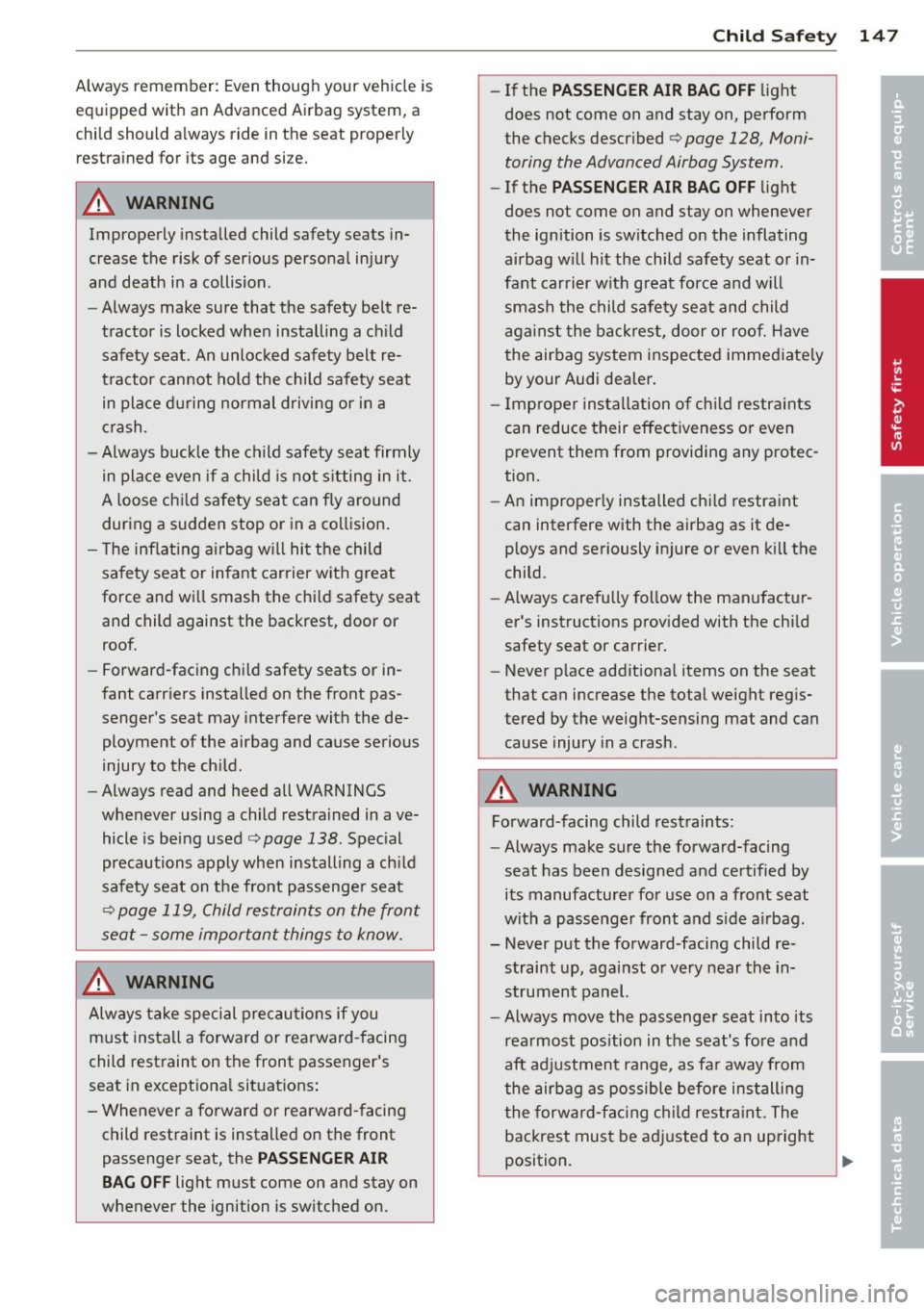
Always remember: Even though your vehicle is
equipped with an Advanced Airbag system, a
child should always ride in the seat properly restrained for its age and si ze.
_&. WARNING
Improperly installed child safety seats in
crease the risk of serious personal injury
and death in a collision .
- Always make sure that the safety belt re
tractor is locked when installing a child
safety seat . An unlocked safety belt re
tractor cannot hold the child safety seat
in place during normal driving or in a
crash.
- Always buckle the child safety seat firmly
in place even if a child is not sitting in it.
A loose child safety seat can fly around
during a sudden stop or in a collision.
- The inflating airbag will hit the child
safety seat or infant carrier with great
force and will smash the child safety seat
and child against the backrest, door or
roof.
- Forward-facing child safety seats or in
fant carriers installed on the front pas
senger's seat may interfere with the de ployment of the airbag and cause serious
injury to the child.
- Always read and heed all WARNINGS
whenever using a child restrained in ave
hicle is being used
r::;,page 138. Special
precautions apply when installing a child
safety seat on the front passenger seat
r::;, page 119, Child restraints on the front
seat -some important things to know.
_&. WARNING
-
Always take special precautions if you
must install a forward or rearward-facing
child restraint on the front passenger's
seat in exceptional situations:
- Whenever a forward or rearward-facing child restraint is installed on the front
passenger seat, the
PASSENGER AIR
BAG OFF
light must come on and stay on
whenever the ignition is switched on.
Child Safety 147
- If the PASSENGER AIR BAG OFF light
does not come on and stay on, perform
the checks described
r::;, page 128, Moni
toring the Advanced Airbag System.
- If the PASSENGER AIR BAG OFF light
does not come on and stay on whenever
the ignition is switched on the inflating
airbag will hit the child safety seat or in
fant carrier with great force and will
smash the child safety seat and child
against the backrest, door or roof. Have
the airbag system inspected immediately
by your Audi dealer.
- Improper installation of child restraints
can reduce their effectiveness or even prevent them from providing any protec
tion.
- An improperly installed child restraint
can interfere with the airbag as it de ploys and seriously injure or even kill the
child.
- Always carefully follow the manufactur
er's instructions provided with the child
safety seat or carrier.
- Never place additional items on the seat
that can increase the total weight regis
tered by the weight-sensing mat and can
cause injury in a crash.
_&. WARNING
Forward-facing child restraints:
- Always make sure the forward-facing
seat has been designed and certified by
its manufacturer for use on a front seat
with a passenger front and side airbag.
- Never put the forward-facing child re straint up, against or very near the in
strument panel.
- Always move the passenger seat into its
rearmost position in the seat's fore and
aft adjustment range, as far away from
the airbag as possible before installing
the forward-facing child restraint. The
backrest must be adjusted to an upright
position. •
•
Page 150 of 244

148 Child Safety
-Make sure t hat the PASSENGER AIR BAG
OFF
light comes on and stays on all the
time whenever the ignition is switched on .
A WARNING
Rearward -fac ing ch ild restra ints:
- A ch ild in a rearward-facing child safety
seat installed on the front passenger
seat will be ser iously injured and can be
killed if the front airbag inflates - even
with an Advanced Airbag System.
- The inflating a irbag will hit the child
safety seat or infant carri er wit h great
force and w ill smash the ch ild safety seat
and child against the b ackrest, door or
roof.
- Alway s be espe cially caref ul if you must
ins tall a re arwa rd fa cing child s afety seat
on the front passenge r seat in exception
al circumstances .
- A tight tether st rap on a rearward-facing
child rest raint attached to the front pas
senger seat can put too much pressu re
on the weight-mat in the seat and reg is
ter a heavier weight in the Advanced A ir
bag System. The heav ier we ight regis
tered can make the system work as
though an adult were on the seat and de
ploy the Advanced Ai rbag when it must
be s uppressed causing ser ious o r even
f a tal inj ury to the child .
- Make su re that the
PASSENGER AIR BAG
OFF
light comes on and s tays on all the
t ime whe never the ignition i s switched
on.
- Never install a rearward facing child
safety seat on the front passenger seat
unless the
PASSENGER AIR BAG OFF
light comes on and stays on . If t he PAS·
SENGER AIR BAG OFF
light does not
come on and stay on the inflating airbag
will hit the child safety seat or infant car
rie r with great fo rce and will smash the
child safety seat and child against the
backrest, door or roof. Have the airbag
system inspected immediately by your
au thori zed Au di d ealer .
Activating the convertible locking
retractor
Use the convertible locking retractor to se
cu re a child re strain t.
Always heed the ch ild safety sea t manufactur
er's instr uctions when installing a child re
st ra in t in your veh icle . To a ctivate the conve r
t ible lo cking re tractor:
.,. Place t he ch ild restraint on a seat .
.,. Slowly pu ll the belt
all the way out .
.,. Route i t around or th roug h the child re
s train t belt pa th
~ .&, .
.,. Push the ch ild safety seat down with you r
full weight to get the safety be lt really tight.
.,. Insert the belt tongue into the buckle for
that seating position .
.,. Guide the safety belt back i nto the retractor
until the be lt lies flat and snug o n the child
safety seat.
"" Yo u should hear a "cl icking " noise as the
be lt winds back into the inertia ree l. Test the
convert ible lo cki ng re tr actor by pulling on
t he belt. You s hould no longer be ab le to
pull t he be lt out of the retrac to r. T he con
vertible locking retracto r is now activated .
.,. Make s ure that the red release button is fac
ing away from the child rest raint so that it
can be unbuckled quick ly.
.,. Pull on the belt to make sure the safety be lt
is properly tight and fastened so that the
s e at ca nnot move forwa rd or sideways more
than one inch ( 2.S cm).
A WARNING
Using the wrong child res traint o r an i m
pr operly ins talled chi ld restraint can cause
se rious pe rsonal injury or deat h in a c rash.
- Always ma ke sure tha t t he safe ty belt re-
trac to r i s loc ked when insta lling a child
safety seat. An un locke d safety belt re
tracto r cannot hold the child safety seat
in place dur ing norma l dr iving o r in a
crash.
- Always buckle the child sa fety seat firmly
-
in place even if a ch ild is not sitt ing in it. ~
Page 158 of 244

156 Intelligent technology
Dynamic energy management
While the veh icle is be ing driven , dynamic en
e rgy management distributes the energy gen
erated according to the needs of the individu
a l components . It regu lates consumption, so
that more electrical energy is not being used
than is being generated and ensures an opti mal state of charge for the battery .
(D Tips
- But even energy management cannot
negate the limits of physics. Consider
that the power and life of a battery are li mited .
- If starting ab ility is threatened, you are
i nformed by a warn ing
<=> page 156,
Driver notification in the instrument
cluster display .
What you should know
The highest priority is given to maintaining
starting capability.
The battery is severely taxed in short-distance
driving, in city traffic and during the cold time
of year. Abu ndant electr ical energy is re
qu ired, but only a little is generated . It is also
cr itical if the engine is not running and elect ri
cal components are turned on. In th is in
stance energy is being consumed but none is
being generated .
It is in precisely these situations that you w ill
notice energy management actively regulat
ing the distrib ution of energy .
Vehicle stands for an extended period
If you do not drive your vehicle over a period
of severa l days or weeks, elect rical compo
nents are gradually cut back o r switched off .
This reduces energy consumption and main
tains starting capabi lity over a longer period.
Take into considerat ion that when you un lock
your vehi cle, some convenience functions,
such as the remote key or power seat adjust
ment, may not be available. The convenience
functions will be available again when you
turn on the ignition and start the engine. With the
engine turned off
If you listen to the radio, for examp le, w ith
the engine turned off, the battery is being dis
charged.
If starting capability is jeopardized due to en
ergy consumption , a message appea rs in the
driver information display.
You have to start the engine to charge the batte ry.
With the engine running
Although electrical energy is generated when
the vehicle is being driven, the battery can be
come discharged. This happens mostly when
little energy is being gene rated and a great
deal consumed and the battery's state of
charge is not optimal.
To bring the energy balance back into equili
brium , consume rs which requ ire espec ially
large amounts of energy are temporar ily cut
back or sw itched off. Heating systems in par
ticu lar require a great deal of energy. If you
notice, for example, that the heated seats or
the heated rear window are not heating, they
have been temporarily cut back or switched
off . These systems will be available again as
soon as the ene rgy balance has been restored.
You wi ll also notice that engine id le speed has
been increased slightly . Th is is normal and not
a cause for concern. By increasing engine idle
speed the additional energy required is gene r
ated and the battery is charged .
Driver notification in the instrument
cluster display
If battery power drops into the range where it
can limit the ability of the engine to start, this
is shown in the instrument cluster display
with the following driver message:
(•i Low battery charge: battery will be
charged while driving
T h is not ificat io n r eminds you that the start ing
capability of the engine may be lim ited. As
soon as you start driving again, the battery .,..